
Haworthia Care: Windows, CAM, Roots, and Practical Light
Haworthia care explained through leaf-window optics, flexible CAM behavior, root-zone oxygen, light response, and an adaptable container mix.
Rachel Torres · 2025-12-29 · Updated 2026-04-04 · 21 min read
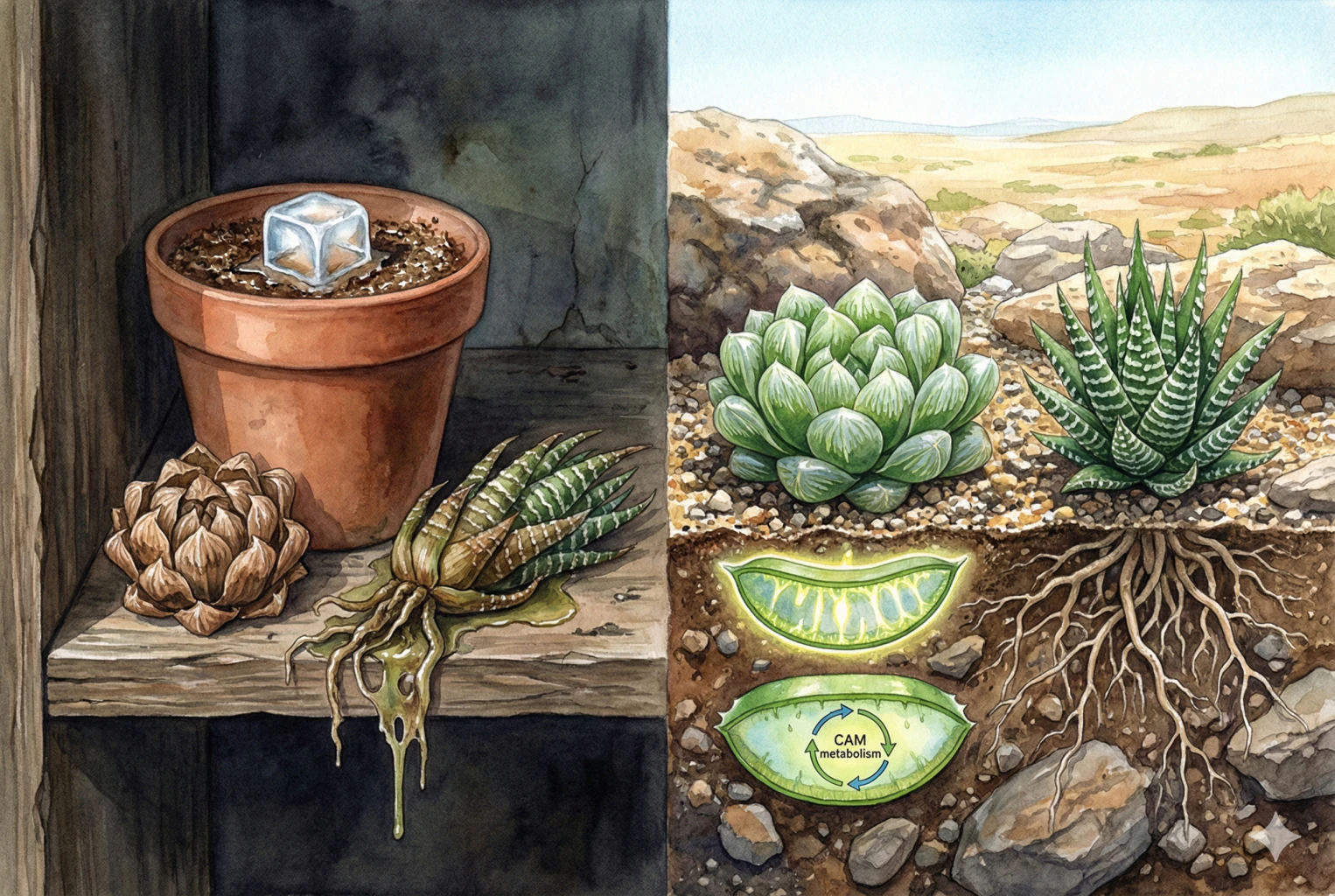
Key Takeaways
- Leaf windows scatter and redistribute light inside a leaf rather than act as a simple magnifying lens. The strongest measurements are species-specific, so use the mechanism to explain internal light, not to infer a universal safe dose.
- Many Haworthia show nocturnal carbon uptake, but amount and timing vary, so use substrate dry-down and plant condition instead of a calendar. Warm nights may slow growth without stopping the roots from absorbing water.
- Wet-mix decline can involve low oxygen, infectious pathogens, or both. Better aeration and measured watering reduce risk, but neither is a complete diagnosis or cure.
- Color is a clue, not a meter. Pigments, genetics, temperature, water status, nutrition, and tissue damage all change how a plant looks.
- A deeper pot and mineral components help when they fit the root mass and dry-down. They are starting options, not genus-wide requirements.
1. Introduction
Haworthia combine translucent leaf windows, water storage, contractile roots, and flexible CAM behavior. Those traits make simple calendar instructions unreliable.
Choose light, watering, substrate, and recovery steps from the evidence while keeping species-level findings separate from broader succulent biology.
What does the name Haworthia cover?
Haworthia is used here as a horticultural group, not as one uniform physiological type.
Current taxonomy places some familiar names in related genera or infraspecific ranks. Haworthia obtusa is treated as Haworthia cymbiformis var. obtusa, Haworthia maughanii as Haworthia truncata var. maughanii, and the accepted name for the former Haworthia fasciata is Haworthiopsis fasciata.
2. Leaf windows and internal light
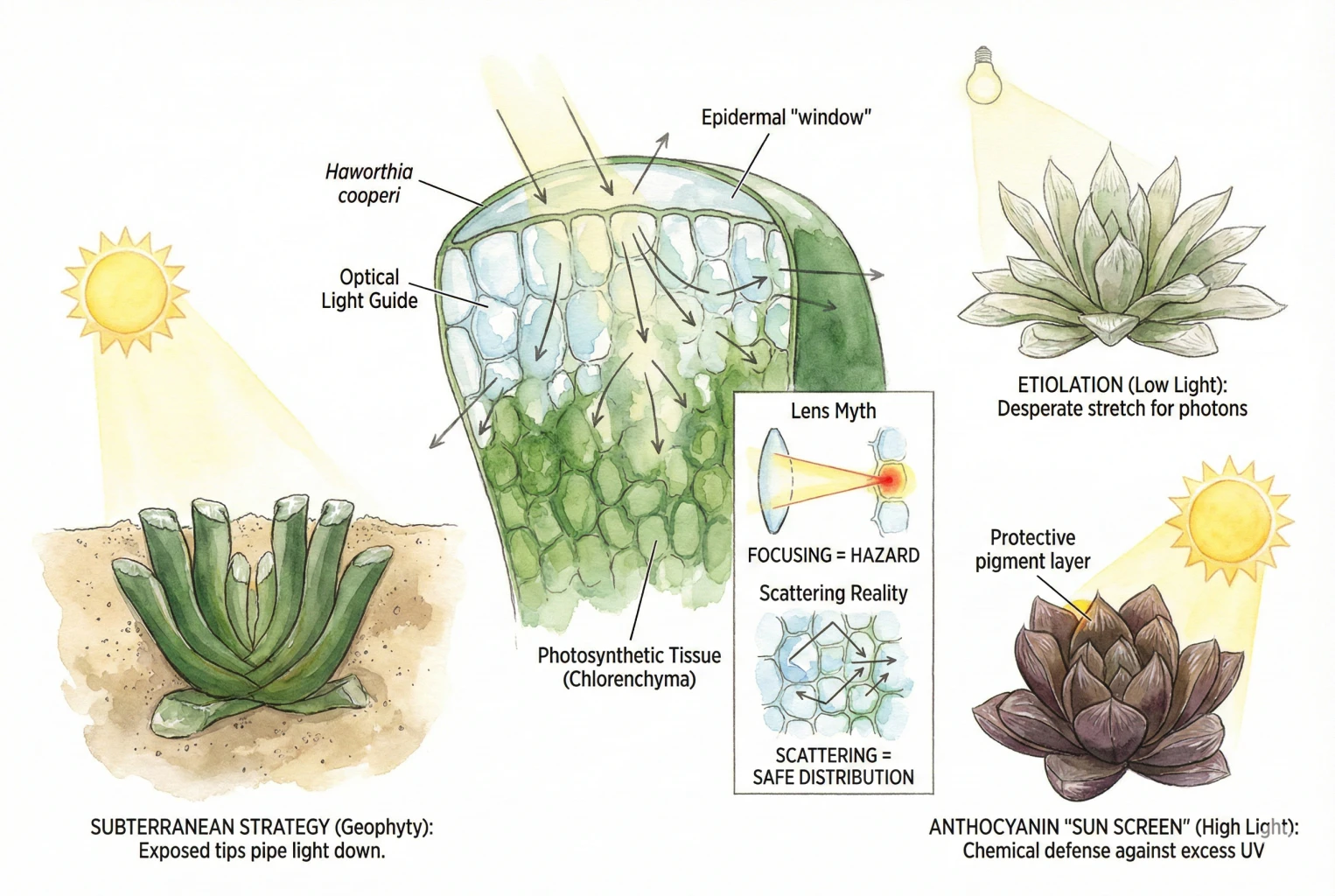
Many Haworthia species have a window, meaning a crystalline, translucent epidermis at the leaf tip.
To a casual observer it can look like a mass of clear tissue, but its internal structure is the useful subject.
From a botanical perspective, the window can be understood as an adaptation to harvesting light while much of the leaf remains sheltered.
2.1 The Underground Strategy and Optical Guiding
Across South Africa's Northern, Western, and Eastern Cape, Haworthia encounter varied rainfall and exposure.
Open sites can impose strong light and evaporative demand, while sheltered crevices provide a different microclimate.
Some species, including Haworthia cooperi and Haworthia truncata, show geophytic growth and can sit with only their windowed leaf tips exposed.
This position can reduce exposure, while the buried tissue receives less direct light.
The window is therefore a candidate way to shape the internal light environment.
It is not proof that every species has the same underground strategy or optical performance.
Research into windowed succulents includes a fibre-optic-probe study of Haworthia truncata and separate work on Haworthia obtusa, now treated as Haworthia cymbiformis var. obtusa.
Treat these as findings from selected taxa, not a measured fact for every Haworthia.
The translucent epidermal cells lack many chloroplasts and contain clear, water-rich parenchyma called hydrenchyma.
This tissue can guide and redistribute some light from an exposed tip toward photosynthetic tissue deeper in the leaf.
In the 2008 study, omni-directional fibre-optic microprobes showed that the light environment inside the measured leaves differed substantially from incident light.
The Haworthia result came from Haworthia truncata within a six-succulent comparison.
In the measured species, light reaching deeper internal chloroplasts was more diffuse and attenuated than incident light.
The cell walls and water-filled vacuoles scatter and attenuate light in the measured leaves.
The result is not a guarantee of even distribution or protection at every exposure.
The scattering effect has also inspired a laboratory daylighting prototype using an acrylic optical fibre with a scattering coating.
It remains a proof of concept, not evidence that every windowed leaf has the same optical performance.
2.2 Lens claims and scattering evidence
A curved window is sometimes described as a magnifying lens that focuses light onto a special chloroplast layer. That picture is too simple for the available evidence.
Studies on epidermal optics suggest that convex cells may focus some collimated light while surrounding tissue scatters and redistributes it.
Focused light can create local high photon flux density and contribute to photoinhibition under unsuitable exposure.
The measured optical behavior does not establish that Haworthia evolved toward scattering instead of focusing.
Internal interfaces between liquid-filled cells and air spaces can redirect light, but the balance depends on the taxon and tissue being measured.
This can increase the path length of photons and distribute absorption across deeper tissue, potentially reducing concentrated exposure.
This helps explain why some Haworthia look cloudy or milky when backlit.
Appearance alone does not reveal the full optical mechanism or a safe light level.
What does the window evidence support?
The window clearly shapes the light environment inside the leaf, but controlled studies found that covering the windows did not always reduce photosynthesis.
The safest conclusion is that internal light distribution is a plausible function. A universal photosynthesis boost has not been established.
2.3 Light management and stress response
Low light is a relative description, not a care prescription. Haworthia need enough stable light for compact new growth without forcing an unacclimated plant into heat or scorch.
Wild shade and indoor shade are not equivalent. A plant under a shrub can still receive more usable light and airflow than one several feet from a window.
When a Haworthia is deprived of adequate light, it can etiolate as leaf bases elongate while the rosette seeks more photons, producing a looser, less stable form.
There is no published Haworthia-specific DLI threshold for this response, so judge the setting by new growth and tissue condition rather than a fixed number.
Under some combinations of light, temperature, water status, and genetics, Haworthia can accumulate anthocyanins, producing red, purple, or bronze tones.
Color is a stress response or trait, not a reliable target state by itself.
In many plants, anthocyanins can act as a photoprotective screen by absorbing part of the incident light and moderating oxidative stress. The magnitude and location of the effect vary.
Roughly speaking, green, bronze, and bleached patches can reflect different combinations of light, genetics, water status, temperature, and tissue damage.
Treat color as a clue rather than a diagnosis, and pair it with firmness, growth, and exposure history.
Red or bronze coloration can reflect protective pigments, genetics, cold, drought, or nutrition.
There is no verified Haworthia-specific light figure for holding a color, so adjust exposure gradually while watching growth and tissue condition.
The plant’s existing color is my baseline, so I photograph the rosette from above and from its window-facing side before moving it into brighter light. I mark the pot orientation, note the time of the strongest exposure, and record whether the leaves were already bronze, cloudy, or stretched. This gives me a baseline for the plant’s own color instead of using another cultivar’s appearance as a target.
I compare only new changes in the fixed top-and-side views anchored to the pot-rim mark. A stable bronze tone with compact new leaves is different from a pale, dry patch spreading on the exposed side. The baseline helps me change light gradually and avoids rubbing the windowed tissue or watering simply to chase a clearer or greener appearance.
3. CAM and nighttime carbon uptake
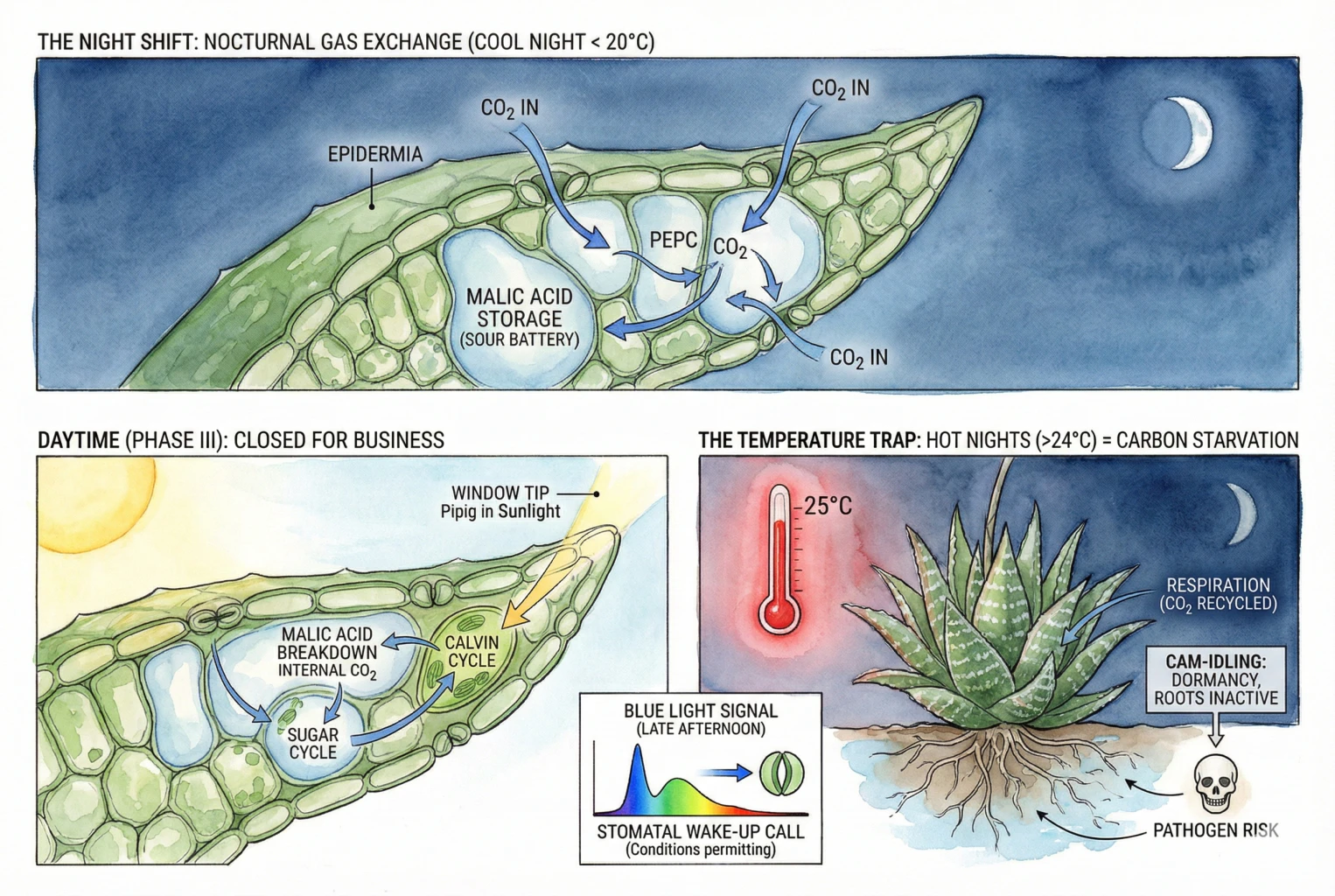
Crassulacean Acid Metabolism, or CAM, is an important part of Haworthia physiology.
Many Haworthia show nocturnal gas exchange, but timing and strength vary. Observe substrate, roots, and growth instead of relying on a watering calendar.
3.1 Nighttime gas exchange
Most plants, including C3 plants, open their stomata during the day to take in CO2 for photosynthesis, which can increase water loss in arid heat.
Many Haworthia use CAM photosynthesis, although the degree and timing can vary. They decouple carbon uptake from light capture.
During the night (Phase I of CAM), Haworthia often opens stomata and fixes incoming CO2 through phosphoenolpyruvate carboxylase (PEPC) into four-carbon acids such as malate.
This acid is stored in vacuoles within the mesophyll. The temporary acidification helps store carbon for daytime use. Ornamental plants should not be tasted and doing so provides no useful care information.
During the day (Phase III), stomata generally close more as stored malic acid is decarboxylated to release CO2 internally.
Rubisco then uses that CO2 in the Calvin cycle when light and tissue condition permit.
3.2 Temperature and summer slowdown
CAM activity depends on temperature and water status, but there is no universal night-temperature cutoff for every Haworthia.
Persistently warm nights may slow carbon gain or increase respiratory demand. The response varies by species, cultivar, water status, and acclimation.
CAM idling is generally discussed as a severe-drought response, not an automatic switch that flips whenever a night is warm.
Lengthen watering intervals without keeping the pot soggy
A hot, slow plant may use water more slowly, so watering intervals often lengthen while a soggy pot remains a rot risk.
Reduced stomatal gas exchange does not stop roots from taking up water and minerals.
Let the mix dry appropriately, but do not impose a zero-water rule during warm weather.
3.3 Blue light and stomatal behavior
The regulation of this cycle is also tied to light quality. Recent research on Agave, a related Asparagaceae, has challenged the old view that CAM stomata are insensitive to blue light.
An Agave study found that blue-light signaling can influence late-afternoon stomatal behavior in that species. It does not establish the same timing or effect for Haworthia.
The Agave result concerned already-open stomata in late afternoon and found no morning effect. It does not show that blue light extends a gas-exchange window in Haworthia or fixes a warm-night problem.
Use it as comparative context, not as a specific spectral prescription.
A warm, low-contrast day and night can coincide with slower growth in some cool-night-adapted plants, so a cooler night may help in the active season. Short warm spells are not automatically fatal.
4. Roots, rot, and container physics
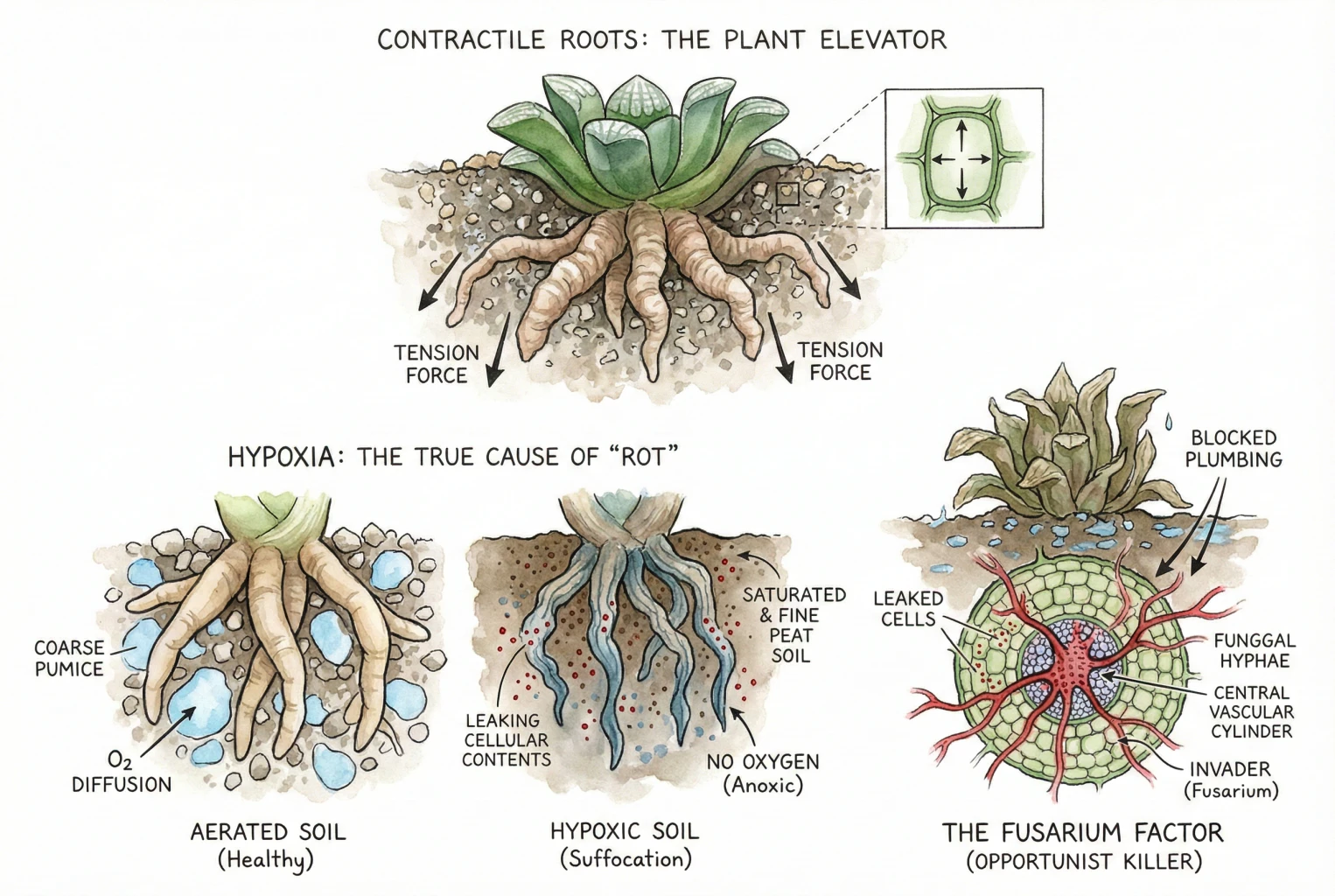
Roots handle water uptake, anchorage, and nutrient acquisition. Haworthia roots are often fleshy and differ from the fine fibrous roots of many ferns.
4.1 Contractile roots and plant depth
Some Haworthia possess contractile roots. As these roots mature, cortical cells can expand radially and shorten longitudinally, generating tension that draws the stem deeper.
In habitat, contraction can place the growing point below the soil surface and reduce exposure.
In a pot, a plant may appear to settle or bury lower leaves. Confirm that roots and tissue remain firm before interpreting the change.
Root anchorage, particle size, container depth, and dry-down all affect how much a plant can move.
A well-aerated pot with enough room for the root mass is a sensible starting point, but exact shape depends on the plant.
4.2 Hypoxia and infectious rot
Root decline can involve two linked but distinct problems. One is low-oxygen injury. Saturated mix limits the oxygen roots need to respire, so the tissue weakens.
The other is infectious rot caused by organisms such as Pythium, Phytophthora, Fusarium, or Rhizoctonia.
Wet, airless conditions can damage roots directly and can also favor infection. Low oxygen and disease are not interchangeable diagnoses.
Root cells, like all living cells, respire. They consume oxygen to burn sugars and generate the energy (ATP) needed to actively pump nutrients across their membranes.
In a well-aerated soil, oxygen diffuses through the pore spaces between particles.
When you water, a film of moisture covers the particles, but air remains in the larger pores.
In a fine-particle substrate (like peat moss or straight potting soil), water can fill more of the pore space and sharply limit gas exchange.
Roots then consume available oxygen faster than it is replenished, creating hypoxic or, in severe cases, anoxic conditions.
With too little oxygen, root respiration is impaired and energy supply falls.
Cell membranes can lose integrity and leak cellular contents, increasing vulnerability to opportunistic pathogens.
4.3 What can a Fusarium finding mean?
Fusarium can be associated with vascular or dry-rot symptoms, but a Haworthia diagnosis cannot be made from genus-level suspicion alone. Pythium, Phytophthora, Rhizoctonia, and abiotic damage remain part of the differential.
Disease risk depends on host stress, root condition, temperature, moisture, and the isolate involved.
Wet conditions can weaken a host and support spread without making the fungus an anaerobic organism.
Some Fusarium diseases involve vascular colonization and impaired water movement, but symptoms and mechanisms vary by species and isolate.
A plant with impaired roots can look thirsty even when the soil is wet.
Check root condition, substrate moisture, firmness, and recent exposure before adding more water.
A dense, water-retentive mix can increase hypoxia risk, while an airy mineral mix can be more forgiving.
Neither material category guarantees safety because particle size, pot geometry, temperature, and pathogen load still matter.
5. Substrate physics
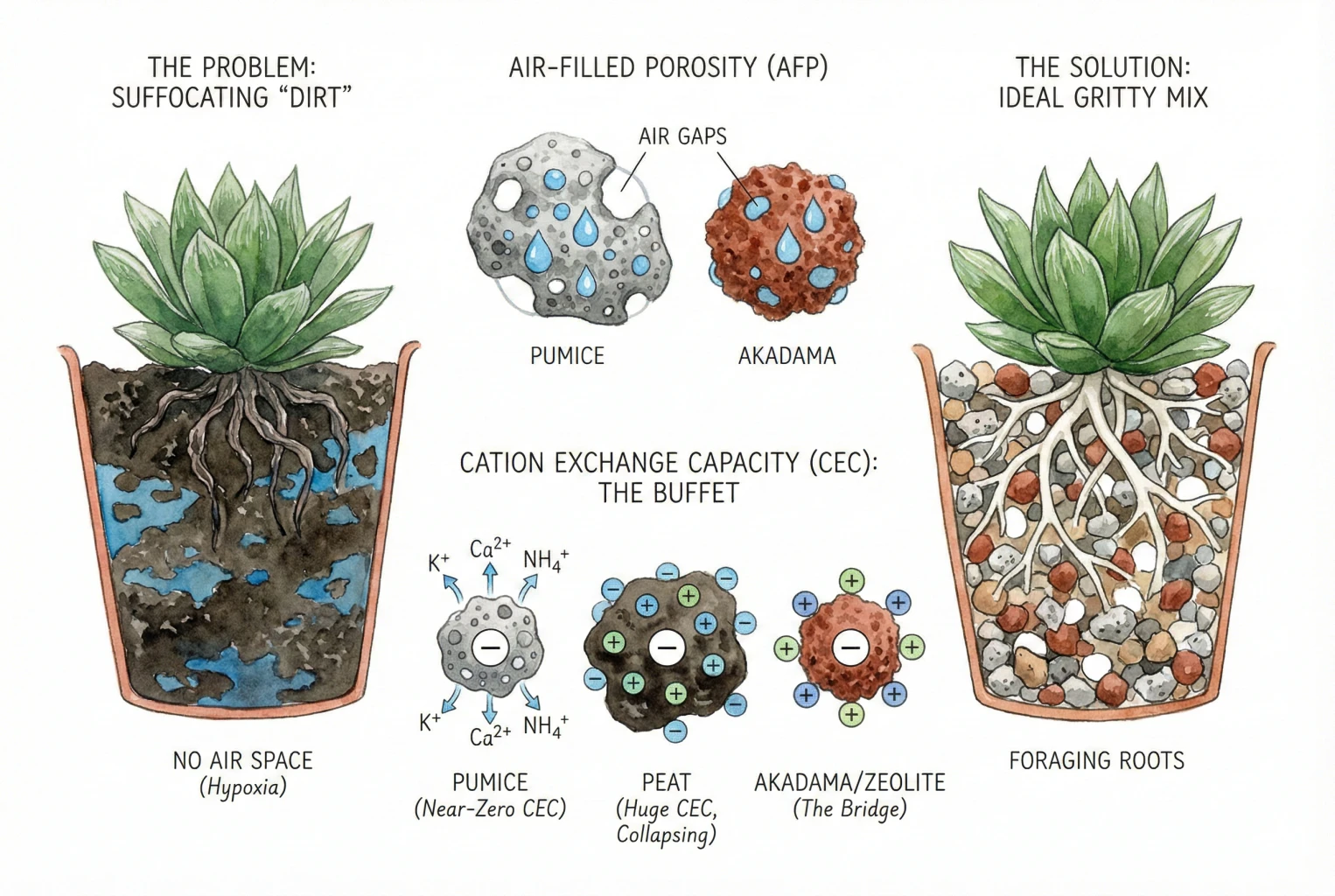
To prevent the oxygen loss described above, look at soil physics, especially porosity and cation exchange capacity (CEC).
A gritty mix can help when its particle size and watering pattern preserve useful air space, but no recipe is automatically correct.
5.1 Air-Filled Porosity (AFP)
A useful Haworthia substrate holds water inside the particles while keeping the spaces between the particles open for air.
Aggregates with internal porosity can help, but the finished mix and dry-down determine the result.
Pumice
Pumice is a porous volcanic material that can hold some water while preserving air spaces.
Durability, fines, and particle size vary, so inspect the actual mix rather than assuming instant drainage or permanent structure.
Akadama
Akadama is a granular clay used in some bonsai mixes. It can hold water and nutrients while remaining structured for a time, but durability depends on grade, handling, frost, and watering.
5.2 Cation exchange capacity
Roots need water and dissolved ions. Potassium, calcium, and ammonium are positively charged cations. Particles with exchange sites can hold some of these nutrients and release them back into the root-zone solution. This holding capacity is called cation exchange capacity, or CEC.
Peat and compost
Peat and compost can provide more nutrient holding and water retention. Fine particles, decomposition, and compaction can reduce air space in some containers, so the grade and finished mix matter.
Pumice and perlite
Pumice and perlite have low to variable nutrient holding. A mostly mineral mix therefore needs a fertilizer plan matched to active growth and the product label.
Akadama, zeolite, and calcined clay
These materials can add exchange sites without behaving exactly like gravel. Their water retention and structural stability still depend on grade and container conditions.
There is no single perfect medium. A sensible trial can combine mostly high-porosity mineral aggregate with a smaller fraction of nutrient-holding material such as akadama, zeolite, or quality compost.
Haworthia habitats range from sand to light clay, so any ratio is a starting point to adjust for particle grade, humidity, pot, and watering habits.
A mineral-rich, organic-poor mix can resemble some crevice conditions, but it does not automatically produce a superior root system.
Adjust the organic fraction to the pot, climate, roots, and dry-down you can actually manage.
6. Practical Haworthia care
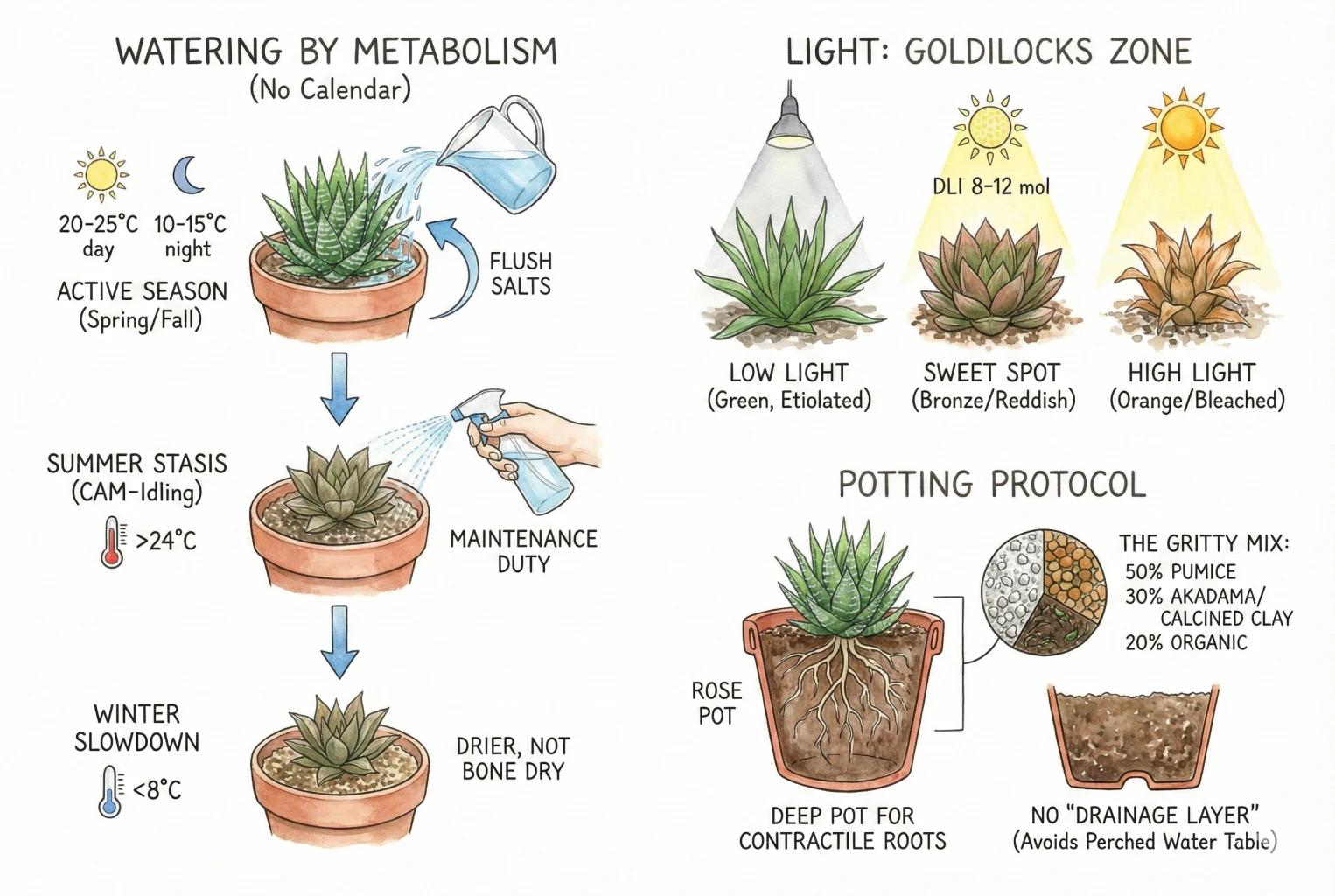
A practical Haworthia regimen should reflect the plant’s water use, light response, substrate, and current growth rather than a calendar.
6.1 Watering by plant state
Do not let a calendar decide. Use substrate dry-down, temperature, light, root condition, and active growth to set the interval.
When active growth is visible
When growth is visible and the mix has dried appropriately, water thoroughly and let it drain. Exact day and night temperatures vary by species and site.
When nights stay warm
Warm nights can coincide with slower growth and lower water use. Let the mix dry appropriately instead of keeping it wet.
A thorough soak-and-dry is usually more reliable than repeated shallow sprays, which wet the surface and crown unevenly while leaving the root zone patchy.
When light and temperature fall
Growth often slows and wet media becomes riskier. Keep the mix drier while preserving viable roots. The right interval depends on the plant and root zone rather than a single temperature cutoff.
6.2 Light and acclimation
Avoid persistently dark locations. Haworthia need enough usable light for active growth, while exposure must be acclimated to limit heat and scorch.
What should the light assessment use?
Bright filtered light or gentle direct sun after acclimation can support active growth.
A meter can compare locations, but no published Haworthia-specific DLI target exists. Refine from stretching, bleaching, heat response, and new growth.
Green or loose growth
Green tissue can occur under lower light or lower stress. If leaves become long and loose, increase light gradually rather than chasing a color.
Bronze or reddish-brown growth
Bronze tones can reflect protective pigments, genetics, cold, drought, or nutrition. They are not a universal target state.
Bleached or dry growth
Bleached, pale, or dry tissue is a warning for excess exposure or tissue damage. Reduce stress while checking heat, water status, roots, and recent changes.
6.3 The Potting Protocol
How deep should the pot be?
Give contractile roots enough depth to anchor without leaving a large wet reservoir. Shape and size depend on the plant, root mass, and dry-down.
How should the mix be chosen?
Combine stable mineral particles with a modest moisture-holding component, then adjust the balance from pot size, climate, and observed dry-down rather than a fixed recipe.
Why skip a separate drainage layer?
A coarse layer beneath finer media does not improve drainage and can change where the wet zone sits.
Fill the container with a consistent mix unless a specific design has been tested for that pot.
Test the finished potting mix
If you use horticultural pumice, test the finished mix rather than judging the ingredient alone. Water a sample pot, check how long moisture remains at root depth, and inspect whether the particles stay open after repeated watering. Choose a grade that preserves air space without making a small root ball dry unevenly. Pumice supplies little nutrition, so feeding still depends on active growth and the fertilizer label.
Akadama or another calcined-clay granule can add moisture- and nutrient-holding capacity alongside pumice, but durability varies by product and watering. Choose a grade from the finished pot’s dry-down, then inspect how well the particles held their structure at repotting.
7. A note on rescuing plants
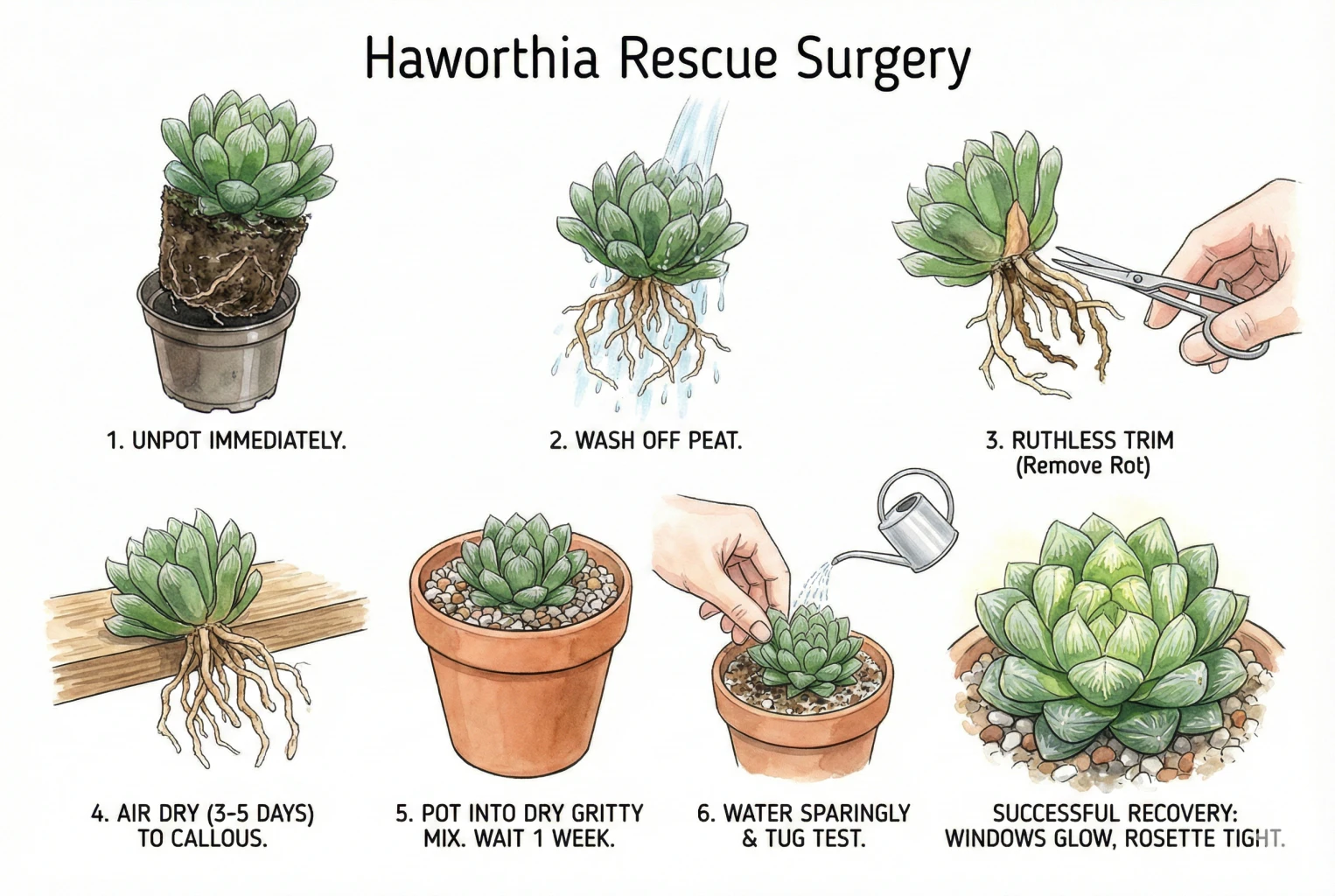
A garden-center Haworthia is often in peat, and sometimes has rot from store overwatering. This is not always the case, so don't assume the worst and put a healthy plant through unnecessary surgery.
What is the least-invasive rescue order?
- First assess by gently unpotting and looking. Firm, pale, attached roots and a firm base are less concerning, so leave healthy roots alone. Wet, mushy, dark, foul-smelling roots or a soft base warrant further investigation.
- If the mix is genuinely staying wet or has broken down, remove it gently. You do not have to scrub every particle off healthy roots because over-washing and tugging adds damage.
- Trim only roots that are clearly dead, such as hollow, slimy, or papery tissue, using a clean, disinfected blade. Keep healthy roots when possible because viable roots may reduce recovery stress.
- Let cut surfaces dry and callus in shade before repotting. The interval depends on cut size, humidity, airflow, and tissue condition.
- Pot into a dry, airy mix and delay the first light watering until the cut and root condition support it.
- Resume careful watering as the plant re-establishes. New anchorage should be judged by time and new growth rather than by pulling on the plant.
8. Stress responses and the window
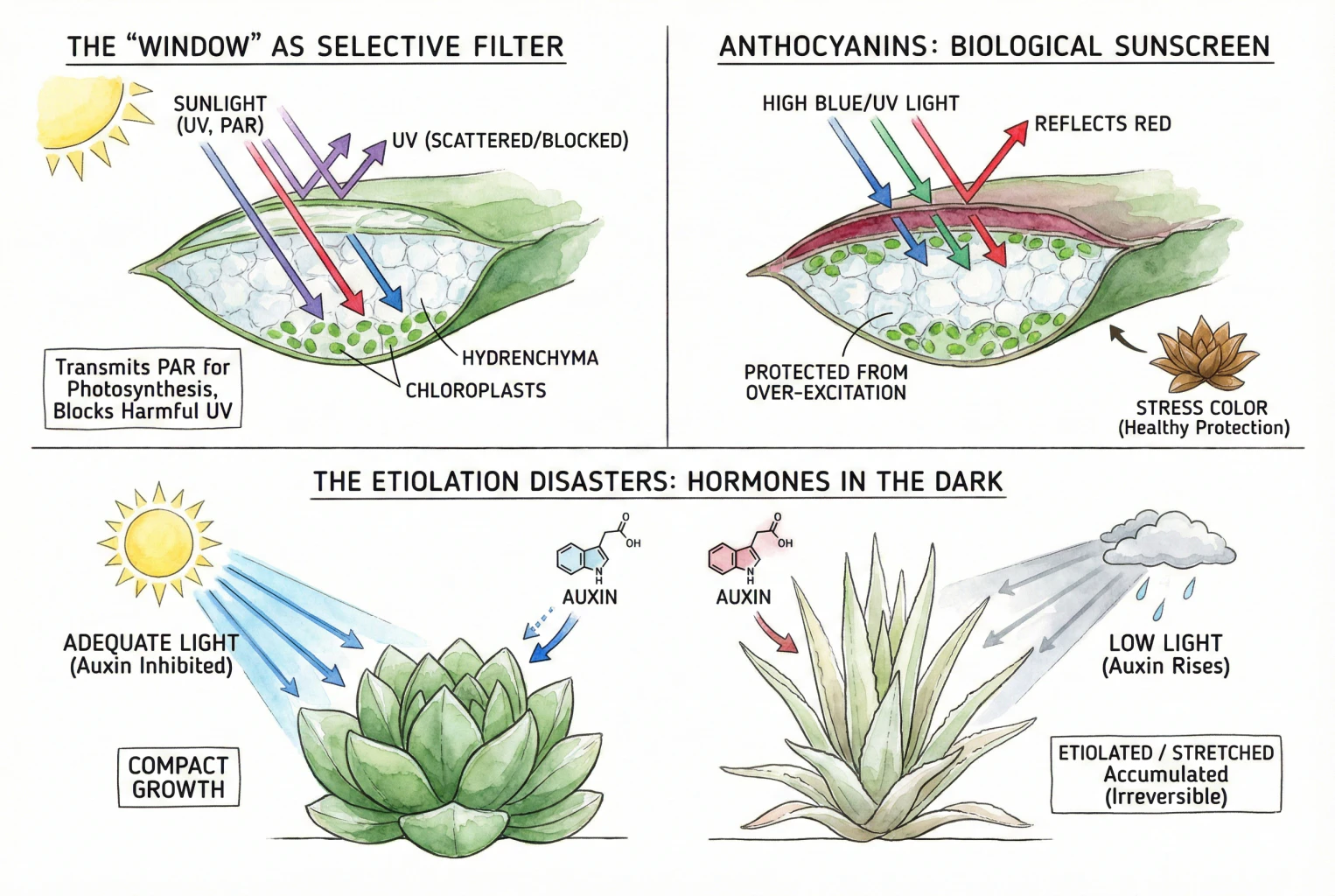
Haworthia care becomes clearer when its apparently contradictory traits are considered together.
It often grows in filtered light yet still needs enough light for compact growth.
It stores water but remains vulnerable to prolonged saturation, and its window appearance changes with tissue and exposure.
The optical and stress-response evidence helps explain these apparent contradictions.
8.1 What can the window filter claim support?
The epidermal window shapes the light that reaches inner tissue. The idea of a precise UV-selective filter remains unproven because the main fibre-optic study measured visible and near-infrared light, not UV transmission.
Field UV exposure and window properties vary by site and species. Do not infer a universal UV filter from appearance alone.
The cloudiness or texture seen in some windowed species may scatter light, but the contribution to UV filtering and wavelength transmission has not been established for every cultivar.
Window clarity does vary in cultivation, and light is one plausible factor, but the exact cause is not established.
A high-light response involving additional scattering tissue remains a hypothesis rather than a demonstrated Haworthia mechanism.
8.2 Anthocyanins and color
Stress colors can involve anthocyanins, which are water-soluble vacuolar pigments whose appearance also depends on pH and genetics.
In Haworthia, light, water status, temperature, and cultivar can all influence coloration.
Anthocyanins absorb portions of the blue-green spectrum and can act as a filter in some tissues.
The exact band and protective effect depend on pigment and leaf structure.
This can moderate over-excitation and associated reactive-oxygen stress, but it does not make high exposure harmless.
Color can reflect a protective response, but deliberately stressing a plant for appearance can still trade away growth or tissue safety.
Use condition and recovery, not a color target, to judge the exposure.
Wild plants can show muted or bronzed coloration under field exposure, but cultivated color still reflects genetics and current conditions.
A bright lime-green or bronzed Haworthia can reflect different combinations of light, genetics, water, cold, and nutrition. Bleached, dry tissue is more concerning. Pair color with firmness, growth, and exposure history.
Use color as a rough directional clue, not a precise light meter (it's confounded by genetics, water, cold, and nutrition, so pair it with actually observing growth and, if you want numbers, measuring light).
8.3 Etiolation and growth signals
Haworthia stretch when low light and other conditions shift growth signals toward cell elongation.
Auxin is part of that network, but no single blue-light rule fits every Haworthia.
Light quality and intensity interact with auxin and other growth signals. In adequate light, elongation signals may be reduced and new growth can remain more compact, but no single blue-light rule fits every Haworthia.
In low light, elongation signaling can increase and leaf bases may stretch.
In habitat, that can help a plant seek light, but in a container it usually appears as etiolated growth. Indoors, excessive elongation usually produces a looser, less stable rosette.
Once a Haworthia has etiolated, the stretched tissue will not shrink back.
Better light can produce more compact new growth, allowing the plant to look better as it grows out. Beheading and re-rooting the top is an advanced option, not the only fix.
Increase light gradually when growth stretches, and reduce heat or exposure when tissue bleaches or scorches.
9. Pathogens and wound care
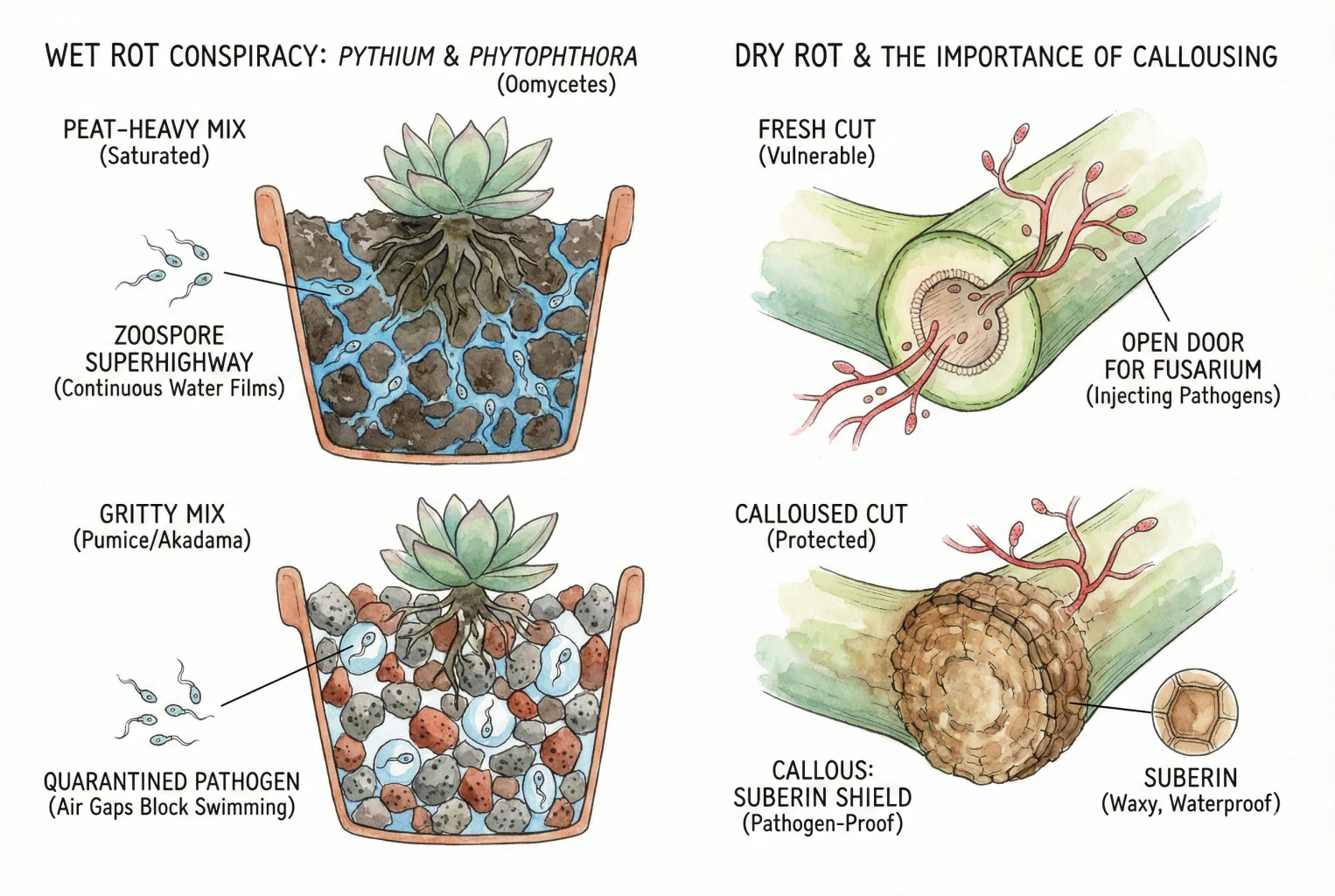
Succulent decline can reflect interactions between container physics, plant condition, and biological agents. Symptoms alone rarely identify the organism.
9.1 Pythium, Phytophthora, and other pathogens
Fusarium and other fungi can be associated with vascular or dry-rot symptoms.
Pythium and Phytophthora are oomycetes often associated with wet conditions. Symptoms alone do not identify the organism.
Pythium and Phytophthora are oomycetes rather than true fungi, and some produce motile zoospores that can move through water films toward roots.
This is one reason porosity matters. In a fine mix that stays saturated, connected water films can persist and favor movement of motile propagules.
Movement speed and disease spread vary with water films, temperature, pathogen, and root condition. Do not treat rapid spread as a universal schedule.
In a gritty mix (pumice/akadama), some water is held in particles while spaces can remain aerated.
That can reduce continuous wet films, but it does not quarantine or eliminate pathogens.
9.2 The role of callusing
Why dry cuttings?
When you cut a Haworthia stem or root, you expose living tissue and increase water loss and contamination risk until the surface stabilizes.
By letting the cut dry, the plant may form a callus, a layer of corky, suberized cells that can reduce water loss and pathogen entry.
Suberin is not a sterile or perfectly waterproof shield, and callusing time depends on cut size, humidity, airflow, and tissue condition.
Drying a cutting before planting can reduce immediate water loss and contamination risk.
A callused surface is not a sterile guarantee, so let cuts stabilize and keep the new medium clean.
10. Advanced propagation
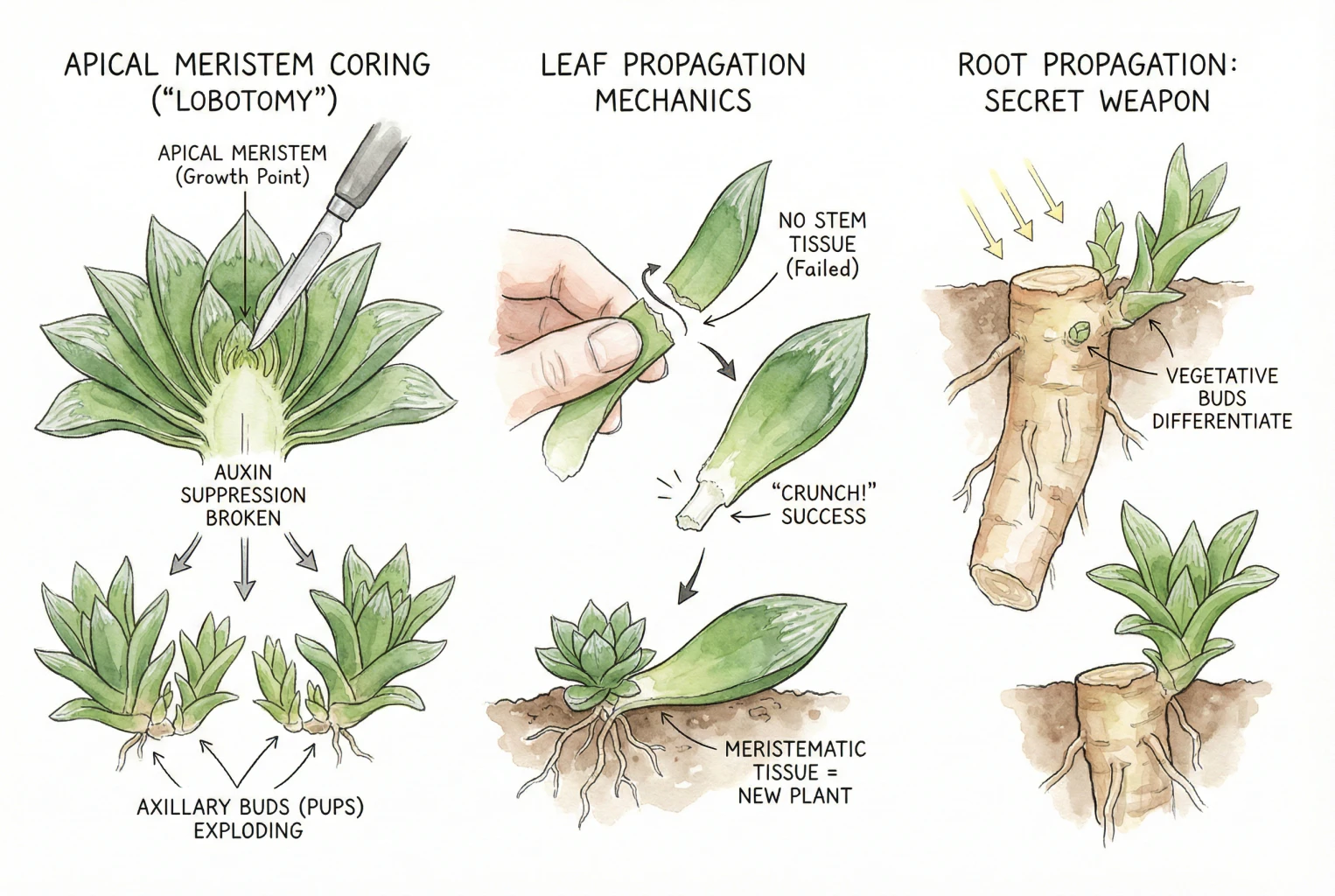
Haworthia propagation can be practical, but success varies with species, tissue, season, and sanitation.
10.1 Meristematic tissue and coring
Haworthia grow from a central apical meristem and can have axillary buds near the leaves.
Those buds may produce offsets after damage or with maturity, but the timing and frequency are not uniform across the genus.
Coring or destroying the apical growth point is a destructive propagation technique.
It may alter apical dominance and release side buds, but it sacrifices the growing point and can introduce infection.
Use it only as a deliberate specialist method after considering offsets, leaf cuttings, or seed.
10.2 Leaf propagation
You can also propagate from a single leaf in some Haworthia, but success depends on taking suitable basal tissue.
A leaf broken off away from the base may fail to produce a plantlet.
Suitable basal tissue improves the chance of a leaf cutting producing a plantlet.
Remove a leaf gently from the base rather than yanking, because twisting can tear the crown or leaf. There is no reliable sound that confirms success.
10.3 Root propagation as a limited method
Hobby reports describe shoots from thick roots in Haworthia truncata and Haworthia truncata var. maughanii.
The method is poorly documented and should be treated as a low-odds experiment rather than a dependable technique.
There is no solid anatomical evidence that these roots are underground stems pre-loaded with buds. Prefer seed, offsets, or leaf cuttings when those options are available.
11. Final synthesis
Successful Haworthia care balances enough light and water for active growth with a root zone that re-aerates before the next watering.
- Reduce watering when heat or low light slows uptake, but do not impose a zero-water rule.
- Use a stable mix whose organic fraction matches the pot and climate.
- Acclimate light and shade from the plant's response, not a color target.
Observe new growth, root condition, and dry-down together. Color and window clarity are useful context, not a substitute for measurement.