
Caudex Plants Fertilizer Guide: Feed Fat Plants Right
Match complete caudex nutrition to active growth, light, root health, water quality, and dormancy without relying on one universal ratio or schedule.
Maya Ellison · 2026-01-27 · Updated 2026-04-16 · 11 min read
Key Takeaways
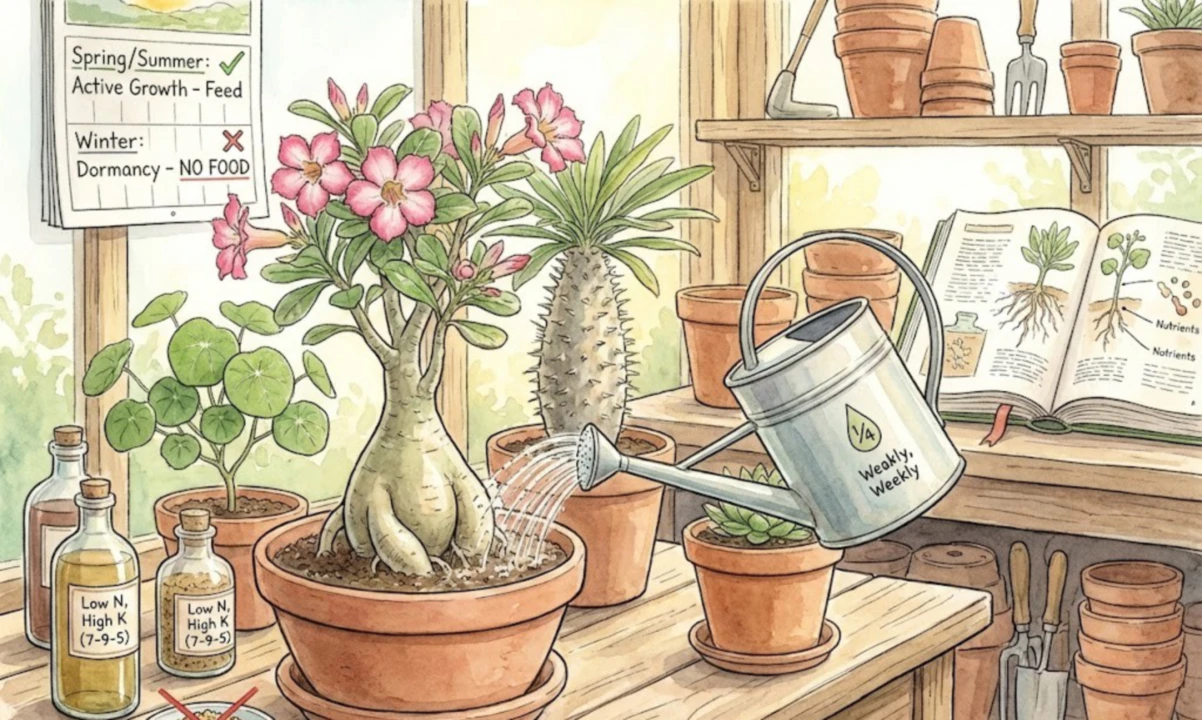
- Feed sparingly with a balanced complete fertilizer that includes potassium. There is no proven rule that potassium must equal or exceed nitrogen for caudex plants.
- Feed only during active growth, diluted at or below the label rate. A dry, cold, recently repotted, or clearly dormant plant is a poor candidate, and winter growers run on the opposite calendar.
- More fertilizer does not make a fatter caudex. Overfeeding pushes soft growth and salt buildup, while light, healthy roots, water, time, and genetics drive real thickening.
- A swollen storage organ does not tell you how much fertilizer a plant needs. Let growth state and normal pot dry-down set the rate, not the size of the base.
- If tips burn or a white crust appears, check salts, water quality, roots, and the label before flushing. Flush only a pot that drains safely, then reassess rather than feeding on a fixed schedule.
Nutrient roles, timing cues, and risk controls differ across Stephania, Adenium, Pachypodium, and Dioscorea, and no single schedule guarantees a result.
The Biology of the Caudex
A caudiciform stores water and nutrients in a thickened stem or root, an adaptation to environments where rain and mineral availability can be seasonal.
Strategies for Survival
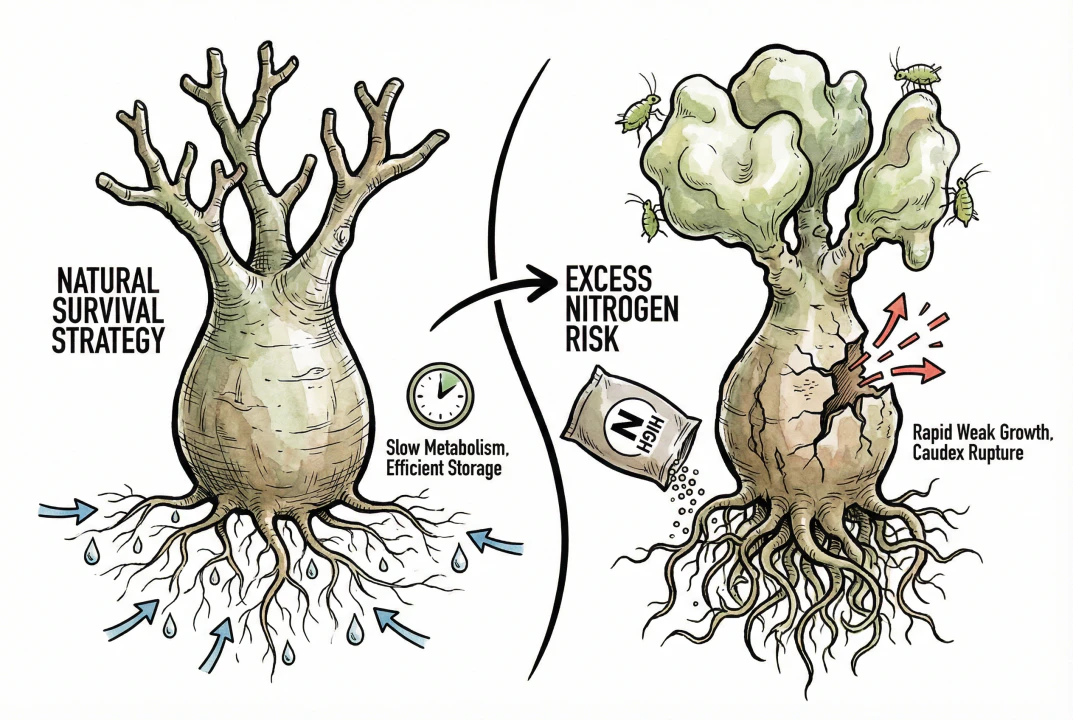
Many caudex plants grow relatively slowly and do not build tissue at the pace of a pothos or monstera, so heavy nitrogen tends to be counterproductive. Habitats do vary. Some caudiciforms come from seasonally dry, poor soils, but others grow in scrub or forest, so treating them all as built for scarcity is too simple.
Excess nitrogen can force soft, weak growth that is more prone to pests and, in some cases, to cracking. A split caudex is not automatically fatal. Cracks have many causes, including rapid water changes, growth, mechanical injury, and heat injury. A split is still a wound and a possible entry point for rot, so avoid forcing it and monitor it if it happens.
Many caudiciforms experience seasonal changes in water and nutrient availability, but habitats vary widely. Heavy feeding can produce soft, elongated growth when light and roots cannot support it. It does not automatically create a fragile swollen base, and a split caudex has multiple possible causes.
It Is Not Food
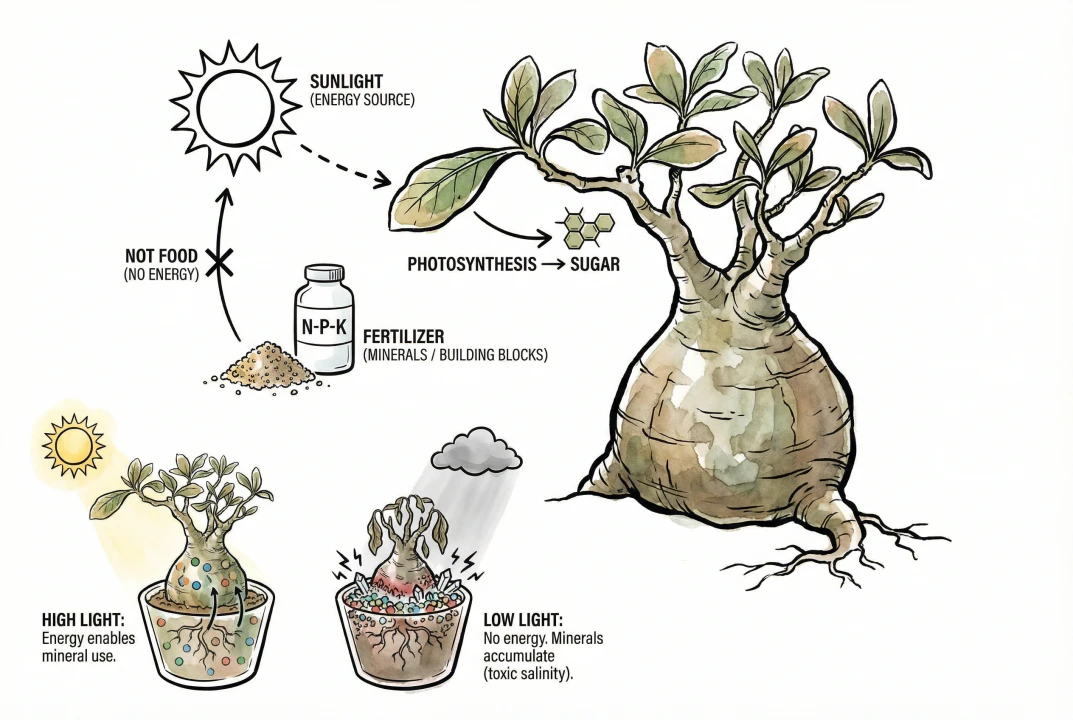
Fertilizer is not food. Plants make their own food, including sugar, from sunlight. Fertilizer supplies minerals that become building blocks for new cells.
Give a plant plenty of building blocks but little energy (light) to use them and the surplus can build up as salts in the pot. Light and actual growth, not your enthusiasm, should set the fertilizer rate.
In low light, feed much less or not at all because the plant cannot use much. This is about matching feeding to growth. A plant growing under strong artificial light in winter, or a naturally low-light species, may still take a light feed. Judge by growth, not a blanket rule.
Think of sunlight as calories and fertilizer as a multivitamin. A plant can use stored reserves for a while, but minerals without enough light cannot be turned into strong growth. A large dose in a dark setup only makes salt management harder.
The same applies to a plant. In a dark corner with little energy for mineral use, salts can sit in the soil and raise osmotic pressure until water is pulled out of the roots instead of into them.
The N-P-K Ratio Decoded
Every fertilizer bottle shows three numbers, like 10-10-10. They stand for Nitrogen (N), Phosphorus (P), and Potassium (K), and for caudex plants the balance between them matters a lot.
Nitrogen (N): The Green Builder
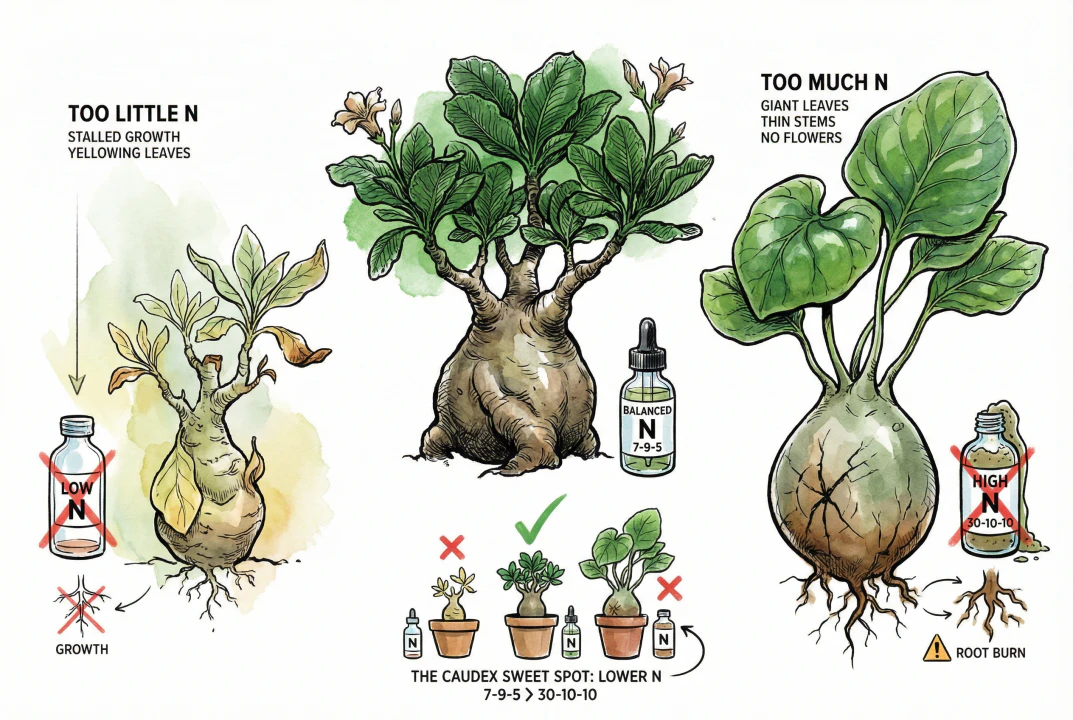
Nitrogen drives leaf and stem growth. It’s the fuel for the green parts.
- Too much nitrogen can cause oversized leaves, long thin stems, fewer flowers, and a risk of root burn.
- Too little nitrogen can leave older leaves yellow and growth stalled.
- A practical cue is to avoid unnecessarily high nitrogen when light or roots are limiting. Choose a complete formula whose label and plant response fit the setup.
High nitrogen pushes leafy, vegetative growth, sometimes at the expense of a compact form, so moderating it helps keep growth tighter.
Simply lowering nitrogen does not automatically enlarge the caudex. Caudex thickening depends on light, healthy roots, carbon supply, water, time, and genetics. Moderate feeding avoids forcing weak growth rather than actively fattening the base.
Phosphorus (P): The Root and Flower Maker
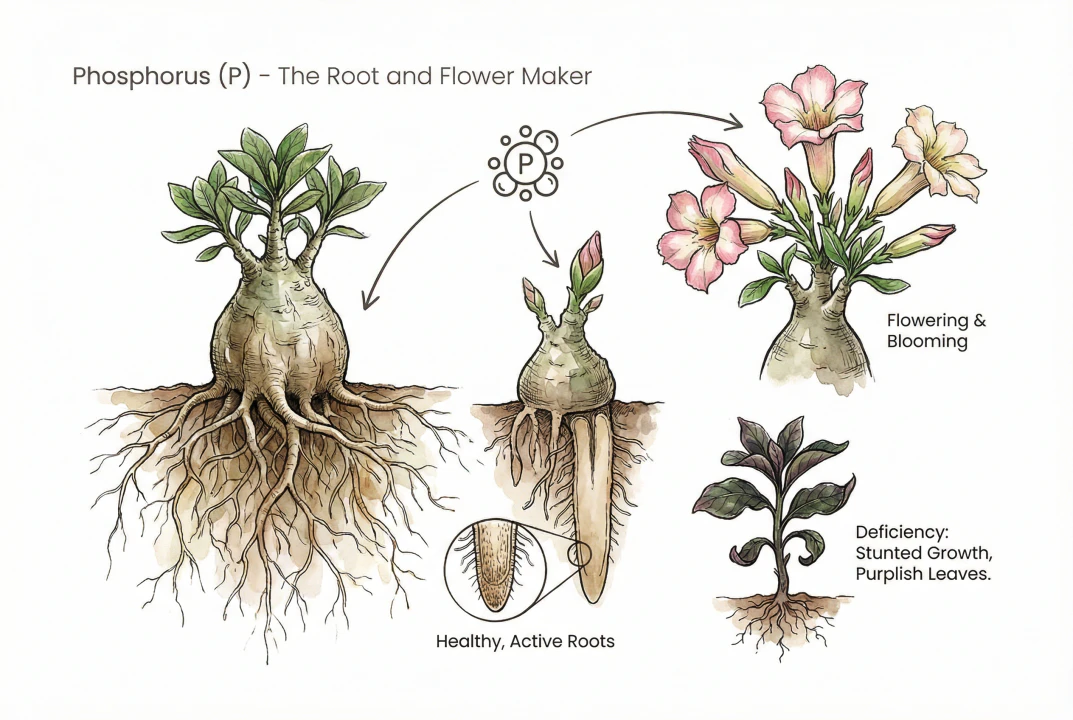
Phosphorus is essential for energy transfer, nucleic acids, and membranes, and a deficiency does stunt growth. Extra phosphorus does not pump up roots, flowers, or the caudex once the plant already has enough. Plants only need a modest amount of P, and piling on more through a high-middle-number bloom formula does not produce more blooms or a fatter base. It can even reduce iron and zinc availability.
- Phosphorus is a necessary nutrient in modest amounts, supplied by any balanced feed.
- Phosphorus deficiency can cause stunted growth and sometimes dark or purplish older leaves.
A balanced fertilizer supplies enough phosphorus. There is no need to chase a high-P formula, and no evidence that loading P makes a caudex fatter. A fat caudex comes from good light, healthy roots, appropriate water, time, and genetics, not from a phosphorus overdose.
Potassium (K): The Health Defender
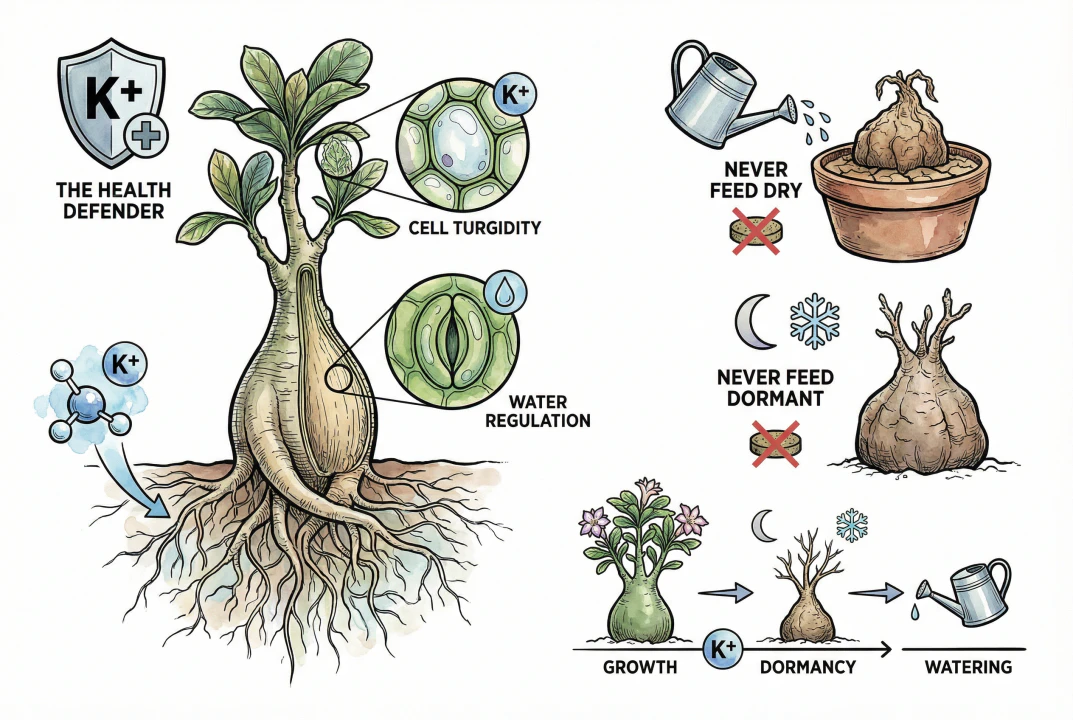
Potassium regulates water pressure inside cells (turgidity), making it an important nutrient for a plant whose strategy includes water storage.
It helps run the opening and closing of the stomata and supports the plant's response to drought and other stresses. Adequate potassium is genuinely helpful for a water-storing plant. That said, it's one of several essential nutrients, not a magic bullet. Enough K supports drought tolerance and general vigor, but it won't by itself make a plant pest-resistant or fungus-free.
Use a complete fertilizer that includes potassium along with the other nutrients. There is no need to hunt for a formula where K specifically exceeds N. A balanced feed works well.
Growth Phases and Timing
When to feed matters as much as the formula. A dry, cold, recently repotted, or clearly dormant plant is a poor candidate for fertilizer. Active roots and usable light are the better cues.
The Active Season (Spring & Summer)
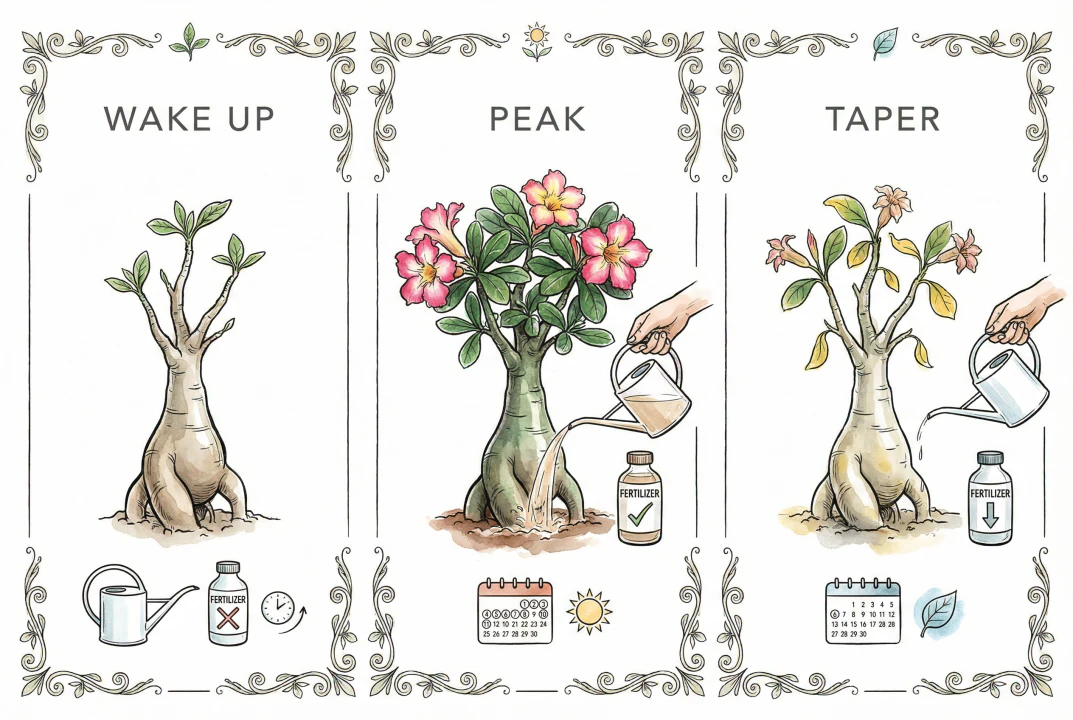
Many Adenium, Pachypodium, and Operculicarya plants respond to warming conditions, but the active period depends on species, provenance, light, and indoor temperature.
- During wake-up, wait for sustained new growth and a root zone that drains normally. Do not feed a dry or compromised plant.
- During active growth, use a diluted, label-compliant feed only as the plant proves it can use water and nutrients.
- During rest, reduce or stop feeding when growth and uptake clearly slow.
The wake-up phase trips people up. Many growers see the first green nub and immediately drench the plant. Early growth may still be running partly on stored energy in the caudex while roots resume activity.
Visible leaves are useful evidence but do not prove root activity by themselves. Introduce a weak, label-compliant feed only after the plant is growing steadily and the pot is drying normally.
When I feed a plant, I tag the pot with the product, label rate used, date, water source, and the evidence that it was actively using water. I keep a separate entry for a plain-water event rather than calling both of them watering. That distinction makes it much easier to reconstruct a salt problem than relying on a vague memory of frequent care.
I compare the log with pot dry-down, new growth, leaf margins, and any surface crust before changing the next application. If the plant is slowing or the pot remains heavy, I pause feeding instead of compensating with a different ratio. The record makes a plant-specific response visible without turning one healthy growth flush into permission for a stronger schedule.
The Dormancy Danger (Winter)
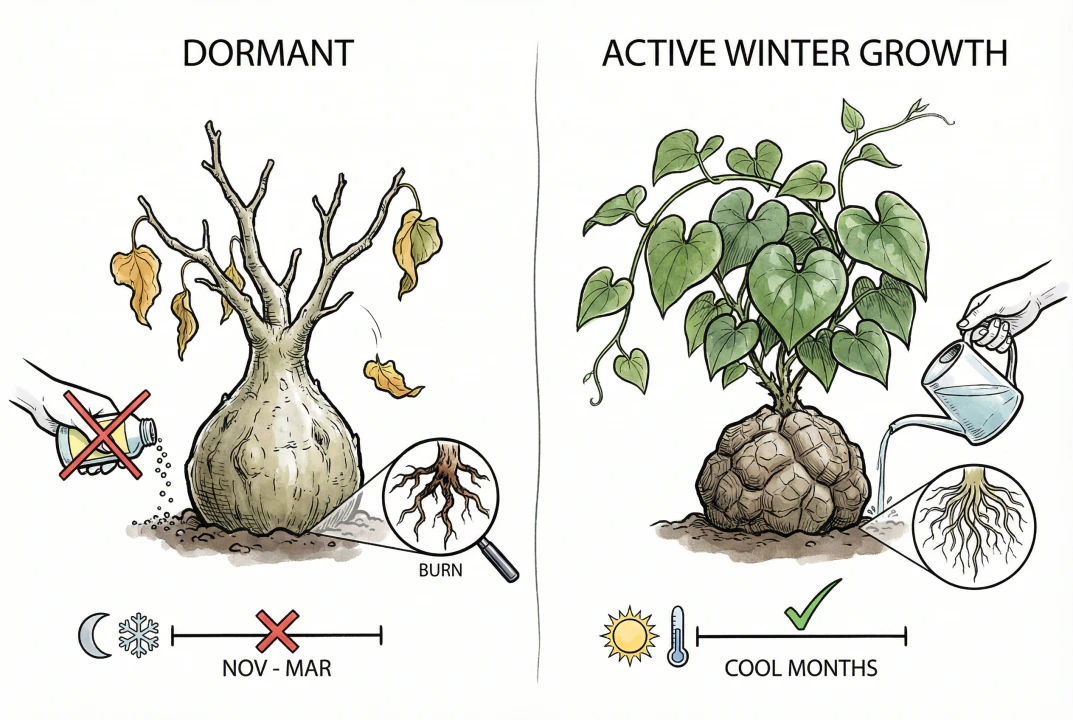
When leaves yellow and drop in winter, the plant may be resting and taking up less water. Fertilizer salts can then accumulate against the roots and increase salt stress if uptake and drainage are low.
Do not use a fixed November-to-March rule. Stop or reduce feeding when the plant's actual growth and root uptake slow, and reverse the timing for a confirmed winter grower.
Dormancy changes demand but does not create a universal sealed-root mechanism. If salts are suspected, use a measured plain-water flush only when drainage and root health permit it, then reassess rather than flushing by calendar.
Fertilizing Methods and Products
There are two ways to deliver nutrients. You can use a liquid drench or slow-release granules. Liquid can be easier to adjust. Granules are convenient but can be less forgiving when the rate or moisture pattern is mismatched.
Liquid Fertilizer (An Adjustable Option)
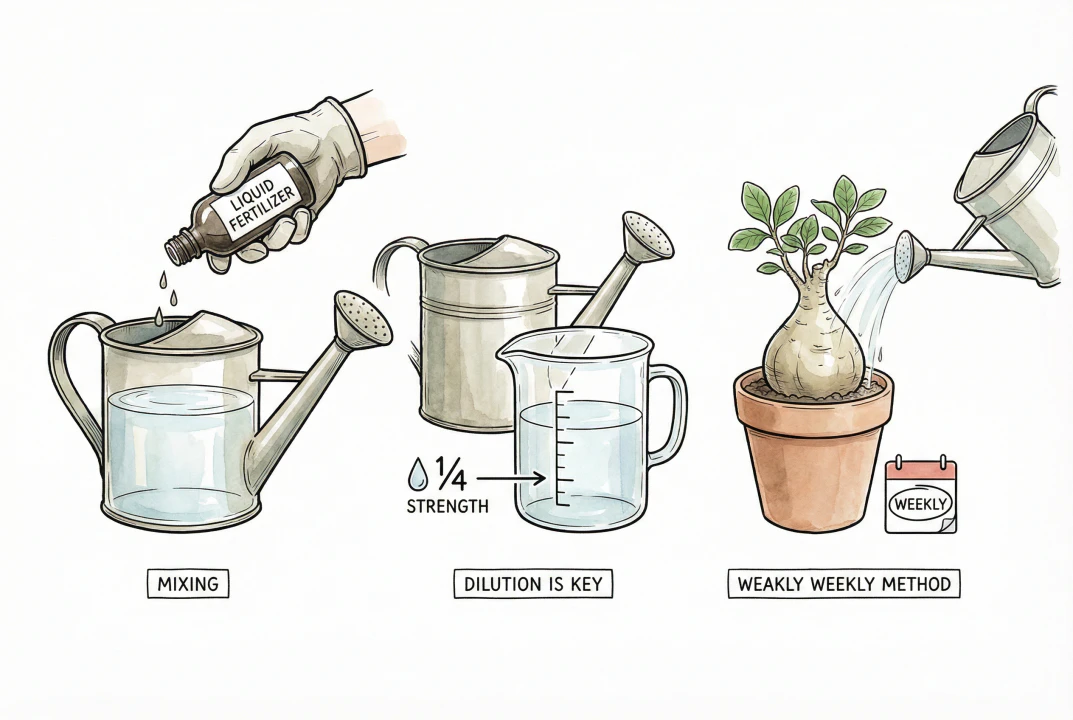
Liquid concentrate can be easier to adjust than a long-lived granule, provided the label is followed and the root zone can drain.
- Start dilution at or below the label's lower rate when the plant is actively growing, then adjust from leaf color, growth, and salt buildup.
- Space applications according to the product label, pot dry-down, light, and plant response. A weekly routine is not universal.
A diluted feed can reduce the risk of a single heavy salt load, but it does not eliminate accumulation. Track applications and occasionally check the pot, water quality, and plant response.
Slow-Release Pellets
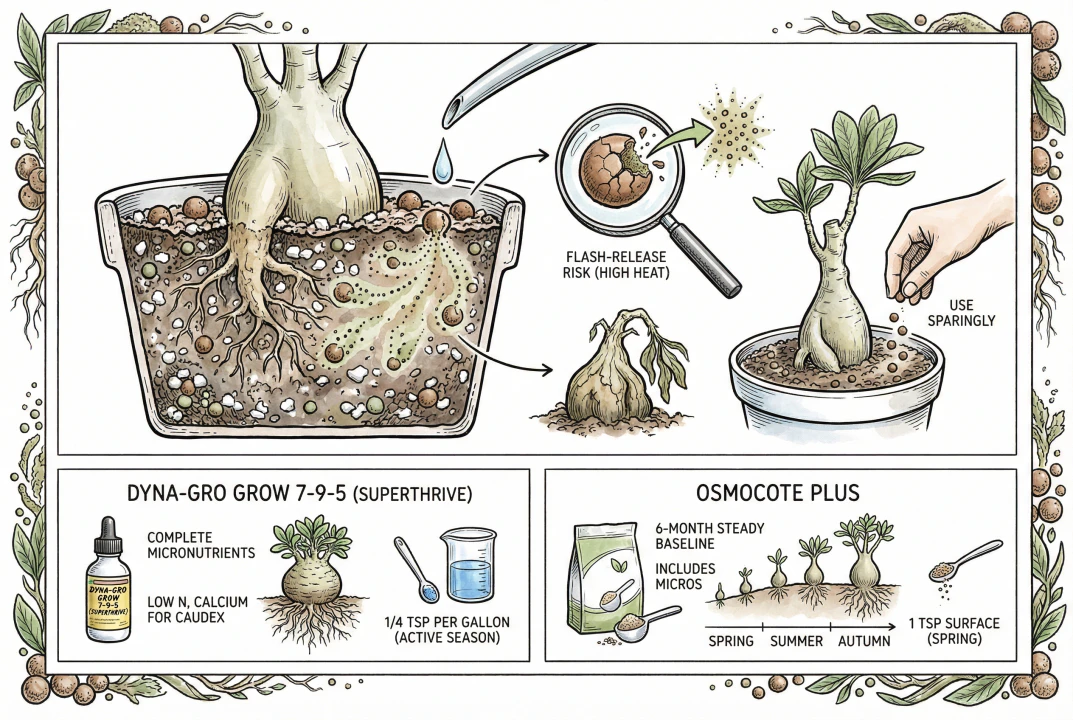
Slow-release granules are coated pellets mixed into the soil that release nutrients when wet.
- Release depends on the product, temperature, moisture, and pot. A granule can overfeed a small root system if the label rate is not matched.
- Use only the label rate appropriate to the pot and plant, and avoid direct contact with exposed tissue.
Coated slow-release fertilizers release according to their label and conditions. Check the current instructions, use a measured amount for the pot, and keep granules away from exposed caudex tissue.
Choosing a Formula
For liquid feeding, a complete formula that supplies nitrogen, phosphorus, potassium, and micronutrients is the safest default. Check the current label for its analysis and rate, then adjust for light, water quality, pot volume, and the plant's response.
For a controlled-release option, a coated slow-release granule works when its rate is matched to the pot. Release duration varies by product and conditions. Use the current label rather than a fixed teaspoon or season-long promise.
Specific Requirements by Genus
Different genera and individual plants have different growth rates, roots, and active seasons. Compare the plant's response rather than assigning a fixed appetite by shape.
Adenium (Desert Rose)
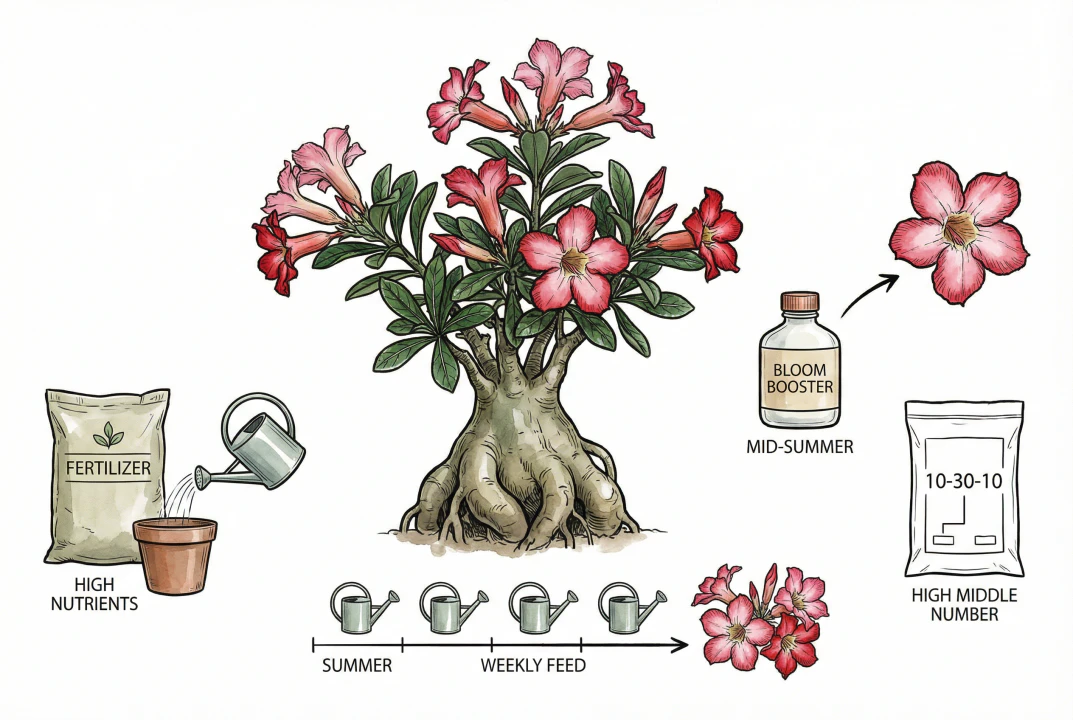
Adenium can grow vigorously in strong light and warmth, but feeding demand still depends on roots, pot dry-down, and cultivar.
- Regular, diluted feeding may be appropriate for Adenium during active growth when roots and light support it.
- Flowers come mainly from strong light, warmth, and maturity, not from a high-phosphorus bloom booster. A balanced feed is fine.
- Follow the label and plant response, and increase feeding only if growth and dry-down support it.
Adeniums can use more water and nutrients during active growth than some slower caudiciforms, but full-strength or gallon-scale feeding is not a general recommendation. Brown tips, salt crust, stalled growth, or root damage are reasons to reassess.
With seedlings, keep nutrition modest and consistent with light and root development rather than feeding for a target caudex size.
Pachypodium (Madagascar Palm)
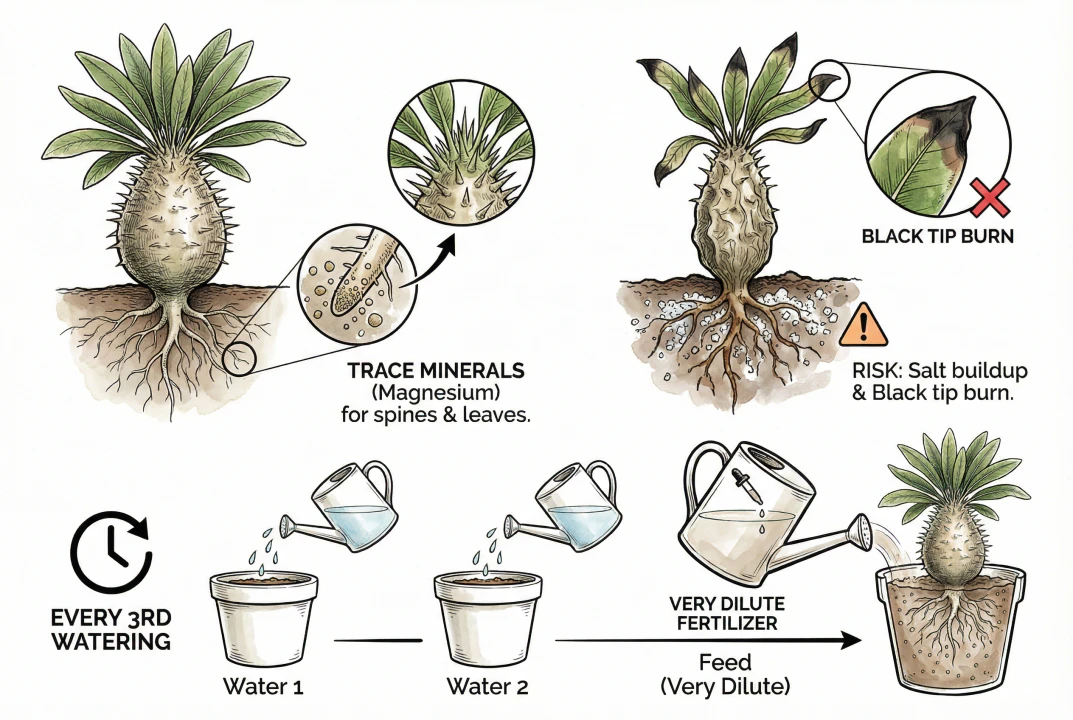
Pachypodium roots can be sensitive to abrupt changes in salts, water, and temperature.
- Pachypodium needs complete nutrition in modest amounts when actively growing.
- Salt buildup and root stress are possible in a dry or poorly draining pot.
- Use a diluted, label-compliant application only when the plant is using water normally.
Pachypodiums can react to abrupt changes in food, light, water, or temperature. Use a balanced, diluted formula only when growth is active, and do not try to force growth with a higher dose.
Excess resources with inadequate light can produce elongated growth rather than a compact form. Caudex thickening also depends on age, roots, water, light, and time.
Stephania and Dioscorea (Tubers)
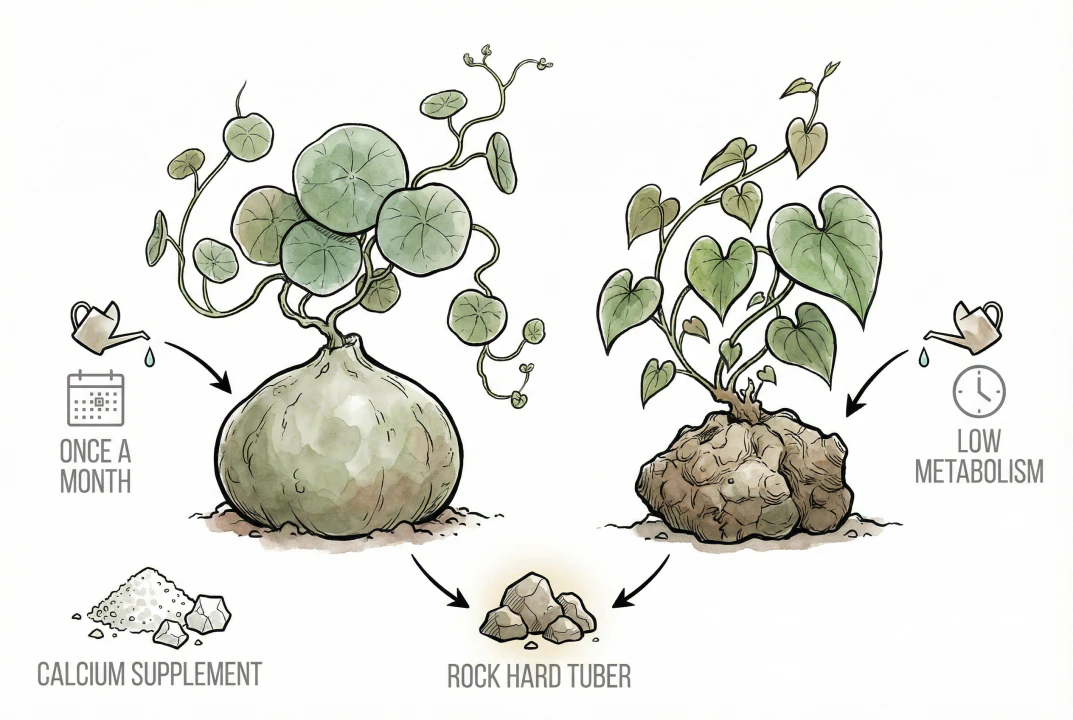
These tubers often have low or strongly seasonal nutrient demand.
- Stephania and Dioscorea need only modest nutrition when roots and vine growth are active.
- Feed only during active vine growth, at a rate matched to the label and plant response.
- Calcium supports normal nutrition when needed, but it is not a guarantee of firmness.
These plants often prioritize vine or leaf growth before visible tuber thickening. Excess nitrogen can produce elongated growth when light is limiting, while phosphorus and potassium cannot substitute for healthy roots and appropriate water.
If a Stephania tuber feels soft, check for dehydration, temperature stress, root loss, or rot before fertilizing. Softness is not a hunger diagnosis.
Troubleshooting Common Issues
Fertilizer Burn
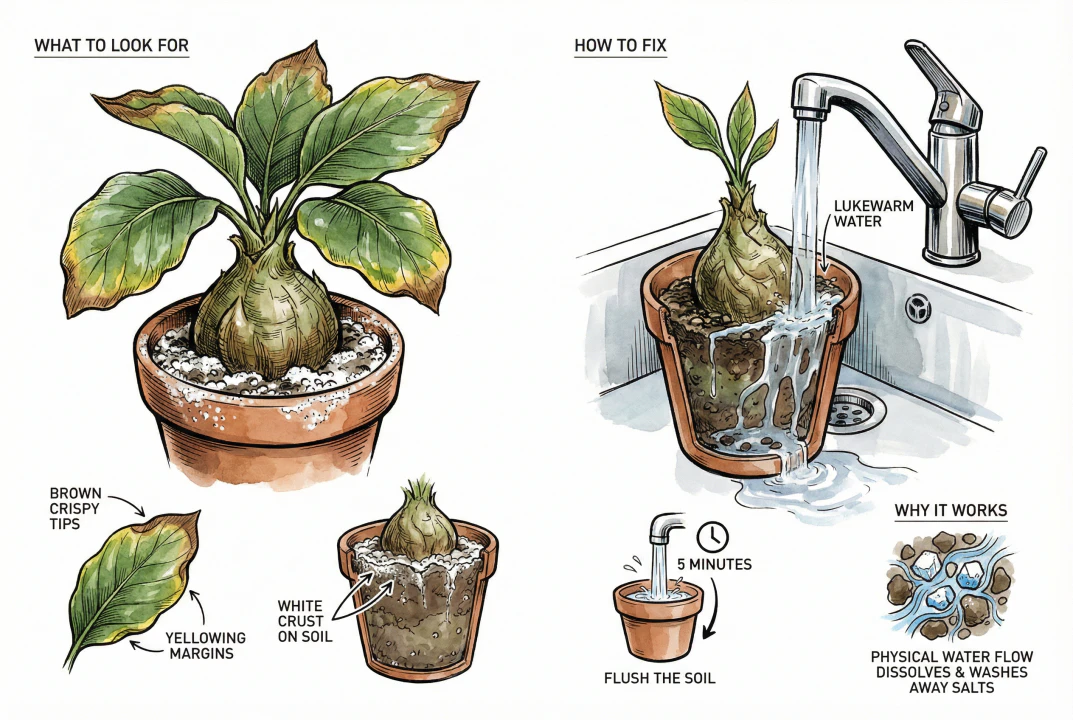
Look for brown, crispy leaf tips, yellowing margins, and a white crust on the soil surface. Check the label, water quality, drainage, and roots. If the mix drains safely, a measured plain-water flush can reduce soluble salts, but do not flush a compromised or poorly draining pot blindly.
Drainage can carry soluble salts away, but the required volume and pause depend on the pot and plant. Reassess before feeding again rather than following a fixed six-week rule.
Damaged leaf tips usually will not green back up, but new growth can show whether the underlying conditions have improved.
Nutrient Lockout
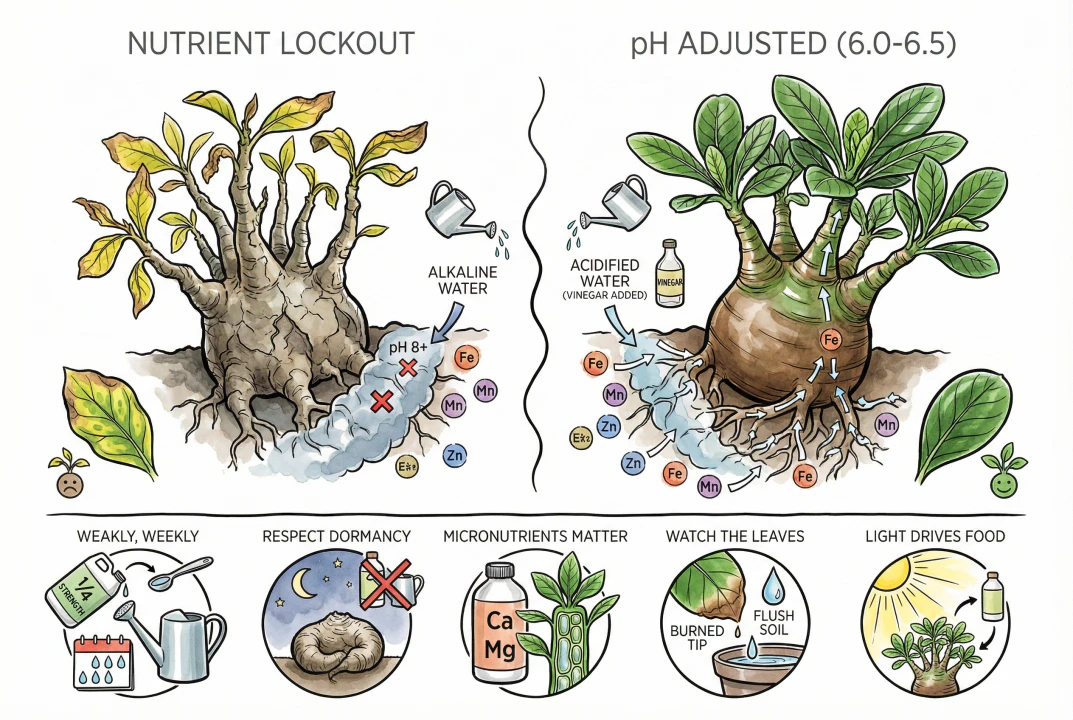
The plant may look hungry, with yellowing leaves, even though you are feeding it.
Check the water's pH and alkalinity because hard water can affect micronutrient availability. Acidify only with a measured product or protocol and verify the result. A fixed vinegar dose or universal target is unsafe without knowing the water's buffering.
pH influences nutrient availability, but yellowing also comes from roots, light, pests, and disease. Confirm the cause before changing the water chemistry.