UV-B Grow Lights for Euphorbia: Safe Color Guide
UV-B light can deepen red/purple color in some Euphorbia, but it's an advanced technique with real eye and skin hazards and no validated dose. What the science does and doesn't show, and how to weigh the risks.
Derek Kim · 2026-03-07 · Updated 2026-04-06 · 7 min read
Key Takeaways
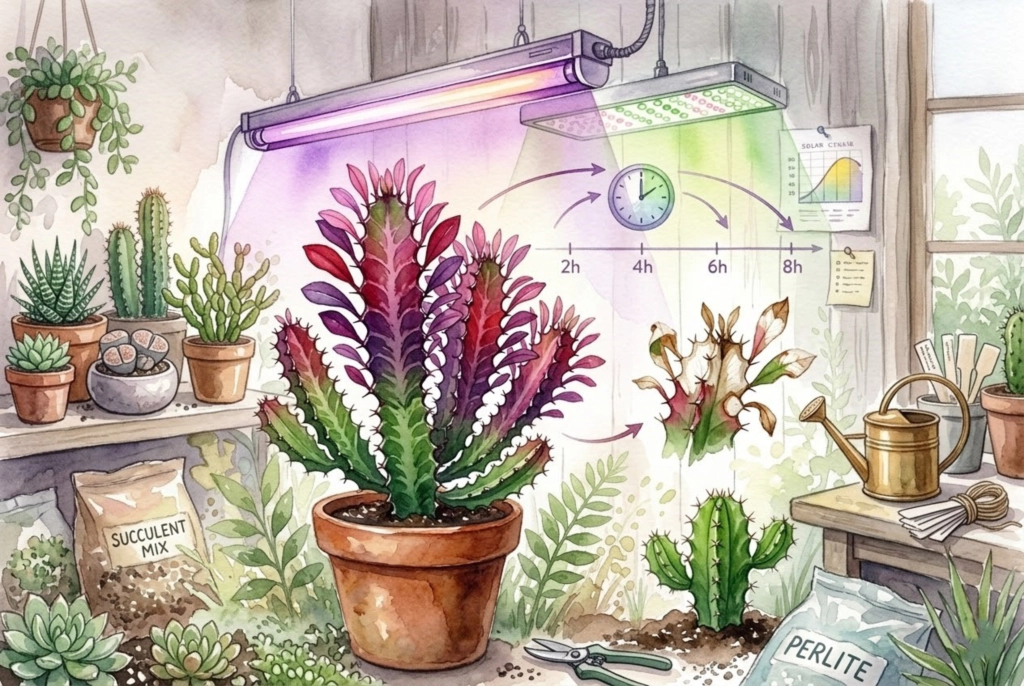
- UV-B can deepen red or purple colour in some Euphorbia by driving protective anthocyanins. Genetics, bright visible light, cool nights, and other stresses also shape colour, so UV-B is neither the only trigger nor a guaranteed one.
- Put human safety first. UV-B burns eyes and skin, and a hobby timer is a convenience, not a safety interlock. Use a fully shielded, UV-rated enclosure with no line of sight to people or pets, or do not run it.
- No validated UV-B dose exists for Euphorbia. Distance and hours are rough guesses. The real dose depends on the lamp, reflector, screen, age, and canopy position, which needs a UV meter to assess.
- UV-B also damages DNA, photosynthesis, and growth, so start extremely conservatively on an expendable plant. Or choose gentler colour methods such as strong visible light and cooler nights.
- This is an advanced, hazardous technique for a cosmetic result. Simpler, safer methods can colour many Euphorbia without adding UV exposure.
Some Euphorbias glow deep red or purple while others stay green, and UV-B light is one factor that can push a plant toward those colors by triggering anthocyanin pigments. Genetics, bright visible light, temperature, and other stresses also matter, so green versus red cannot be reduced to UV-B alone.
If you use a UV-B lamp, understand up front that it is a genuine hazard to your eyes and skin. Safety has to come first.
Is UV-B lighting safe for you, not just the plant?
Protect People Before Testing Plant Color
Treat a UV-B fixture as a real hazard to your eyes and skin because the 280 to 315 nm light that colors a Euphorbia also burns human tissue. Never look directly at a lit lamp. Brief exposure can cause photokeratitis, and repeated skin exposure carries the risks of too much midday sun.
A lower-risk arrangement is a fully enclosed, UV-rated cabinet or box where UV cannot escape toward people or pets, ideally with a switch that cuts power when the door opens. A wall timer is only a convenience. It is not a safety interlock, so rely on physical shielding and no line of sight to the lamp.
A reptile hood mesh screen is not human protection and can also reduce UV reaching the plant. If you must be in the room while it runs, use eyewear rated for 280–315 nm with side coverage, cover your skin, and keep exposure brief. If you cannot shield it properly, do not use it.
The Science of Plant Pigments
Why is my Euphorbia turning red?
Read pigment as one part of the stress response
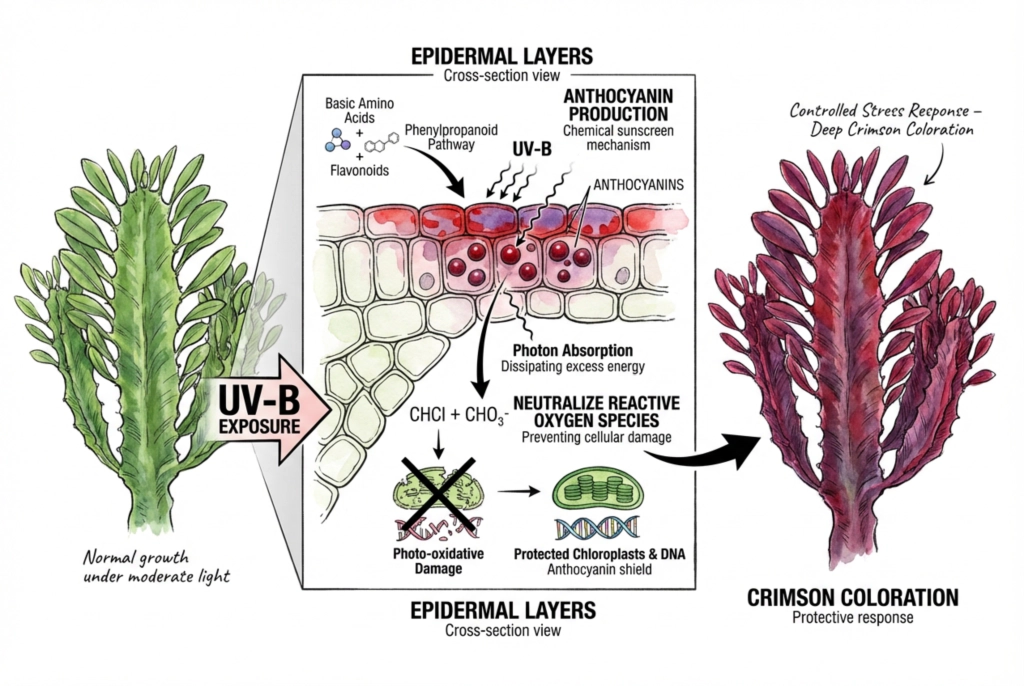
UV-B exposure can prompt a Euphorbia to make anthocyanins, the red and purple pigments that contribute to light protection. They may build up in epidermal cells, while UV-B also activates the phenylpropanoid pathway and other protective responses.
Protection and damage are not either-or. The same exposure can drive protective signaling and cause DNA damage, reactive-oxygen stress, and photoinhibition at the same time, so seeing color does not prove the plant is unharmed. The balance depends on dose, spectrum, and species.
Anthocyanins are part of a wider light-defense system rather than a solo sunscreen. Flavonols, other phenolics, antioxidant enzymes, carotenoids, and DNA-repair machinery also contribute, so red pigment does not neutralize every form of damage.
What is the grow light spectrum difference for UV-A, UV-B, and UV-C?
Choose the band for its actual biological effect
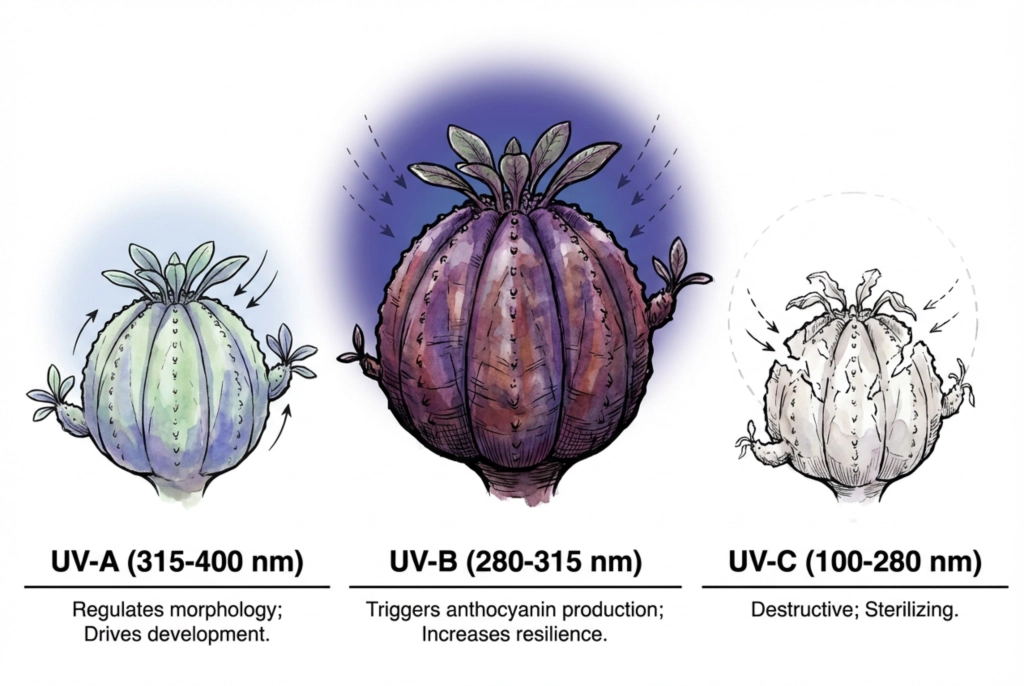
The three UV bands have different biological effects. UV-A can influence growth responses, UV-B can trigger stress signaling and pigment changes, and UV-C is generally damaging at plant-relevant exposures.
UV-A spans 315–400 nm and works with blue light on shape and phototropism, while transmission through glass varies. UV-B spans 280–315 nm and can signal pigment and cuticle changes. UV-C spans 100–280 nm, damages DNA, and belongs to controlled sterilization rather than casual plant lighting.
UV-B is not the only way to obtain red or purple color. Strong visible light, cool temperatures, and other stresses can also drive anthocyanin in many species.
| UV band | Wavelength | Effect on the plant |
|---|---|---|
| UV-A | 315 to 400 nm | Shapes growth and phototropism |
| UV-B | 280 to 315 nm | Can trigger pigment and cuticle responses |
| UV-C | 100 to 280 nm | Can damage DNA. Used for sterilization, not routine growth |
Hardware and Setup for UV Stressing
Does using standard grow lights provide enough UV-B for red stress in Euphorbia?
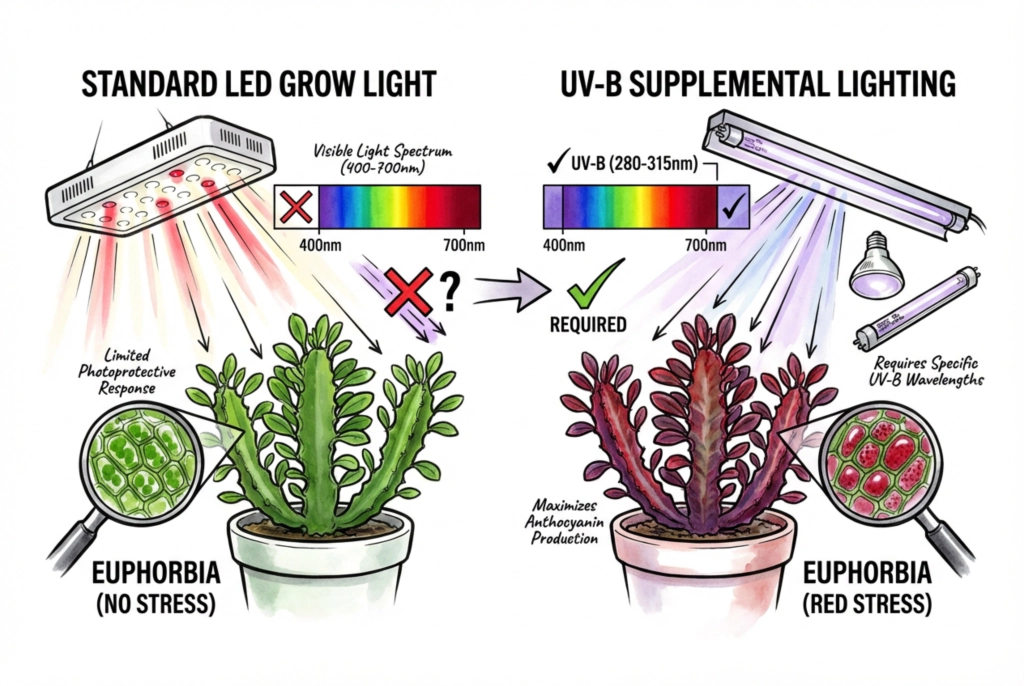
Do not assume a standard grow light supplies UV-B
Usually not. Standard full-spectrum LED grow lights are generally specified for visible output and do not provide a measured UV-B dose. Increasing visible intensity can still affect pigment through other pathways, but it does not substitute for a measured UV-B source.
Many growers assume a brighter LED will turn a Euphorbia purple, but raw visible intensity is not the only trigger. Deliberate indoor UV-B exposure requires a dedicated source in the 280 to 315 nm band, such as a reptile terrarium bulb or horticultural UV-B bar.
Verify the fixture, spectrum, and shielding
If you go this route, know exactly what you’re buying. Some reptile terrarium products are sold as a fixture only, with the UV-B lamp sold separately, so verify that the package includes an actual UV-B source. Using a reptile UV-B system for plants also repurposes equipment designed for animal vitamin-D needs at terrarium distances behind mesh. Its label does not establish a plant-coloring dose or human shielding, and UV-B output declines with use, so a lamp can still light up while emitting less UV-B. A calibrated UV meter is the most direct way to check the canopy dose, subject to its own limitations.
Because of all that, treat any specific hang height and run time as a placeholder, not a validated recipe.
How to Approach UV Stress Indoors
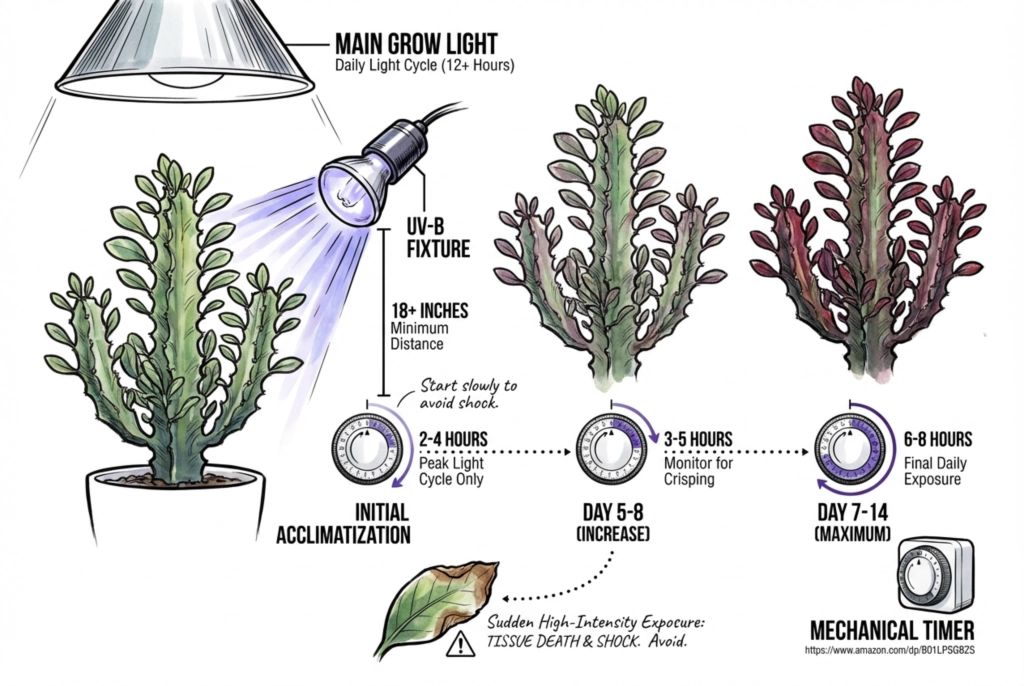
Ramp exposure only as a measured experiment
If you proceed, do so very conservatively and ideally on an expendable plant first. Increase exposure gradually so tissue can acclimate, but do not treat a distance, starting duration, or maximum as validated for Euphorbia because the actual dose depends on the lamp, reflector, screen, and lamp age.
Start far lower than feels necessary, ramp slowly over weeks, and stop at the first sign of yellowing, bronzing, or crisping. Compare against an untreated control and measure canopy UV when possible rather than guessing from a clock. Damage can be invisible at first, so looking fine is not proof of safety.
Use a timer only for convenience
A 24-hour mechanical outlet timer can automate the on/off cycle, but only as a convenience.
It is not a safety interlock and won’t stop you being exposed if you’re in the room. Physical shielding does that.
Diagnosing Stress vs. Damage
How do you distinguish between healthy stress coloring and sunburn?
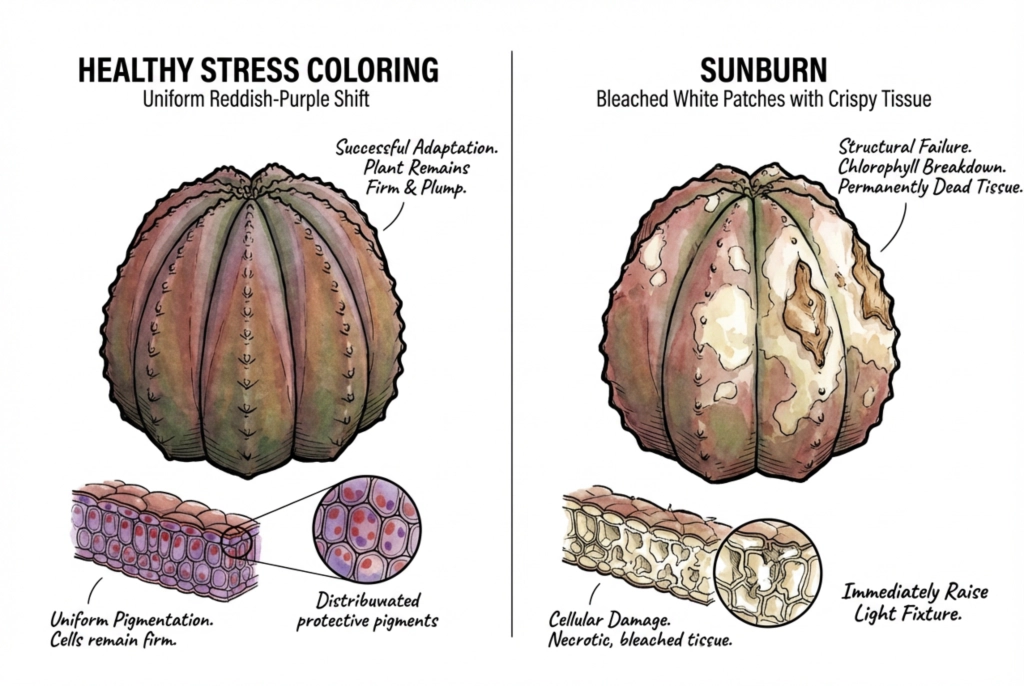
Distinguish pigment from tissue injury
Healthy stress can appear as an even reddish-purple shift across lit surfaces, while sunburn can show as pale, bleached patches with crispy tissue. Check firmness, new growth, and exposure history rather than color alone.
When a Euphorbia adapts well, pigment may spread evenly while the plant stays firm and plump. Sunburn indicates structural injury where light outpaces photosynthesis, often on the lamp-facing side, and scorched tissue may not recover.
If bleaching appears, reduce exposure immediately by increasing distance, adding shielding, shortening the run, or stopping the UV source while you reassess.
Does UV-B lighting increase anthocyanin at the cost of long-term health?
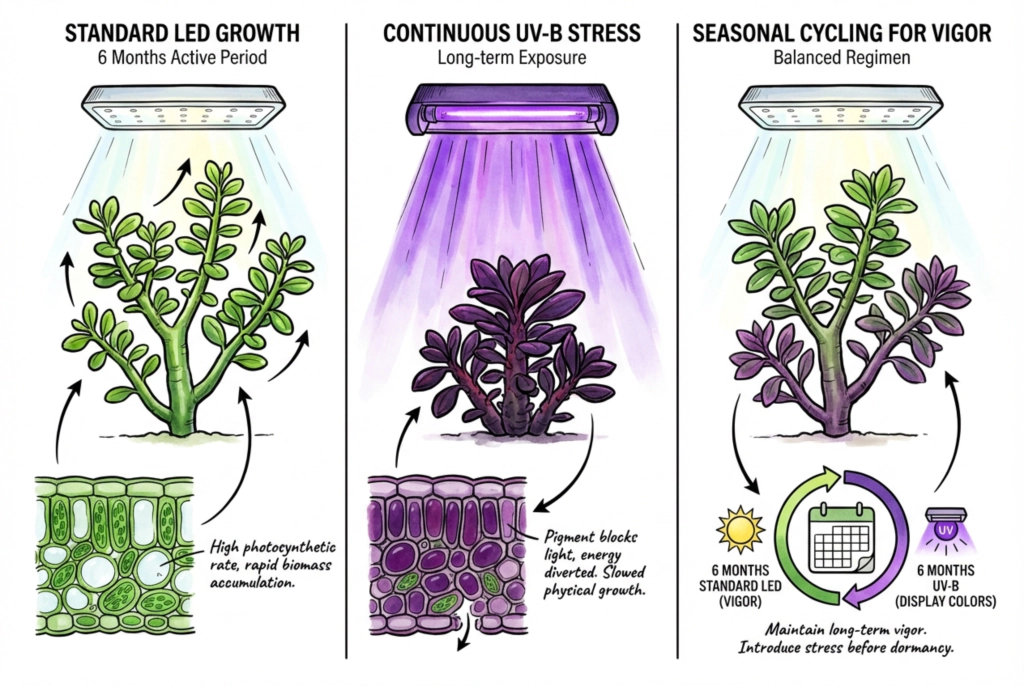
Do not chase deeper color at the cost of growth
It can. Sustained high UV-B can reduce photosynthesis and slow growth, but the problem is the dose rather than the color itself. A naturally red or purple cultivar is not unhealthy because of its color, and redness alone cannot diagnose stress without a decline in growth or plant condition.
If you use UV-B, do not chase ever-deeper color. Give the plant long stretches under normal light and weigh whether the cosmetic payoff justifies the plant risk and human hazard. For most growers, gentler color methods are the better trade.
If a UV-B fixture is present, I treat the shield and switch-off step as the first check, not the timer. I turn the source off before I work at the shelf and confirm that nobody else can enter the exposure area while it is operating.
I photograph the lamp-facing and shaded sides before any fixture-height, timer, or shielding change and stop if bleaching or crisping appears. The paired views help me identify a tissue warning without pretending that visible color makes an exposure safe.