
Variegated Pachypodium gracilius Reversion Guide
Confirm true green reversion, prune it without sacrificing healthy variegated growth, and decide whether your Pachypodium actually needs a grow light.
Rachel Torres · 2026-03-11 · Updated 2026-07-11 · 11 min read
Key Takeaways
- Do not try to hold variegation with drought, cold nights, magnesium deficiency, or a special fertilizer. No lamp, feed, or stress schedule stabilizes a chimeral meristem.
- Confirm a shoot is repeatedly and fully green before cutting, and trace it to its origin. One darker or newly opened leaf, or a green rootstock sucker below a graft, is a different case.
- For true reversion, remove that shoot at its point of origin or back to clearly variegated tissue. Light does not reverse a shoot that has already gone green.
- Keep the rest of the plant healthy and well lit, acclimating light in steps. Pale sectors show heat or light injury before green tissue does.
- Buy a grow light only when the current location cannot produce compact growth without stretching. A blue-only fixture, a bloom fertilizer, and stress treatments are not reversion cures.
A green leaf is not automatically a crisis. New leaves can change as they harden, shade can mute contrast, and a grafted plant can produce a green rootstock shoot that needs a different cut from a green shoot on the scion. Watch the next leaf or two and trace the shoot to its origin before reaching for a blade.
Good care supports the variegated plant, while pruning removes a confirmed competitive shoot. No lamp, fertilizer, or stress schedule can replace that decision.
Is this true reversion or just a greener leaf?
Treat Chimera Type as a Hypothesis
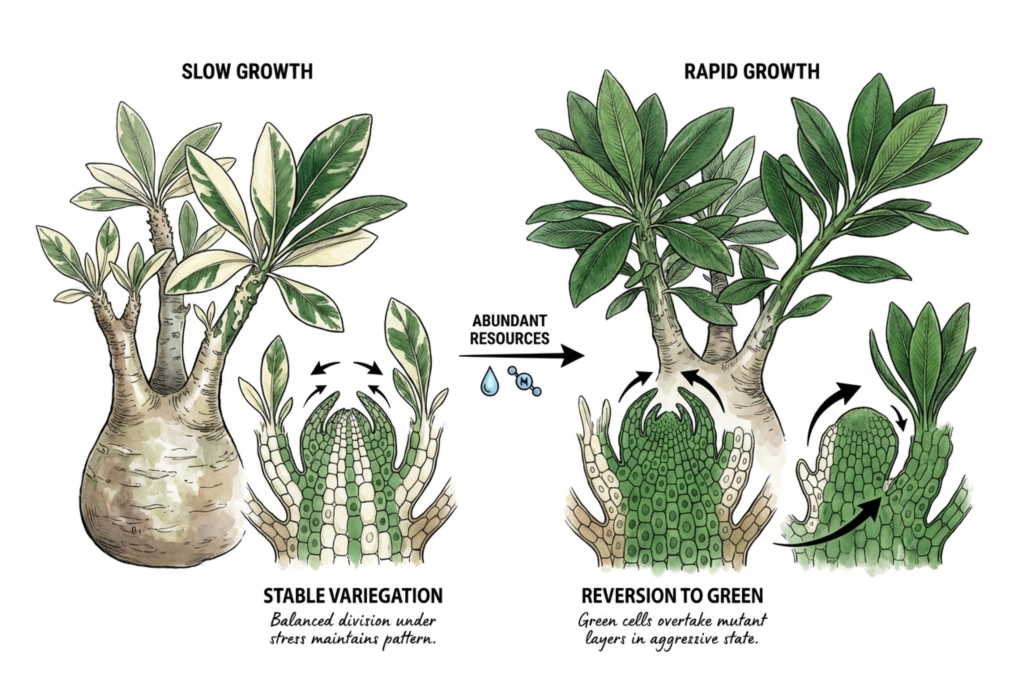
Variegation has several possible causes. A common one is a chimera in which genetically different cell layers share the same shoot tip and some layers cannot make normal chlorophyll. The leaf pattern alone cannot prove whether this particular plant is periclinal, mericlinal, sectorial, inherited, or produced by another mechanism.
Confirm repeated green growth
Call it likely reversion when a distinct shoot repeatedly produces fully green leaves and stem tissue while neighboring shoots retain the expected pattern. Compare several leaves under the same light. A single darker leaf, a newly opened leaf, general greening across the whole plant, or pale tissue caused by damage is not enough evidence.
Trace the shoot to its origin
Trace the shoot before cutting. Growth from below a visible graft union may belong to the green rootstock. A shoot arising within the variegated crown is a different case. If the origin is buried, crowded, or close to the main growing point, expose and photograph it first. An experienced Pachypodium grower or nursery can help you avoid sacrificing the scion.
Why can an all-green shoot take over?
Why Green Tissue Can Outgrow Variegated Tissue
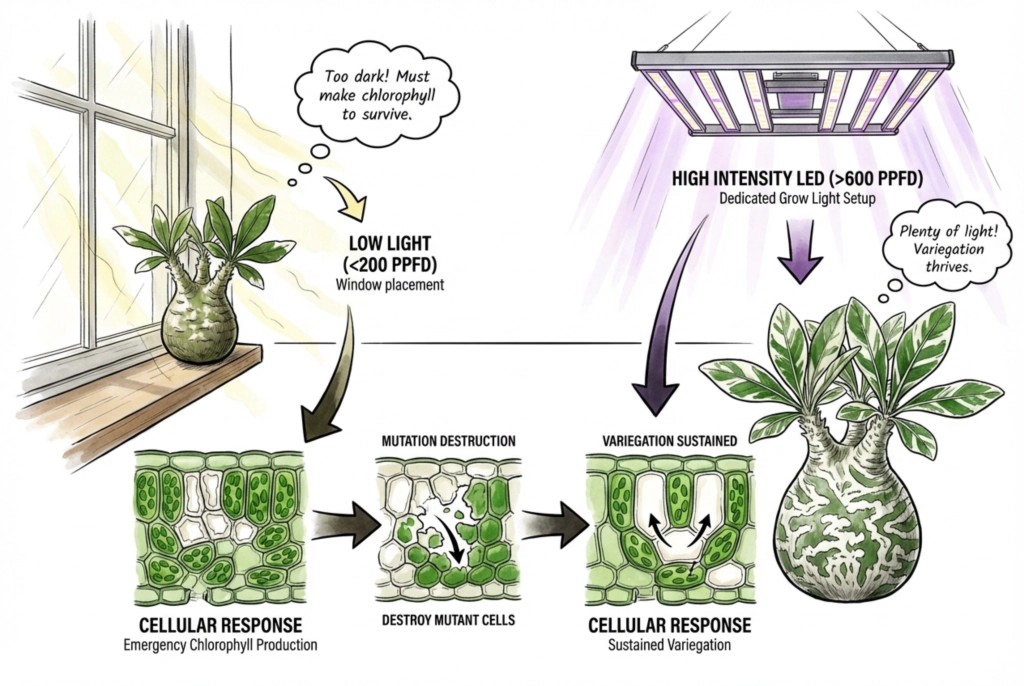
Green tissue has more chlorophyll than white or yellow tissue and can usually support faster growth. When a fully green shoot appears, that advantage can let it shade or outgrow the slower variegated crown. The plant is not acting for survival or deliberately destroying mutant cells. Two types of tissue are simply competing within the same plant.
Remove confirmed green stems
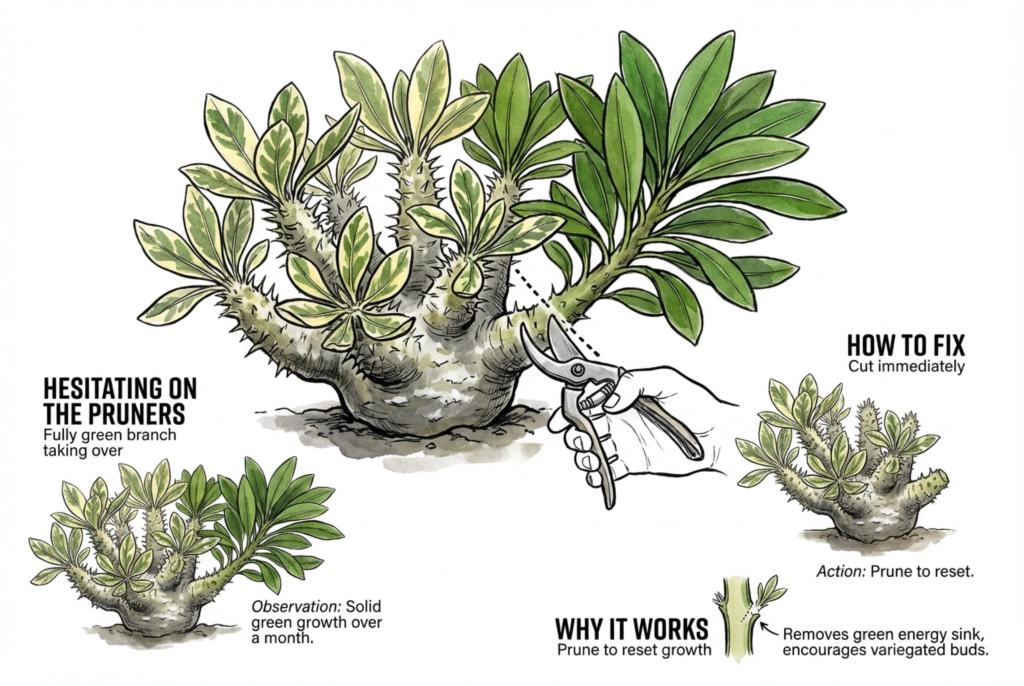
This is why waiting for a mature green branch is a poor bet. University extension guidance for chimeral plants consistently recommends removing non-chimeral green stems. It does not recommend starving or stressing the whole plant to slow them.
To separate reversion from a normal color shift, I tie a numbered soft tag below each new shoot and mark its origin on a graft-union sketch. I wait for the first two leaves to expand fully because one unfinished leaf can darken as it matures. A shoot below the union is tracked separately from a greener sector on the scion.
I match the tag number to the sketch before discussing any cut with a skilled grafter. This prevents a lighting change, an unfinished leaf, or the wrong branch from being labeled as reversion.
How should you prune a confirmed green shoot?
Mark the Pruning Boundary
Photograph the branch first, then mark the boundary between repeated all-green growth and the patterned tissue you want to retain. On an ungrafted branch, cut the reverted shoot back to its junction with variegated growth rather than leaving a green stub. On a grafted plant, remove a rootstock sucker at its origin without cutting into the grafted scion. Do not cut the main caudex simply because one leaf looks green.
Prepare a controlled cut
Use a sharp, clean tool that can make one controlled cut. Pachypodium stems are spiny and the sap should be kept off skin and out of eyes, so gloves and eye protection are sensible. The caudex protective-gear chooser explains when simple glasses are enough and when sealed goggles or handling tools make more sense.
Monitor replacement growth
Let the cut stay clean, dry, and ventilated. Recheck the new buds instead of assuming the first pruning permanently solved the problem. New growth may be variegated, green, or nearly white, depending on which cells form the replacement shoot.
How much light does a variegated Pachypodium need?
Use Light for Compact Growth
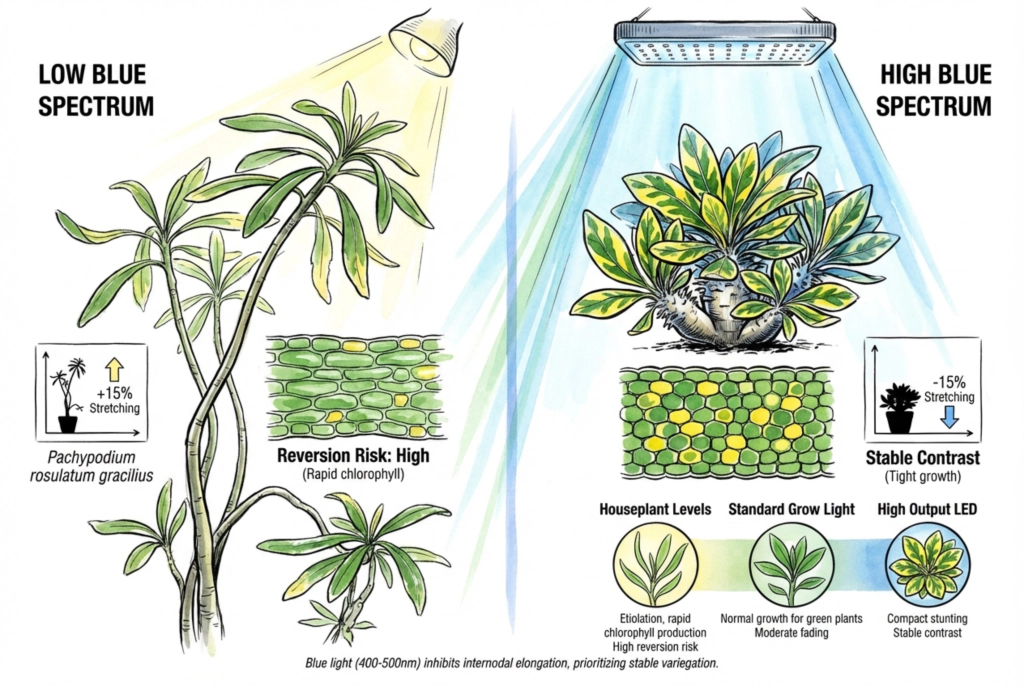
Give it enough light to produce compact, sturdy growth, but acclimate it in steps. Pale sectors have less chlorophyll and can show heat or light injury before the green tissue does. There is no validated Pachypodium gracilius threshold proving that 600–800 µmol/m²/s preserves variegation, and more light is not a cure for an already reverted shoot.
Read the plant's growth signals
Stretching internodes, leaning growth, and steadily smaller new leaves can justify measuring and improving the setup. Bleaching, tan patches, or damage on the pale sectors means pause the increase and reassess heat, distance, and acclimation. The PAR-meter chooser starts with phone and lux-based checks before a costly meter.
Do not buy blue-only light for reversion
A white full-spectrum panel already contains blue wavelengths. A separate blue-only fixture is not required, and current evidence does not show that buying one stabilizes chimeral layers.
When is the Spider Farmer SF1000 worth buying?
Buy a Grow Light for a Measured Shortfall
The current manufacturer describes the SF1000 as a dimmable 100 W full-spectrum panel with a 2 × 2 ft core coverage area. That makes it a practical candidate for a small indoor shelf where daylight is genuinely inadequate and you can adjust height or output during acclimation. It is not a variegation treatment.
| Your setup | Decision | Reason |
|---|---|---|
| Compact growth in reliable sun | Skip the panel | You do not need another light merely because the plant is variegated. |
| One 2 × 2 ft indoor area with stretched growth | Compare the SF1000 | Dimming and a defined footprint make acclimation easier than a fixed-output lamp. |
| Several shelves or a wider canopy | Measure first | One panel may create an uneven map. Design the coverage before buying multiples. |
Check the current light listing
Model revisions and marketplace inventory change. Confirm that the Amazon unit is the dimmable version, check the seller and return terms, and compare its actual footprint with your shelf. The broader caudex grow-light setup guide covers PPFD, DLI, timers, and acclimation without pretending one hanging height fits every room.
Can fertilizer stop Pachypodium reversion?
Feed for Healthy Growth
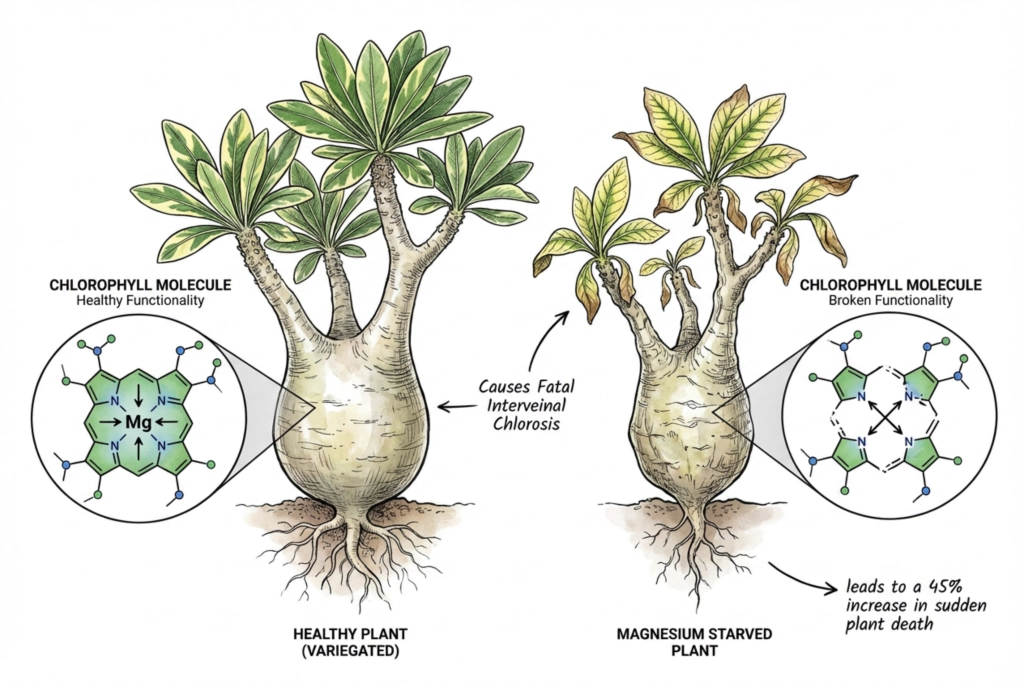
No fertilizer has been shown to lock a variegated Pachypodium into a chimeral pattern. Feed for healthy active growth, not for selective pressure. Deliberately withholding magnesium can cause real chlorosis in green tissue and make the plant harder to diagnose. It does not create healthy variegation.
Compare the fertilizer analysis
The old recommendation for a 1-3-4 ratio also conflicts with the linked Dyna-Gro Bloom 3-12-6 listing. A 3-12-6 bloom formula is phosphorus-heavy. It is not automatically the best general feed for Pachypodium, and its label rate should not be replaced with an improvised quarter-strength schedule.
Keep a complete feed when it works
If you already have a complete fertilizer that supports healthy growth in your water and substrate, do not buy Bloom to prevent reversion. Compare this product only when your nutrient plan has a specific reason for that analysis and the current label covers your use.
Do temperature swings or drought preserve variegation?
Do Not Use Stress to Preserve Variegation
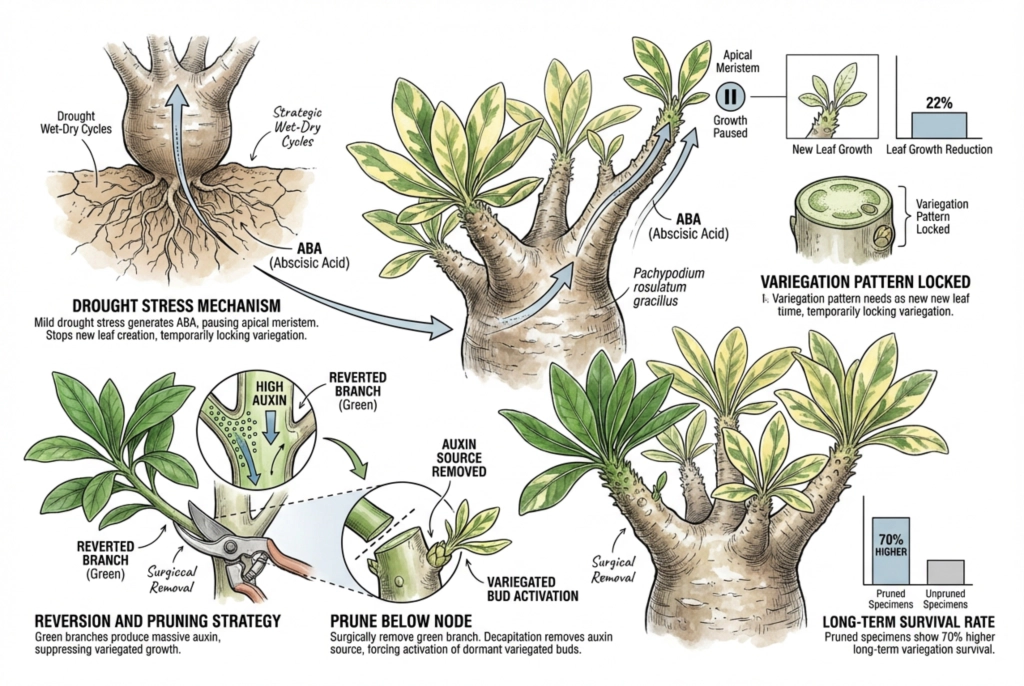
There is no Pachypodium evidence that a 15°F day-night swing, chronic drought, or another stress recipe stabilizes the meristem. Stress may slow all growth, which only delays the moment when a reverted shoot becomes obvious. It does not turn that shoot back into a chimera.
Match temperature and watering to plant condition
Do not stack cold nights, intense light, dry roots, and low nutrition in the hope of slowing green growth. That combination can damage the pale sectors and weaken the green tissue that supports them. Seasonal watering and temperature should follow active growth, dormancy, root condition, and the plant's actual environment.
Should you remove an all-white shoot?
Balance White Growth Against Green Tissue
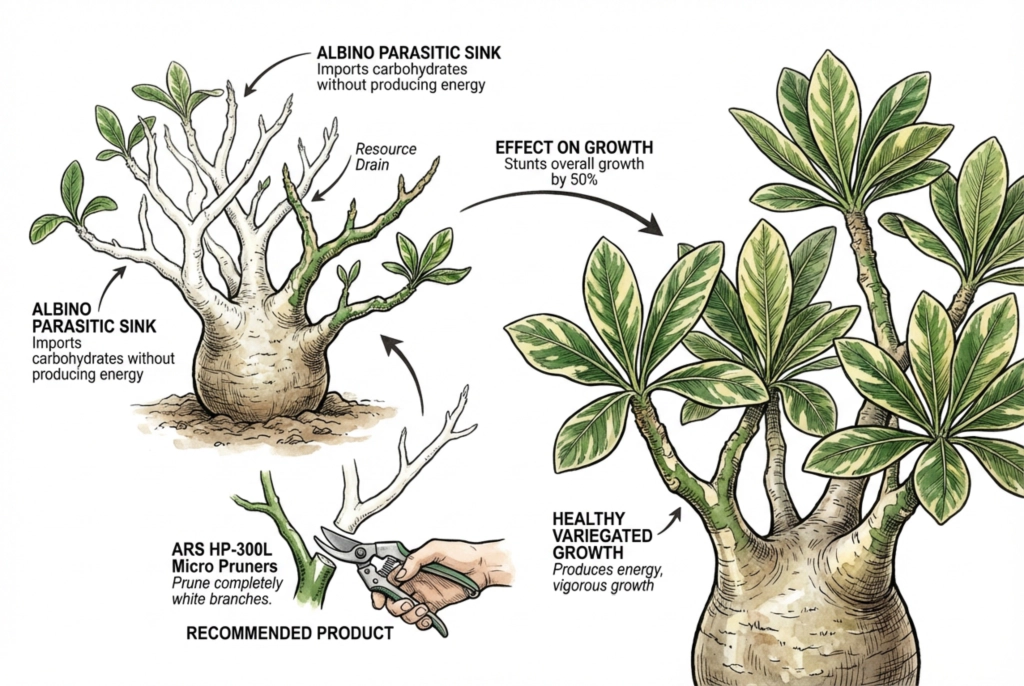
An all-white shoot contributes little photosynthesis, but that does not make every small white branch an emergency. If it is a minor ornamental part attached to a vigorous plant with plenty of green tissue, you can keep it and monitor the balance. Remove or shorten it when it becomes extensive, repeatedly wilts, shades useful foliage, or the plant is losing vigor.
Judge the whole-plant trend
There is no measured one-third rule that says a white branch cuts growth in half for this taxon. Use the whole plant's green-to-white balance and trend, not an invented percentage.
Use sulfur only under its label
Bonide Sulfur Plant Fungicide is registered for labeled diseases and application sites. The current EPA record does not turn it into a pruning-wound sealant. Do not buy it for a clean Pachypodium cut. If you are comparing the Bonide sulfur listing for a separately diagnosed, label-covered problem, read the current label and follow its PPE, plant, disease, temperature, and application restrictions.
Do watering or mineral soil prevent reversion?
Water for Root Health
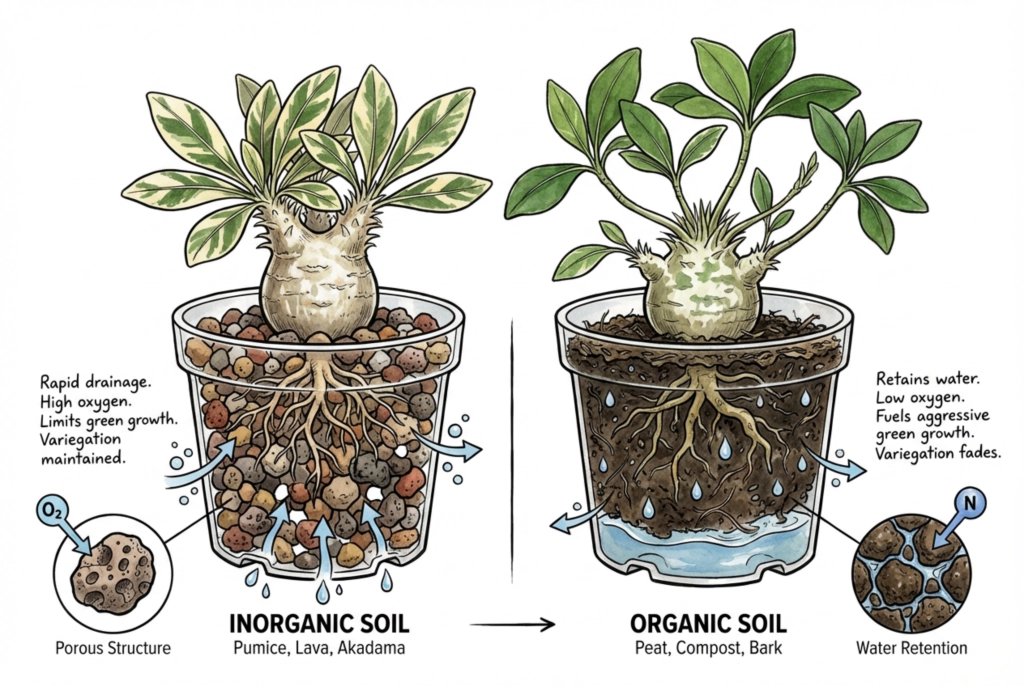
No. An airy, fast-draining substrate and a deliberate dry-down help manage root health. They do not preserve a genetic layer. Water according to active growth, pot mass, root condition, temperature, and how quickly the mix dries. Do not force the caudex to shrivel on every cycle just to slow growth.
Verify even wetting
A mineral-heavy mix can be useful when it matches the pot, climate, and watering habits, but more mineral is not automatically safer if the root ball never wets evenly. The top-versus-bottom watering guide explains how to verify wetting and drainage instead of watering by the calendar.
Can you propagate the same variegation?
Propagate Confirmed Patterned Material
Seed should not be sold as a reliable copy of a chimeral pattern. Vegetative material must include the cell layers that produce the desired variegation, and even then new growth can segregate toward green or white. For Pachypodium gracilius, grafting a confirmed patterned shoot onto a compatible healthy rootstock is usually the more defensible collector route because cuttings are not consistently easy to root.
Separate propagation from rescue
Propagation is not a rescue step for an uncertain shoot. Confirm the pattern across repeated growth first, and use a grower experienced with spiny, sappy Pachypodium grafts. A green shoot that emerges from the rootstock after grafting is not proof that the variegated scion recovered. It is a sucker and should be traced to its origin.
Which purchase fits the problem you actually have?
| What you observe | Best next step | What not to buy yet |
|---|---|---|
| One darker or newly opened leaf | Photograph it, equalize light, and watch the next leaves | Pruning supplies, fertilizer, or a new lamp |
| A repeated all-green shoot on the scion | Trace it, mark the boundary, and make one controlled cut | Variegation booster products or a stress treatment |
| A green shoot below the graft | Remove the rootstock sucker at its origin | Anything marketed as a reversion cure |
| Compact growth in adequate sun | Keep the current light and continue monitoring | SF1000 solely for variegation |
| Measured light shortfall and a 2 × 2 ft shelf | Compare the dimmable SF1000, seller, footprint, and return terms | Blue-only light or a fixed 600–800 PPFD promise |
| Healthy growth on a complete feed | Keep the current program | Bloom fertilizer to lock the pattern |
| A clean pruning cut | Keep it dry, clean, and ventilated | Sulfur sold as an unlabeled wound seal |
Match Purchases to Measured Need
A credible purchase should solve a measured constraint. In this case, that may be inadequate light or unsafe cutting access. Reversion is managed by correct identification and pruning, not by filling a cart.
Keep claims within the evidence
The options described here rely on current university guidance, manufacturer specifications, regulatory labels, and marketplace information rather than hands-on testing of these specific listings. Models, labels, sellers, prices, and availability can change, so confirm the current offer and label before use.
Affiliate Disclosure
This article contains Amazon affiliate links. As an Amazon Associate I earn from qualifying purchases. If you use these links, the site may earn a commission at no extra cost to you. Product availability, price, and specifications can change. Check the current listing before buying.