
Aspirin for Caudex Rot: The Salicylic Acid Method
Can aspirin (salicylic acid) help prevent caudex rot by priming a plant's defenses? An honest look at the science, the real dose math, and why good drainage matters far more.
Rachel Torres · 2026-03-13 · Updated 2026-05-03 · 8 min read
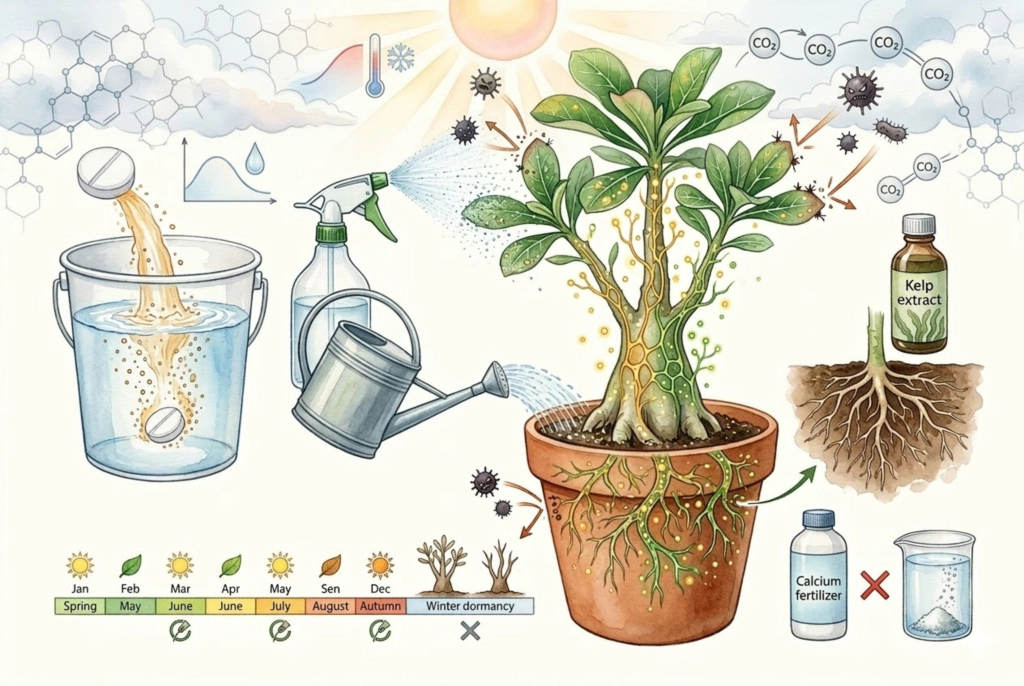
Key Takeaways
- Salicylic acid is a real regulator of plant immunity and can prime defenses in some species, but no direct caudex-plant trial validates aspirin as a rot preventative. Any use here is an unvalidated experiment.
- Fast drainage, careful watering, and airflow address the conditions that most often increase rot risk, and a salicylate experiment cannot replace them. Start with culture before chemistry.
- One 325 mg aspirin tablet in one US gallon is about 0.477 millimolar acetylsalicylic acid, not 1 millimolar. Complete hydrolysis would yield the same molar amount of salicylic acid, and a tablet mixture has no measured, fixed concentration.
- Phytotoxicity depends on species, tissue, growth stage, concentration, and route, with no universal caudex threshold established. Stop at any sign of tissue injury rather than chasing a result.
- No evidence establishes a three-to-four-week schedule, a combined foliar-and-drench benefit, or a stop-when-leaves-drop rule. A collapsing plant needs diagnosis and cultural or labelled disease management, not an immune-signal hope.
Rot risk is usually managed through the growing environment. Fast-draining media, a pot that can shed excess water, careful watering, and adequate airflow are more established controls than a household salicylate mixture.
Salicylic acid research explains why a chemical signal might change plant defense responses. It does not show that a pharmacy tablet prevents bacterial soft rot, oomycete or fungal root rot, or non-pathogenic waterlogging injury in Adenium, Pachypodium, or another caudex plant.
Any use of aspirin here remains an unvalidated experiment. A plant that is already collapsing needs diagnosis and appropriate cultural or labelled disease management, not an assumption that an immune signal will reverse damaged tissue.
What is Systemic Acquired Resistance?
Understand the Defense Signal First
Systemic acquired resistance, or SAR, is a whole-plant defense state that can develop after a plant senses a threat. Local signals and mobile regulators help prepare other tissues to respond to later challenge.
Salicylic acid is an important signal in many SAR studies. NPR1 is a central regulator, but the network also includes NPR3 and NPR4, pipecolic-acid and N-hydroxypipecolic-acid signaling, methyl salicylate, and other context-dependent components.
What does the SAR evidence show?
Separate an elicitor from a labeled fungicide
Exogenous salicylate is mainly studied as an elicitor of the plant's own defenses rather than as a labelled fungicide. Some laboratory studies also report direct pathogen inhibition at higher concentrations. That finding does not mean a dilute aspirin mixture controls a caudex pathogen.
Why Do Caudiciforms Need Immune Boosting?
Caudex plants store water, but the word rot can describe several different problems. Bacterial soft rot, oomycete or fungal root and crown disease, and oxygen stress from saturated media need different diagnosis and management.
Once tissue inside an Adenium or Pachypodium is soft and damaged, a priming signal cannot restore it. Plant-priming research is background context and not evidence that aspirin prevents an established infection.
Good culture therefore comes first. Check the pot, media, roots, watering pattern, temperature, and airflow before considering an unvalidated chemical experiment.
How Does Aspirin Compare to Pure Agricultural Chemicals?
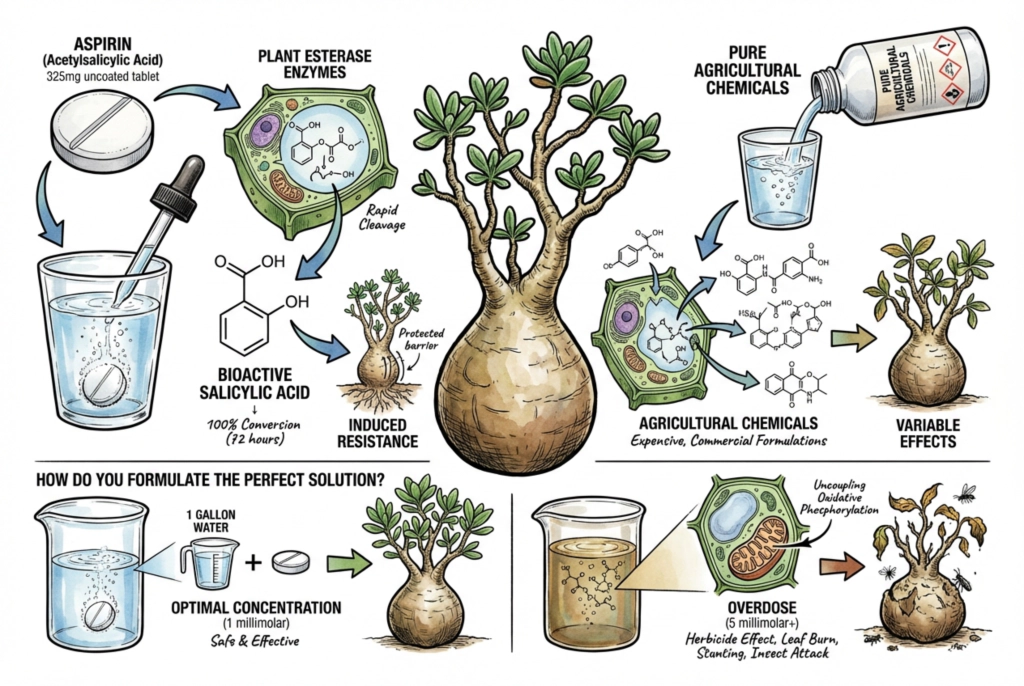
Do not treat a tablet as a measured acid dose
Aspirin is acetylsalicylic acid, often abbreviated ASA. It is an acetyl ester of salicylic acid. Water can hydrolyze ASA into salicylic acid and acetic acid, but the rate depends on pH, temperature, and time. A tablet mixture therefore does not have a measured or instantly fixed salicylic-acid concentration.
Early tobacco work used injected aspirin or salicylic acid and observed resistance to tobacco mosaic virus. That route, host, and controlled challenge do not validate a tablet mixture for a caudex plant.
Read the rubber-tree study as bounded evidence
The rubber-tree study used 21-day-bud-grafted Hevea brasiliensis RRIM600 seedlings. Researchers sprayed 5 millimolar pure salicylic acid on leaves, kept the plants in high humidity, inoculated them one day later with Phytophthora palmivora, and measured disease severity four days after inoculation. Three groups of ten seedlings showed an approximately 41.67 percent reduction under those conditions.
That result is useful as a bounded example of foliar priming. It did not test aspirin, a 0.477 millimolar tablet mixture, a soil drench, a caudex tissue, Adenium, Pachypodium, naturally occurring rot, or protection lasting several weeks.
What evidence applies to which question?
| Evidence source | What it supports | What it does not establish |
|---|---|---|
| Tobacco injection studies | Salicylate can be associated with defense responses in a defined host and route. | A household tablet dose, foliar spray, soil drench, or caudex outcome. |
| Rubber-tree foliar study | Pure salicylic acid pretreatment changed disease severity under a controlled pathogen challenge. | Aspirin equivalence, a home concentration, a different host, or weeks of protection. |
| Caudiciform aspirin use | At most, a hypothesis that requires controlled observation and plant-specific tolerance checks. | Preventive efficacy, treatment of active rot, or a repeatable dose and interval. |
| Foliar plus soil drench | No direct comparison is identified here. | A claim that using both routes is more reliable than one route. |
How Should a Household Experiment Be Framed?
Keep the Household Experiment Traceable
The basic dose calculation must keep the two chemicals separate. One 325 mg ASA tablet in one US gallon is approximately 0.477 millimolar ASA. If every molecule hydrolyzed, the salicylic-acid molarity would still be approximately 0.477 millimolar. The mass of tablet, the tablet excipients, the solution pH, the water temperature, and the waiting time do not provide a measured final concentration.
One millimolar is not a verified target for caudiciforms. Higher concentrations can injure tissue, but the boundary varies with species, genotype, organ, developmental stage, stress, and route. Salicylic-acid and jasmonic-acid interactions are also context dependent, so a simple concentration threshold cannot predict insect pressure.
Why is there no validated tablet recipe?
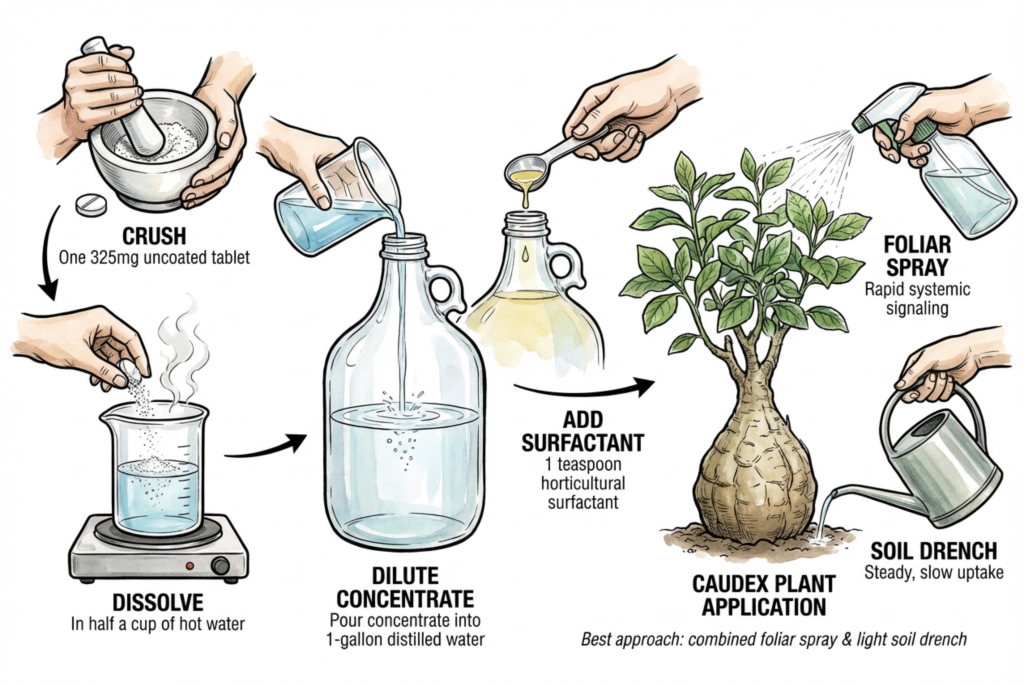
Do not call an improvised recipe validated
Crushing a tablet can change how quickly it disperses, and warmer water can accelerate both dissolution and hydrolysis. Those observations do not standardize the final mixture. Unknown tablet coatings or excipients, changing water chemistry, and uncontrolled storage make a hot-water recipe unsuitable as a validated plant treatment.
No published caudex study establishes a household tablet formulation, a storage period, a foliar volume, a soil-drench volume, or a repeat interval. Avoid treating a convenient recipe as a measured chemical protocol.
If you still record an experiment
- Record the plant identity, growth state, route, tablet formulation, water source, temperature, timing, and observed response.
- Keep untreated or culture-only observations separate from any salicylate observation so normal recovery is not mistaken for treatment benefit.
- Stop when tissue injury, unusual leaf loss, root decline, or worsening rot appears. Do not escalate the concentration to chase a result.
When a plant looks unwell, I first record pot mass, recent watering, root-zone temperature, crown condition, and the location of any soft tissue. If the base is already soft or the pot stays wet, I treat that as a diagnosis problem and do not begin a tablet experiment.
I also keep ordinary-care observations separate from any chemical observation. That boundary has been useful because a dry-down, better airflow, or a root inspection can change the plant's course without showing that an improvised mixture did anything.
What does the adjuvant label actually cover?
A non-ionic surfactant is a spray adjuvant. It helps droplets spread across a leaf instead of beading, but it is not a salicylic-acid source and its label does not establish a caudex soil drench.
Use the current label for rate, protective equipment, storage, and mixing compatibility. Eye and skin irritation, mist exposure, and crop phytotoxicity remain relevant. A small plant-area test cannot prove that a full treatment is safe.
What Application Routes Have Evidence?
Keep the Application Route Within Evidence
The rubber-tree evidence is foliar. No direct comparison establishes a soil drench, a combined route, or a safer uptake pattern for a caudex plant. A surfactant is also labelled for spray use and should not be moved into the root zone by assumption.
If a foliar observation is made, avoid wetting the crown or leaving water pooled in leaf axils. That is a moisture-management precaution, not evidence that a fine mist prevents rot.
Are There Synergistic Ingredients to Combine?
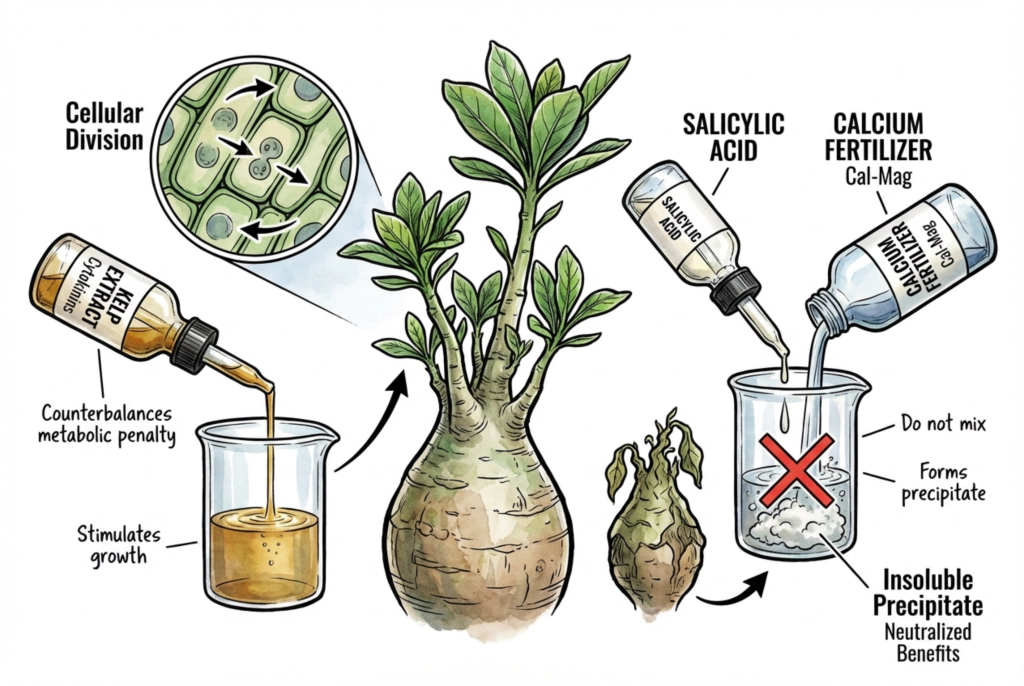
Do not assume synergy from a biostimulant
Liquid seaweed extracts are sold as general biostimulants, but their composition and plant response vary. No cited trial establishes that a seaweed extract offsets the metabolic cost of salicylate defense in a caudex plant.
Most are made from Ascophyllum nodosum and carry a low guaranteed analysis, typically around 0-0-1, so they supply trace potassium rather than meaningful feeding. Follow the guaranteed analysis and dilution rate on whatever extract you use. Doing so does not prove synergy with aspirin or make the extract a salicylic-acid antidote.
How should calcium compatibility be treated?
Calcium compatibility depends on the actual ions, pH, concentration, water, and product formulation. There is no universal rule that every salicylate and calcium mixture will precipitate or that every combined application will fail. Separate applications are a conservative mixing choice, not proof of a biological benefit.
When Should You Apply the Solution?
How should timing be judged?
Use timing as an observation variable
The available trial measured defense changes over days. It did not establish a three-to-four-week protection window or a repeat interval for caudiciforms. Timing should therefore remain an observation variable rather than a calendar prescription.
Leaf drop alone does not prove dormancy. Consider species, indoor or outdoor conditions, temperature, photoperiod, new growth, root condition, and moisture history before changing care.
What handling precautions apply?
Keep any labelled product and any experimental mixture clearly identified and away from children and pets. Follow the product label for protective equipment, storage, disposal, and re-entry guidance. Do not use an immune-signal hypothesis as a substitute for diagnosing active rot.