
Paclobutrazol for Caudex Plants: Evidence & Safety
Does paclobutrazol make a caudex thicker? Compare Adenium studies, check the Berati label, avoid unsupported DIY dosing, and choose safer inputs.
Maya Ellison · 2026-03-29 · Updated 2026-08-17 · 14 min read
Key Takeaways
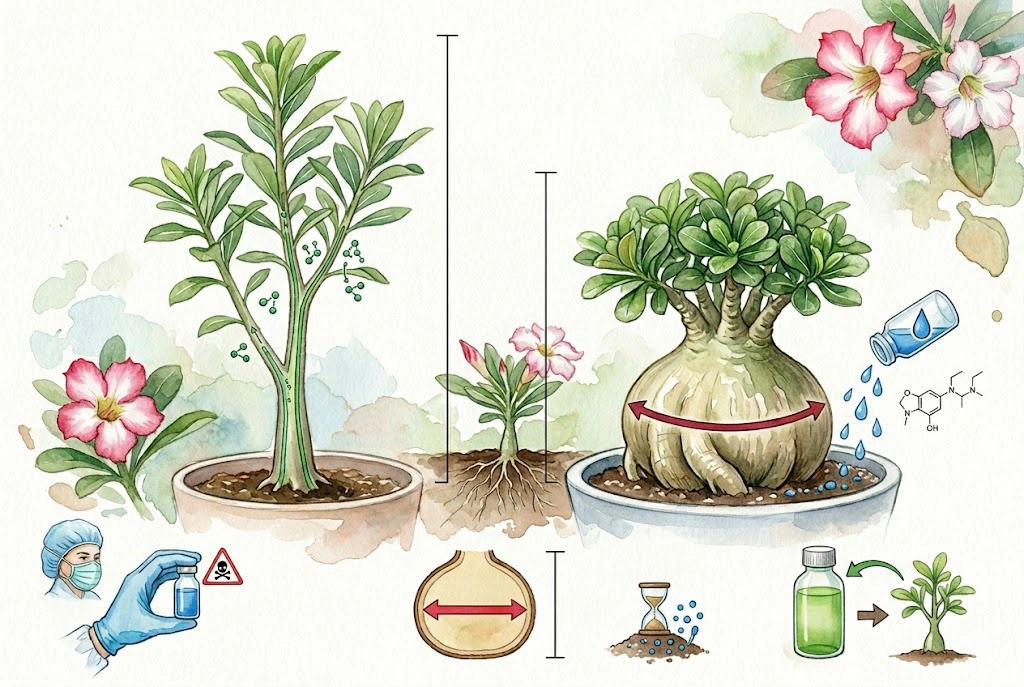
- Paclobutrazol reliably shortens shoot growth, but the available Adenium studies do not show a reliable caudex-width increase over an untreated plant. Reduced height and increased girth are separate outcomes.
- One controlled study found no significant stem-diameter change and less dry mass as the dose rose. A later seedling study saw width only trend upward, not differ significantly. A shorter plant can look broader without new radial biomass.
- There is no defensible home ppm recipe. A rate lifted from a paper or another formulation can be wrong even when the arithmetic is correct, because label, crop, method, site, and law all govern it.
- Consider a paclobutrazol product only when its current label clearly covers your plant, site, purpose, and jurisdiction, and a trained user can follow it. For a home collection, skip it.
- Build girth through species-appropriate light, healthy roots, balanced nutrition, and time. Fix a measurable cultural bottleneck before considering any growth regulator.
A chemical that keeps a stem short while the base grows sounds like a way to trade waiting for precision, but reduced height and increased caudex girth are separate outcomes. Paclobutrazol is good at the first. Evidence for the second is inconsistent.
The decision here is a purchase and evidence check, not an application guide. It gives no concentration, drench volume, timing schedule, or rescue recipe, because those numbers depend on the exact registered product, crop, application method, production site, and local law.
Can paclobutrazol actually thicken a caudex?
Not reliably, based on the available direct Adenium evidence. The studies answer narrower questions than whether a particular specimen will become wider, and their designs should not be blended into one success claim.
| Study | What it tested | What the girth result means |
|---|---|---|
| Takane et al., 2019 | One paclobutrazol treatment on greenhouse-grown Adenium obesum, with an untreated control and several treatment levels | Stem diameter was not significantly different. Shoot, root, and total dry mass fell, and leaf phytotoxicity increased at higher treatment levels. |
| Rocha et al., 2025 | Young A. obesum seedlings exposed to cytokinin, gibberellin, paclobutrazol, combinations, or a control over a short experimental period | Caudex width trended higher with paclobutrazol but was not significantly different from the control. This is not proof of added girth. |
| Goplani et al., 2025 | Ten Adenium varieties/genotypes assigned to 500 or 1,000 ppm treatments | The lower-treatment group had greater mean girth than the higher-treatment group, but there was no untreated control. It cannot show that either treatment beat normal growth. |
Read Visual Compactness Separately from New Biomass
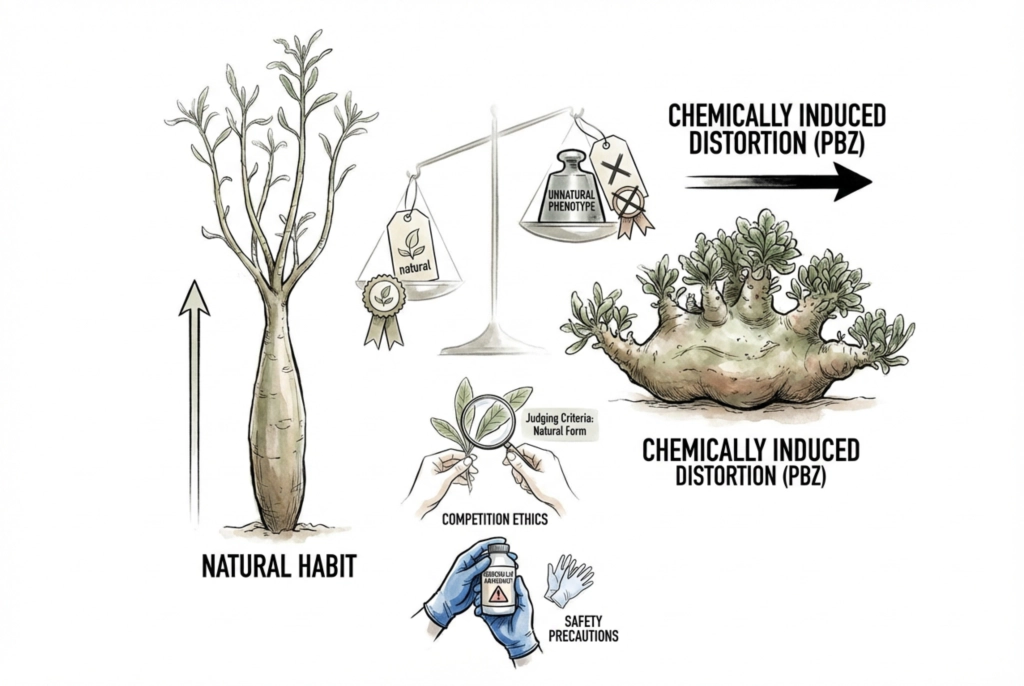
The fair conclusion is that paclobutrazol can create a more compact silhouette by suppressing elongation. A shorter plant may look broader, but that visual ratio is not the same as new radial biomass. If caudex width is the goal, the direct evidence does not justify treating PBZ as a dependable shortcut.
What does paclobutrazol do to plant hormones?
Use the Hormone Mechanism Only for Its Narrow Claim
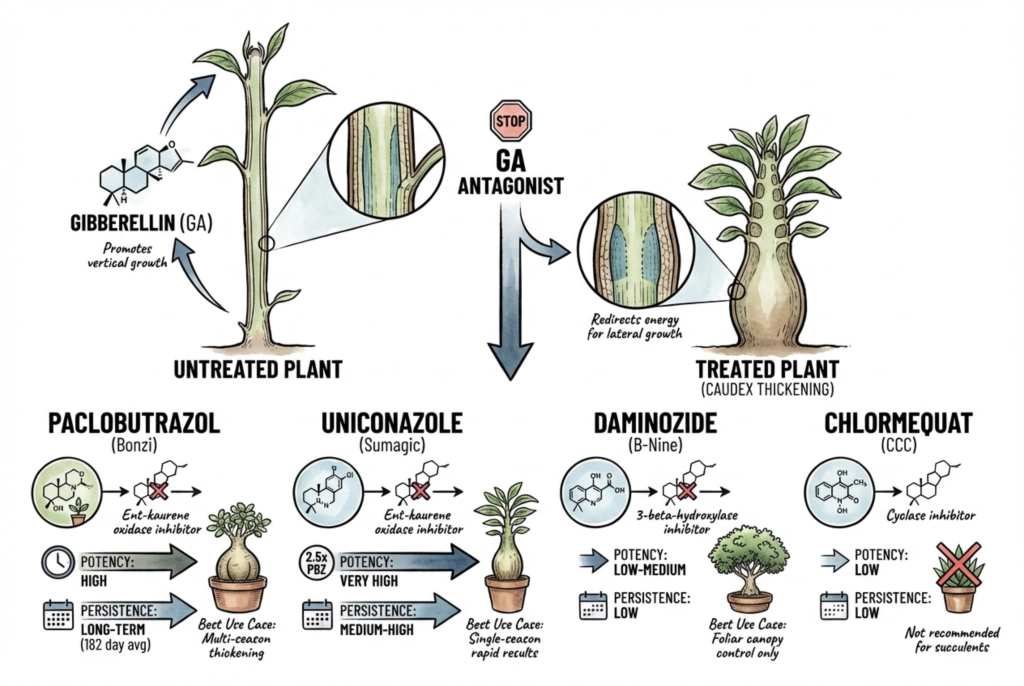
Paclobutrazol is a triazole plant growth regulator that inhibits an early oxidation step in gibberellin biosynthesis. Lower gibberellin activity limits stem elongation through the GA–GID1–DELLA signaling system. That broad mechanism is well established.
Why does shorter growth not prove more width?
Expect several biological effects at once
Suppressed vertical growth does not mean unused growth potential is redirected into caudex width. Growth regulators alter several processes at once, including root and shoot development, leaf form, chlorophyll appearance, and interactions among hormones. In some plants gibberellin promotes xylem development. In other organs it can oppose storage-organ thickening. Species, organ, age, treatment, and environment matter.
Why is caudex thickening not one simple process?
Identify Which Organ Is Actually Enlarging
Caudex describes a growth form, not one identical tissue plan. The enlarged organ may be mostly stem, mostly root, or a stem–root transition. Species differ in wood, storage parenchyma, vascular organization, cambial variants, seasonal rhythm, and the way a taproot or lateral roots contribute to the visible base.
How should a container be chosen?
Choose the container around the root system
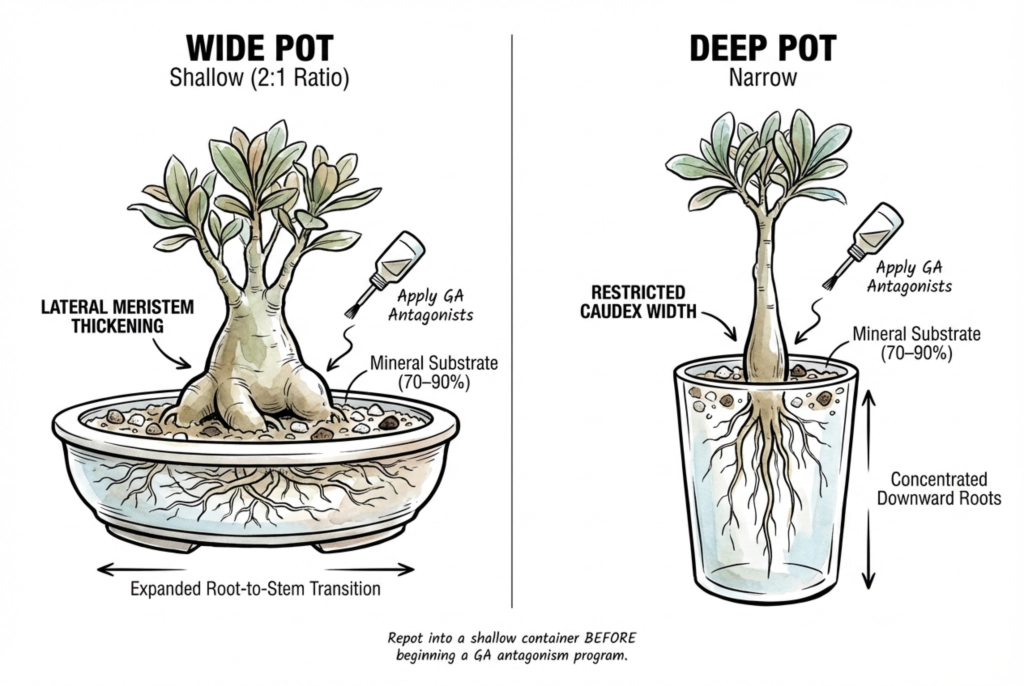
This diversity makes fixed claims about a pot forcing width or a deep pot pulling growth downward unreliable. A shallow vessel can suit a stable, fibrous-rooted specimen and be a poor choice for a young plant that needs taproot depth or anchorage. Choose the container around the actual root system, drainage, particle size, watering interval, and stability rather than a universal ratio.
Is the linked Berati product a good buy?
Check the Current Product Identity
The linked Atticus Berati is a real EPA-registered plant growth regulator, not a generic caudex thickener. The current manufacturer page identifies paclobutrazol at 0.4% or 4,000 ppm, EPA registration 91234-225, a 12-hour restricted-entry interval, and a non-restricted-use classification. Non-restricted-use classification does not mean that any person may use it at any rate or site.
Check site and crop coverage separately
The EPA-accepted label describes ornamentals grown in containers in nurseries, greenhouses, shadehouses, and interiorscapes. It does not name Adenium, Pachypodium, or caudex thickening, and its testing process for unlisted flowering and foliage plants does not answer whether a home shelf is a covered site or whether the product is registered in your state.
| Your situation | Decision | Reason |
|---|---|---|
| Commercial ornamental production, covered site, current state registration, trained label-compliant handler | Verify with the label, employer, manufacturer, and regulator | The product is designed for professional height control, but the crop response still requires a controlled trial. |
| Home collector seeking a fatter Adenium or Pachypodium | Skip | The label-site question is unresolved and direct studies do not establish reliable caudex thickening. |
| Seller listing lacks the full label, EPA number, sealed package, or current lot information | Skip | You cannot establish identity, permitted use, handling, or disposal from marketing copy. |
| Pregnant, may become pregnant, or unable to maintain locked chemical storage and controlled waste handling | Skip | The current product SDS flags suspected reproductive toxicity and requires controlled handling. |
If you are a qualified professional checking the exact product, use the link to compare the current package with the official label. Everyone else should treat this as a skip condition, not an invitation to improvise.
Why is there no paclobutrazol home dose here?
Formulation and Label Determine Any Lawful Rate
A useful number cannot be separated from the exact formulation and label. Berati is 0.4%, while other products sold under the same active-ingredient name can be many times more concentrated. Labels also separate sprays, drenches, bulb soaks, crop groups, pot volumes, media, climate, and sequential applications. Copying 500 ppm from an experiment into a hobby drench bypasses all of those controls.
Keep study concentrations in their original context
The 500 and 1,000 ppm values in the 2025 Adenium paper are experimental treatments, not a consumer recommendation. The 2019 paper used a different formulation and study protocol. Neither can be converted into a lawful, safe Berati recipe for a home caudex.
Resolve coverage before any calculation
Do not use a syringe, online calculator, or lowest-rate language to turn an uncovered use into a covered one. The right next step is to ask the manufacturer or your state pesticide agency whether the exact product, site, and intended ornamental use are permitted. If the answer is not clear, do not apply it.
What should you improve before considering any PGR?
Fix Measurable Cultural Bottlenecks First
Start with the bottleneck you can measure. A caudex does not become larger just because it receives strong light, high nitrogen, or a shallow pot. Growth depends on species, season, leaf area, temperature, water, root health, nutrient availability, and time.
- Confirm active growth. Compare the plant with its own seasonal history. Dormancy or a damaged root system cannot be corrected by forcing shorter internodes.
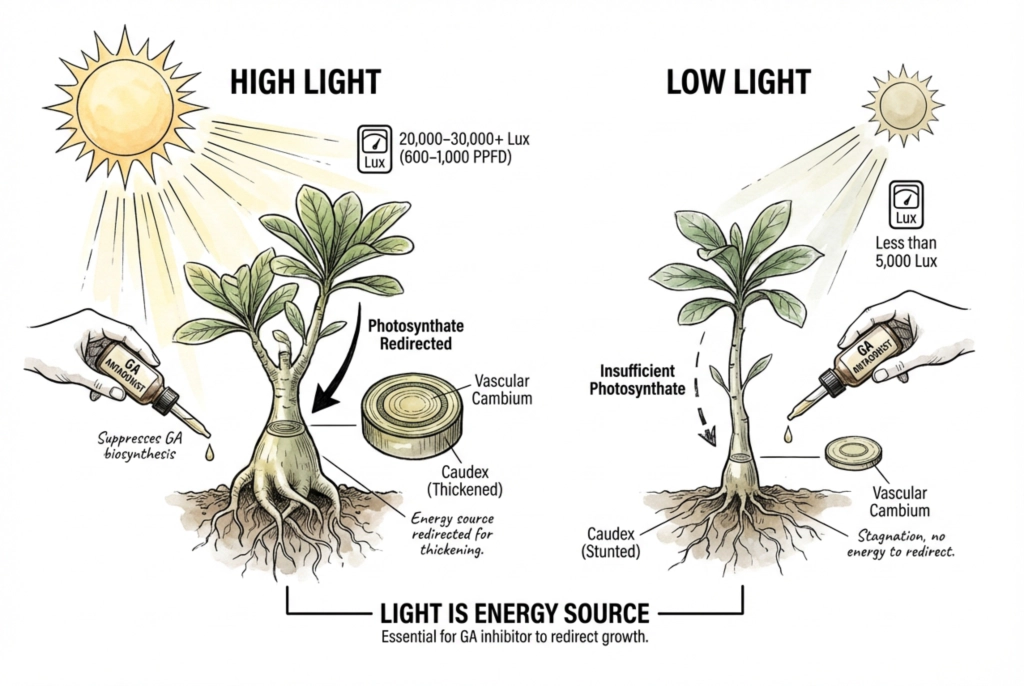
- Measure canopy light. Use PPFD and photoperiod to estimate DLI, then acclimate gradually. The caudex grow-light guide covers the setup, and the PAR-meter guide helps choose a measurement tool.
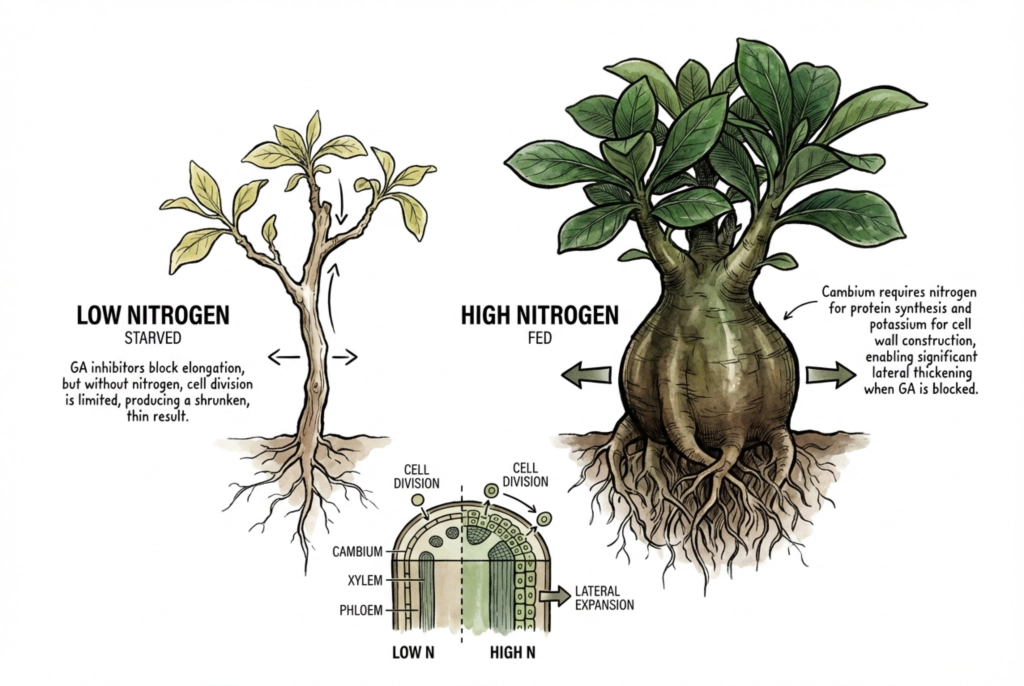
- Feed for health, not swelling. Use a complete fertilizer only while the plant is actively growing and adjust to source-water and substrate EC. More nitrogen is not a caudex-width command.
- Fit the pot to the roots. Give the root system enough depth, air, drainage, and stability. Do not cut a taproot or move to a shallow display pot solely to chase a ratio.
- Let seasons accumulate. Compare height, circumference, and branch structure over complete growth cycles. The fast-growing caudex guide explains why species choice often matters more than a speed hack.
Buy a grow bulb only for a measured gap
The linked SANSI 36W BR30 grow bulb is a reasonable small-footprint supplement when a canopy map shows it fills a real deficit. SANSI currently publishes PPF 65.6 µmol/s and a center PPFD reading of 265.58 µmol/m²/s at 1 ft. That point reading is not a shelf-wide coverage guarantee. Buy it for one or a few compact plants that fit the measured footprint. Skip it for a broad shelf or where sunlight already meets the plant's needs.
Use fertilizer to correct a real nutrient gap
The linked Foliage-Pro 9-3-6 is an optional complete soluble fertilizer, not a PBZ companion. It suits a grower who needs a measured liquid nutrient and can monitor the plant and salt load. Skip it if your current complete feed is working, the plant is dormant or stressed, or the root zone already shows high EC or crusting. The salt-buildup guide is the better next step in that case.
How should you measure real caudex progress?
Measure Circumference at a Fixed Point
Use a repeatable baseline instead of judging fatter from a close-up photo. Mark one height above the substrate and measure circumference at that same line. Record total plant height, several representative internode lengths, pot and substrate, canopy PPFD, photoperiod, watering dates, and fertilizer changes. Take a photograph from the same distance and angle once a month during active growth.
Change one meaningful variable at a time
If you repot, prune, raise light, increase fertilizer, and apply a regulator together, the result is uninterpretable. Make one meaningful adjustment, let the plant settle, and compare at the end of a suitable growth interval. For a collection plant, a season is more informative than a week.
Score health alongside circumference
A useful outcome is not merely a lower height-to-width ratio. Look for healthy roots, normal leaf expansion, stable flowering, acceptable internode length, and actual circumference gain without loss of total vigor. That broader score would have caught the tradeoff in the 2019 study, where compactness came with reduced dry mass.
Because compact growth is not the same as a larger caudex, I keep one season of measurements before considering any growth-control claim. At a marked height above the substrate, I record circumference, new-leaf count, representative internode length, and pot mass. Each photograph uses the pot-rim orientation and recorded camera-to-rim distance while the plant receives only its ordinary care.
That baseline has taught me how much apparent thickening follows hydration and camera angle alone. It gives me a meaningful cultural comparison without adding a regulator to a collector plant.
What should you do after suspected overapplication?
Separate Possible Regulator Effects from Other Stress
Short internodes, dark leaves, delayed growth, distorted new leaves, or reduced flowering may follow excessive growth regulation, but none is diagnostic by itself. Cold, poor roots, mites, nutrient imbalance, disease, and normal dormancy can look similar.
- Stop all further PGR applications and keep people and pets away as directed by the label.
- Retain the container, label, lot number, application record, and photographs. Write down what was applied, where, when, and by whom.
- Prevent runoff. Do not flush the pot into a drain, yard, or waterway.
- Contact the product manufacturer, your local Extension service, state pesticide agency, or a licensed horticultural professional for plant and disposal guidance.
- If a person may have been exposed, follow the product first-aid directions and contact the service named on the label or Poison Control. Bring the label with you.
Do not improvise a reversal treatment
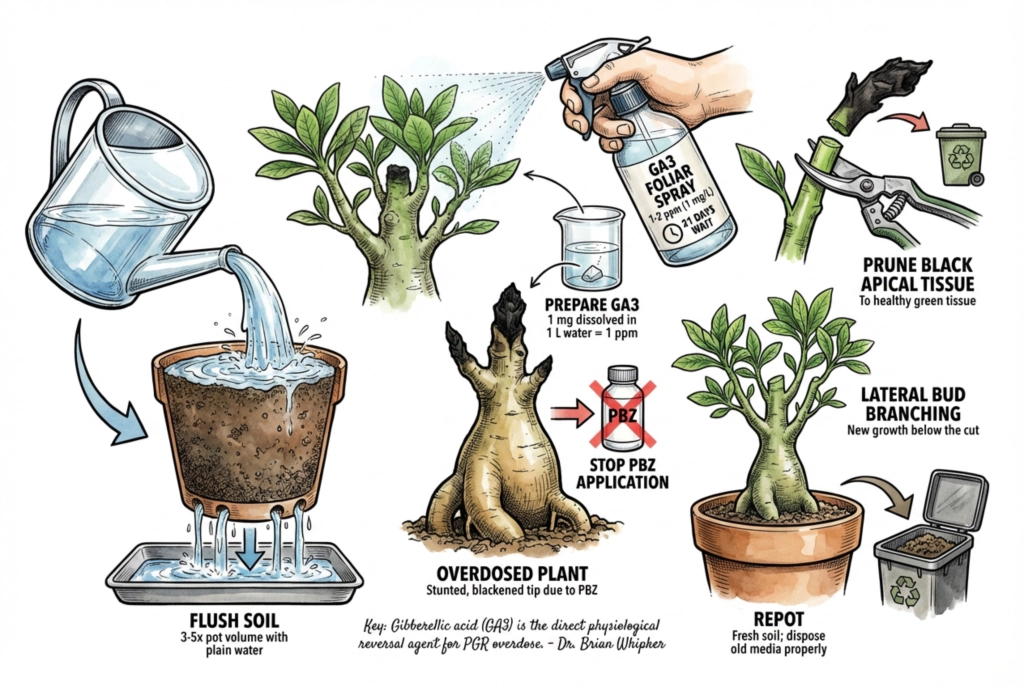
Do not counter-dose with GA₃ powder, repeatedly flush the pot, or discard treated media outdoors based on a blog. A greenhouse reversal method for one crop is not an antidote protocol for a caudex, and uncontrolled rinsate can spread the pesticide.
What legal and safety checks come before purchase?
Confirm the Jurisdiction Before Purchase
In the United States, the Berati label states that using the product inconsistently with its labeling violates federal law and directs users to consult their state or tribal pesticide agency for local requirements. The current Atticus page also warns that the product is not registered in every state. Readers outside the United States must use the label and law for their own jurisdiction.
Use the exact SDS and label controls
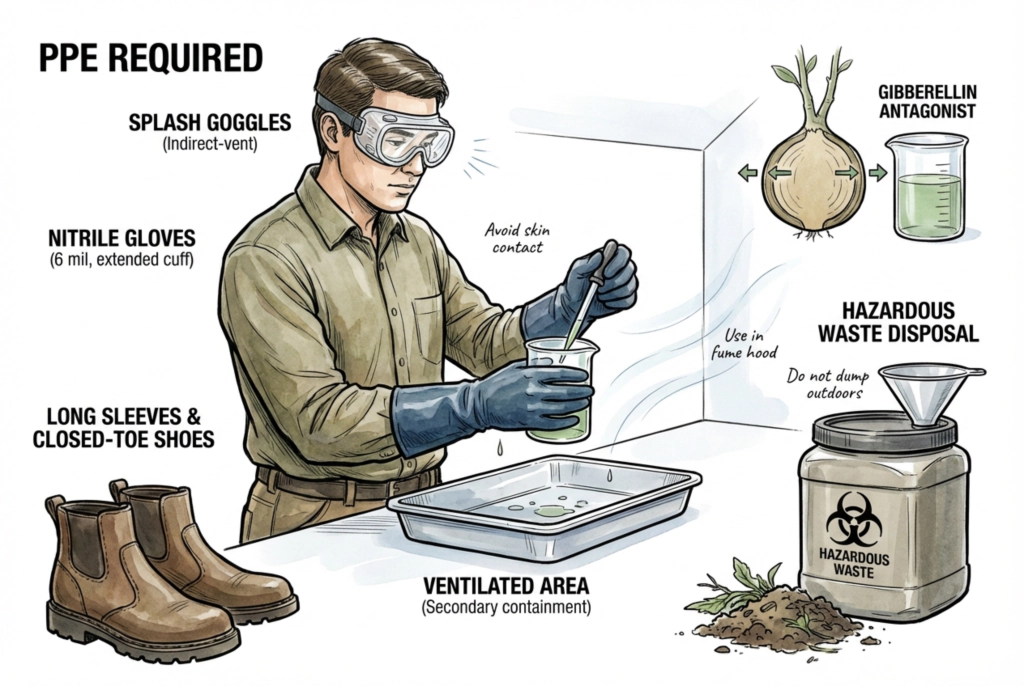
The exact Berati SDS classifies the formulation for suspected reproductive toxicity. It also says to obtain and follow safety instructions, wear protective gloves and clothing, store the product locked, prevent material from entering sewers or waterways, and dispose of contents and container under the label and local rules. The EPA label requires long sleeves, long pants, specified chemical-resistant glove materials, and shoes plus socks for applicators and handlers. It sets a 12-hour REI for covered agricultural use.
| Purchase check | What the linked item can do | When to skip |
|---|---|---|
| Chemical-resistant gloves | The linked Venom nitrile gloves may be a candidate because nitrile is among the materials on the Berati label. | Skip if the exact formulation compatibility, size, condition, or task-specific protection is not confirmed. Nitrile alone does not guarantee breakthrough time. |
| Eye protection | The linked SUPERMORE goggles are sold as splash/dust protection. | Skip until the current listing or manufacturer documentation confirms the marking, fit, venting, and standard required by your SDS and task. |
Keep PPE separate from permission to use
Buying PPE does not make an uncovered use safe or lawful. It only supports work that is already permitted, planned, and controlled. For general caudex handling rather than pesticides, use the separate protective-gear guide.
Should you use paclobutrazol on a caudex?
For a home collection, the answer is no. The likely benefit is a shorter shoot, not a proven increase in caudex width, and the product brings label, exposure, persistence, and waste-handling obligations that ordinary cultural improvements do not.
What is the professional question?
Keep professional height control separate from collector girth
For a professional ornamental producer, the question is whether the exact current label covers the site, plant category, purpose, method, and state, and whether a small controlled trial can answer a legitimate production-height problem. That is not the same decision as making a collector plant fatter.
| Goal | Best next action | Purchase decision |
|---|---|---|
| More caudex girth | Measure light, roots, nutrition, and seasonal growth. Select a naturally faster species if speed matters | Do not buy PBZ for this goal |
| Fix a dim indoor position | Map canopy PPFD and calculate DLI | Buy the SANSI bulb only if its small footprint closes the measured gap |
| Correct incomplete nutrition | Review the current fertilizer label and root-zone EC | Buy Foliage-Pro only if it fills a real nutrient-program gap |
| Professional crop-height control | Confirm label, site, state, crop category, training, trial design, PPE, REI, and waste plan | Only a covered professional should consider Berati |
Affiliate Disclosure
This article contains Amazon affiliate links. As an Amazon Associate I earn from qualifying purchases. If you use these links, the site may earn a commission at no extra cost to you. Product availability, price, and specifications can change. Check the current listing before buying.