
Smooth vs Knobby Pachypodium Caudex: Why It Differs
Why do cultivated Pachypodium often look smoother than wild ones? Age, genetics, and growing conditions (light, watering, wounds) all play a part. What's known, what's speculative, and how to grow a plant hard without harming it.
Rachel Torres · 2026-05-26 · Updated 2026-06-08 · 20 min read
Key Takeaways
- Smooth-versus-knobby is really three things: surface state (green skin vs corky periderm), tubercle count (leaf scars), and old branch or wound scars. Species, genetics, age, and growing conditions all feed each one.
- Most of the mechanism here is reasoned from general plant biology, not controlled Pachypodium studies, so treat multiplier figures as illustrative. No single factor or tidy number explains texture.
- Cultivated plants stay smoother mainly from stable temperature, less UV, generous moisture, faster grafted growth, and less mechanical injury. A smooth caudex is a different developmental history, not a defect.
- Grow a plant hard for health, not to manufacture habitat texture. Deliberate wounding or severe drought is damage, not improvement. Manage light, dry-down, substrate, and wounds for the plant's benefit.
- Texture and geometry are soft origin clues, never a provenance test. Legality rests on documentation and chain of custody. If a shop plant looks wild-collected, treat it as a red flag and demand permits.
What Actually Makes a Caudex Smooth or Knobby?
Separate Surface State from Plant History
The smooth-versus-knobby distinction combines several traits. These include whether the surface is green skin or brown corky periderm, how many tubercles or leaf-scar bumps the plant carries, and how many old branch or wound scars it bears.
Keep the mechanism claims bounded
Much of the explanation below is reasoned from general plant biology and observation rather than controlled studies on Pachypodium. Surface texture reflects species, genetics, age, and growing conditions, and no single factor or tidy set of numbers fully explains it.
So treat the mechanisms here as plausible explanations to weigh, not proven cause-and-effect. Texture alone can’t reliably tell you a plant’s origin.
What is the caudex made of?
Read the caudex as a swollen stem
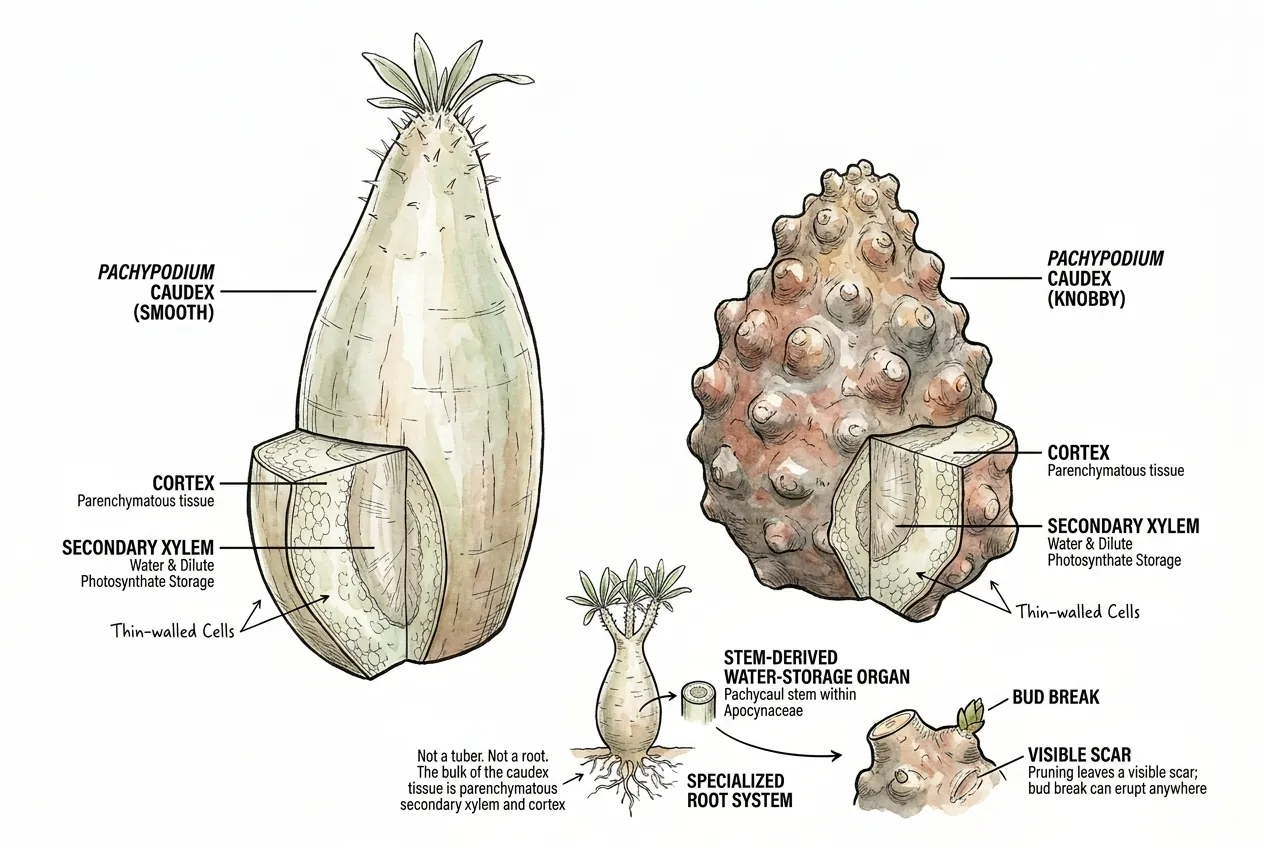
The caudex is generally treated as a pachycaul stem rather than a tuber. Its swollen storage tissue should not be assumed to be a root.
Molecular phylogenetic work on Pachypodium addresses evolutionary relationships, not caudex anatomy in detail. The general textbook picture is a pachycaul stem whose bulk is water-storing parenchyma rather than a swollen root.
Because it is a stem, pruning a branch leaves a visible trunk scar, buds can break in various places on the body, and root rot does not automatically kill the caudex above it.
Why does the surface go from smooth green to brown and corky?
Expect normal cork development with age
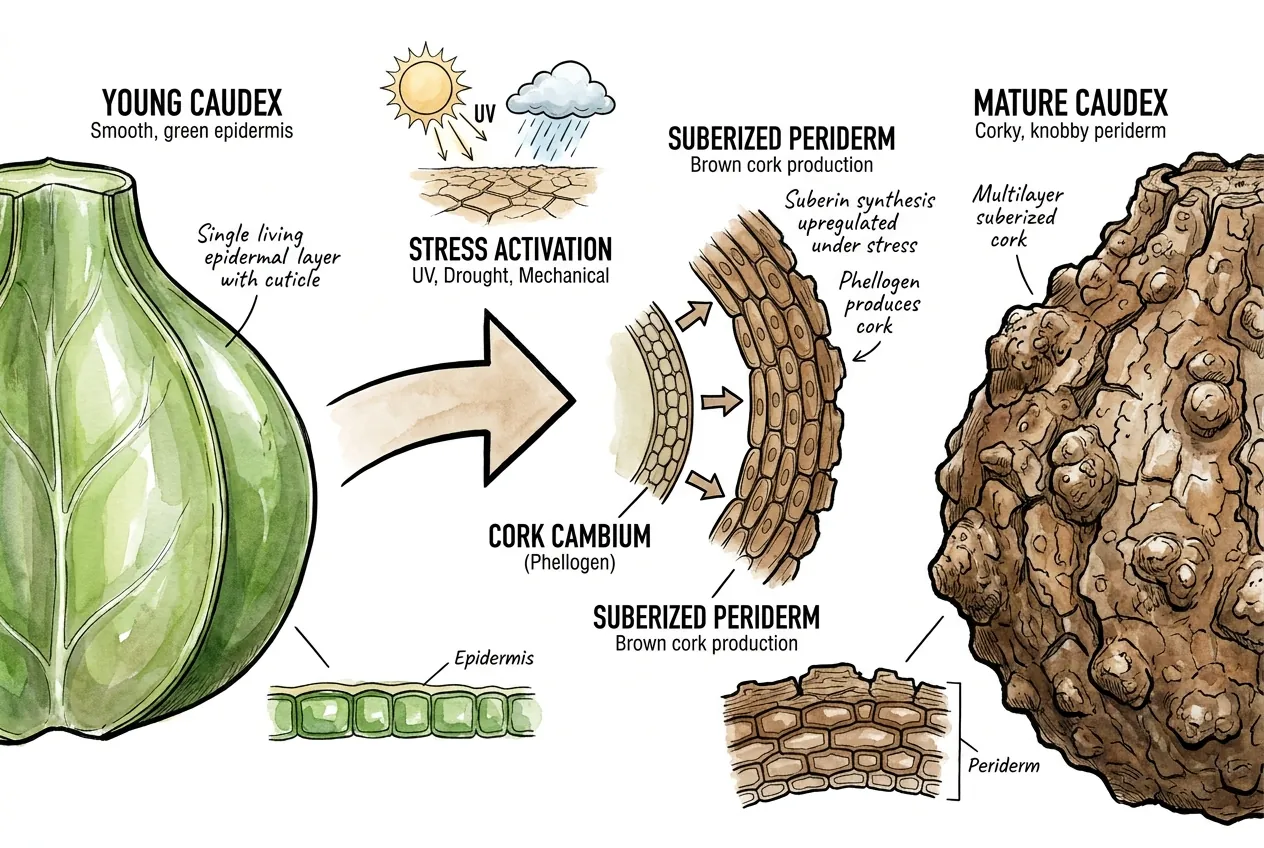
Surface texture records how the cork cambium produces cork. A young caudex carries a living epidermis with a waxy cuticle, creating the glossy green or silver-bronze sheen seen in young plants.
As the plant ages and thickens, the cork cambium normally forms a brown, suberized periderm. Strong UV, drought, or wounding can add to or accelerate cork formation, but a healthy plant still develops brown bark through ordinary secondary growth.
So it’s an oversimplification to say the cork cambium sits dormant until stressed or that without a stress signal there is no cork. General suberin research shows suberin is deposited in both normal development and wound responses. Specific multiplier figures (for example 3–8× under combined UV-B and drought) are not established numbers for Pachypodium, so read them as illustrative at best.
What exactly are the knobs?
Interpret knobs as accumulated leaf scars
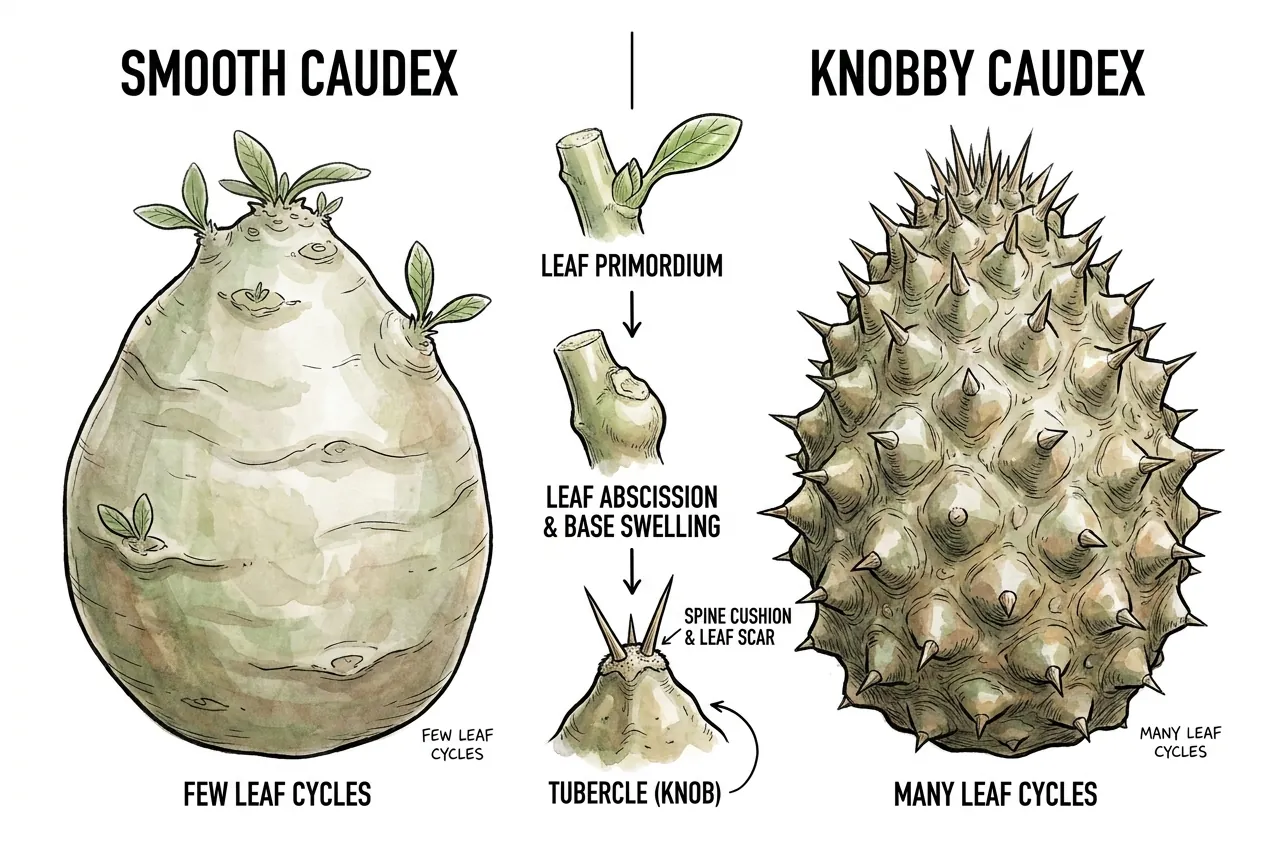
The signature knobs are tubercles, pyramid-to-cone projections of cortical parenchyma topped by a spine cushion and leaf scar. Each began as a leaf primordium during a previous growing season, and the basal parenchyma remained enlarged after the leaf abscised.
A plant that has produced many leaves over its lifetime accumulates more tubercles, while a plant that repeatedly lost leaves to stress may have fewer.
What is a branch scar?
Use scars as a record of mechanical history
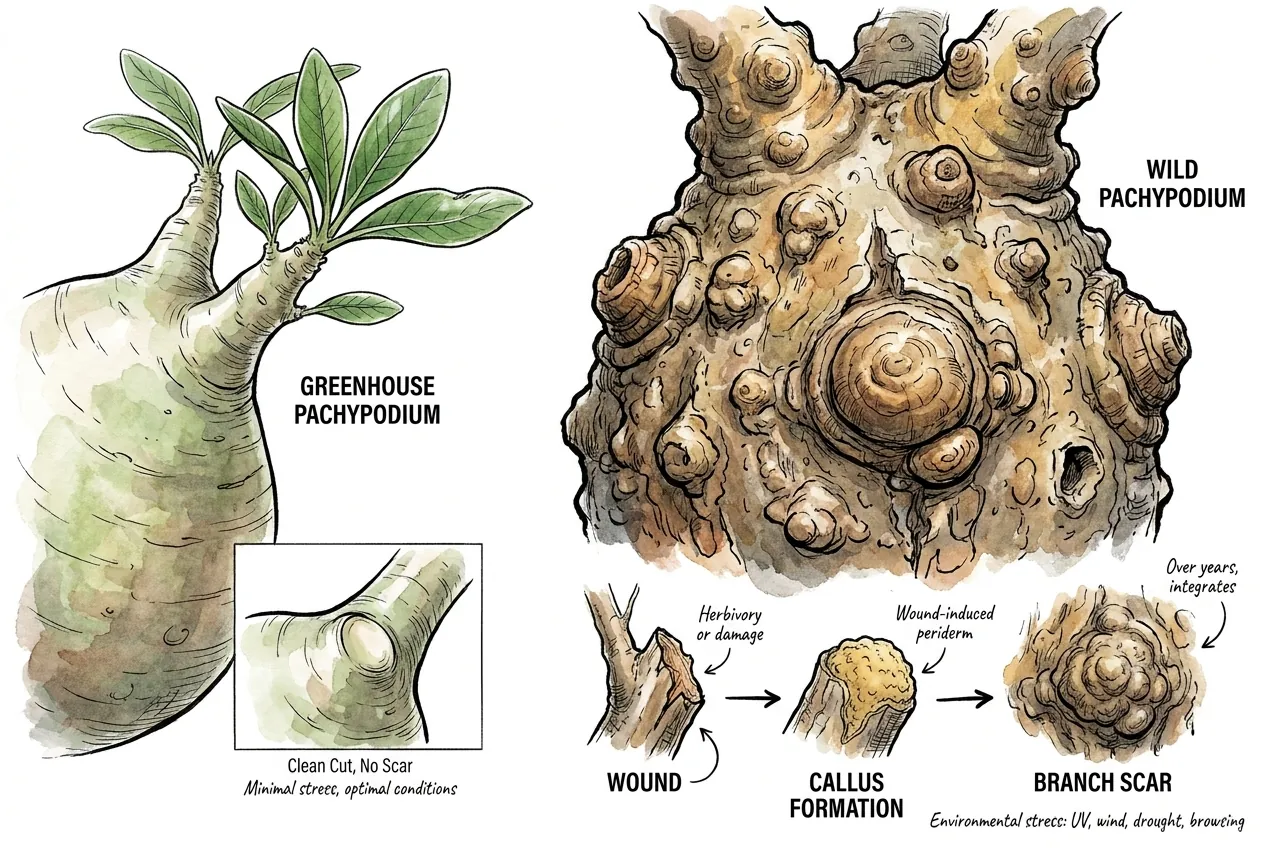
The third axis is mechanical history. Herbivory, wind, fire, rockfall, and pruning can trigger wound-induced periderm, but the timing and final scar depend on wound size, tissue, climate, and recovery.
A callus may integrate with surrounding bark over time. It is not a predictable cosmetic schedule.
Field descriptions often show multiple scars from browsing, wind, fire, rockfall, or other damage, while a same-age greenhouse plant may carry few.
Scar counts vary with site, age, and cultivation history, so they are context rather than a fixed age test.
Why Does the Wild Plant Look So Different?
Use Habitat Conditions as Context, Not a Recipe
Wild populations experience brighter, drier, and more thermally variable conditions than many indoor collections.
The exact UV, rainfall, and surface-temperature values vary by site and season, so use habitat data as context rather than a home prescription.
How does habitat UV change the surface?
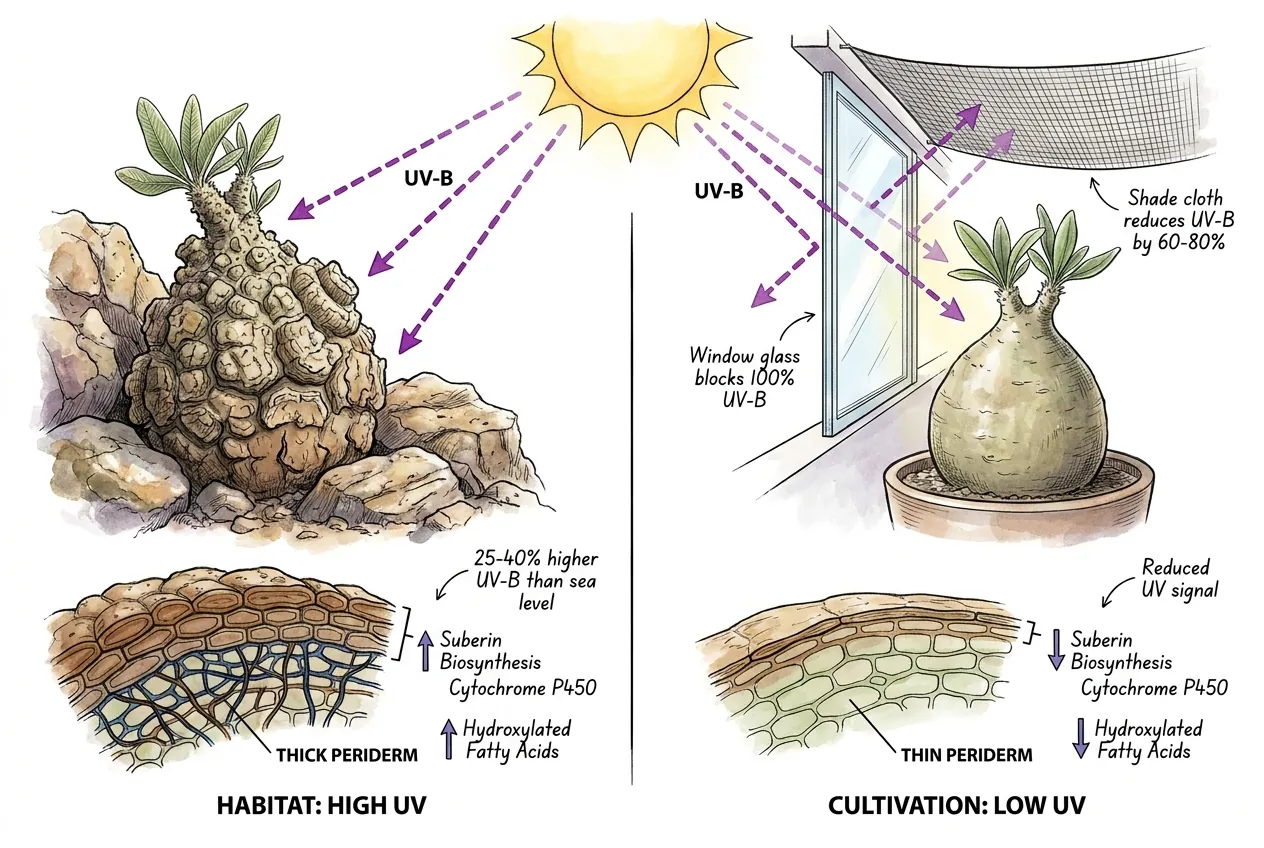
Some Pachypodium habitats in Madagascar’s central highlands are high-elevation, exposed quartzite landscapes. The exact altitude and exposure vary by site.
Higher elevation and open rock can increase the light and UV load relative to an indoor collection, but the size of that difference depends on latitude, weather, and time of day.
Strong UV can promote the plant’s protective and cork-forming responses in general terms, but the specific claim that UV-B upregulates particular cytochrome-P450 steps as the rate-limiting switch for Pachypodium cork is not established. That’s a mechanism borrowed from general suberin biology, not measured in this genus.
Keep the glass and UV claim precise
Ordinary window glass does block most UV-B, which is a real reason indoor plants get little UV.
But it is not true that glass blocks essentially all UV (typical glass still transmits a fair amount of UV-A, varying with glass type, thickness, and coatings).
The honest point is simply that indoor plants receive far less UV (and less intense overall light) than outdoor ones, not that indoor UV is zero.
How does seasonal drought sculpt the body?
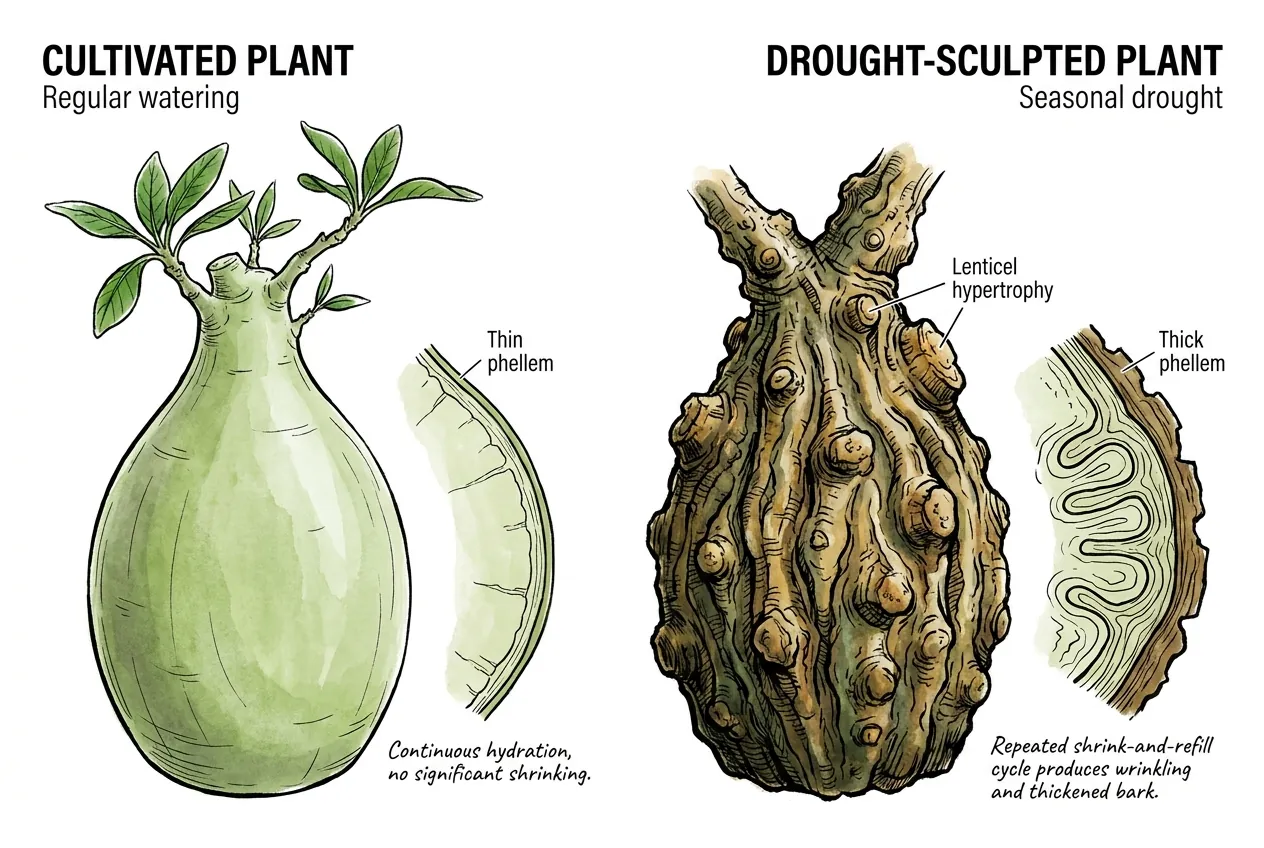
Do not force drought to manufacture texture
Many habitats have a pronounced dry season, but rainfall and plant water loss vary by elevation and species.
A cultivated plant need not be driven to a measured percentage of tissue dehydration to develop healthy bark.
Repeated shrink-and-refill cycles can contribute to longitudinal wrinkling, lenticel changes, and phellem deposition, but those features also reflect age, genetics, and injury history.
A plant kept constantly wet may experience fewer of the seasonal cues associated with bark maturation, but watering frequency alone does not determine texture.
Genetics, age, light, wounds, and grafting also contribute.
How does mechanical insult build the scar lumps?
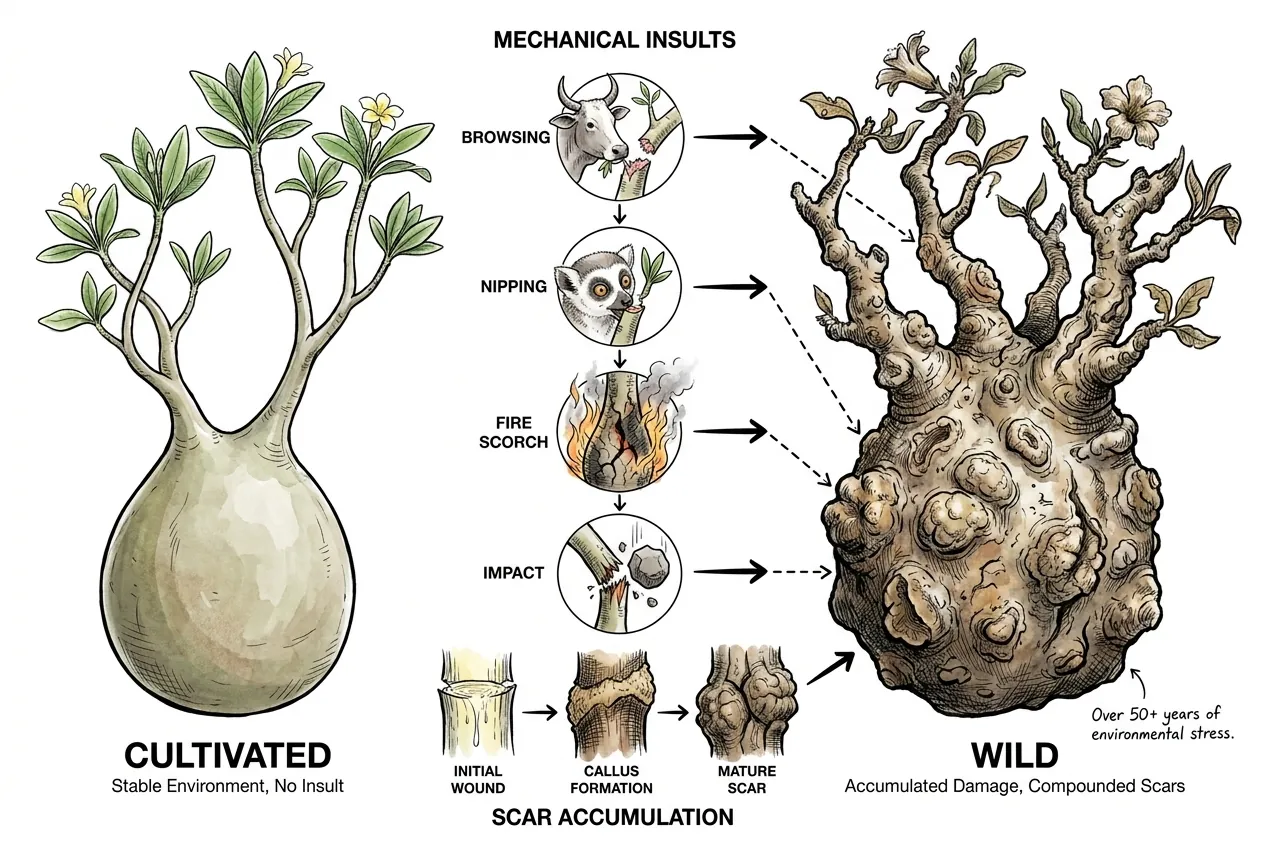
Wild Pachypodium can experience browsing, wind, fire, rockfall, and other mechanical damage.
Those events may leave callused or suberized scars, and repeated injury can make scars more numerous over time.
Cultivated plants in stable indoor environments experience few of these insults, so they accumulate fewer scars.
That’s a difference in history, not a defect. An unscarred, healthy plant isn’t lacking character, and manufacturing scars to fake age is damage, not improvement.
Why Do Cultivated Pachypodium Stay So Smooth?
Understand Why Cultivated Plants Stay Smoother
Stable temperature, attenuated UV, generous moisture, and an organic-heavy substrate can reduce some of the environmental cues associated with wild texture, but none of them acts as a single switch.
Grafting onto vigorous rootstock can accelerate juvenile growth, but the size of that effect varies by stock, scion, and conditions. No universal multiplier applies.
The smooth phenotype is not a defect.
It can reflect a different balance of age, genetics, grafting, and cultivation conditions.
Why does indoor bright light not reproduce every habitat cue?
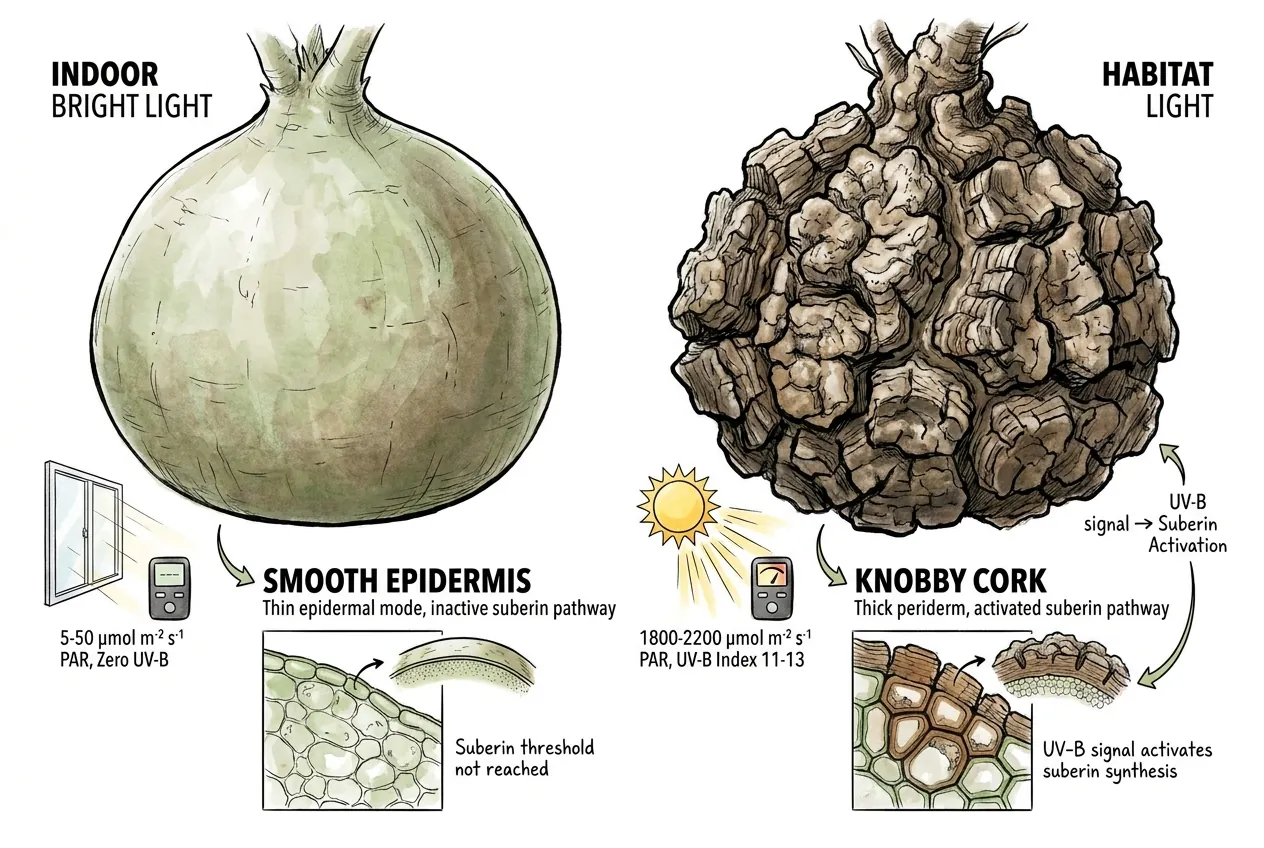
Open-habitat midday light can be orders of magnitude stronger than a bright indoor window, while the exact PPFD depends on weather, latitude, season, and measurement position.
Adjust light without chasing texture
Window glass removes much UV-B, although transmission varies with the pane and coatings. Indoor plants therefore receive a different UV environment rather than literally zero UV.
Indoor light usually supplies less UV-B than exposed habitat, which may reduce one cue associated with surface protection.
That does not prove a single UV threshold or prevent periderm development as the plant ages.
How can watering frequency influence periderm thickening?
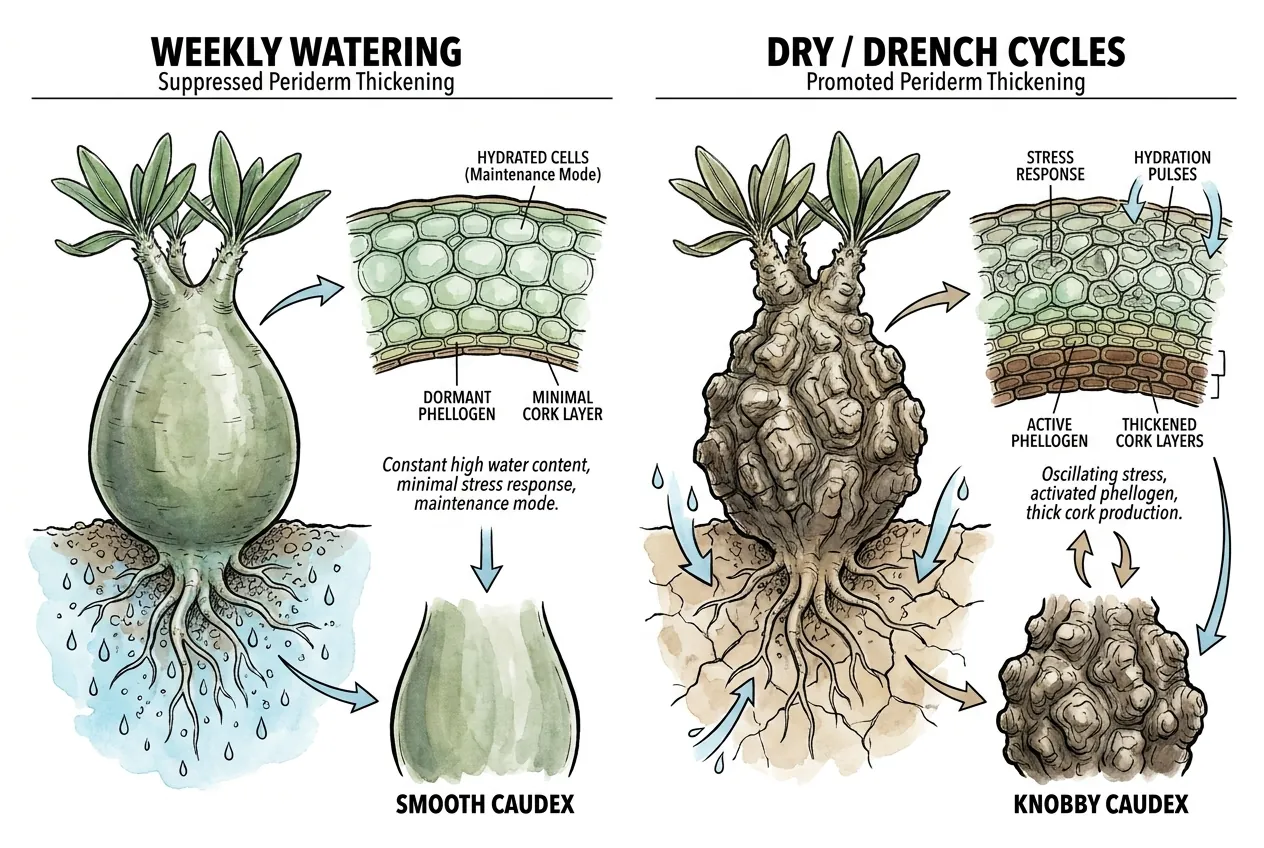
Frequent watering can keep caudex tissue highly hydrated for long periods, but the actual water content depends on species, pot, roots, and dry-down. Avoid treating a fixed percentage as a home measurement.
Wound-induced suberization research shows that cork formation can respond to stress signals, but studies in other plants do not establish a simple watering threshold for Pachypodium.
Continuous moisture may reduce the dry-down cues some growers associate with bark maturation, while also raising root-rot risk if the mix stays wet.
Use dry-down as a health control
Use a repeatable wet-to-dry cycle suited to the plant, pot, and mix. Allow an appropriate dry-down before watering again, but do not force complete dehydration or a calendar-based pulse.
How can substrate moisture influence surface texture?
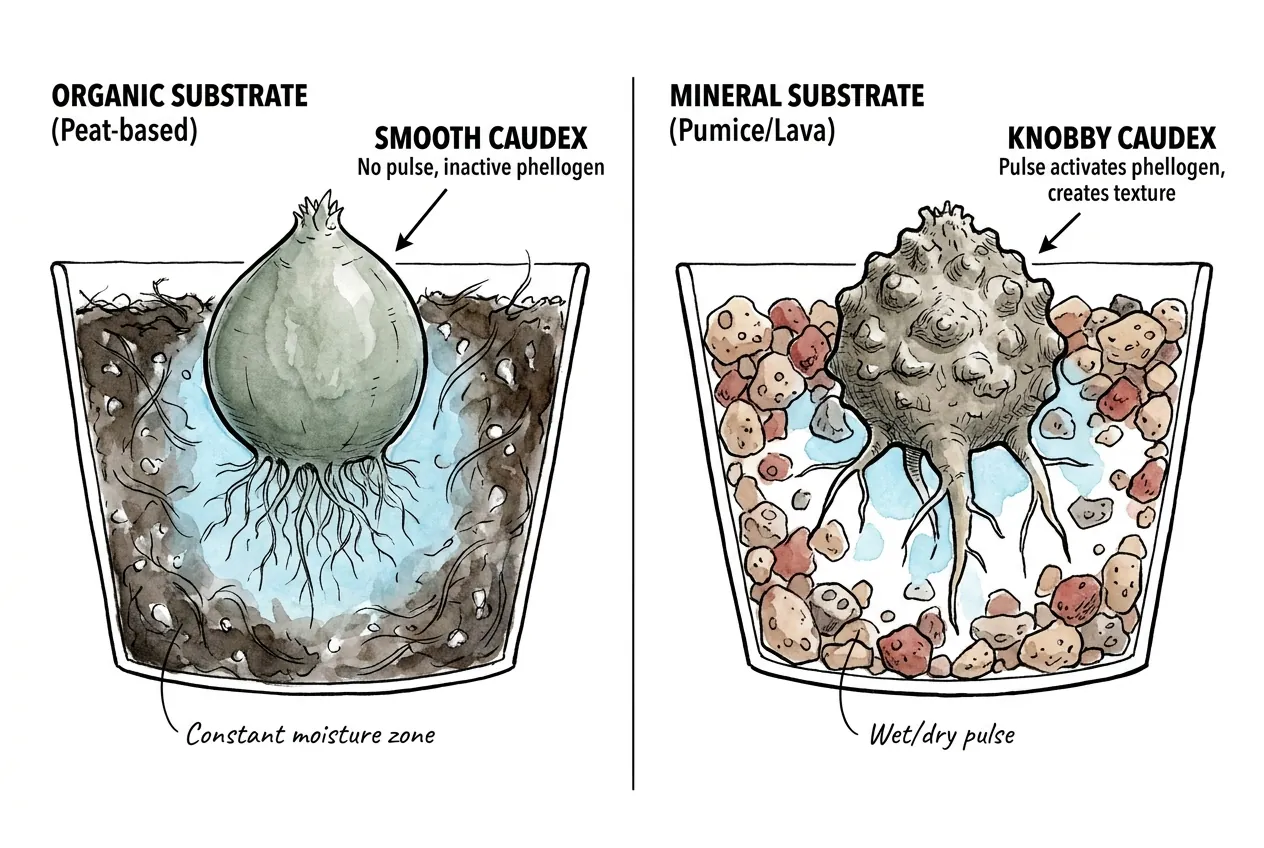
Peat-based and mineral mixes retain different amounts of water after drainage depending on particle size, fines, and packing.
Measure the behaviour of the finished mix rather than transferring a single volumetric percentage.
Akadama and lava sit between the extremes. Organic and mineral mixes can produce different moisture curves, but the finished mix, pot geometry, and watering habits determine the actual root-zone behaviour.
Dry-down may be one cue among many for surface development. The absence of a pronounced pulse does not by itself prevent texture.
How can grafting change the texture timeline?
Keep grafting effects species-dependent
Grafting a slow species like Pachypodium brevicaule onto a vigorous rootstock (such as P. lamerei) can speed growth noticeably and change the look of the plant.
The size of that effect varies by stock, scion, and conditions, so avoid treating anecdotal growth multiples as a Pachypodium rule.
Grafting reviews in other crops describe faster scion growth through improved water and hormone supply, but their reported multiples are not measurements for Pachypodium and should not be transferred directly.
Accelerated growth can produce a smoother, faster-expanding caudex before the surface has accumulated the same developmental history as a slower seed-grown plant.
Related grafting research suggests that rootstock can influence scion development, but the magnitude and persistence of that effect are not established for Pachypodium.
Which Species Show Different Texture Patterns?
Compare Patterns Without Turning Them into Provenance Rules
The smooth-versus-knobby gap is not equal across species.
Several broad groups show different patterns.
Data Comparison: Habitat vs Cultivation by Species
| Species | Habitat Form | Cultivated Form | Indicative Texture Gap | Common Sale Form |
|---|---|---|---|---|
| P. brevicaule | Flat pancake, suberized | Hemispherical, smooth | Often pronounced | Grafted |
| P. eburneum | Flat disc, white tubercles | Rounded, smoother | Often pronounced | Seed or Grafted |
| P. gracilius | Elongate bottle, silver-bronze | Spheroid, glossy | Variable | Seed |
| P. rosulatum | Variable | Spheroid green | Variable | Seed |
| P. densiflorum | Branched stem, knobby base | Single-stem, smooth | Variable | Seed |
| P. lamerei | Columnar tree, spine cushions | Same form, smaller | Small | Cutting or Seed |
| P. geayi | Columnar tree, silver leaves | Same form | Small | Seed |
| P. namaquanum | Tall club, gnarled | Slow, blocky | Variable | Seed (rare) |
| P. saundersii | Squat caudex, branching | Squat, smoother | Variable | Seed |
The pancake-like species are often described as showing a larger cultivated-versus-habitat contrast, while elongate and tree-form species may show a smaller or more variable contrast.
These are broad tendencies, not provenance rules.
P. baronii can reach a large tree-like size in habitat, and mature cultivated specimens may converge toward that architecture over long periods, but the result depends on age and conditions.
Note
P. rosulatum spans varied habitats and can show a broad range of forms.
A bright-green smooth-skinned plant in a shop could reflect age, recovery, genetics, or cultivation, so texture alone cannot distinguish a field-collected plant from a nursery-grown one.
Can I Push My Cultivated Plant Toward Habitat Form?
Prioritize Health Over a Forced Habitat Look
Some cultivated plants can develop more mature-looking surface features over years, but the timeline and outcome vary and no setup can replicate every habitat signal.
Light, dry-down, substrate, temperature, and wound history are useful variables to manage for health. Their combined effect on texture remains species- and plant-dependent rather than a guaranteed multi-year conversion.
How do I acclimate a plant to outdoor sun without scorching it?
Acclimate light in measured steps
Move it in stages, allowing new tissue to acclimate before increasing exposure again.
Start with brief morning exposure and increase it only after the plant shows no bleaching, crisping, or persistent wilt.
The pace depends on species, season, starting light, weather, and container conditions. A multi-week acclimation is common, but there is no universal calendar.
Caution
A bronze flush can be a light-stress response, while white bleaching or crisping indicates injury. Interpret the plant’s response rather than assuming every colour change is beneficial.
After acclimation, some plants tolerate strong outdoor light, but full habitat exposure is not a safe default.
Outdoor duration and any visible surface change depend on climate, species, and repeated seasons.
What substrate change makes the biggest difference?
Change substrate for root health first
If the current medium stays wet too long, repot during suitable active growth into a stable, airy mix whose particle size fits your pot and watering habits.
There is no universal 100% mineral ratio or guaranteed water-retention drop.
Let the finished mix dry down to a level appropriate for the plant before watering again. Do not force the caudex to dehydrate severely in pursuit of texture.
Optional mineral components
For a clay component, look for a hard-fired clay granule. The hard-fired grades (hard akadama is one example) resist crumbling far better than the soft, cheaper grades that break down into fines within a season. Firm grades add stable particle structure, though durability and water release still vary by grade and conditions, so test a small batch before you commit a whole collection to it.
Match the particle size and proportion to your pot. Use enough to keep the root zone airy without creating a dry core. As a rough guide, coarser grades suit larger pots and drier-loving plants, while finer grades hold more moisture and suit smaller pots. Repot in active growth when possible, let damaged roots or cuts dry according to their condition, and resume watering after the new medium has been assessed rather than following a fixed day count.
Horticultural pumice is another useful mineral component. Its contribution to air space and water release depends on grade, proportion, and the other particles in the finished mix, so weigh it as part of the whole recipe rather than in isolation.
Can I prune branches to generate habitat-like scar lumps?
Keep pruning tied to a real purpose
You can, but think hard about whether you should.
Deliberately cutting a healthy plant just to fake habitat character means creating permanent wounds, each an entry point for rot, an exposure to the plant’s irritant latex, and a risk to the growing points, on what is often a slow-growing, conservation-listed species.
That is damage for cosmetics, so keep pruning tied to a real horticultural purpose such as removing damage, shaping, or propagation, and accept that scars are a byproduct, not a goal.
If you do prune, do it safely and cleanly.
Wear gloves and eye protection (Pachypodium sap is a skin and eye irritant) and keep it away from children and pets.
Use a sharp, clean blade and disinfect it (for example with isopropyl alcohol) between cuts to reduce crushing and contamination.
Time cuts for the plant’s active season, when healing is generally more favourable, and keep the wound dry while it calluses.
Note that a clean cut still leaves a scar (clean cut, no scar is a myth) and the exact healing timeline isn’t established for Pachypodium, so watch the wound rather than trusting a fixed day count.
Any fungicidal dressing (a labeled product, used per its label) is optional. Kitchen cinnamon is a folk remedy of unproven benefit.
What about cold dormancy and root pruning?
A cooler, drier winter rest can suit high-altitude species (such as brevicaule and eburneum) and, over years, tends to favor a squatter, more compact form.
Be careful with exact temperatures, though. How cold is safe depends on the species, the individual, and how well it’s hardened off, and a figure like 5 °C can cause cold injury to an unacclimated plant.
Claims that a winter rest cuts meristem activity by some precise amount (a figure like 80–95% sometimes gets quoted) and redirects carbon into structural deposition are not measured values for these plants. Treat them as illustrative, not as targets to hit.
Root pruning as a routine cosmetic technique is risky and not something to do casually.
Removing a large share of the root mass and then withholding water for weeks, especially during active growth, can dehydrate fine roots and invite rot rather than reliably producing a flared base, for which there isn’t good evidence.
If you root-prune at all, do it conservatively as part of a normal repot, keep only healthy roots, and don’t combine it with prolonged drought stress.
How Do I Read a Plant at the Shop?
Read Shop Plants with Soft Clues
Use geometry alongside texture, and treat both as soft clues rather than proof.
Potential visual clues include basal asymmetry, mixed-age scar distribution, and soil-line band geometry.
With the seller’s permission, I photograph the plant from four sides with the pot rim, soil line, and visible base transitions in frame. Each image receives only observable notes such as healed scar, uneven flare, or horizontal band. Seller claims about age, seed-grown status, or collection history remain in a separate field.
Before buying, I ask for the propagation history and paperwork that apply to that plant. Photographs never determine whether a specimen is wild-collected or legal. They provide my non-invasive care baseline while keeping visible clues separate from verifiable provenance.
Why can asymmetric basal flare be a clue?
Wild plants grow against rock and through soil pockets.
The lower caudex develops asymmetrically (flat on one side, swollen on the other, often with concave depressions where the trunk pressed against bedrock).
Pot-grown plants may develop more symmetric bases when the container and substrate are uniform, while rock contact and soil pockets can contribute to asymmetry.
Examine the basal area from several angles.
Asymmetric flare can support a habitat-origin hypothesis, but genetics, pot shape, repotting, and training can create similar geometry.
Why does mixed-age scar distribution matter?
Wild plants accumulate scars across their lifespan.
Multiple scars of different apparent healing ages can cluster on an exposed face, while cultivated plants may show fewer or more closely grouped scars from pruning.
Neither pattern is exclusive to one origin.
Scar appearance often changes as suberized tissue matures, but healing speed depends on wound size, species, climate, and care.
Mixed-age, asymmetrically distributed scars may support a habitat-history hypothesis. Single-age uniform scars may be consistent with cultivation pruning. These are soft clues, not a diagnostic count.
What do soil-line bands tell me?
A plant that grew at a stable soil line may show a horizontal contour shift on the trunk.
Above the line. Exposed-to-air weathering and lighter color.
Below the line. Soil-buried and often darker.
A field history may leave an older line alongside the current pot line, while repeated repotting can create multiple stacked bands. Neither pattern is exclusive.
Remember
Treat these features as soft clues, not a reliable test. There’s no validated accuracy behind any X% of the signal figure, and the same shapes can come from genetics, pot shape, past root pruning, bonsai training, repotting, grafting, or sun scald, not just wild tenure.
The reason to notice them is not to hunt out and buy old wild-collected plants, which would fuel poaching. Use the traits as warning signs instead. If a shop plant shows hallmarks of wild collection, ask for legal, documented provenance before buying or walk away.
What about laundered habitat plants?
A laundered habitat plant kept warm and moist for a season smooths out and develops fresh green epidermis on its growing apex.
The old habitat-developed periderm remains on the basal trunk but the apical impression shifts.
Hybrid texture, a rough older base with smoother new growth, can be a clue that cultivation history differs across the plant.
Basal geometry may persist when texture changes, but it still needs corroborating provenance evidence.
What about grafted plants?
Disproportionate caudex fattening, a visible seam near the soil line, or a root system from another species can suggest grafting, but each feature has alternative explanations.
Ask the seller directly and request the propagation history or documentation where available.
A visible graft union may make identification easier, but concealed or healed unions can still require careful inspection.
What About the Legal Question?
Keep Morphology Separate from Legality
Caudex morphology and texture do not establish CITES status. What matters legally is the documentation, including the actual export and import permits, legal acquisition, and chain of custody. Source codes such as A for artificially propagated and W for wild appear on permits, but a code alone does not prove legality. CITES listings and trade conditions vary by species and can be revised, so check the current Appendices and the rules for the exact transaction.
Check domestic rules alongside CITES
Purely domestic movement of a legally imported plant may not need fresh CITES paperwork, but other laws such as the US Endangered Species Act, the Lacey Act, and state regulations can still apply. Do not treat interstate movement as a blanket exemption. General wildlife-trade research, often focused on other taxa, also cannot prove that a Pachypodium channel is well managed.
Madagascar does have an authorized nursery-export channel, and buying legally propagated, properly documented plants through it is legitimate.
But that a legal channel exists doesn’t mean every seller or specimen is legal (verify the species, source, and permits for the specific plant).
Keep the decision tied to the individual plant
Buyers should verify the documents and chain of custody for the specific plant, while sellers should maintain the records required by applicable rules.
Morphology cannot substitute for that paperwork. A knobby plant is not automatically stolen, and a smooth plant is not automatically clean. Texture speaks to cultivation history, while legality depends on paperwork.
Common Problems and Mistakes
My plant stays glossy green despite plenty of sun
Window glass removes much UV-B regardless of how bright the room feels, but UV is only one factor in periderm development.
If outdoor light is appropriate for the species and climate, move the plant gradually and monitor for injury.
Treat bright indoor light as a growth setting that may not reproduce every outdoor cue.
My substrate dries out but no texture develops
Do not dehydrate a plant for appearance
Do not chase texture by deliberately dehydrating the plant. Brown corky bark mostly develops with age and healthy growth, while a water-retentive mix is a problem only when it stays wet for the plant and climate.
Also, be careful with the squeeze test. The usual relationship is the reverse of what’s sometimes claimed. A well-hydrated caudex is firm, while a dehydrated one loses turgor and tends to give or wrinkle.
A rock-hard, firm caudex is generally a well-watered one, not a dehydrating one.
If a caudex is going soft, suspect dehydration or rot and investigate, rather than withholding more water.
Pruning cut rotted instead of healing
Common contributors include high humidity, contaminated tools, or moisture entering the wound, but the exact cause is not always recoverable after the fact.
Use clean cuts and a dry callus
Cut back to clean, firm tissue with a disinfected blade (wearing gloves and eye protection for the irritant sap), then keep the plant dry and airy while the wound calluses.
A labeled fungicidal dust is optional. Kitchen cinnamon is a folk remedy of unproven benefit.
Make future cuts in dry conditions and during the plant’s active season.
Caudex collapsed after switching to mineral substrate
The transition may have damaged roots or changed the dry-down behaviour.
Check for rot and inspect the root zone.
If few live roots remain, recovery can be difficult. If some live roots remain, restart watering cautiously and watch for renewed uptake rather than using a fixed schedule.
Next time, repot during suitable active growth, protect live roots, and allow any cuts to dry before reintroducing moisture.
I bought a plant labeled 10-year seed-grown but the base looks weird
Probe just above the soil line for a horizontal mark, colour change, or texture shift, while avoiding injury to the plant.
Healed unions can sit below the visible soil line.
If you find a union, the plant is grafted. The scion age cannot be inferred reliably from appearance alone.
Ask how the seller defines the listed age.
Practical Conclusion
Apply the Evidence-Aware Conclusion
Surface state, tubercle pattern, and scar history all contribute to the smooth-knobby spectrum, alongside genetics, age, grafting, and climate.
Use cultivation to keep a plant healthy, not to force habitat texture.
Outdoor exposure can add stronger light and thermal cues, but acclimate gradually and verify the plant response. Indoor care cannot reproduce every habitat signal.
Grafting often accelerates size while preserving a different developmental history from seed-grown plants.
Choose propagation method for health, conservation, and growth goals.
Visual texture is not a provenance diagnostic.
Geometry and scar patterns are soft clues only. Legal status rests on documentation and chain of custody, not bark appearance.
Treat morphology and legality as separate questions, and ask the seller for both the propagation history and the relevant documentation.