
Adenium Cucumber Mosaic Virus: Field-ID and Triage
Recognize why cucumber mosaic virus is difficult to identify in Adenium, compare common look-alikes, and use testing, sanitation, and quarantine as risk-reduction steps rather than symptom-based proof.
Rachel Torres · 2026-05-30 · Updated 2026-07-13 · 20 min read
Key Takeaways
- A documented CMV record in Adenium does not mean the virus is in your collection. Occurrence has been confirmed in several regions, but that is not the same as prevalence, so treat any new plant as potentially exposed until it is quarantined and assessed.
- There is no cure for a CMV-infected plant. Management is containment, not treatment, so isolate or remove symptomatic plants rather than trying to cure the virus.
- Aphids spread CMV in seconds, so insecticide alone will not stop it. The virus rides non-persistently on the mouthparts, and a probing aphid transmits it before a spray can act, so control weed hosts and aphid sources instead of relying on a systemic.
- Never confirm CMV from symptoms alone. Mosaic and ringspots overlap with other problems, so screen with an ImmunoStrip and confirm with a lab RT-PCR before culling a valuable plant.
- Prevention is quarantine plus sanitation. Isolate new acquisitions, disinfect tools between plants, and keep aphids and nearby weeds down.
How widespread is cucumber mosaic virus in adenium?
CMV is documented in Adenium in several regions, but a documented occurrence is not proof of prevalence in every collection. Peer-reviewed reports from Florida (2003), Taiwan (2012), and Brazil (2024) describe plants naturally infected in cultivation.
A 2023 Australian report is different in kind. It describes CMV plus a novel virus found in imported Chinese plants intercepted in post-entry quarantine. That is an interception, not evidence of the virus established in Australia, so do not read the quarantine case as a natural Australian occurrence.
CMV has a broad documented host range and can be transmitted non-persistently by many aphid species. Those global counts vary by review and sampling effort, so they should not be treated as a measure of risk for one collection.
Records from ornamental supply chains reflect both true detections and changing surveillance. They establish possibility, not prevalence in every Adenium population.
The earliest North American record came from southwest Florida nurseries in November 2002, where Baker, Achor, and Adkins confirmed CMV in Adenium showing mosaic with dark-green islands around veins and chlorosis at leaf margins.
Eight years later, Chen and colleagues documented CMV in all eight Adenium plants in a private Taiwanese garden, isolating 28 nm spherical particles and showing 92 to 96 percent nucleotide identity to CMV subgroup I via RT-PCR.
In the 2023 Australian quarantine intercept, imported Chinese Adenium tested positive for CMV alongside a newly described potexvirus, Adenium obesum virus X (a 6,781-nucleotide genome). This was a single imported batch, so it shows supply-chain risk rather than how often the two viruses co-occur in the wider Adenium population.
The 2024 Brazilian occurrence used high-throughput sequencing to confirm CMV on symptomatic desert rose plants.
Why does CMV spread so easily into Adenium collections?
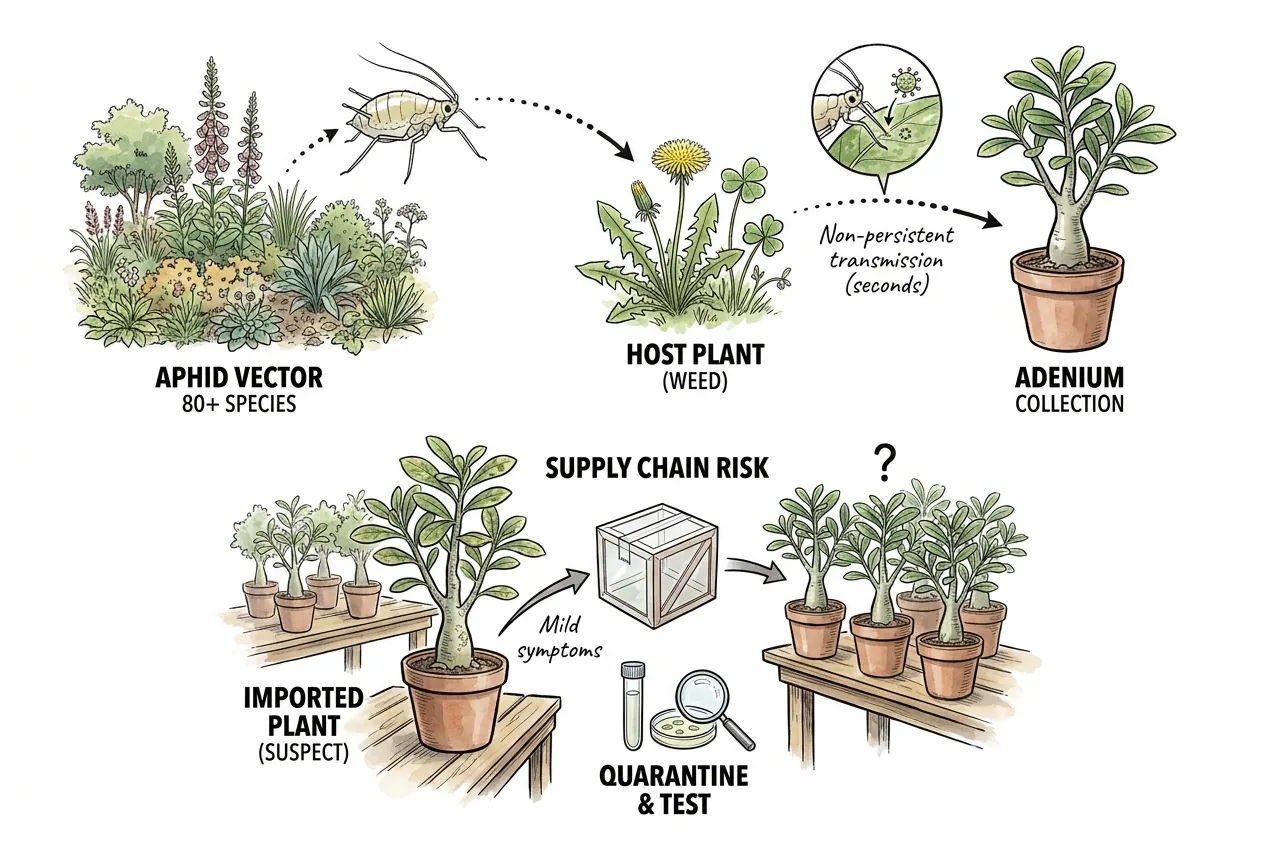
CMV has a very broad documented host range, although the practical host and vector risk still depends on the local collection and surrounding plants.
CMV’s broad host and vector range makes outside sources relevant, but an absent record can also reflect limited sampling. An aphid that probes infected material may transmit virus quickly. The exact chance depends on vector, source, plant, and environment.
The Australian quarantine intercept is the clearest demonstration of supply-chain risk. Imported Adenium showing only mild mottling tested positive for both CMV and a novel potexvirus.
Quarantine new Adenium from mixed sources while you inspect and, where warranted, test them. Quarantine reduces exposure. It cannot certify a symptomless plant as virus-free by time alone.
What does cucumber mosaic virus look like on adenium leaves?
Foliar mosaic, chlorotic ringspots, and line patterns on newer leaves should trigger testing, but they are suspicion-raising features, not a canonical diagnostic triad.
Mosaic shows as dark-green islands or patches alternating with chlorotic regions.
Ringspots can be circular yellow rings, sometimes with a contrasting center. Size and appearance vary with tissue and isolate.
Line patterns are narrow chlorotic streaks following or running between veins.
Symptom severity is strongest on actively growing tissue.
Older leaves established before infection often stay green even when the plant is systemically infected.
The Australian quarantine paper documented CMV-positive imported plants displaying only mild mottling.
Subtle color shifts on apical leaves deserve observation and, when consequential, testing. They are not proof of infection.
Where on the plant should you scout first?
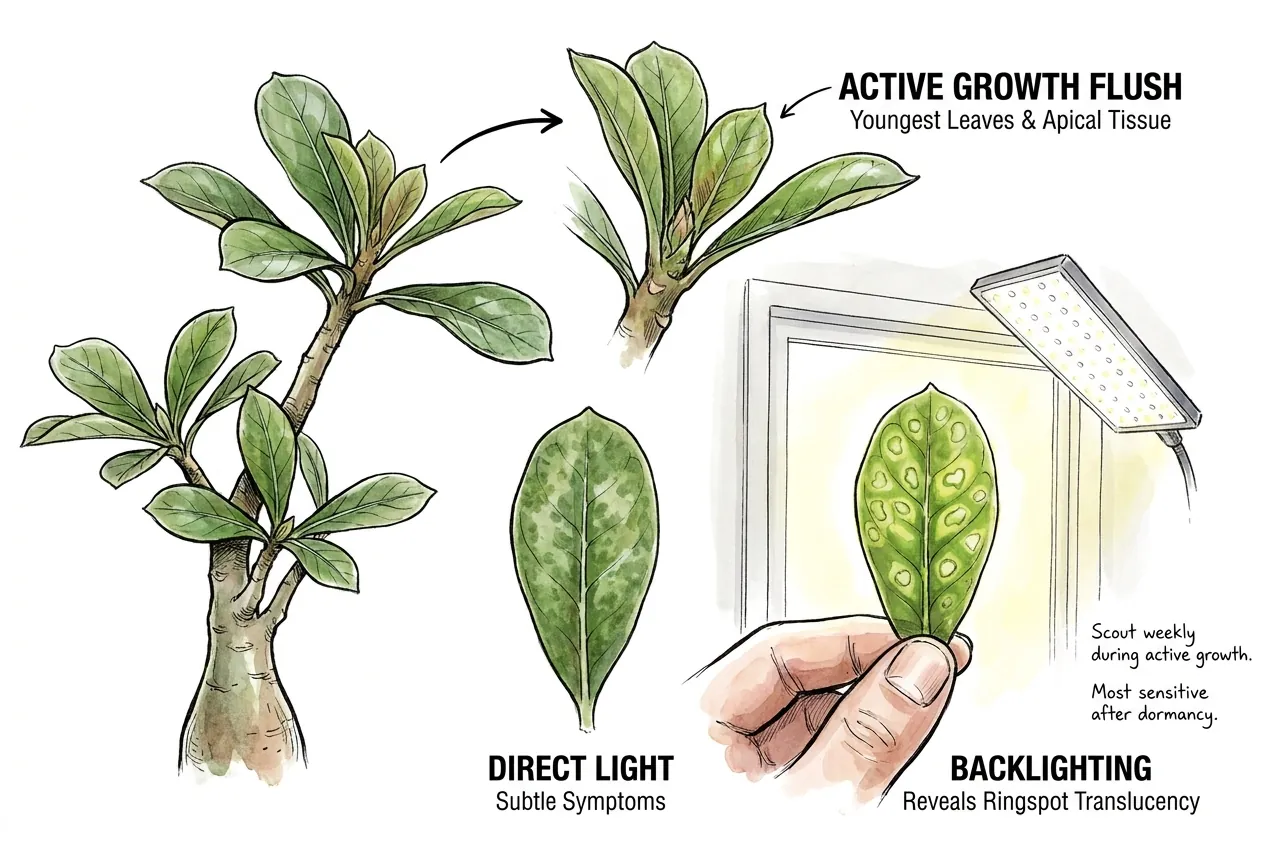
Inspect newer leaves during active growth and repeat the check after meaningful changes in the plant or collection.
Young tissue can show symptoms more clearly in some infections, but viral titer and symptom expression vary by virus, host, and stage.
Backlighting helps with subtle cases. Hold the suspect leaf between you and a window or bright LED because ringspot translucency can be easier to see than under direct top-down light.
When concern begins, I label the youngest fully expanded leaf N0 on a duplicate photograph. Each leaf that unfolds after it becomes N1, N2, and onward, and I never renumber the series when an older leaf drops. This separates marks that were already present from patterns that formed during quarantine.
Each numbered leaf gets one photograph under the same overhead lamp setting and one with the same backlight, neutral card, and pot-rim orientation. My log covers its unfolding date, light moves, sprays, feeding, root work, and any aphids seen before the next leaf opens. A different lamp or camera setting can otherwise make a color shift look biological.
If a similar irregular pattern repeats on successive new leaves, I use the ladder to choose representative symptomatic tissue under the test or laboratory instructions. I do not call that repetition a virus diagnosis. Clean-looking new leaves are encouraging, but they also do not release a high-risk plant from quarantine when the testing decision still matters.
Do CMV-infected Adenium show flower symptoms?
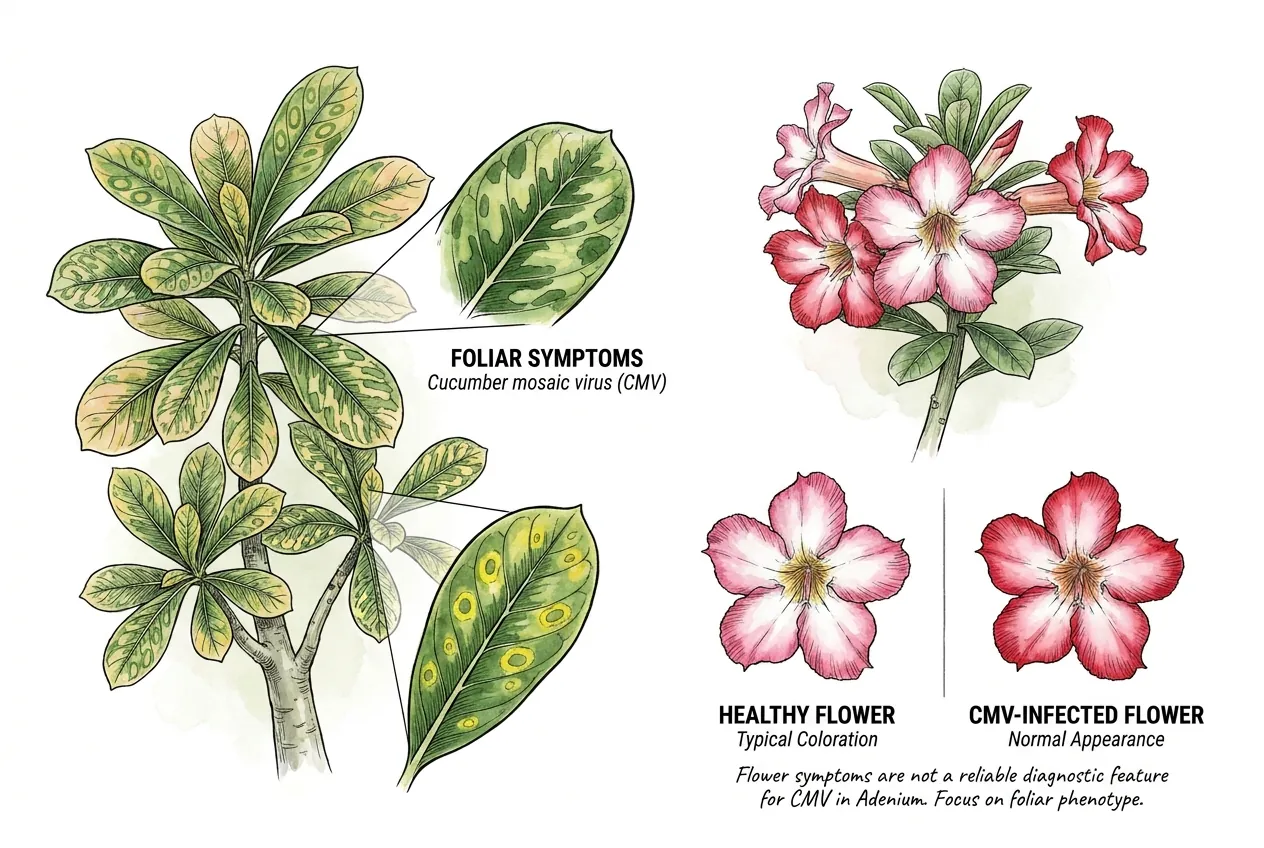
CMV can cause flower color-breaking in many ornamentals but is not consistently reported on Adenium flowers.
None of the Florida, Taiwan, Brazil, or Australia papers list flower symptoms as a primary diagnostic feature.
Do not rule out CMV because the blooms look normal, since leaf symptoms are the more useful signal. But leaf symptoms alone cannot confirm CMV either. Several other problems mimic it, so a laboratory test is the only way to be sure. See the testing section below.
Could it be something other than CMV?
Common CMV look-alikes on Adenium include nutrient-deficiency chlorosis, spider-mite stippling, sun scorch with oedema, and bacterial or fungal leaf spot.
Use symmetry as a clue, not proof. CMV tends to make irregular, asymmetric mosaic and discrete ringspots, while nutrient deficiencies more often make roughly symmetric, gradient-based chlorosis that tracks leaf venation.
These are tendencies that help you decide whether to test, not a substitute for testing. Symptoms overlap, and Penn State and other extension sources are explicit that virus diseases cannot be diagnosed by symptoms alone.
Before treating a suspected deficiency, also rule out root problems and check your medium's pH and salts, since foliar feeding based on a wrong guess can cause its own damage.
| Feature | CMV Mosaic | Nutrient Deficiency | Spider Mites | Sun Scorch | Bacterial Spot |
|---|---|---|---|---|---|
| Pattern symmetry | Irregular | Often more symmetric | Diffuse stippling | Often sun-facing | Discrete lesions |
| Leaf age affected | Often newer first | Element- and context-dependent | Any age | Sun-exposed | Any age |
| Lesion edge | Diffuse | Gradient | Pinpoint dots | Sharp line | Sharp with halo |
| Underside check | Same as top | Same as top | Mites and webbing | Top only | Same as top |
| Mechanical transfer clue | Possible. Not visible | None | None | None | Possible |
Magnesium deficiency often appears first on older leaves because Mg is phloem-mobile, but symptoms still depend on roots, pH, salts, and plant stage.
Iron deficiency often appears on newer leaves because Fe is relatively phloem-immobile. Use leaf age as a clue, not a diagnosis.
Nutrient deficiencies can produce patterned chlorosis, but response time and appearance vary with the element, roots, pH, and salts. CMV may be patchy or asymmetric, yet symptoms overlap. Fertilizer response does not confirm or exclude it.
How do you tell CMV ringspots from spider mite damage?
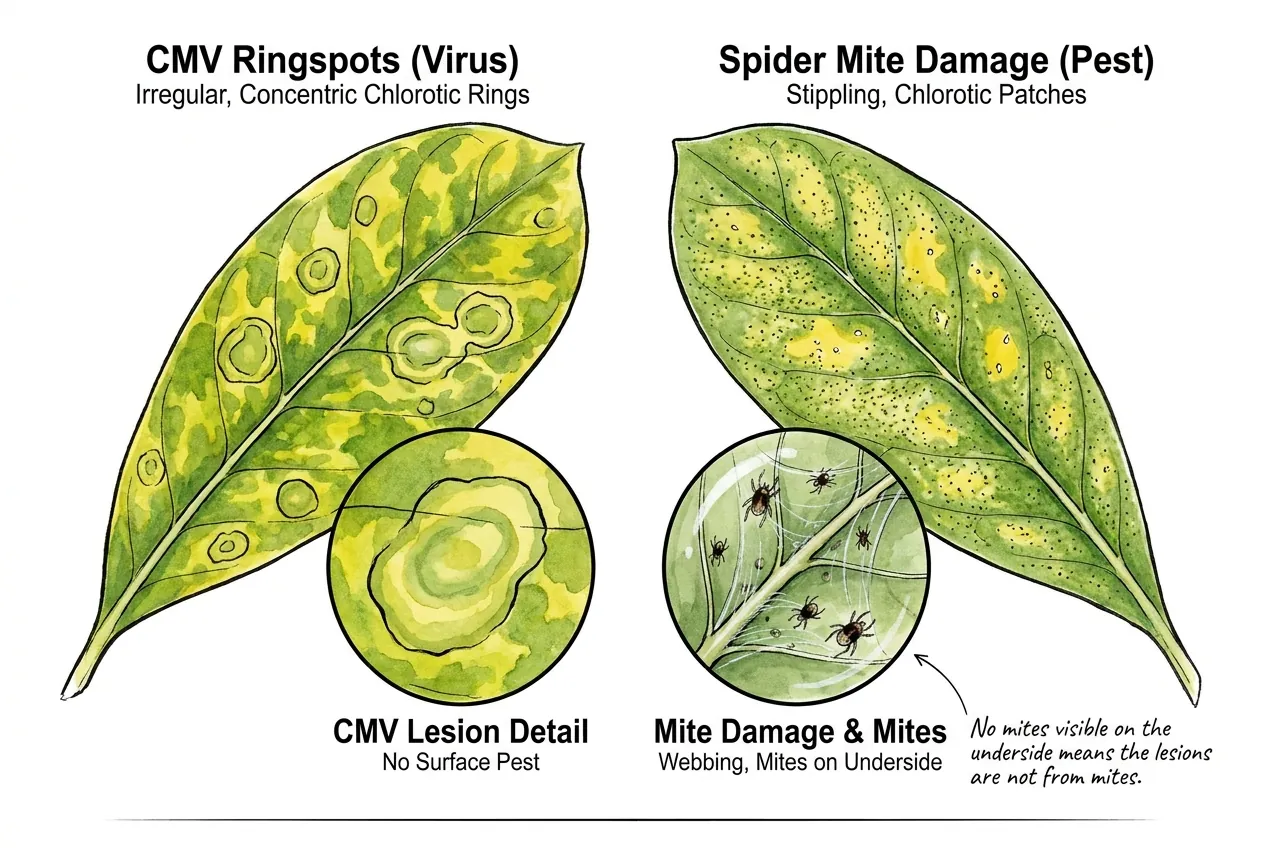
Flip the leaf and inspect the underside with a hand lens, where around 10× is a useful starting point.
Two-spotted spider mites (Tetranychus urticae) are about 0.4 mm with two dark dorsal spots and produce 0.1 to 0.5 mm stippling aggregating into chlorotic patches.
Fine webbing points strongly to mites, but webbing usually shows only at higher populations, so its absence does not rule mites out.
Not seeing an adult mite on one quick look also does not clear mites. Eggs and nymphs are tiny, populations start on lower leaf surfaces, and other mite species behave differently. Check several leaves' undersides under magnification, and tap foliage over white paper to spot moving specks before concluding mites are not involved.
What about co-infection with other Adenium viruses?
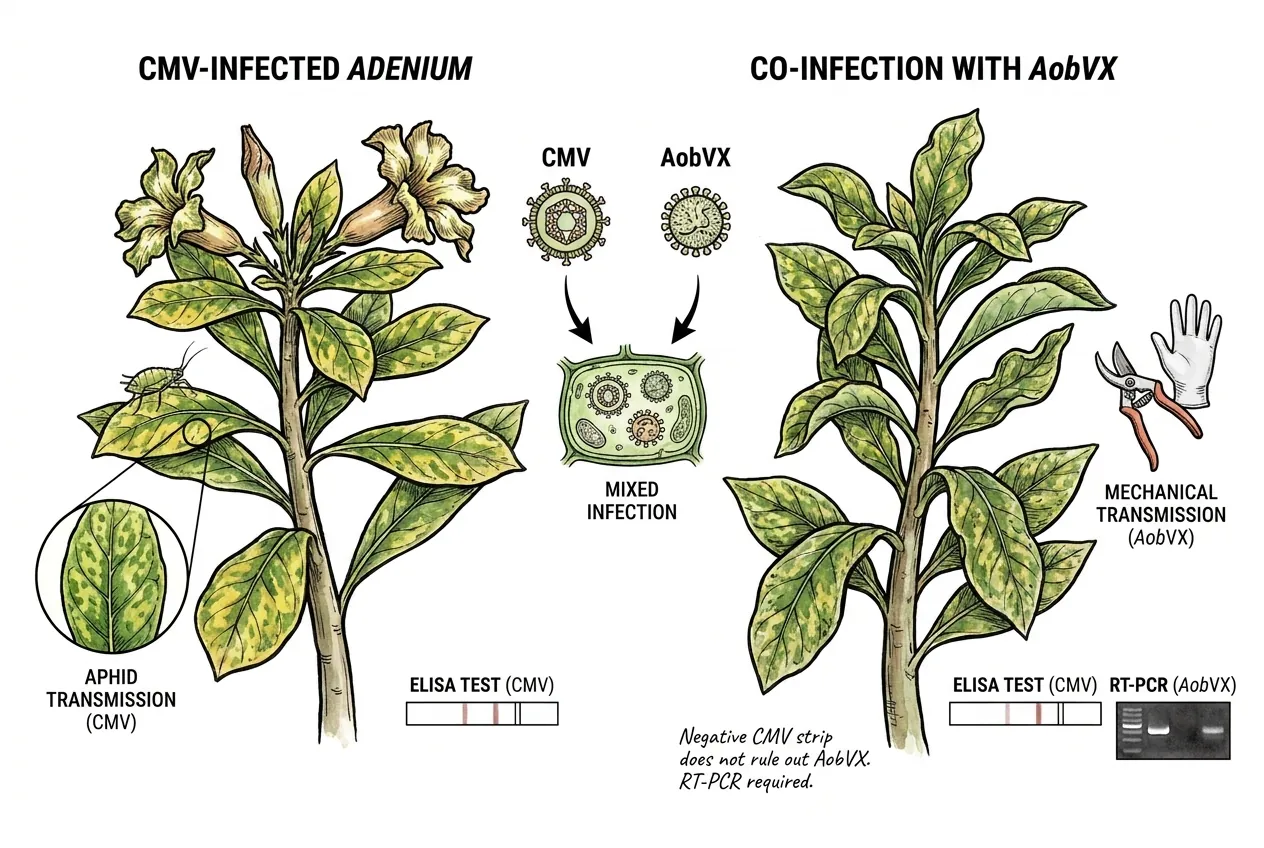
Adenium obesum virus X, a potexvirus first sequenced in 2023, produces foliar mottling that overlaps with CMV. It was found together with CMV in the imported batch where it was discovered, but how often the two genuinely co-occur in the wider population is not established.
A negative CMV ImmunoStrip on a mottled plant does not mean the plant is virus-free.
Confirmation of AobVX generally requires a laboratory assay such as RT-PCR.
AobVX is not established as insect-vectored. Mechanical transfer through tools remains a sanitation concern even when aphids are absent.
How do aphids spread CMV so fast that insecticides fail?
CMV moves during brief aphid probes and does not require virus replication inside the vector, so a probe can transmit it before an insecticide can act. Published timings vary by virus, aphid, and assay, so no single second count is a household threshold.
Because transmission can precede insecticide activity, aphid control should be treated as population and exposure management, not as a guaranteed interruption of each probe.
Under some conditions, sublethal systemic-insecticide exposure has been associated with altered aphid probing, so it should not be treated as a guaranteed interruption of CMV transmission.
CMV particles bind loosely and reversibly to aphid mouthparts during probing (the canonical non-persistent, stylet-borne transmission profile).
The exact molecular receptor on aphid stylets remains uncharacterized for CMV. The Stylin-01 protein on the acrostyle, sometimes mentioned in popular sources as a generic aphid-virus receptor, was demonstrated to bind the closely related Cauliflower Mosaic Virus rather than CMV. Researchers have not successfully attached CMV to that site.
The binding is mechanical and short-lived.
CMV is classified as non-circulatively transmitted. It is not known to replicate inside the aphid, and retention is brief.
This non-circulative transmission is why killing aphids after they arrive cannot be assumed to stop every prior probe. Vector management still reduces future exposure.
Which aphids actually transmit CMV in a US hobby greenhouse?
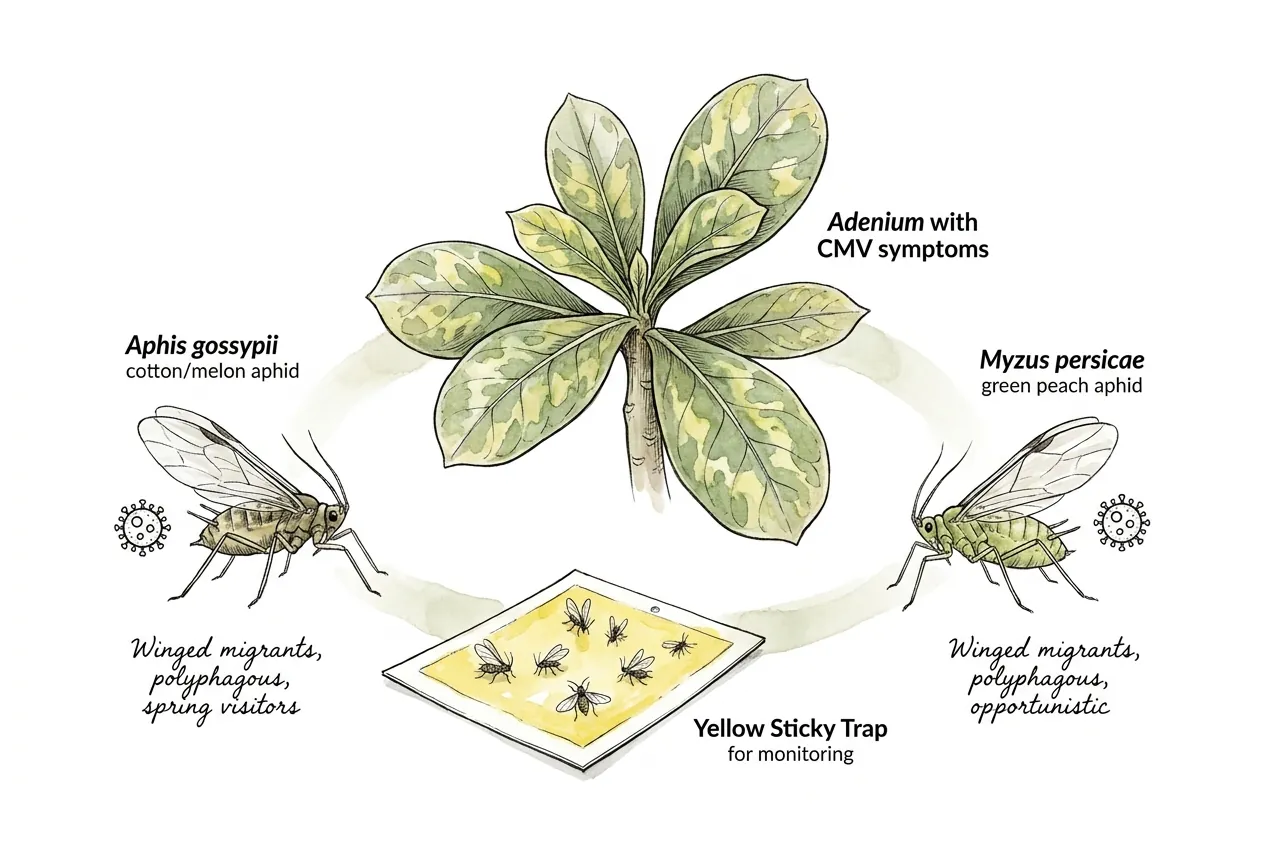
Many aphid species can vector CMV, but the relevant species at one bench depend on local weeds, season, and crop surroundings.
Aphis gossypii and Myzus persicae are common examples in horticultural systems, not a complete list for every greenhouse.
Yellow sticky traps near the bench can monitor flying aphids. Species identification still requires closer examination.
Why does imidacloprid fail or make things worse?
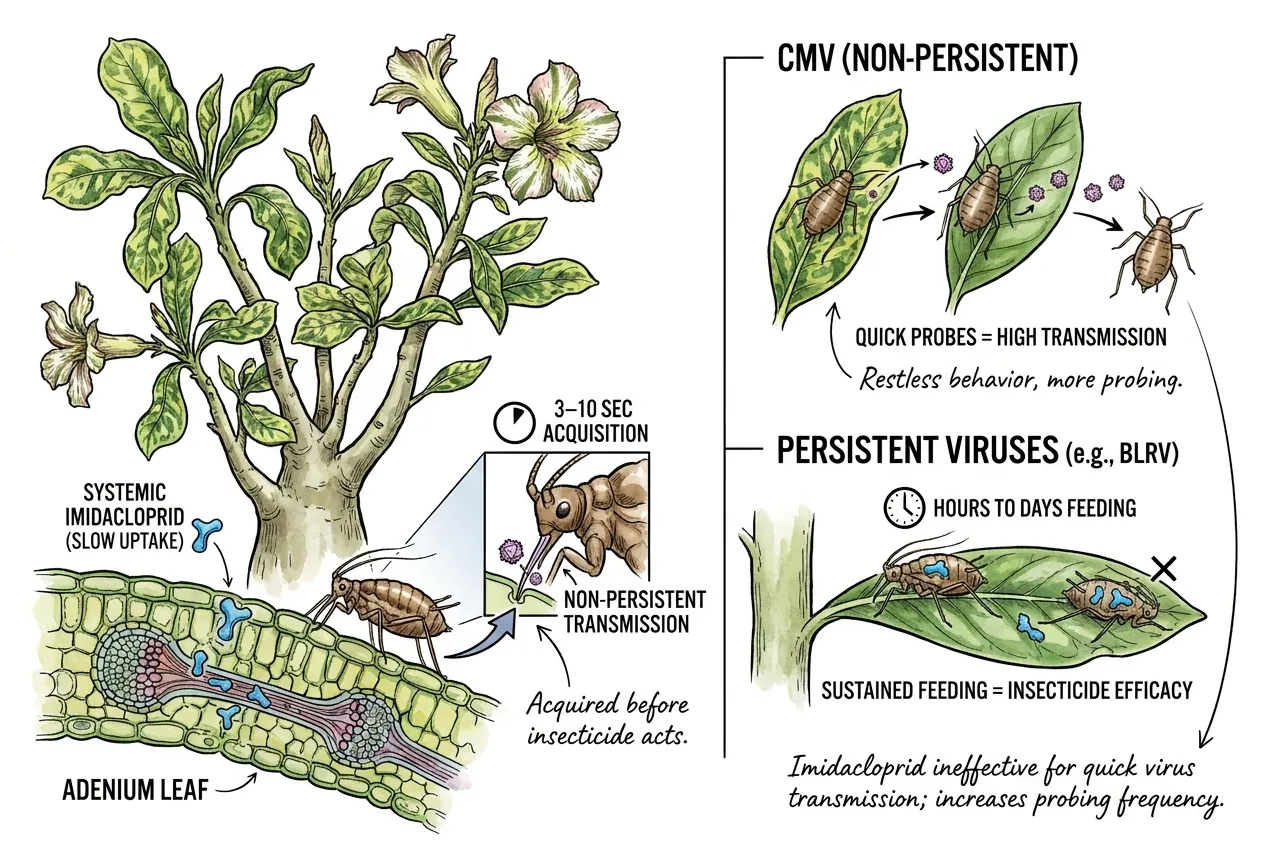
Do not treat imidacloprid as a CMV cure. It is ingested during sustained feeding, but CMV acquisition happens during the pre-feeding epidermal probe.
The aphid acquires and transmits the virus before the insecticide has time to act.
Sublethal imidacloprid exposure may alter aphid behavior, including probing frequency, so product choice must follow current label and extension guidance.
UMass Extension explicitly recommends against systemic neonicotinoids for non-persistent virus management.
Systemic products can fit some persistent-virus programs, but they are not a stand-alone CMV solution. Choose controls according to the vector, crop/site label, and local guidance.
| Transmission Type | Acquisition Time | Retention | Latent Period | Insecticide Efficacy |
|---|---|---|---|---|
| Non-Persistent (CMV) | Brief probe. Timing varies | Brief to variable | None | Often limited |
| Semi-Persistent | minutes to hours | hours to days | None | Moderate |
| Persistent (Circulative) | hours | days to life | hours to days | Product- and context-dependent |
How do you test adenium for CMV at home?
The Agdia CMV ImmunoStrip is a lateral-flow screening assay for the targets covered by the current kit. Use fresh symptomatic tissue and follow the manufacturer’s current sample, buffer, timing, and interpretation instructions. Do not substitute a generic timing or pooled sample.
Treat the strip as screening, not proof. It is a reasonable first test, but a negative result can miss low titers and does not test for other viruses such as AobVX.
A laboratory assay such as RT-PCR can be appropriate when symptoms persist after a negative strip, when another virus is possible, or when a high-value decision requires stronger confirmation. The suitable test depends on the laboratory and suspected pathogen.
Sample collection matters.
Young symptomatic tissue is often the most useful sample, but titer varies with isolate, host, and stage. Follow the kit or laboratory guidance on tissue amount and whether samples may be pooled.
Avoid old, yellow, or necrotic tissue.
Viral titer can be lower in senescent leaves, which may increase the chance of a false-negative screen on an infected plant.
Preserve and ship samples according to the receiving laboratory’s instructions. Temperature and timing requirements differ by assay.
| Test | Time | Cost | Specificity | Best Use |
|---|---|---|---|---|
| Agdia ImmunoStrip | Per current kit instructions | Check current price | Target- and kit-dependent | Bench-top first test |
| Extension ELISA | Laboratory-dependent | Check current fee | Assay-dependent | Confirmatory routine |
| RT-PCR plus sequence | Laboratory-dependent | Check current fee | Sequence- and target-dependent | High-value plant or AobVX co-infection |
Tooling for pre-strip leaf inspection
A hand lens can help inspect symptoms and mite evidence before a test, but it cannot diagnose a virus. A loupe is sufficient for many inspections, and a microscope is optional documentation equipment, not a requirement for triage.
A USB digital microscope with adjustable LED ring illumination is a close-inspection option when a hand lens cannot resolve small mites or leaf patterns. Budget USB scopes in this class typically advertise a 40–1000× magnification range, though the useful working range for leaf tissue sits well below the top figure.
Treat the advertised top-end number cautiously, because very high magnification rarely adds useful detail on plant tissue. If you only need basic mite-vs-virus differentiation, a low-cost jeweler’s loupe is usually enough, and a microscope is an upgrade rather than a requirement.
What if the ImmunoStrip is negative but symptoms persist?
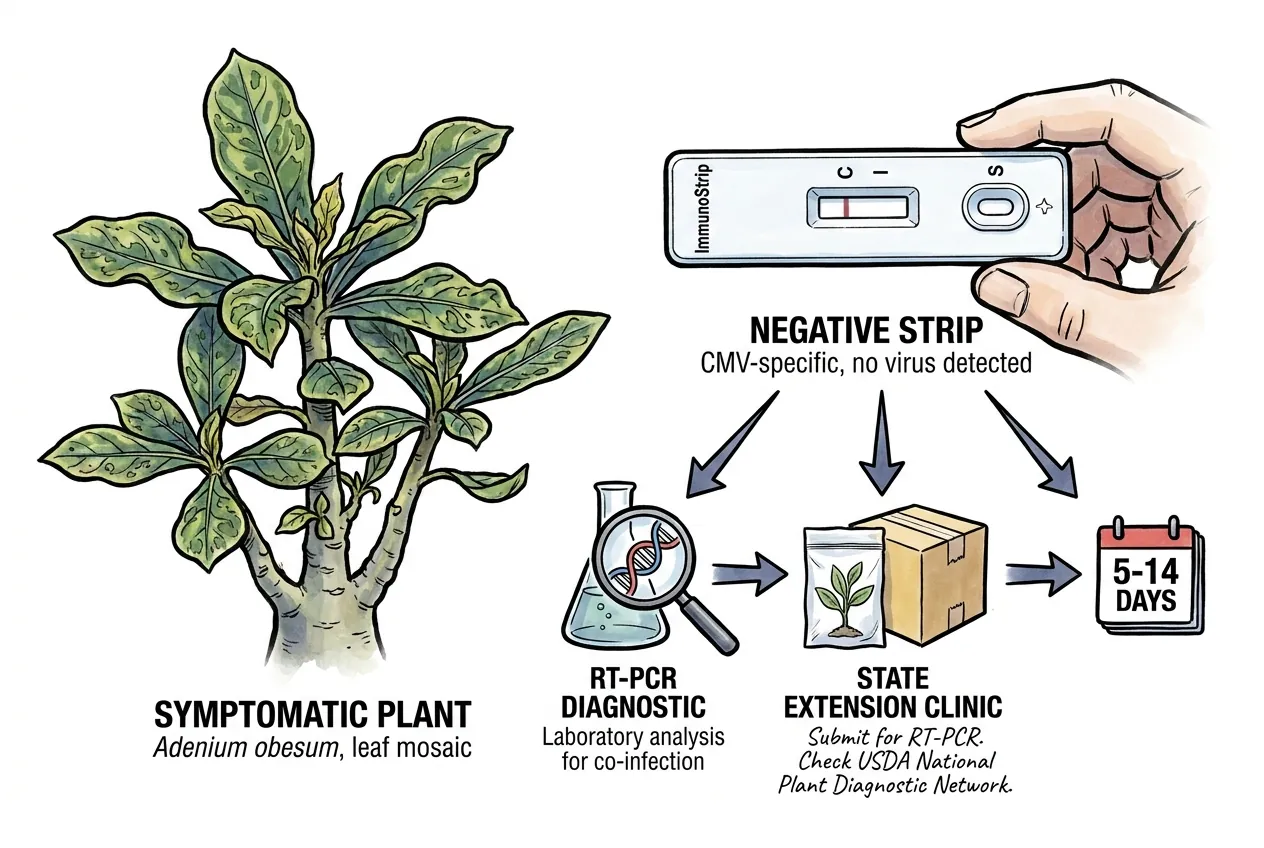
Suspect AobVX co-infection or another virus that the CMV-specific strip cannot detect.
Ask a state extension plant diagnostic clinic which assay and sample are appropriate. RT-PCR may be useful.
Fees and turnaround vary by laboratory, assay, and shipping. Check with the receiving clinic before sending material.
Find your state lab through the USDA National Plant Diagnostic Network.
When should you pay for RT-PCR sequencing?
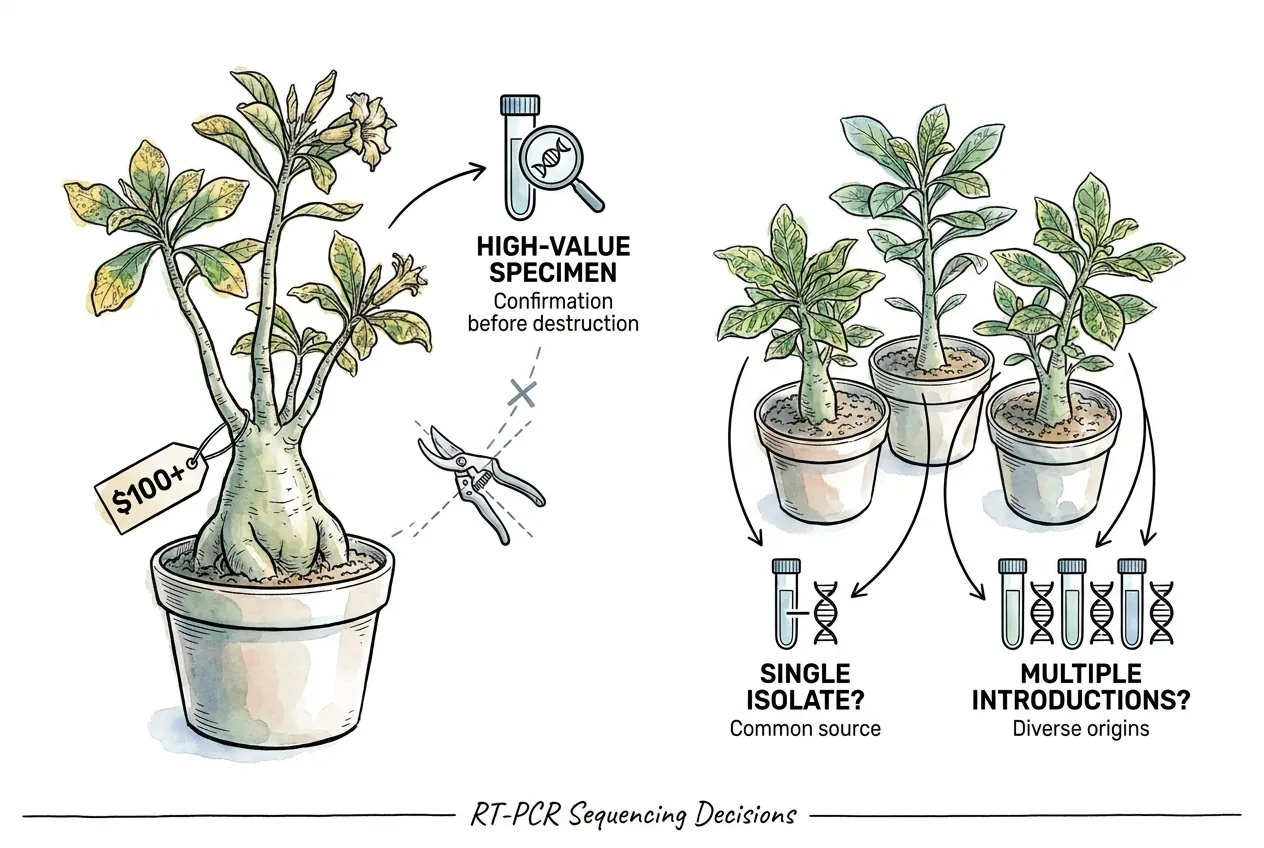
Consider stronger confirmation before an irreversible disposal decision, when symptoms persist despite a negative screen, or when several plants may share an introduction. The appropriate assay and cost are laboratory-specific.
What aphid controls actually interrupt CMV transmission?
No single aphid control guarantees interruption of CMV, so manage exposure with an integrated plan of exclusion, sanitation, reflective surfaces, and population management. Results depend on crop, vector, product, coverage, and environment.
Reflective mulch and horticultural oils have been studied in other crops, but their rate, timing, phytotoxicity, and benefit cannot be copied directly to Adenium.
Contact soaps reduce exposed aphids but do not reverse transmission that already occurred. Systemic insecticides may be poor tools for non-persistent transmission and can have non-target, resistance, and label concerns. Follow local labels and extension guidance.
| Intervention | Mechanism | CMV Efficacy | Aphid Kill | Best Use |
|---|---|---|---|---|
| Reflective mulch | May alter visual/UV landing cues | Crop- and trial-dependent | None | Bench foundation |
| Horticultural oil (label rate) | Coats stylet-acquisition site | Variable | Low | Migration windows |
| Insecticidal soap | Cuticle desiccation | Low | Variable. Label-dependent | Visible colony control |
| Imidacloprid (systemic) | Neural toxin via feeding | Not a guaranteed interruption | Variable. Feeding-dependent | Use only if label and local guidance support it |
| Insect netting | Physical exclusion | Variable with fit and coverage | None | High-pressure sites |
| Beneficial predators | Population reduction | Low | Variable | Long-term IPM |
Why does reflective mulch work when sprays do not?
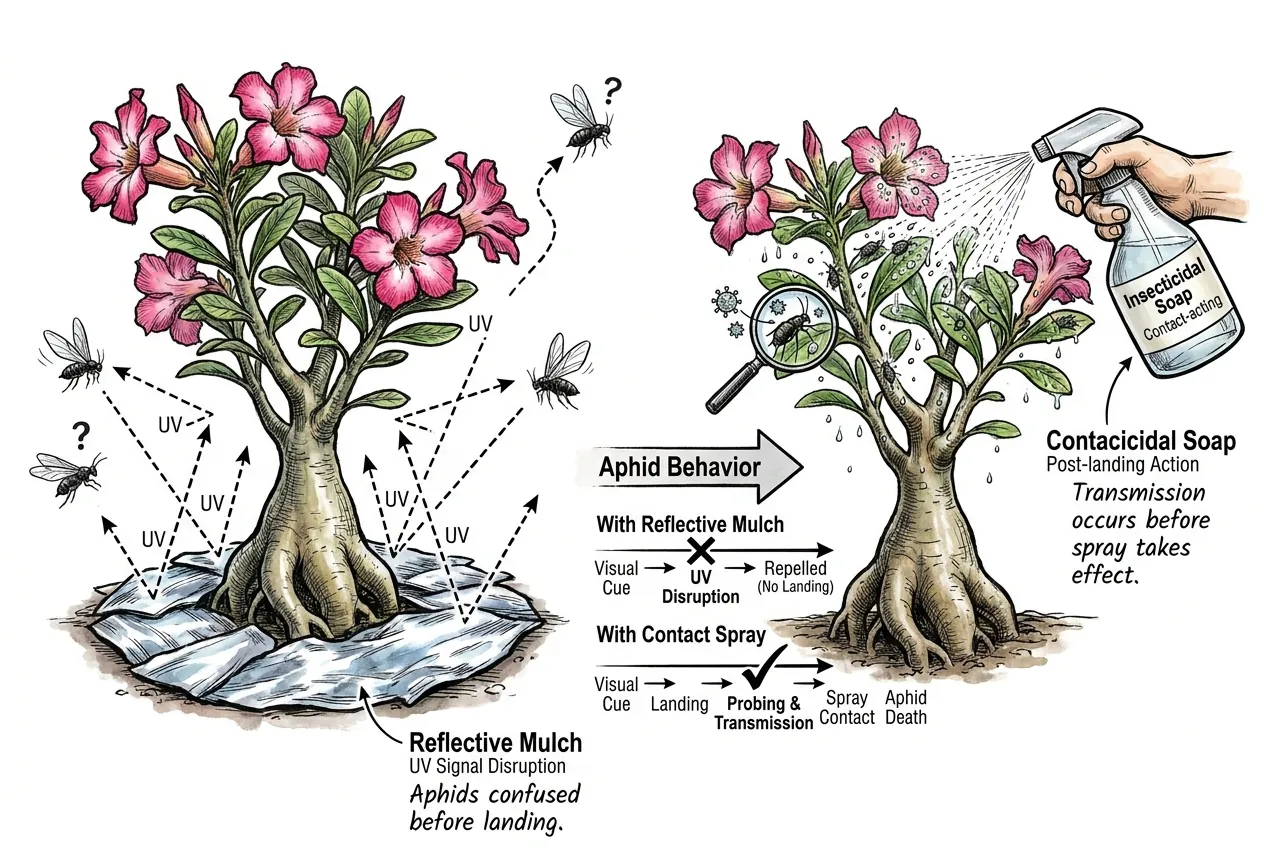
Aphids use visual and near-UV cues when locating hosts, and reflective materials can alter those cues in some crop trials.
Reflective mulch (silver, aluminum-foil-laminated polyethylene, or UV-reflective film) may reduce landing or probing under particular conditions, but the effect depends on crop, coverage, light, and vector pressure.
Because any effect occurs before or during landing, it may complement sanitation and population management. It does not guarantee interruption of non-persistent transmission.
The Stapleton and Summers 2002 cantaloupe study and the 2024 Capsicum trial both quantify the effect.
Choose an aphid-control product only after checking its current label, crop/site authorization, active ingredient, PPE, and phytotoxicity warnings. Product concentration, application interval, and organic certification vary.
Apply contact products only as the label directs to visible colonies, and repeat only when the label and plant response support it. Test a small area when the label permits.
Insecticidal soap mainly reduces exposed aphids. It is not a virus cure and cannot undo transmission. Lowering aphid pressure can still reduce future exposure when the product is appropriate for the plant.
Contact products can injure foliage or beneficial insects, so follow the current label and test cautiously.
What about beneficial predators like lacewings and ladybugs?
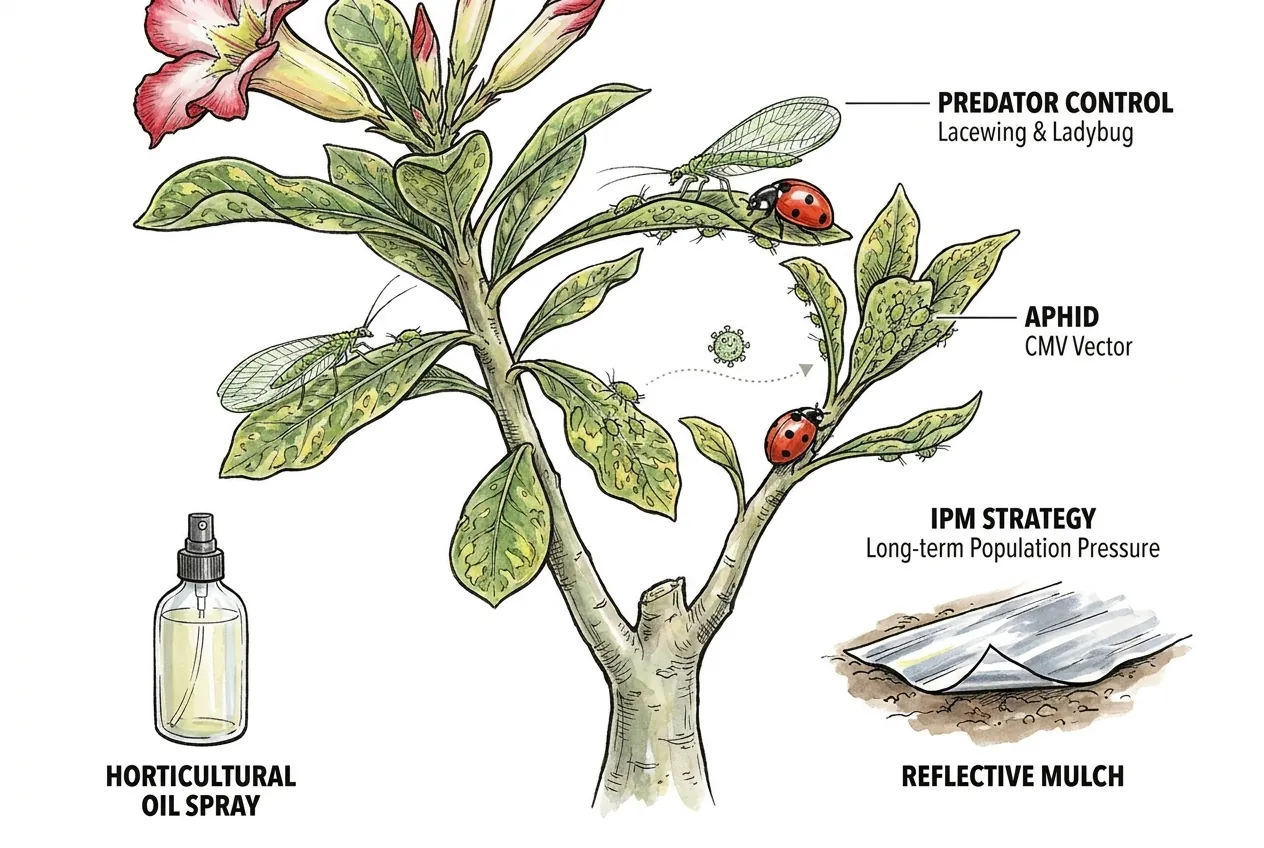
Beneficial predators can reduce aphid pressure over time, but they do not guarantee that a brief transmission event will be prevented.
Use them as one part of an integrated plan with monitoring, sanitation, exclusion, and label-compliant controls.
How do you quarantine and sterilize to protect an adenium collection?
Build quarantine and sanitation together, because neither one alone protects a collection. A sensible CMV protocol has five components.
First, quarantine new arrivals in a physically separated space with no shared tools. Use a locally appropriate observation period, understanding that symptomless or low-titer infections can outlast any calendar window. Treat quarantine as risk reduction and use testing or laboratory advice when an exit decision matters.
Second, remove plant debris before disinfecting tools and follow the disinfectant label for concentration, contact time, ventilation, rinsing, and material compatibility.
Third, monitor plants for changing symptoms and document what you see so testing decisions have context.
Fourth, maintain bench separation between quarantine and the main collection.
Fifth, define in advance how confirmed positives will be isolated or disposed of under local plant-health rules.
Clean visible sap and debris off the blade first, since disinfectants work poorly over dried plant residue. Use a compatible, label-compliant disinfectant for the material and pathogen concern. No wipe should be described as a universal guarantee.
Some disinfectants are more effective against plant viruses than others, but efficacy depends on the product and protocol. Use a fresh, label-compliant solution, protect skin and eyes, provide ventilation, and keep flammable alcohol away from ignition sources. Never mix chemicals.
| Disinfectant | Concentration | Contact Time | Virus-control relevance | Tool Corrosion | Best Use |
|---|---|---|---|---|---|
| Isopropyl alcohol | Label-dependent | Label-dependent | Target- and product-dependent | Material-dependent | Routine between-cut |
| Bleach | Label-dependent | Label-dependent | Target- and label-dependent | Can be high on some metals | Periodic deep clean |
| Lysol APC | Product label | Product label | Product- and target-dependent | Material-dependent | Use only where label permits |
How long should the quarantine bench hold a new arrival?
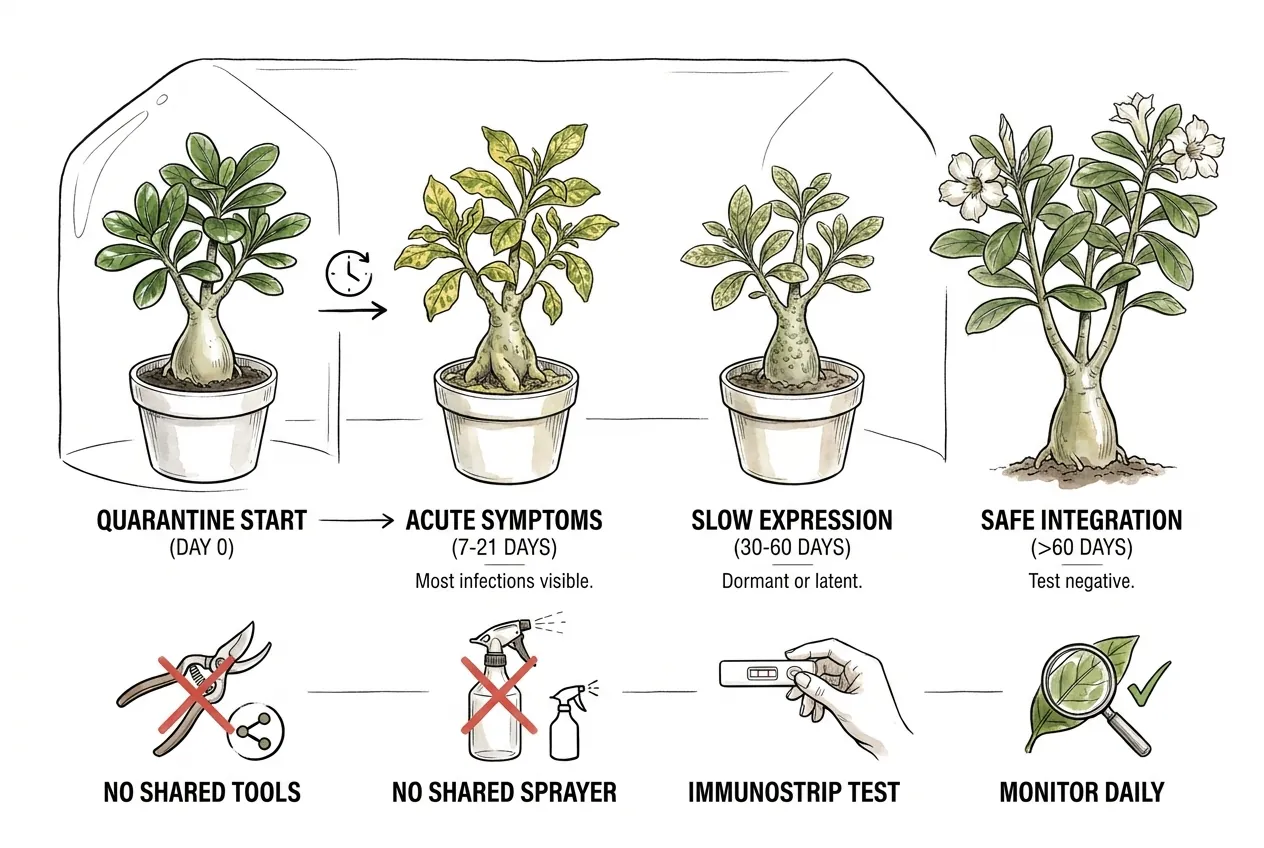
A longer observation period can reveal some infections, but symptom timing varies with isolate, host, and growth state. A calendar window never proves that a plant is clean.
Keep the plant physically separated, use dedicated tools and sprayers, and test before integration when the risk or value justifies it.
Should you destroy a CMV-positive Adenium?
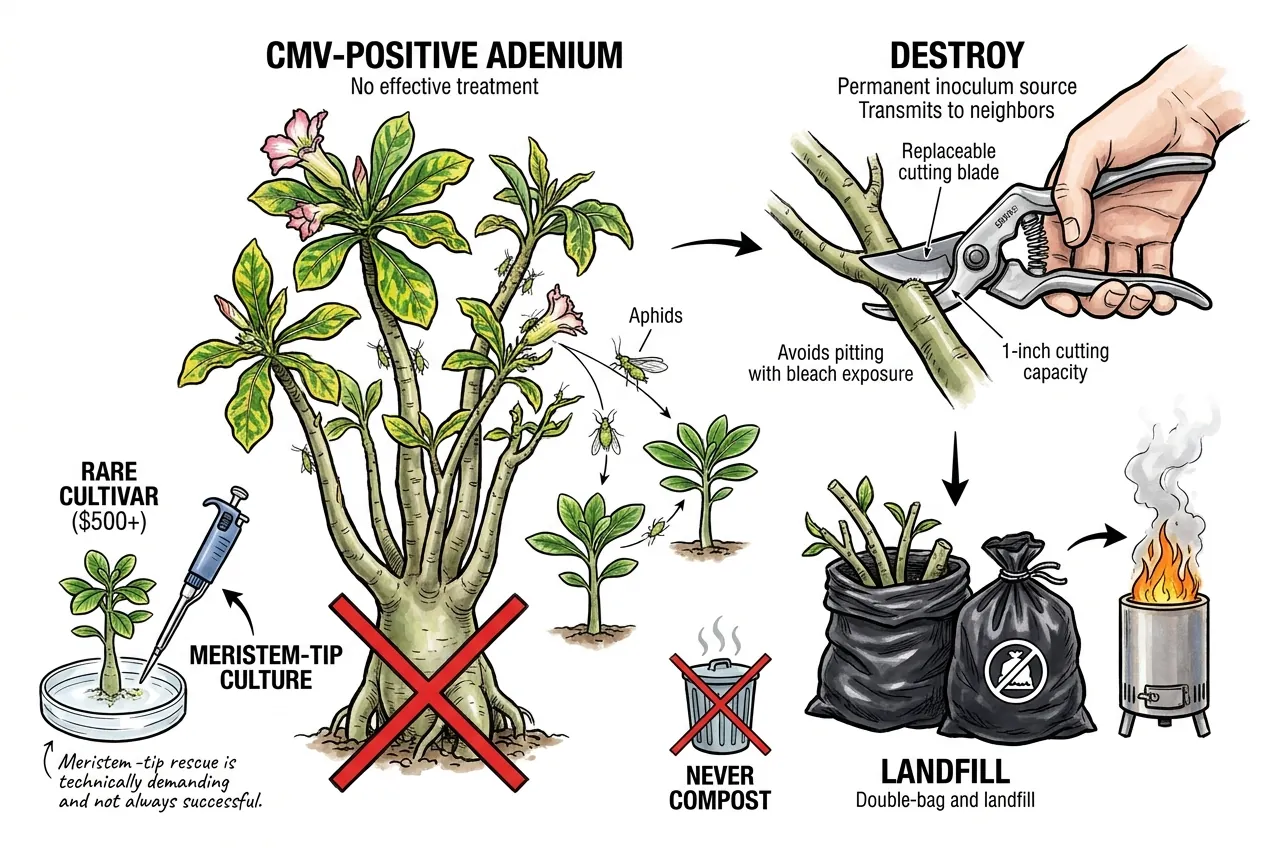
A confirmed positive has no routine curative treatment in home cultivation, so isolation or disposal is a risk-management decision, not a medical one.
Discuss valuable or regulated material with a plant-health laboratory or extension service before acting. A positive plant can serve as an inoculum source, but the practical risk depends on vectors, handling, and physical separation.
Dispose of infected material according to local plant-health, waste, and fire rules. Keep prunings sealed and away from the collection until disposal is arranged. Do not assume burning, burial, or composting is legal or effective.
For a genuinely rare or valuable cultivar, meristem-tip culture (often combined with heat treatment) at a tissue-culture lab can sometimes recover virus-free material. Success rates vary a lot by virus and species, real Adenium-CMV services and costs are not well documented, and it is expensive and not guaranteed. Check with an actual provider about assay, turnaround, and cost before counting on it.
Choosing a pruner that survives daily IPA and quarterly bleach
A pruner should make clean cuts and be compatible with the sanitation method the collection requires. A durable bypass pruner with a hardened blade, replaceable wear parts, and cutting capacity suited to your stems earns its place when repeated cutting and frequent sanitation make longevity matter.
Choose bypass for cut quality rather than for virus control. A bypass pruner slices cleanly and may reduce crushing compared with an anvil cut, but wound healing and virus spread depend on tissue condition and blade disinfection, not blade style. The stronger claim that anvil pruners specifically maximize virus transmission is not well supported.
Disinfect the blade between plants to manage virus spread. A hardened carbon-steel blade will corrode if you soak it in bleach, so wipe it clean and dry promptly and reserve long bleach soaks for tools rated for it.
A quality pruner costs several times a generic one, so a sharp existing pruner with diligent, label-compliant sanitation may be adequate for occasional propagation. A replaceable-blade pruner justifies its cost when cutting sessions are frequent or tool longevity matters. If you also propagate, you can match a blade and sterilant to your graft-union risk using the same clean-cut and disinfection logic.
Troubleshooting common scenarios
Work each scenario from physical checks toward a laboratory test, and never confirm CMV from symptoms alone. The scenarios below map common patterns to the next sensible step.
Yellow leaves on a 5-year-old potted Adenium
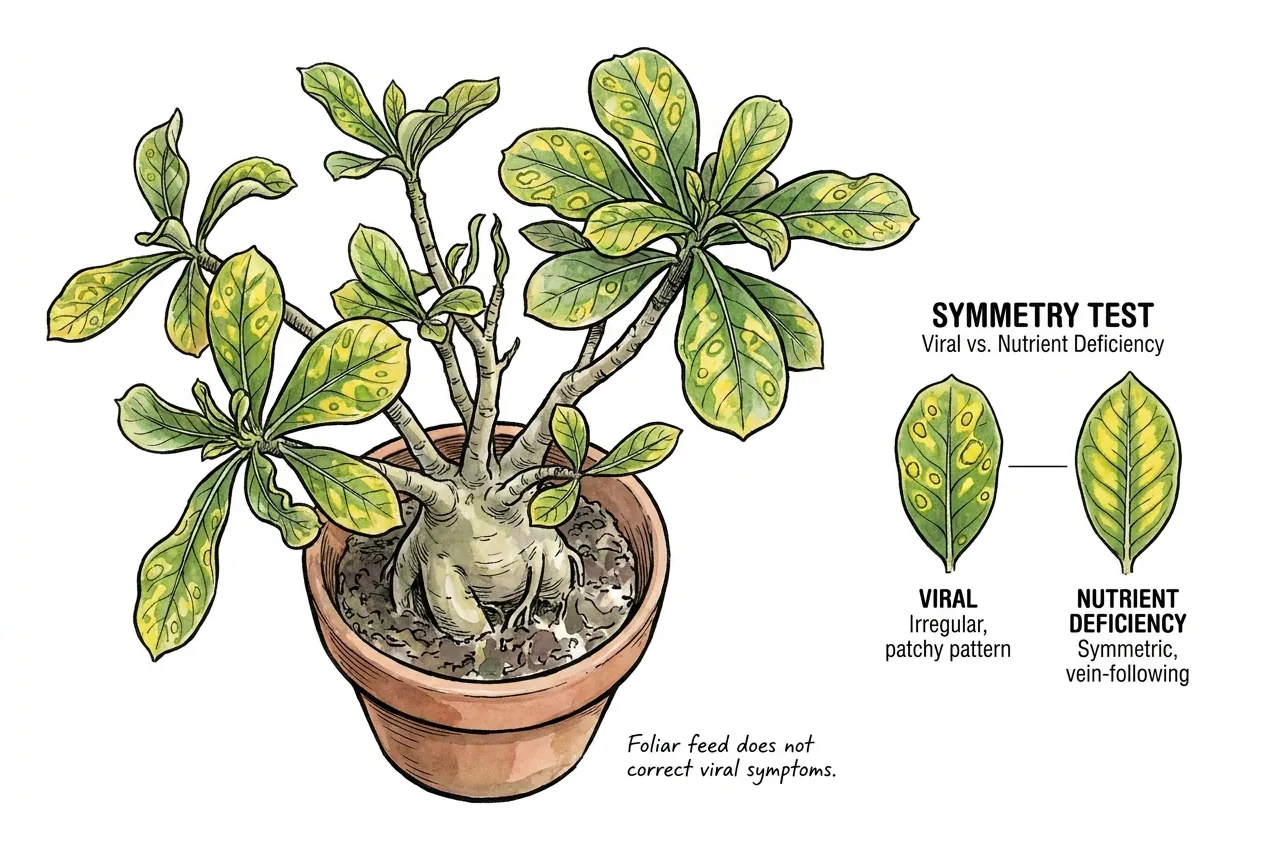
Run the symmetry test first.
If chlorosis is symmetric and follows venation on leaves of an age associated with a suspected nutrient, deficiency becomes one possibility. Confirm roots, pH, salts, and other causes before treating.
Do not apply a foliar feed from pattern alone. Confirm roots, pH, salts, and the suspected element, then follow current label or clinic guidance and reassess on an appropriate interval.
If the pattern is irregular and patchy with discrete ringspots, consider an ImmunoStrip or laboratory guidance before assuming CMV.
Spotty pale patches on otherwise green leaves
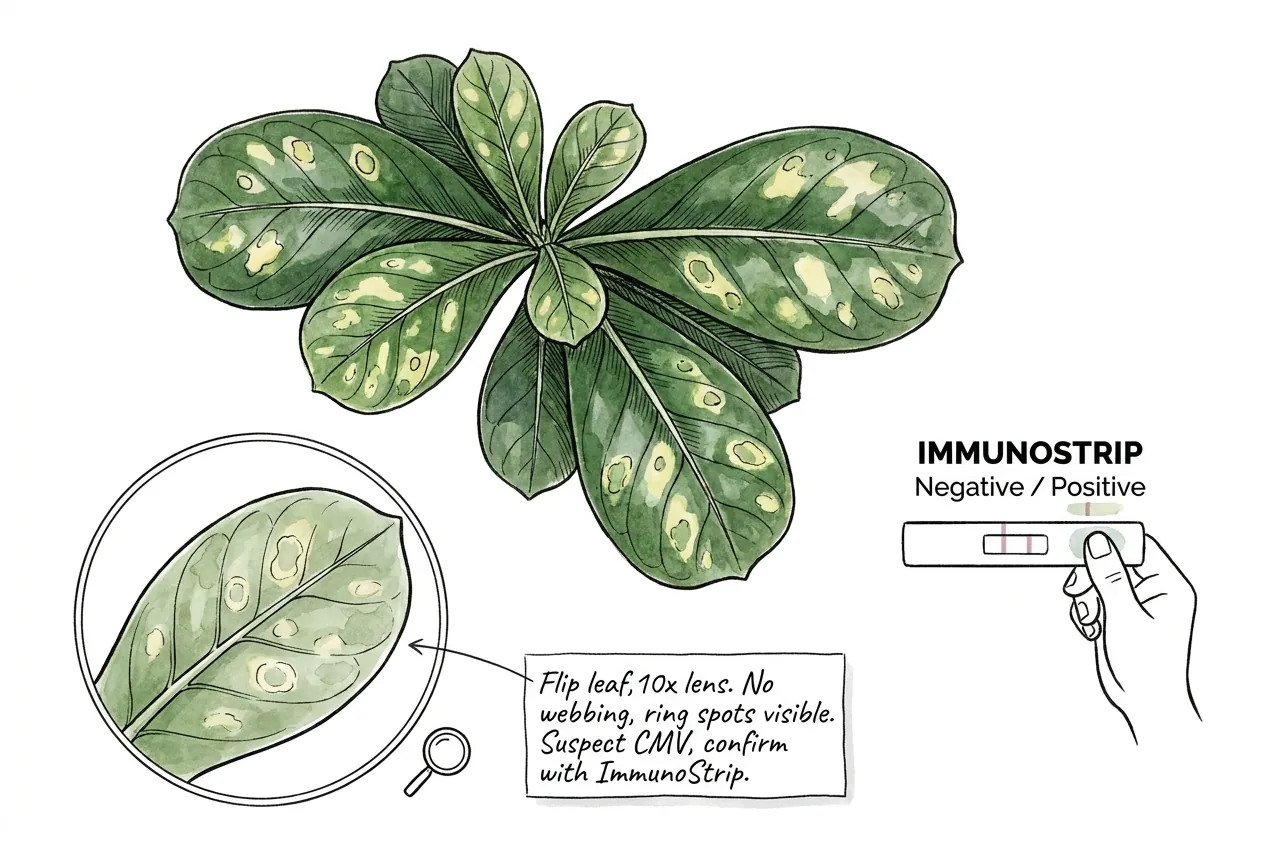
Flip the leaf and hand-lens the underside at 10×.
Two-spotted spider mites are about 0.4 mm with two dark dorsal spots.
Webbing supports a mite hypothesis but is not diagnostic by itself.
No mites visible plus ring-shaped lesions with green centers raises suspicion for CMV (consider an ImmunoStrip or laboratory guidance before assuming).
Aphid colony spotted on one Adenium
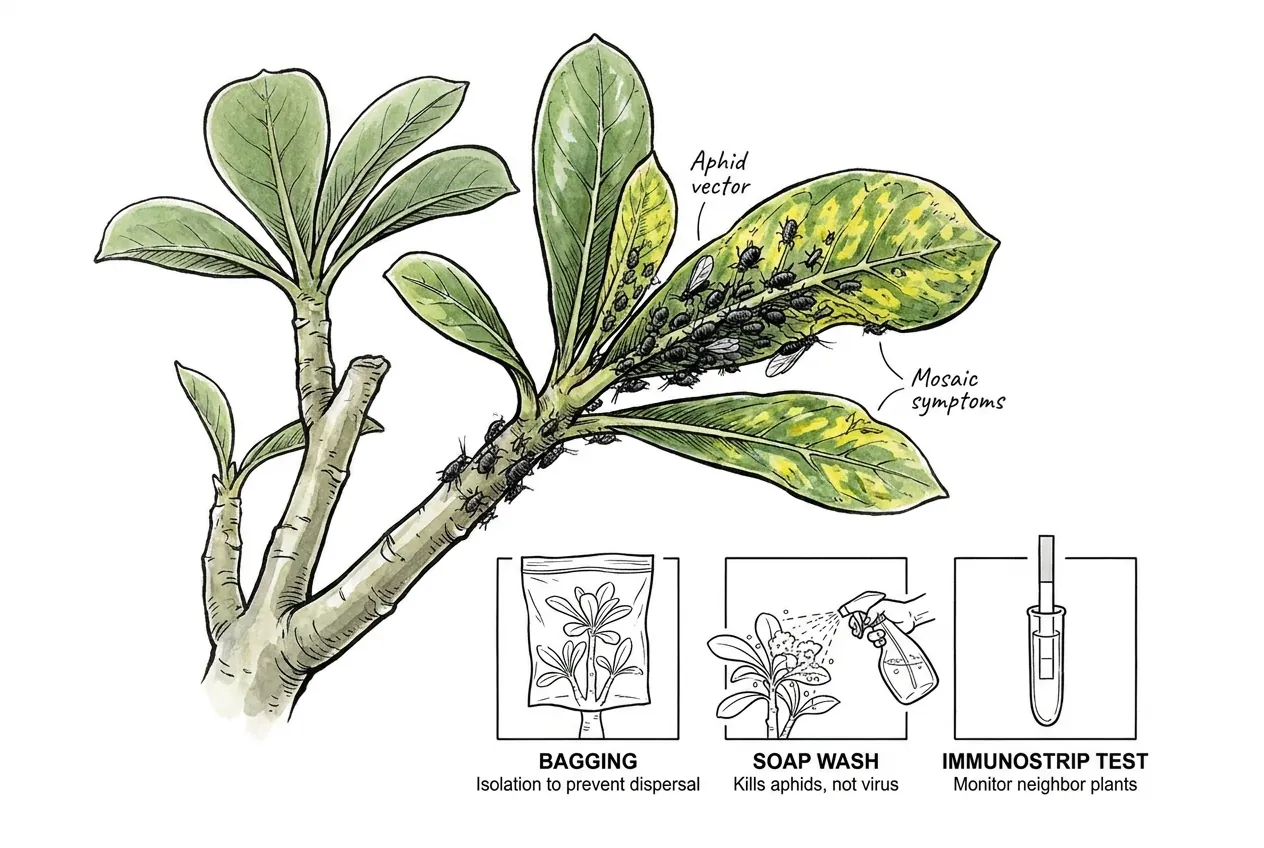
Isolate the plant and manage aphids using a label-compliant method. Do not rely on a bag that overheats or traps moisture. A soap treatment cannot undo transmission, and testing neighbors should follow a plant-health professional’s advice and the assay’s timing.
Transmission can occur during an early probe, so an aphid colony may represent exposure that has already happened.
Soap can reduce exposed aphids under its label conditions, but it does not reverse prior transmission.
Imidacloprid was sprayed and new symptomatic plants appear
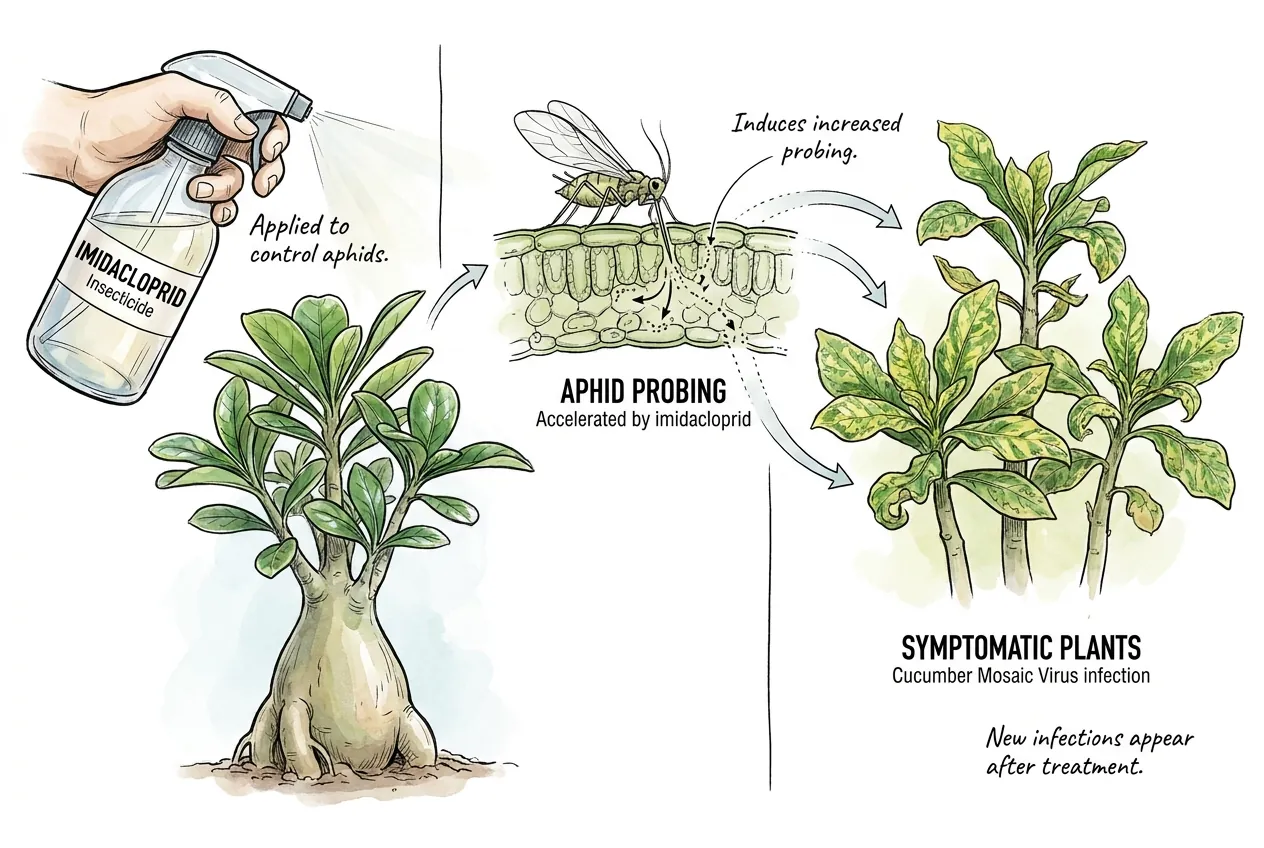
Do not repeat an imidacloprid application solely to chase new symptoms. Review the current label and local extension guidance before changing controls.
Review the product label and local extension guidance before changing controls. Contact products, exclusion, and sanitation may reduce future exposure, but no home treatment guarantees interruption or cures the virus.
Symptoms persist on a plant that tested negative on the ImmunoStrip
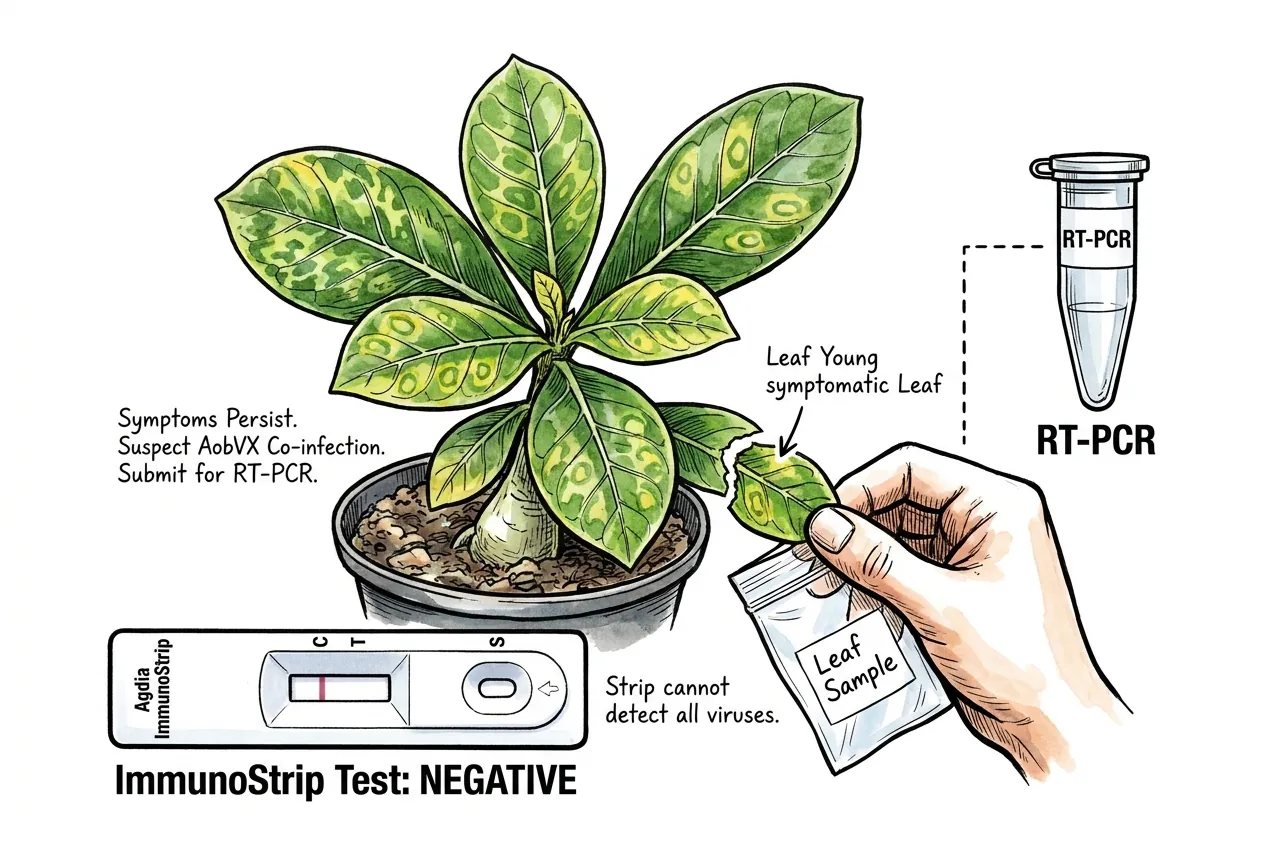
Suspect AobVX co-infection or another virus that the CMV-specific strip cannot detect.
Ask a state extension plant diagnostic clinic which assay and sample are appropriate. RT-PCR may be useful.
Find your state lab via the USDA National Plant Diagnostic Network.
Practical conclusion
Keep occurrence separate from prevalence, since a documented CMV record in Adenium does not mean the virus is in your collection. Treat a new acquisition as potentially exposed until it has been quarantined and assessed.
Use symptoms to trigger testing, not to confirm it. Mosaic, ringspots, and mottling raise suspicion, but mild mottling also has many nonviral causes, so a laboratory test is the route to confirmation.
Manage vectors without overpromising. Brief aphid probes can transmit CMV, so insecticides are not a guaranteed interruption. Use an integrated, label-compliant plan and reduce future exposure.
Interpret a negative strip carefully. A current CMV screening strip can be a first test when its target and instructions fit the case, but a negative result does not prove the plant is virus-free, especially when symptoms persist.
Quarantine and sanitize consistently. Keep new plants separate, avoid shared tools, and disinfect blades with a compatible labeled product, and use specialist advice when the virus decision is consequential.