
Dioscorea elephantipes Vine: Cut or Wait?
Decide whether a yellow Dioscorea elephantipes vine is senescing or damaged, when to leave it, when to trim it, and how to adjust dormancy care.
Maya Ellison · 2026-06-03 · Updated 2026-08-17 · 17 min read
Key Takeaways
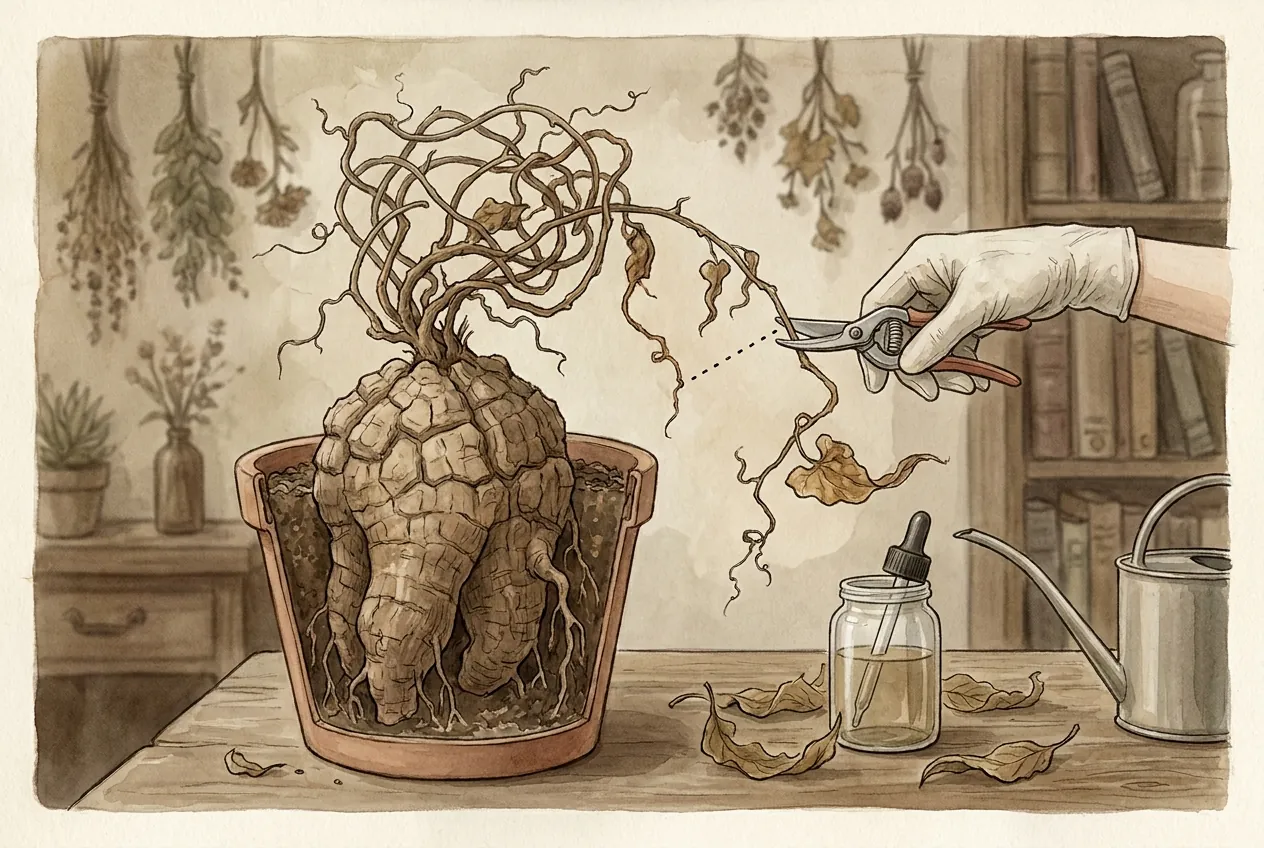
- Leave a green or partly yellow vine attached unless there is clear damage that needs intervention. Color, yellowing pattern, and a gentle release cannot prove that nutrient recovery is complete.
- Once the vine is entirely dry, leave it or trim it carefully above the crown if it is in the way. Do not pull against the growing point or follow a fixed stub-length rule.
- If the caudex or crown becomes wet, soft, foul-smelling, or rapidly worse, stop treating it as routine dormancy. Isolate the plant and investigate root or crown damage.
- Use the plant's current state, not the calendar, as the decision point. Cutting a functional vine removes useful tissue, while dismissing crown or root damage as dormancy delays help.
- Reduce water as functional leaf area falls, and keep a genuinely resting plant on the dry side. Let the mix dry and avoid calendar sips that wet only part of the root ball.
Ask whether the plant is completing a normal growth cycle or changing quickly for another reason. Habitat season, indoor conditions, pot moisture, and the condition of the caudex all provide context, but none of those observations is a diagnosis by itself.
Is the vine dying or naturally senescing?
Use Habitat Rhythm as Context, Not a Home Schedule
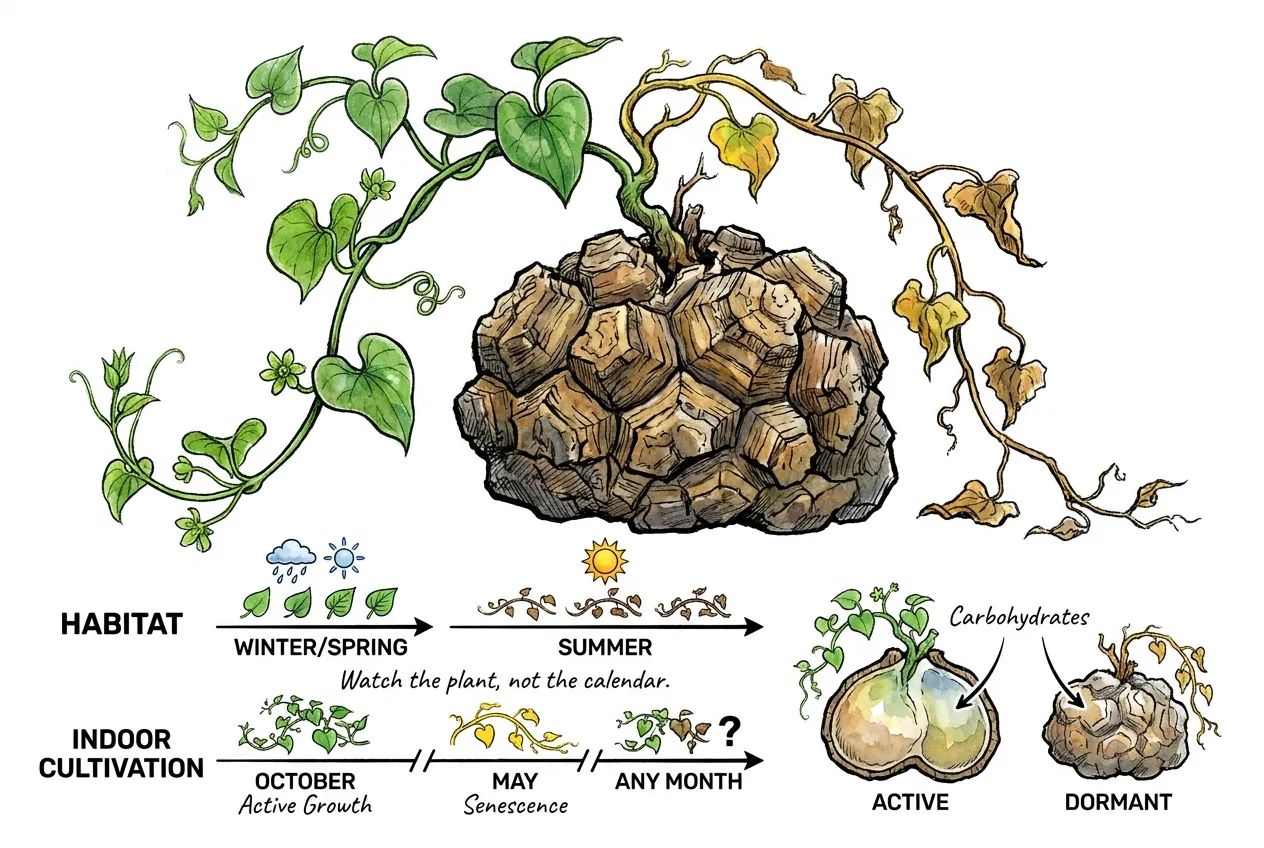
Dioscorea elephantipes is a South African, summer-deciduous geophytic climber. SANBI describes growth in winter and spring followed by a hot, dry summer rest in habitat. In the southern hemisphere, leaf drop may occur around late spring. A plant in a heated room or under artificial light does not necessarily follow the same calendar, so watching the vine and root zone is more useful than converting a habitat month to a northern-hemisphere date.
Track the pattern over several days
Normal senescence is more plausible when yellowing progresses gradually across an otherwise intact vine, the caudex remains stable, the crown is dry, and the pot is not staying saturated. Stress-induced yellowing can overlap with that pattern, so record the change over several days rather than relying on a single glance.
To make gradual vine fade visible, I divide the supported growth into crown, middle, and tip zones on a duplicate photograph anchored to the pot-rim mark. In each zone I choose one permanent node and record its leaf as green, yellowing, dry, or dropped. The route around the trellis stays visible so a hidden section does not disappear from the record when the pot is turned.
At each check, I record caudex firmness, crown condition, and pot mass beside the three leaf observations. A shielded logger at vine height and a root-zone probe store five-minute readings from sunset until two hours after sunrise. I add hours since irrigation because those fields distinguish a cold, wet night from gradual vine-wide senescence without claiming a dormancy diagnosis.
Support the vine without probing the root ball
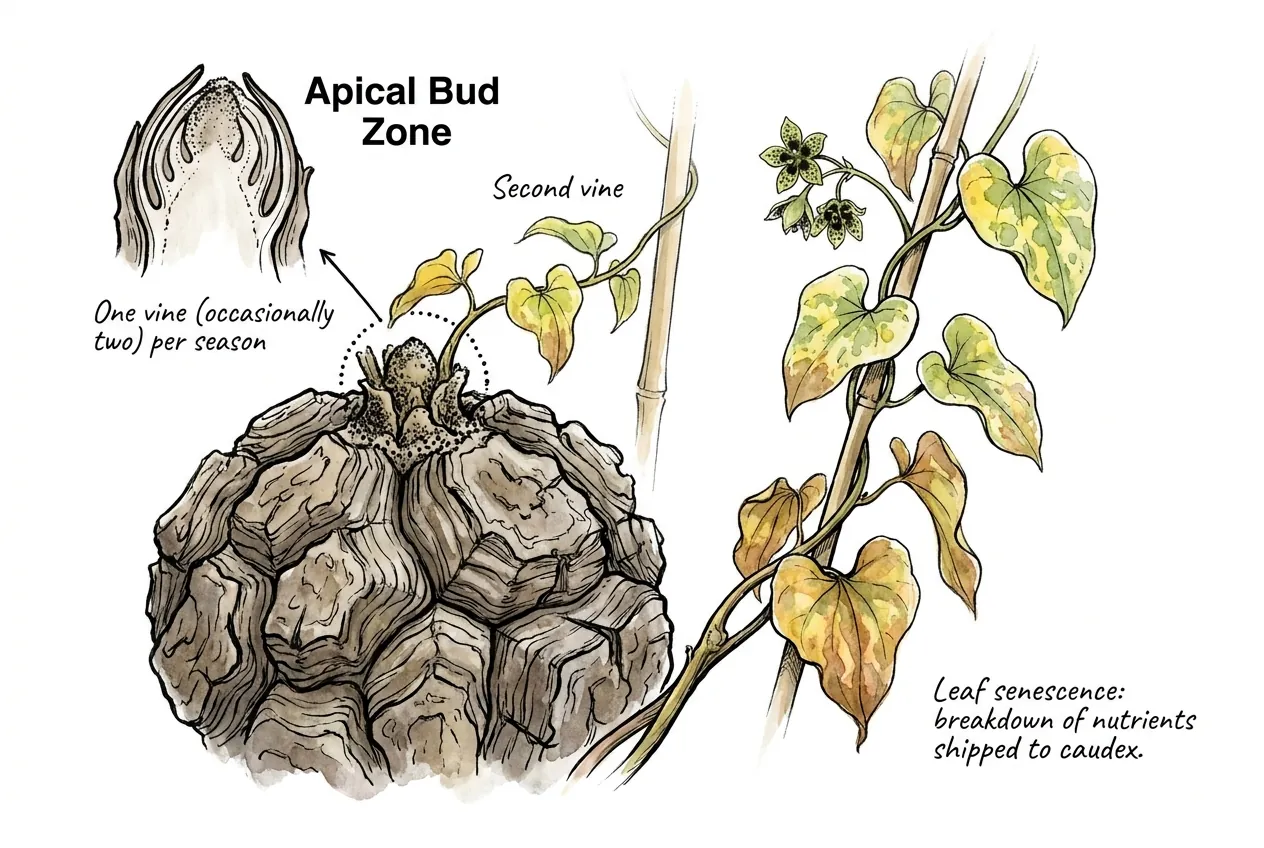
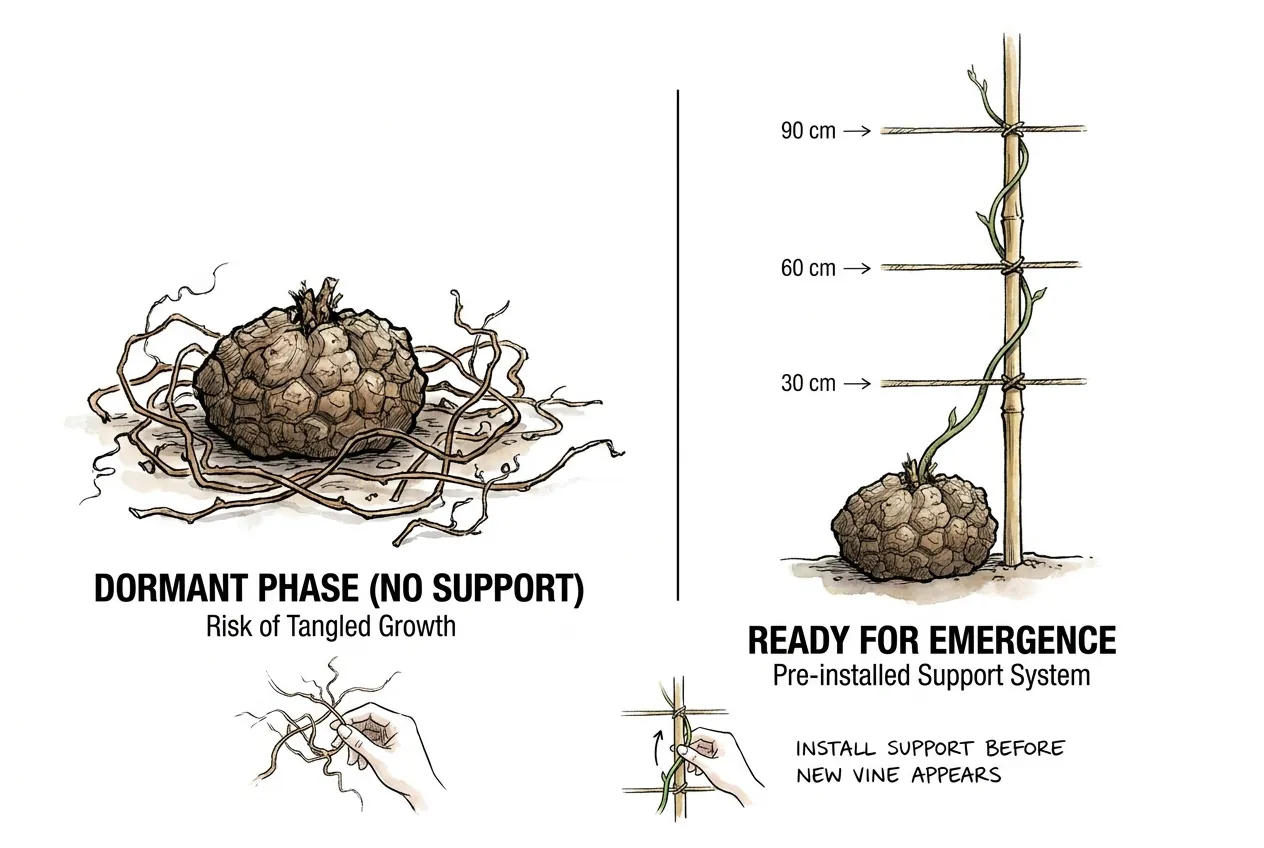
Provide support while the vine is active, but do not force an established vine off its route to make the plant look tidy. A surface-mounted hoop, trellis attached outside the pot, or other support that avoids probing through the root ball is safer than inserting a stake blindly.
Should you cut a yellow vine?
Leave Green or Partly Yellow Tissue Attached
Usually, no. If part of the vine is still green or yellow and the base is sound, leaving it attached avoids an unnecessary wound and lets any continuing photosynthesis and nutrient remobilization proceed. There is no need to impose dormancy for appearance.
Trim only fully dry material that obstructs care
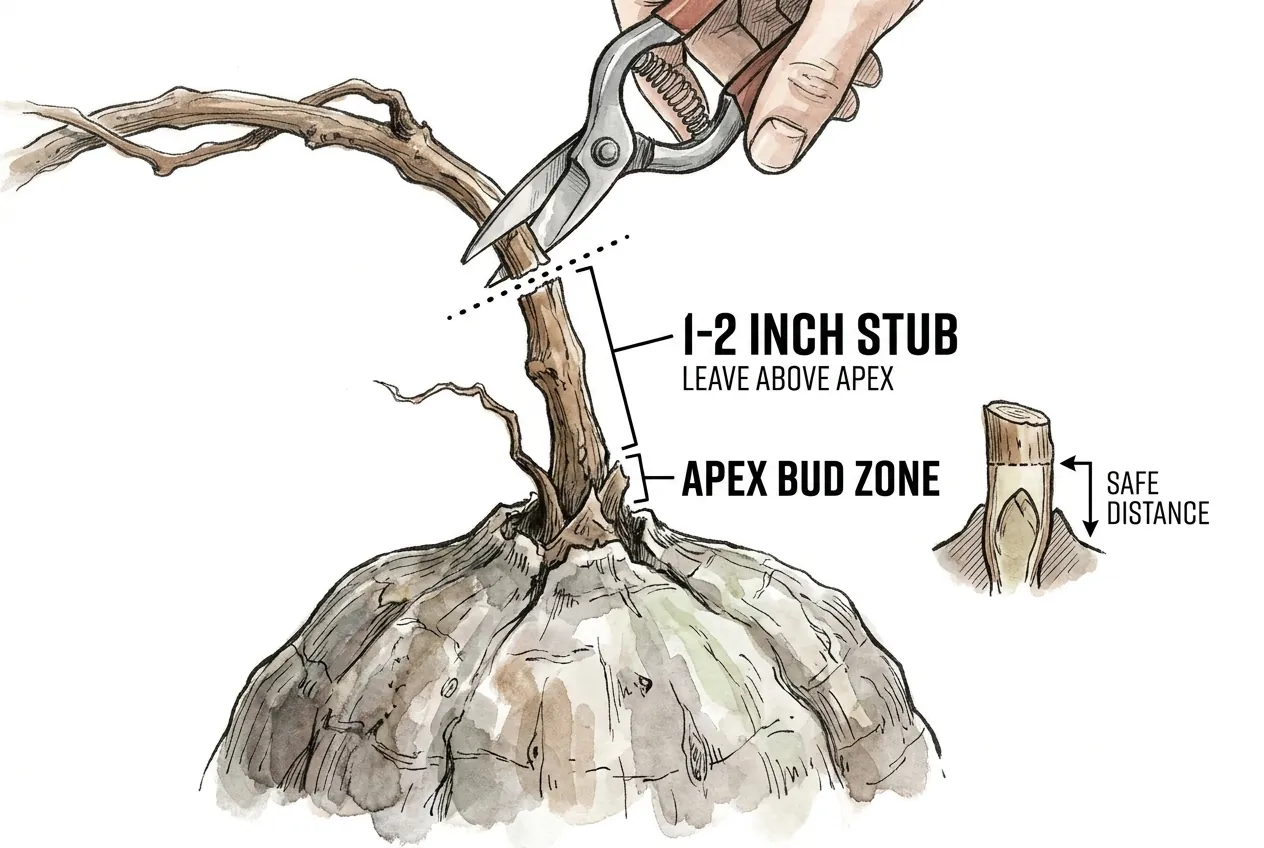
Once the vine is entirely dry, you have two reasonable options. Leave it until it releases on its own, or trim the dry stem if it tangles, obstructs access, or traps debris. Support the stem with one hand without pulling the crown, then cut the dry portion far enough above living crown tissue that the blade cannot enter the growing point. The safe distance depends on the plant and the visible anatomy. A universal stub length has not been validated.
Clean a broken vine without entering the crown
If the vine snapped while still green, clean up only a ragged free end that is catching or tearing. Do not cut into the crown in an attempt to make the break symmetrical. Watch the remaining base for drying, wet collapse, or new damage.
What does senescence actually recover?
Understand What Senescence May Recover
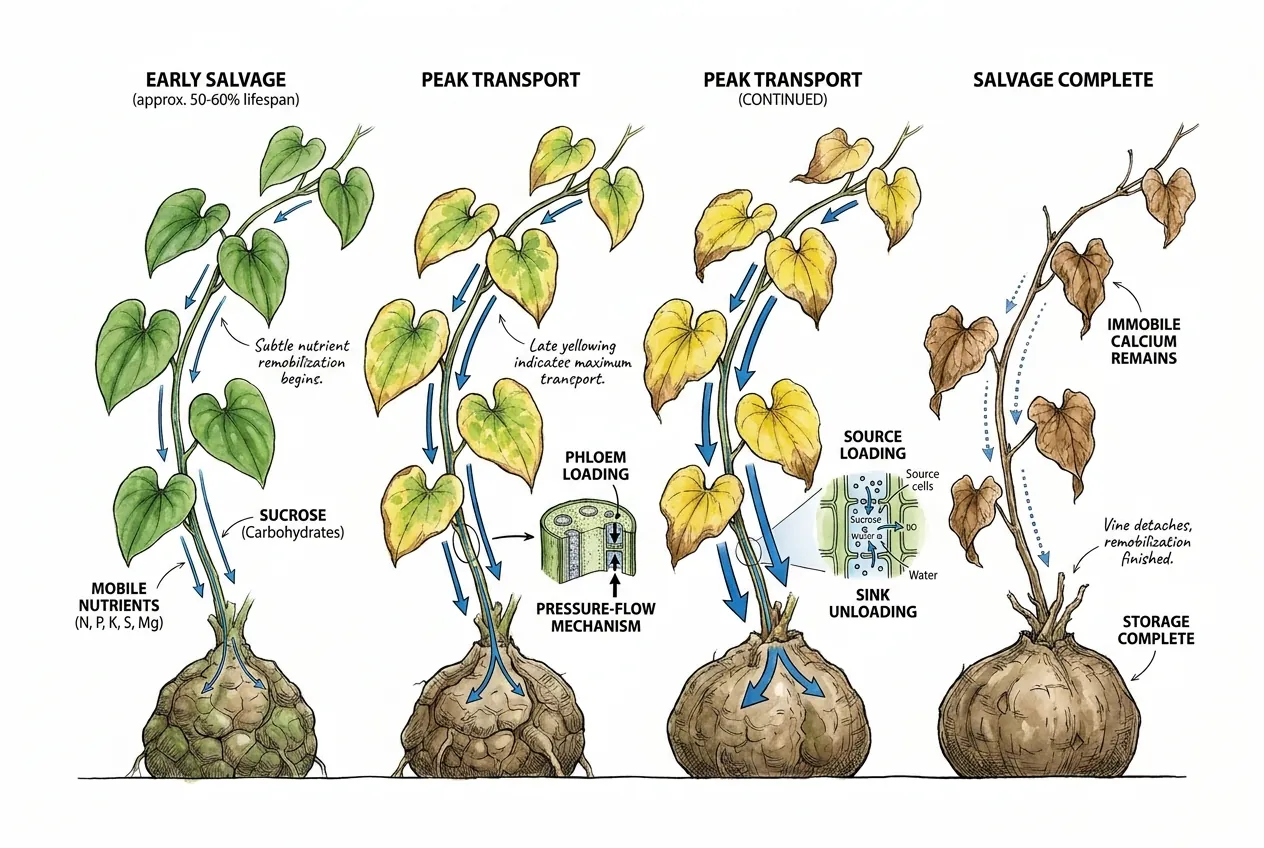
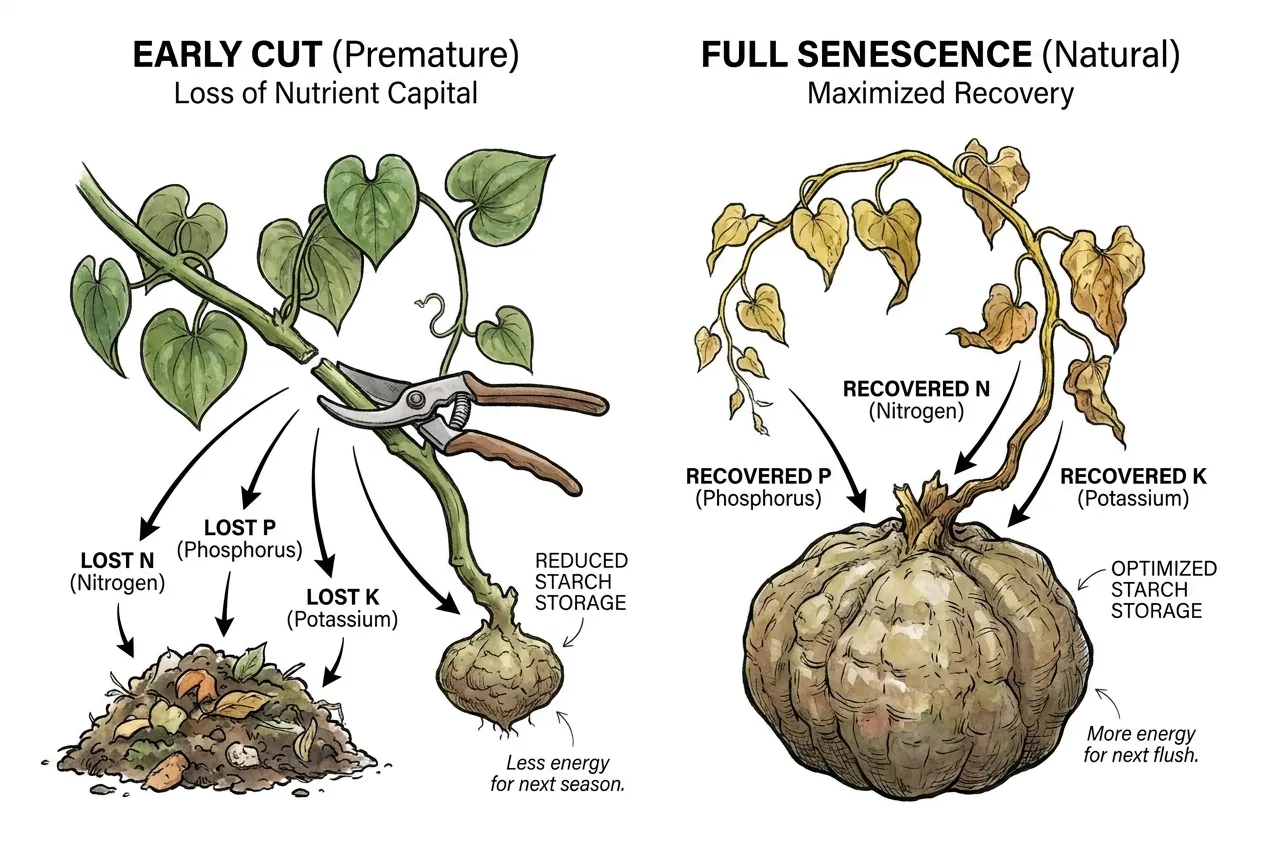
Leaf senescence is an organized transition from active photosynthesis toward dismantling and reuse. Proteins, chlorophyll-associated components, and some mineral nutrients can be broken down and transported to other tissues. That general process supports the conservative choice to leave a naturally senescing vine attached.
Do not convert other species into a recovery percentage
What the research does not provide is a D. elephantipes percentage. Published comparisons across crops and trees show wide differences among species and among nitrogen, phosphorus, potassium, and other nutrients. Those values cannot be averaged into a vine-to-caudex recovery rate or used to predict next season’s caudex growth.
Keep the conclusion bounded
The evidence supports a modest conclusion. A functioning or senescing vine may still contribute to the plant, while a fully dry vine no longer photosynthesizes. Waiting is usually cheap, but one more week cannot be presented as a guarantee of a larger caudex.
Is the light-tug test reliable?
Use Release as a Handling Cue Only
It is a rough handling cue, not a validated physiological test. Plant abscission generally involves a specialized separation zone, hormone signaling, cell-wall breakdown, organ separation, and formation of a protective surface. A dry stem that releases without force suggests that separation is advanced. It does not measure nutrient transport or prove that every recoverable nutrient has moved.
Never pull a resistant vine
Do not tug a green, yellow, or resistant vine repeatedly. Mechanical resistance can also come from tangled support, dried fibers, or a break above the natural separation zone. If the base does not release with essentially no force, leave it or trim only the dry portion above the crown.
When is urgent intervention justified?
Escalate When the Caudex or Crown Changes Rapidly
Intervene when the evidence points beyond ordinary leaf aging. Concern rises when the caudex or crown becomes wet or soft, a lesion expands, tissue sloughs, odor appears, the pot stays heavy, roots collapse, or several plants develop a similar problem. These signs justify investigation, but they do not identify a pathogen on their own.
| Pattern | Reasonable first interpretation | Action |
|---|---|---|
| Gradual yellowing, dry crown, stable firm caudex | Natural senescence is plausible | Leave the vine and reduce watering in response to declining growth |
| One-sided pale or dry patches after a light/heat change | Exposure injury is plausible | Stop the abrupt exposure and acclimate gradually. Do not force dormancy. |
| Rapid wilt while the mix is dry and the plant was hot | Water stress or root failure are both possible | Check the root zone before reflexively soaking |
| Soft or wet crown, expanding lesion, odor, sloughing roots | Active tissue breakdown is concerning | Isolate, document, unpot carefully, and seek diagnostic help for a valuable or unclear case |
Diagnose before applying a product
Do not respond to an uncertain soft spot with sulfur, copper, or 3% hydrogen peroxide. Those are not interchangeable wound treatments, and the correct product, if any, depends on diagnosis and the current label. The Adenium root-rot triage explains the same diagnose-before-you-cut principle. For a rare Dioscorea, a plant diagnostic clinic or experienced caudiciform nursery is the better escalation point.
Which cutting tool fits a dry vine?
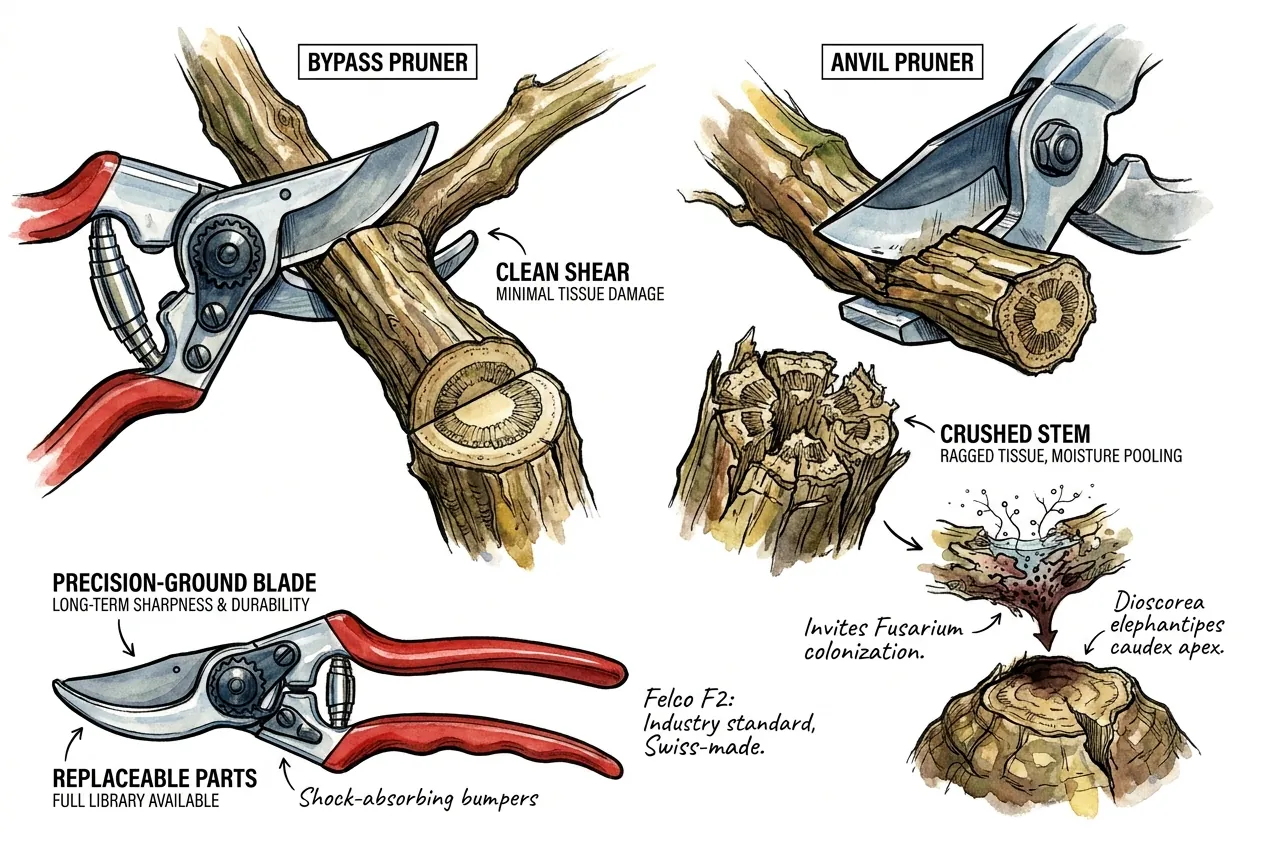
Match the Tool to the Dry Stem
Use the smallest sharp tool that can control the dry stem without crushing, twisting, or bringing the blade close to the caudex. Clean debris from the cutting surfaces, disinfect them, and let them dry before use. Wear gloves because RHS lists D. elephantipes as a skin irritant and toxic if eaten.
Choose a larger pruner only for broader work
The linked FELCO 2 is a repairable right-hand bypass pruner intended for broad garden work. The current official specification is 215 mm long, 251 g, and up to 25 mm cutting capacity. It makes sense for a large-handed grower who also prunes shrubs and woody stems, but it is expensive and oversized for one dry Dioscorea vine.
Use a no-purchase alternative when it fits
If broader use justifies a bypass pruner, compare the exact FELCO 2 listing with the official model and parts. For a medium right hand, the linked FELCO 6 is shorter at 195 mm and lighter at 219 g. Neither model is the default purchase for this one task. Clean scissors or fine snips that already fit the dry stem are the no-purchase alternative.
How should dormancy watering change?
Reduce Water as Functional Leaf Area Falls
Reduce watering as the vine loses functional leaf area, but do not use a fixed half-watering rule at first yellowing. The pot’s dry-down changes with temperature, light, root health, container size, and substrate. A plant that is still green and taking up water is not managed like a fully leafless plant in a cool rest.
At first yellowing, I photograph the vine against a fixed two-by-five background grid and count the cells containing green tissue. I retire the leafy-season interval when half or fewer of the starting occupied cells remain. That halfway point is my repeatable switch, not a biological dormancy threshold, because a few yellow leaves should not reset the baseline.
I pair pot mass after 30 minutes of free drainage with its 24-hour mass and the current occupied-cell count. As green area disappears, that pot’s 24-hour loss becomes its new baseline rather than a fraction of the old schedule.
Keep full dormancy dry without calendar sips
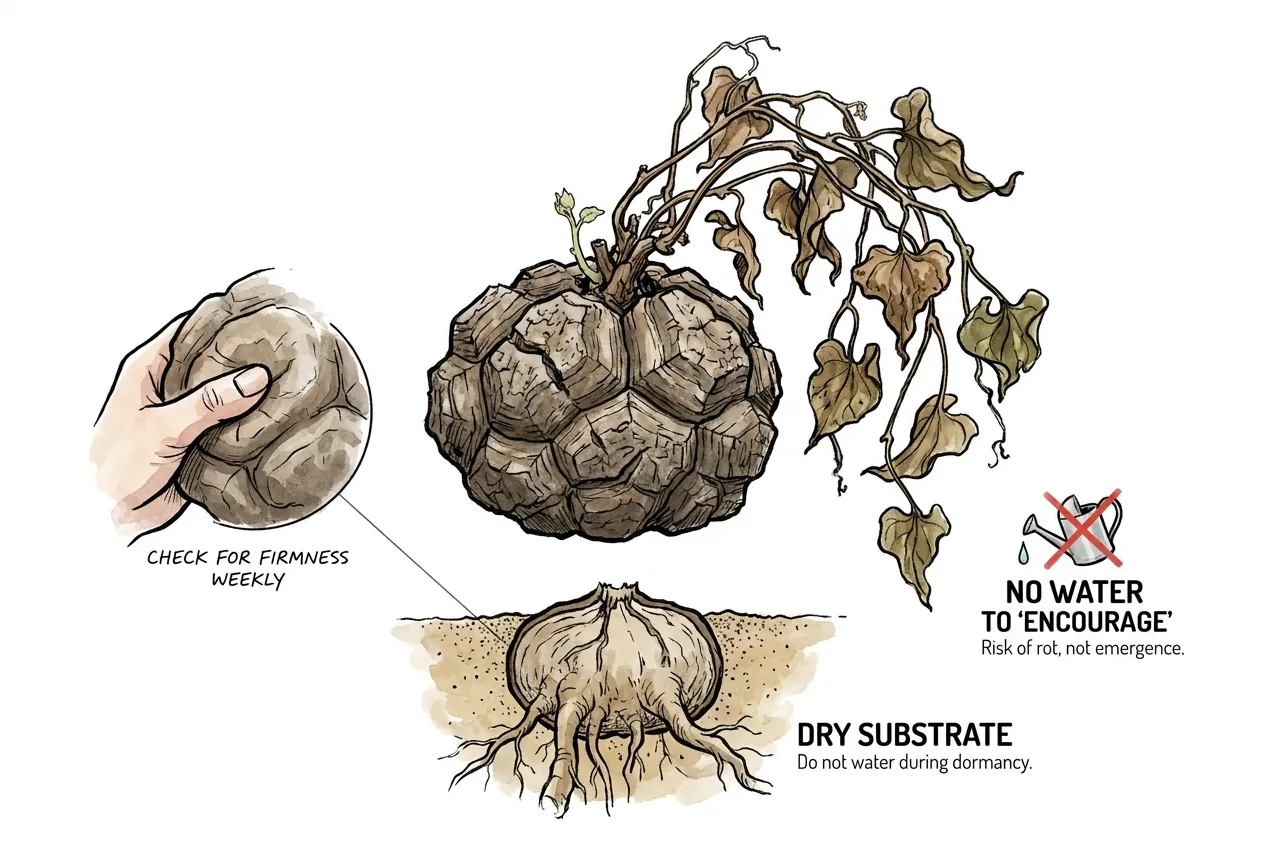
For an established, leafless, genuinely resting plant, SANBI’s central warning is to avoid summer overwatering, while RHS gives a dry-rest recommendation under its UK glasshouse framework. That supports a dry bias, not a universal three- or six-week drink. Let the mix dry, prevent standing water, and avoid calendar sips that repeatedly wet only one part of the root ball.
Give seedlings and recovering plants separate rules
Seedlings, freshly rooted plants, and specimens that continue active growth need separate judgment. If you are uncertain whether a leafless plant has viable roots, repeatedly adding water to wake it is riskier than checking the root zone and obtaining species-experienced advice.
What substrate, light, and temperature fit dormancy?
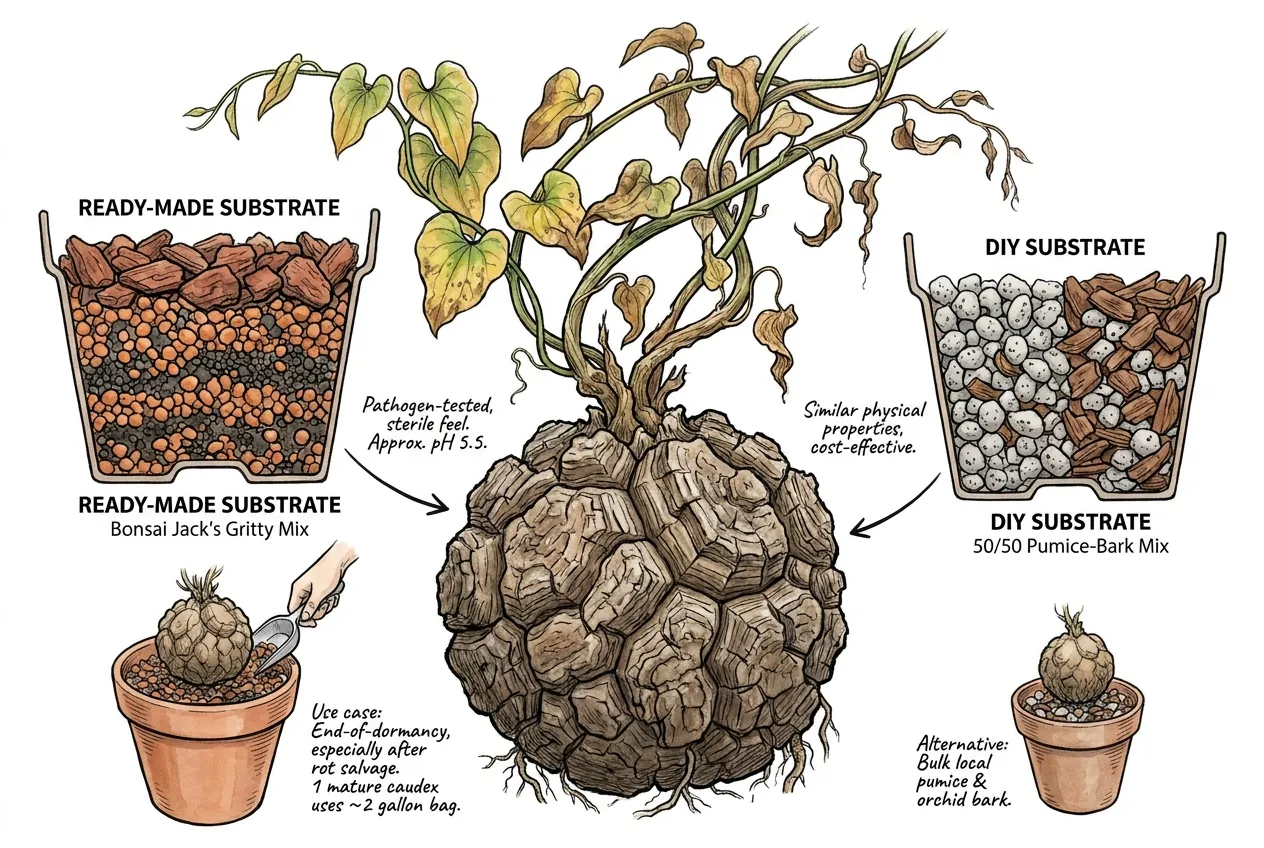
Judge the Finished Mix, Not One Ingredient Ratio
A well-drained mix is appropriate, but an inorganic majority is not a complete specification. The same ingredient ratio behaves differently in a shallow clay pot and a tall plastic pot. Particle size, fines, root density, temperature, and how completely the mix re-wets all matter. Use the substrate comparison to design a small trial instead of adopting a universal recipe.
Buy a ready blend only when dry-down fits
The linked Bonsai Jack Gritty Mix is a convenient premium blend of pine bark, calcined clay, and Monto Clay. The manufacturer says the ideal percentage varies with plant and microclimate, which is the important limitation. Buy it when you want a screened, ready-to-use coarse blend and can monitor its fast dry-down. Skip it if your current clean mix already works or if a root-poor plant needs more even moisture retention.
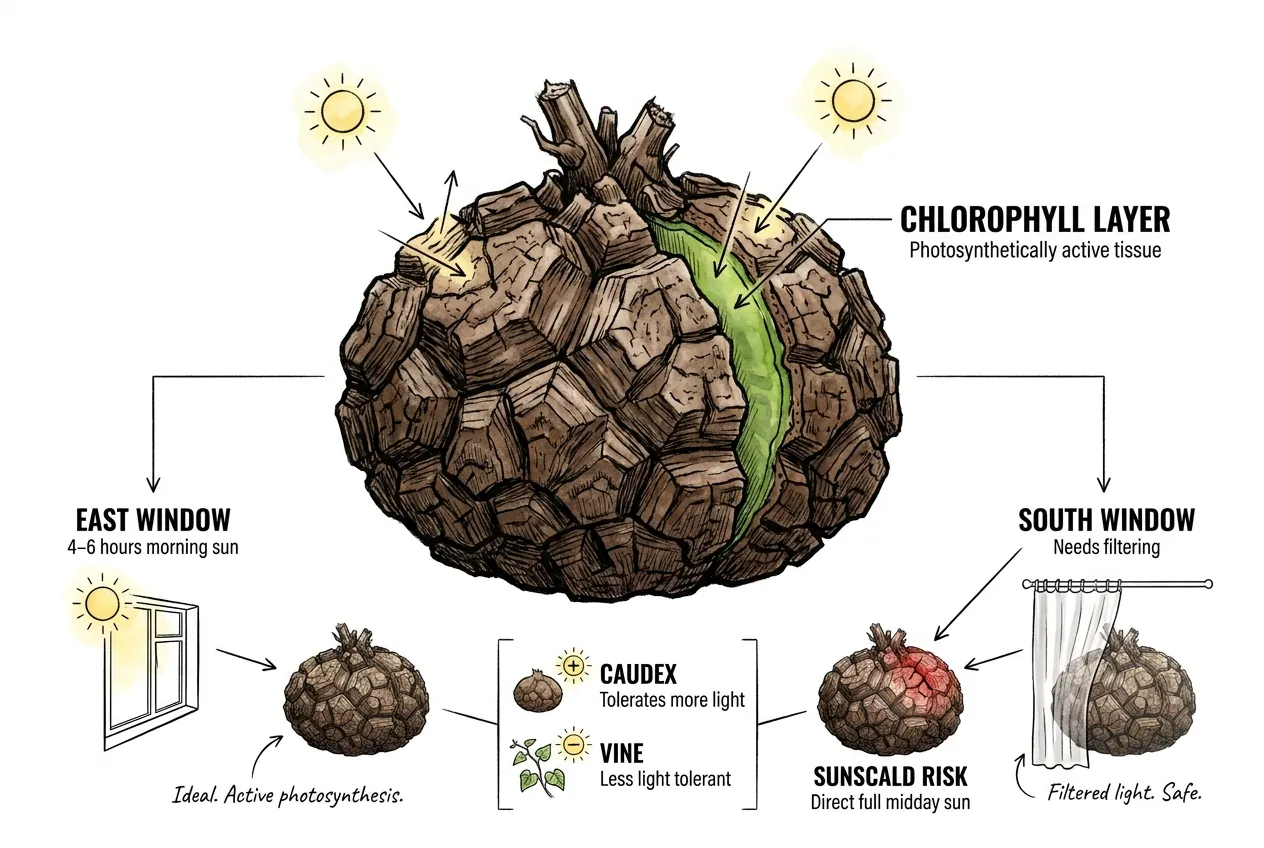
Acclimate light changes gradually
Keep the resting plant in bright, safe conditions rather than moving a previously shaded caudex into harsh direct sun. The thick cork does not prove that the leafless caudex can tolerate more radiation than the vine. If light changes, acclimate gradually and monitor surface temperature and discoloration.
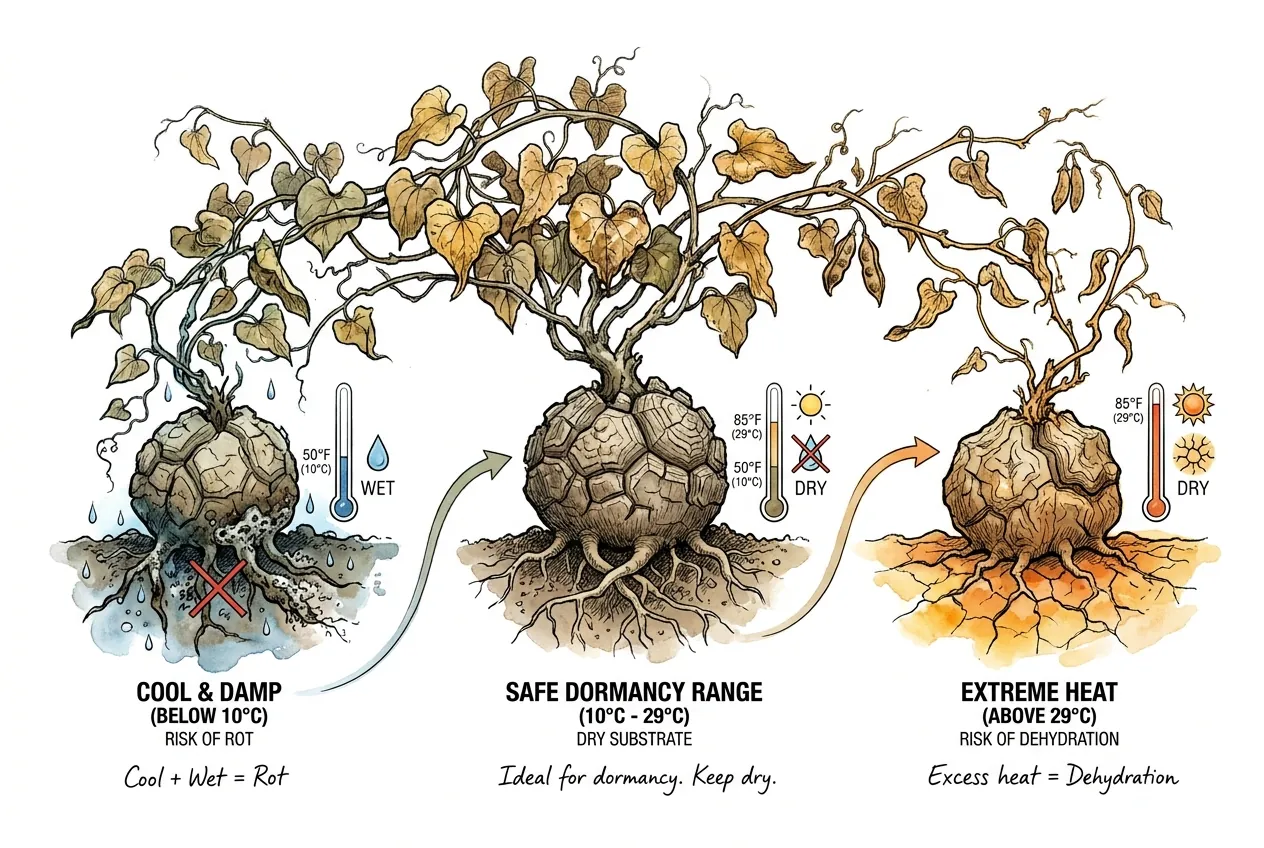
Use stable, frost-free conditions
SANBI’s habitat notes include both high heat and brief cold, but those observations do not establish a 10–29°C safe band for a potted plant. A small pot has less thermal buffering than a habitat-grown caudex. Use stable, frost-free conditions and manage moisture with temperature rather than chasing one number.
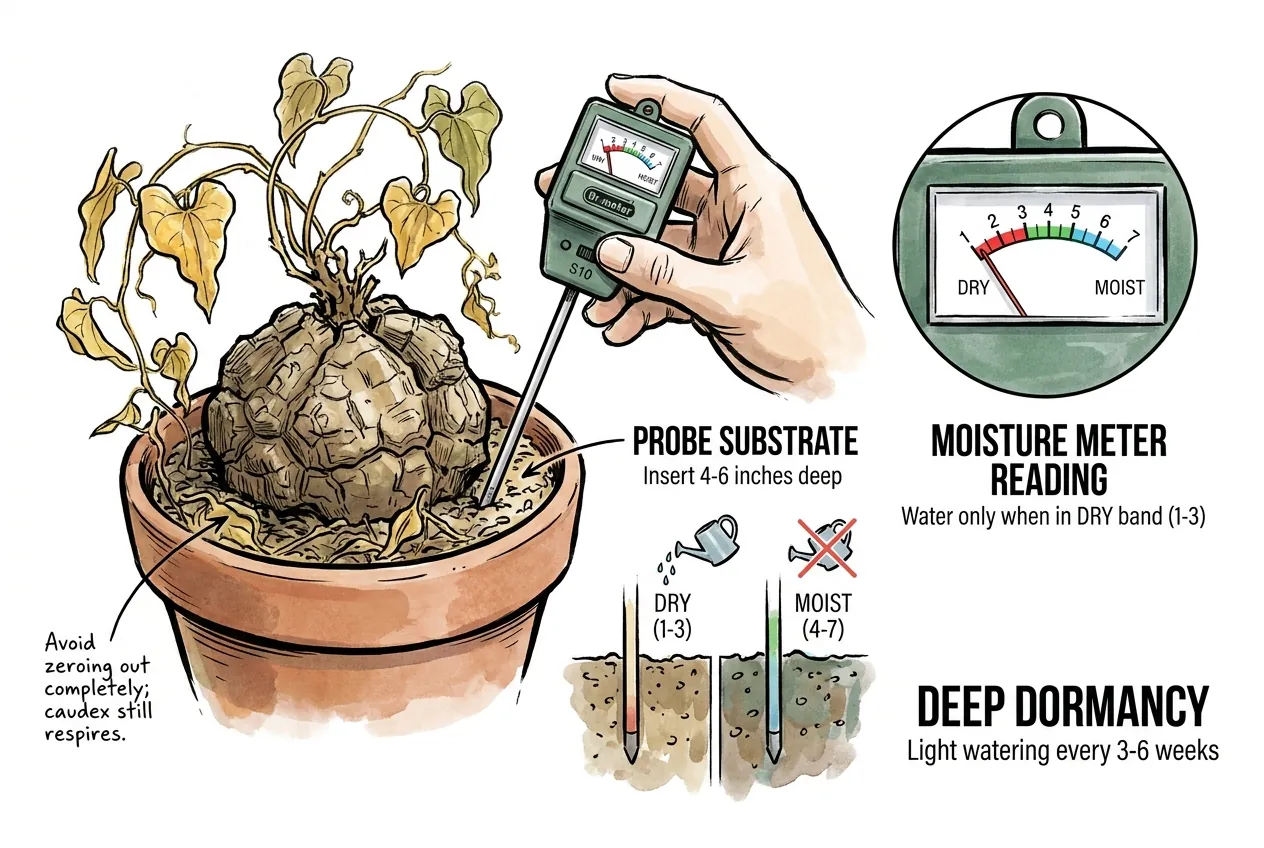
Use a moisture meter only as a calibrated trend
The linked Dr.meter S10 has an eight-inch single probe and a 1–10 dial, but it should not make the watering decision for a coarse low-EC mix. Buy it only as a cheap secondary trend tool after testing it against known wet and dry pots. Skip it if pot mass, visible drainage, and a repeatable dry-down log already answer the question more reliably. Never force the probe through aggregate or leave it in the pot.
When should you resume water and fertilizer?
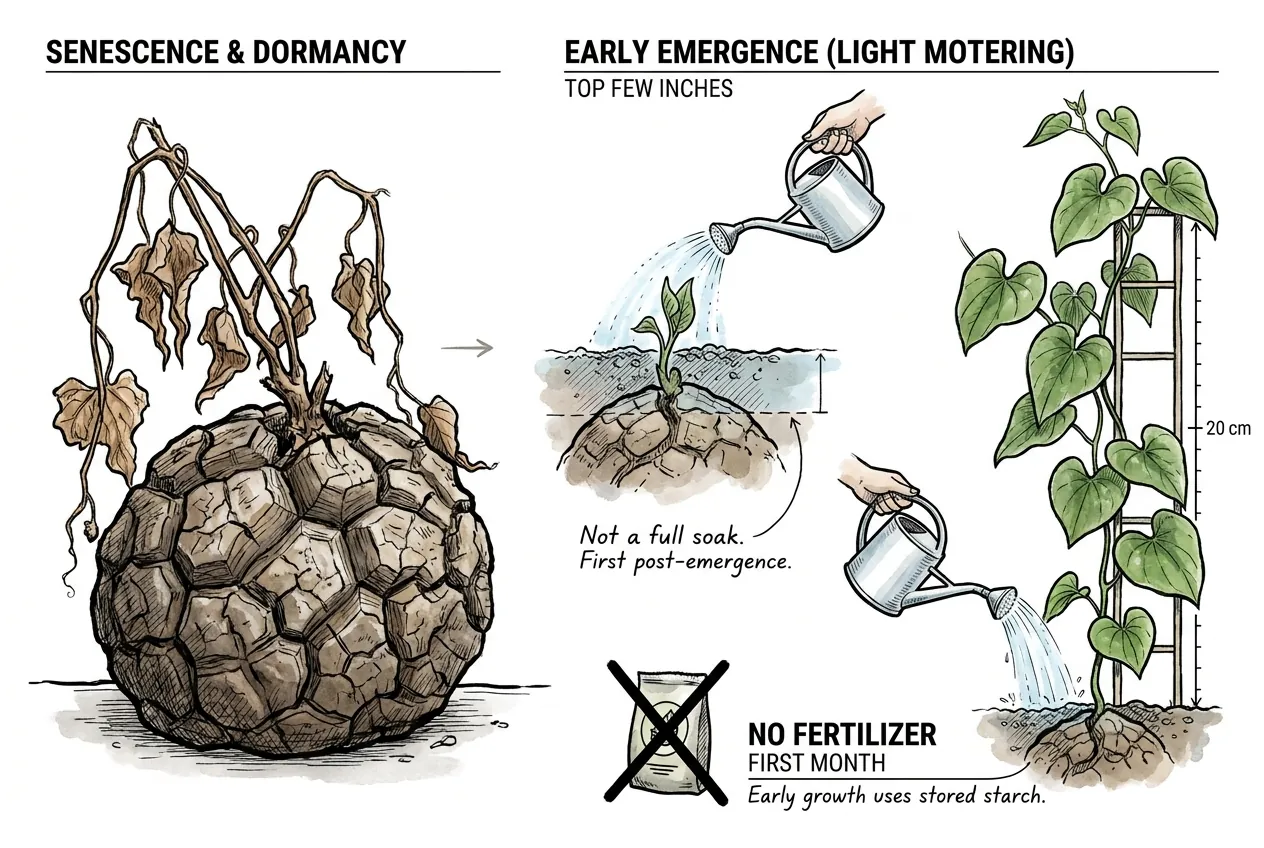
Resume Water from a Fresh Shoot and Dry-Down
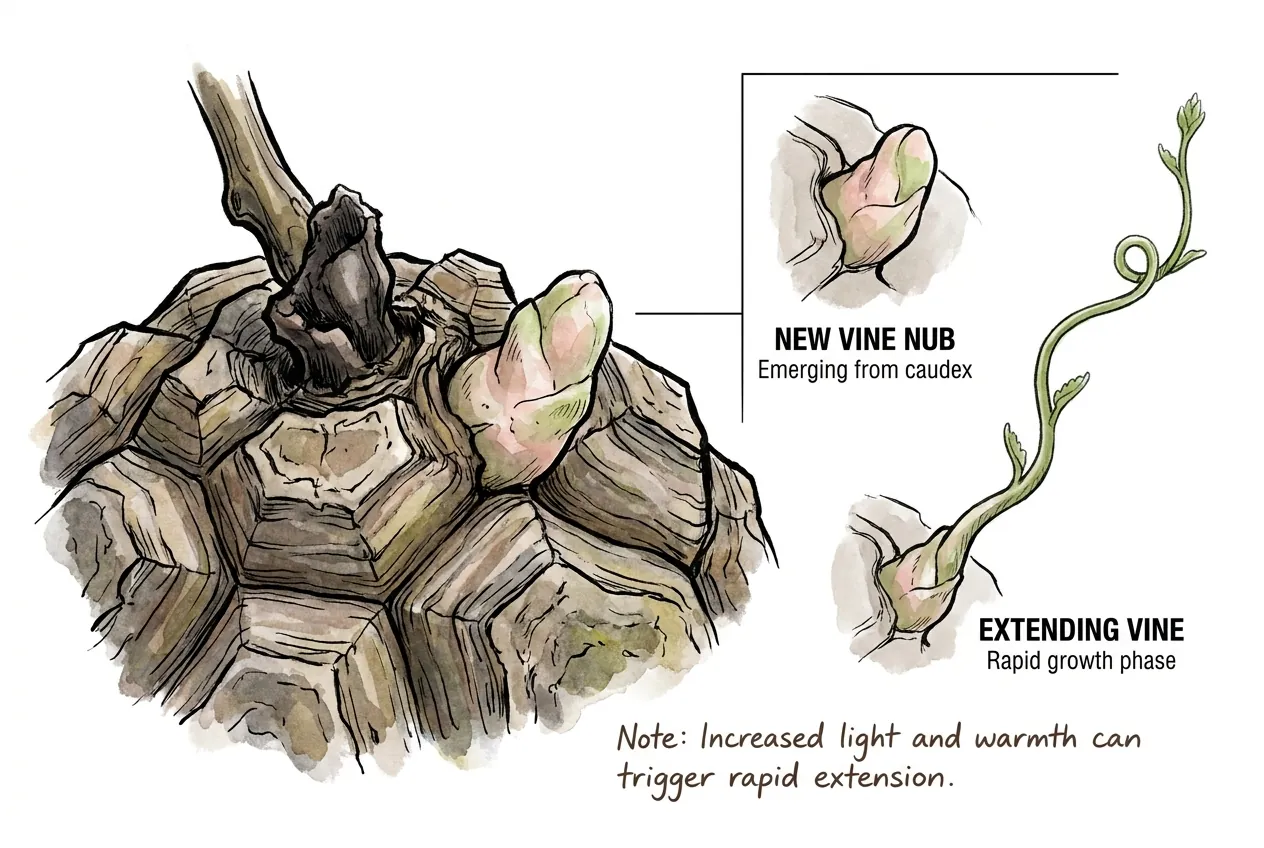
A fresh shoot at the crown is the clearest practical sign that active growth is returning. Check that the pot is not already wet, then reintroduce water in a way that moistens the root zone evenly and drains freely. Increase frequency only as uptake, leaf area, temperature, and dry-down increase.
When growth returns, I call the first crown shoot that lengthens by at least 1 mm day zero. I photograph it beside a metric ruler showing 1 mm divisions in the same plane without touching the tip. The first three leaves receive permanent identifiers as they unfold, and I record shoot length, leaf opening, pot mass, and root-zone temperature on the same dates.
Shoot extension alone never counts as a full restart in my notes because stored reserves can support early growth. I require continued extension, new leaves, and a repeatable increase in water use across later cycles. A stalled shoot beside a persistently heavy pot sends me to the root zone instead of another wake-up watering.
Keep other species’ dormancy phases out of this schedule
Do not transfer the 220/35/10-day dormancy phases reported for one cultivated white-yam system to D. elephantipes. They describe another species, genotype, organ, and research endpoint. They do not prove that water is useless before the shoot appears or set an indoor elephant’s-foot schedule.
Fertilize only after active growth is established
Fertilize only after growth is established and the root zone is functioning. Use the current label, source-water quality, substrate, and observed EC to choose concentration and interval. There is no validated first-30-days ban or one-eighth-teaspoon recipe for this species.
Use a complete fertilizer only for a real nutrient need
The linked SUPERthrive Foliage-Pro 9-3-6 is a complete liquid nutrient, not a dormancy treatment. Buy it if you need one complete soluble fertilizer and can measure a conservative program. Skip it if your current complete feed is working, the plant is leafless, roots are compromised, or the mix already shows salt buildup.
What should you do if the caudex softens or wake-up stalls?
Isolate and Document Before Changing the Setup
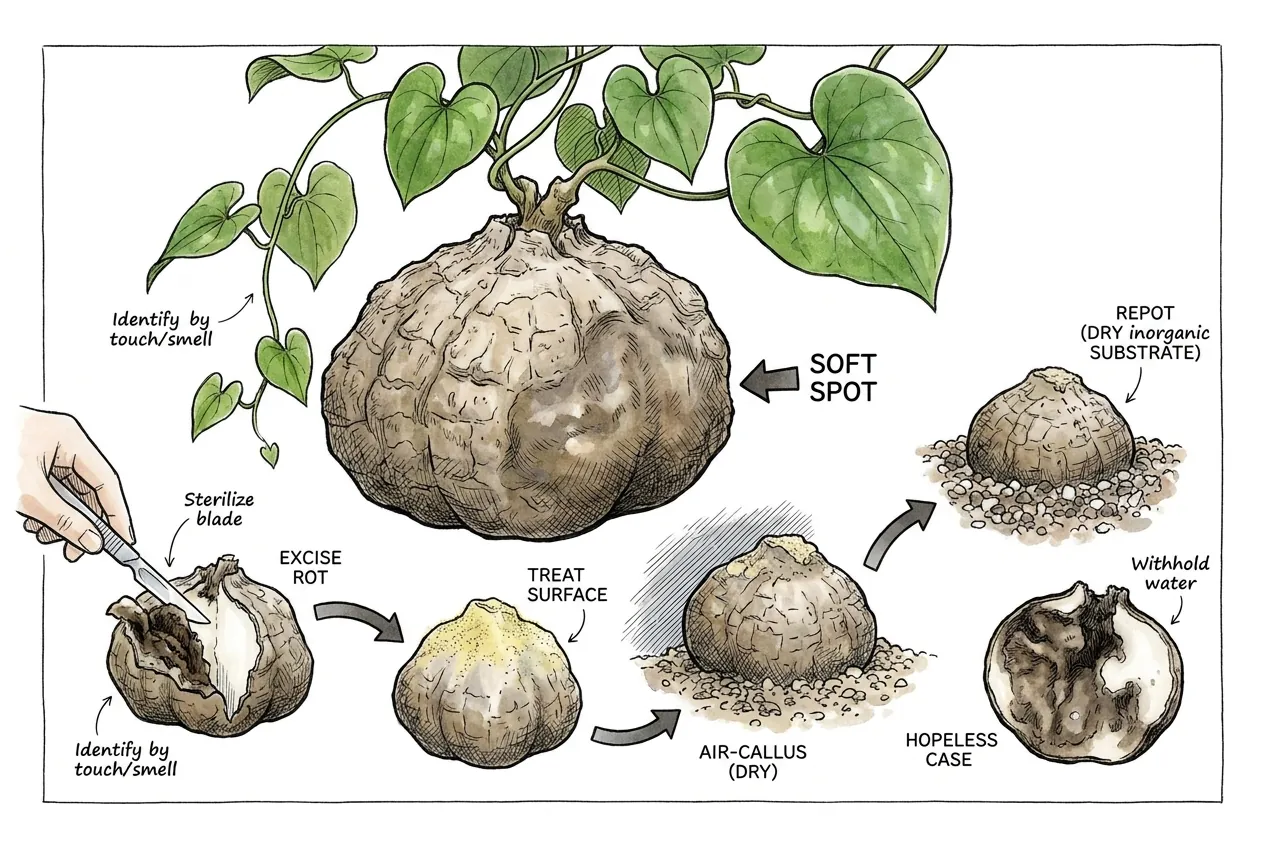
First isolate and document the plant. Stop leaving water in the saucer or cachepot, but do not impose a long dry cure before you know whether roots are alive. If the area expands, tissue is wet or sloughing, the crown loses structure, or roots collapse, unpot on a clean surface and seek diagnostic help for a valuable plant.
Protect yourself from irritant tissue
Do not smell a lesion closely, handle the plant bare-handed, or cut repeatedly until the interior looks white. RHS identifies the plant as a skin irritant and toxic if eaten. Wear gloves and suitable eye protection, keep children and pets away, and use the repotting protective-gear guide for ordinary equipment fit.
Check the root zone before forcing wake-up
If wake-up stalls, compare the plant with its own baseline. Check whether the caudex is stable, the mix is wet, temperatures recently changed, and roots were disturbed. Do not keep watering an already moist pot. If the plant is firm and stable, patience is often lower risk than a hormone, heat, or soaking treatment.
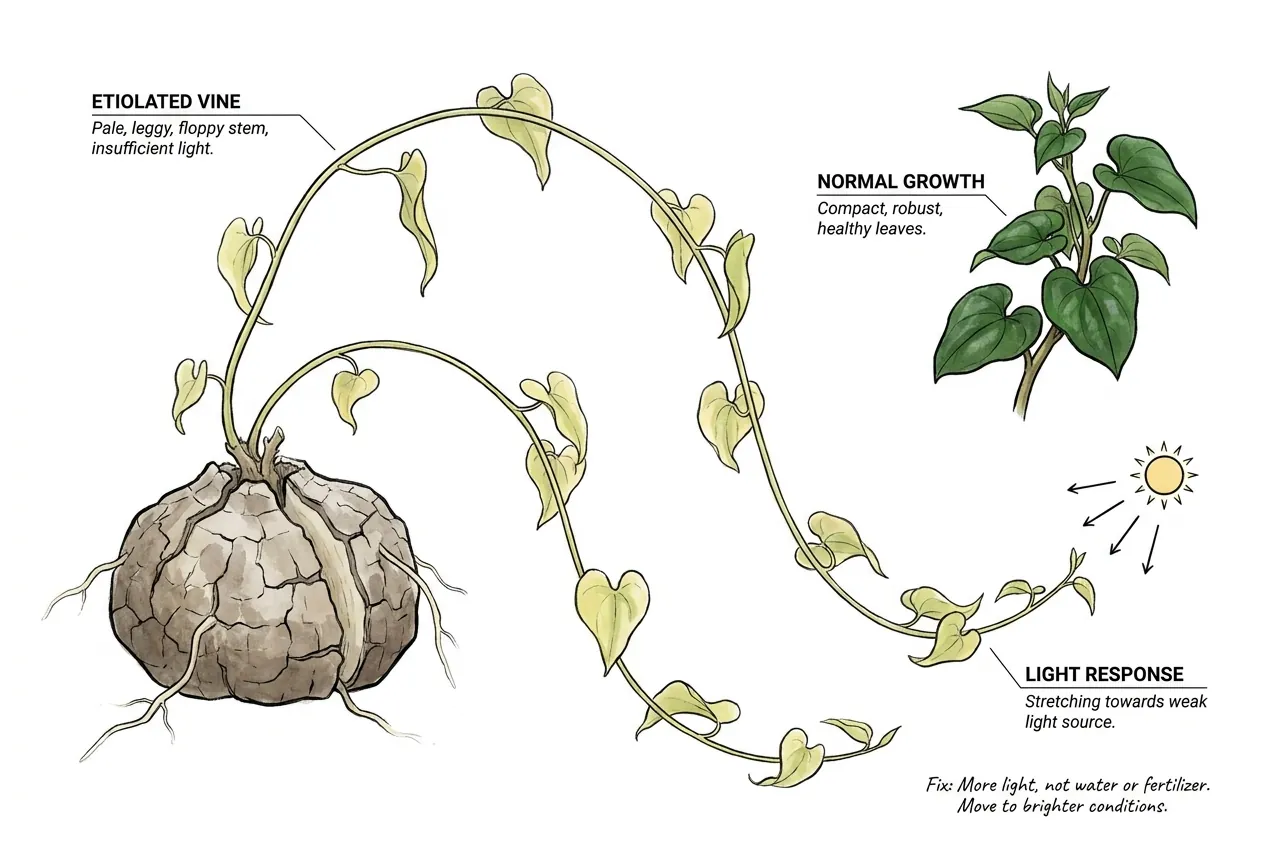
Measure light before correcting pale growth
For a pale, elongated vine, measure the light at the leaves and acclimate any increase gradually. Existing stretched growth will not become compact. The caudex grow-light guide explains how to use canopy measurements rather than a fixed window orientation or lamp distance.
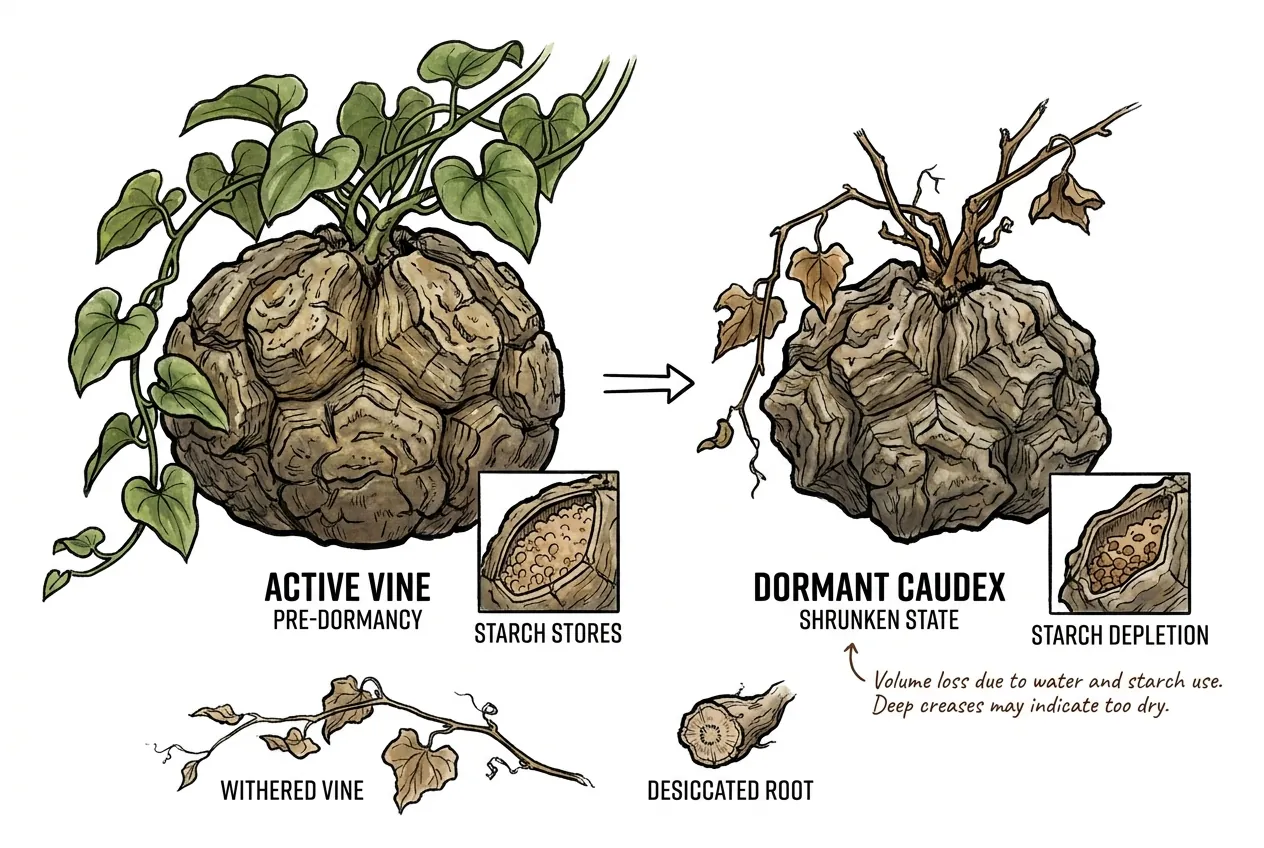
Measure shrinkage alongside pot moisture
If the caudex shrinks, do not choose water from appearance alone. Compare a repeatable measurement, pot moisture, temperature, roots, and the speed of change. Gradual mild wrinkling on a dry, stable plant is different from rapid collapse above a wet or failed root system.
| Product | Buy only when | Skip when |
|---|---|---|
| FELCO 2 | You need a large right-hand, repairable pruner for broader garden work | You need one thin-vine cut or the grip does not fit |
| FELCO 6 | You need a compact medium right-hand pruner for broader use | Existing clean snips fit the dry stem, or you need a left-hand model |
| Bonsai Jack Gritty Mix | You value a screened ready blend and its dry-down fits the real pot | Your current clean mix works or the plant needs more moisture retention |
| Dr.meter S10 | You will calibrate it only as a secondary relative trend | You expect a dry reading to mean water now in coarse media |
| Foliage-Pro 9-3-6 | An actively growing, rooted plant needs a complete soluble fertilizer | The plant is resting, stressed, root-damaged, or already adequately fed |
Keep the final decision simple
The cut-or-wait decision rarely requires a shopping list. Leave a functioning vine, trim only fully dry material when necessary, reduce water as activity declines, and investigate the caudex rather than just the leaf color when change is rapid.
Affiliate Disclosure
This article contains Amazon affiliate links. As an Amazon Associate I earn from qualifying purchases. If you use these links, the site may earn a commission at no extra cost to you. Product availability, price, and specifications can change. Check the current listing before buying.