
Cyphostemma Juttae Sunburn: Bark Split Prevention
Cyphostemma juttae sunburn and bark-split guide: protect the natural bark, acclimate gradually, choose shade or surface protection carefully, and monitor wounds for rot.
Nathan Brooks · 2026-06-06 · Updated 2026-06-24 · 18 min read
Key Takeaways
- Keep the papery bark in place and acclimate a stripped, imported, or recently shaded plant gradually. Sudden full sun is a common route to damage.
- Read splitting as a combined stress of light, heat, hydration, and tissue history. Heavy watering after severe heat is a plausible risk, not a validated species-specific trigger.
- Set the exposure pace from cooler periods and surface response, not a calendar. No universal acclimation schedule or temperature cutoff applies to every plant.
- Treat reflective shade, kaolin, or a compatible coating as conditional aids. Product suitability and the local label matter more than a default shade percentage.
- During heat, let the mix and roots determine watering, and keep any split clean, dry, shaded, and under observation. Do not follow an unvalidated grading recipe.
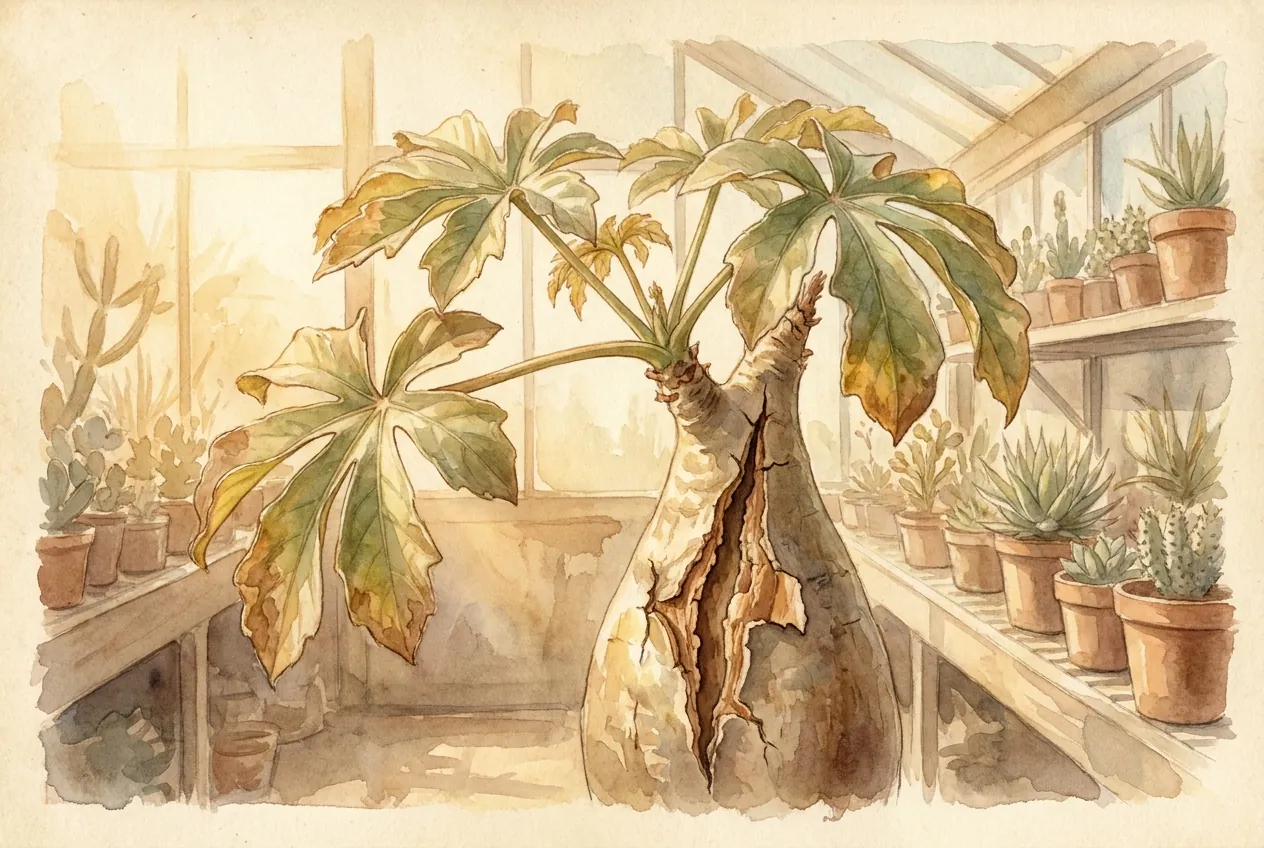
Cyphostemma juttae is adapted to bright, dry conditions, but a container plant can still burn or split when exposure changes faster than the tissue can acclimate.
Bark splitting is not a heat problem alone. Light, temperature, hydration, bark condition, and wound history can interact, so the same event will not produce the same result on every plant.
Use those factors to choose exposure, shade, watering, and post-injury monitoring decisions.
Why can Cyphostemma juttae crack in summer?
The wild plant develops a protective surface under its native exposure. A cultivated plant may have a different exposure history and therefore need a slower transition.
Cyphostemma juttae is native to Namibia, including northwestern and north-central areas in desert and dry shrubland.
SANBI describes its habitat as very dry and hot, rocky open scrub. It is a summer grower that is deciduous in winter.
Some hobby sources extend the range or list a dolomite preference, but those claims are not confirmed by authoritative botanical databases, so treat them cautiously.
Rocky, open sites can drain quickly and expose tissue to large day–night swings, but a container mix and local position will behave differently.
The species has a peeling, papery, cream-white cork layer that may shed and rebuild with seasonal growth.
The pale layer changes how the surface reflects and absorbs radiation, but its cooling effect depends on coverage, angle, airflow, and local sun.
No fixed albedo or surface-temperature conversion has been established for this species.
Removing the papery layer exposes greener tissue to radiation before a new protective surface forms, increasing risk during subsequent exposure.
Is the peeling white bark dirty or diseased?
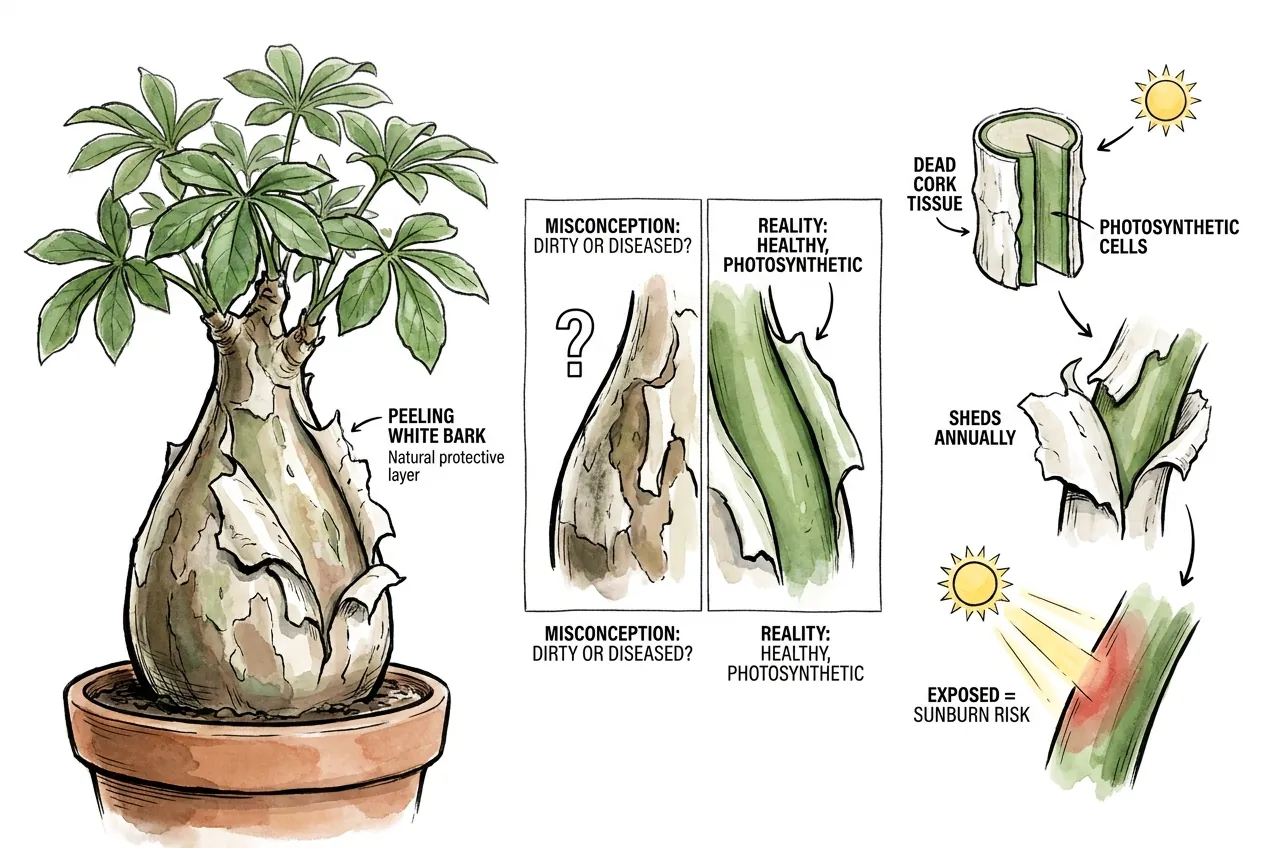
Usually not. It is often the species’ normal shedding surface, although discoloration, odor, or soft tissue still warrants inspection.
The papery layer is dead cork tissue that can become pale and shed as the plant grows.
The yellow-green smooth surface underneath contains chlorophyll in cortical tissue and may contribute some photosynthesis.
Stripped of the papery cover, it is a more exposed green surface and may be vulnerable to excess-light stress, including photosystem II (PSII) damage.
If your plant is showing intact white papery shreds, avoid removing them without a clear reason.
If it is glossy smooth green after stripping or abrasion, provide gradual exposure and consider a compatible protective measure only after checking the tissue and product label.
Why are imported and freshly repotted plants more vulnerable to sunburn?
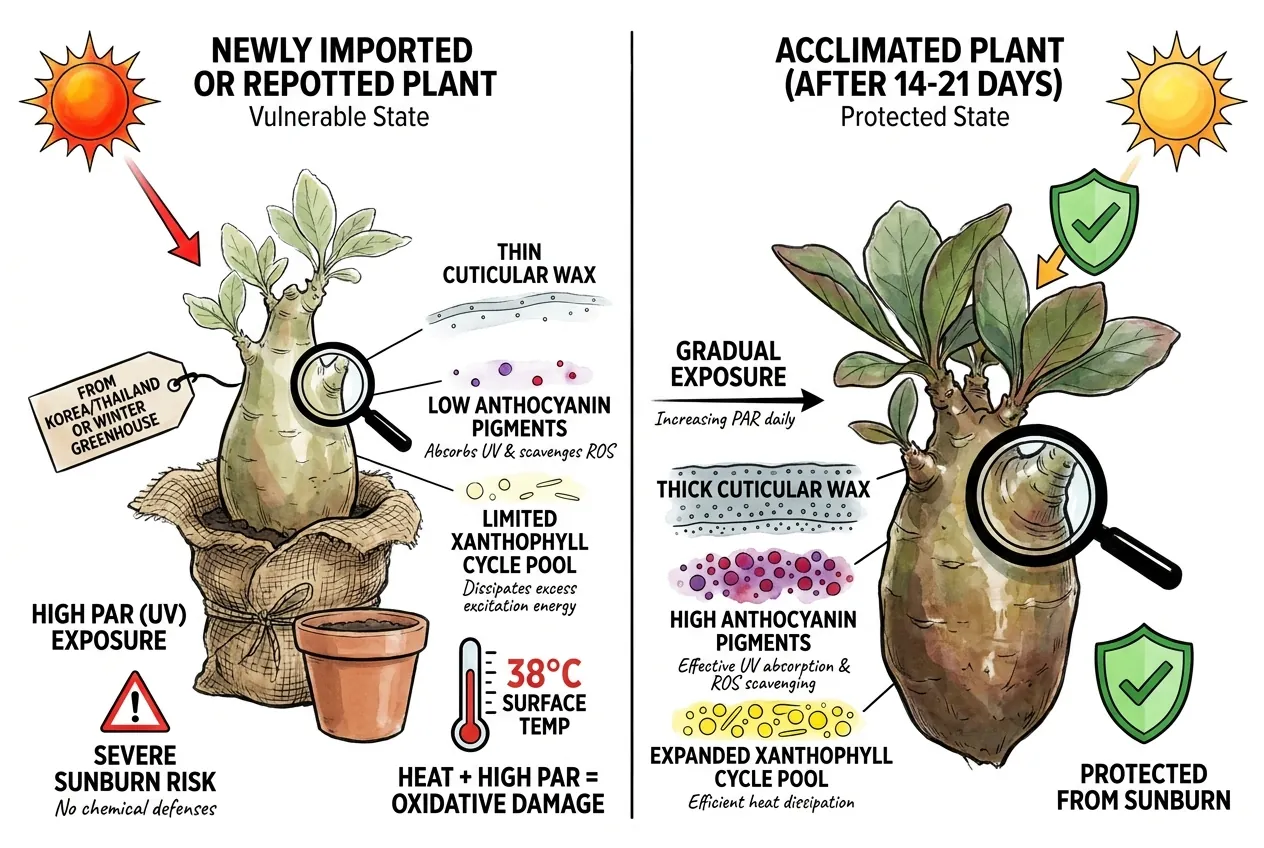
They may not yet have the surface and pigment adjustments associated with the previous growing site.
A plant that has just shipped or emerged from a shaded greenhouse may differ from a wild specimen in several protective traits.
Cuticular wax, pigment levels, and other stress responses can be lower after shade, shipping, or overwintering.
Protective waxes and pigments can be reduced after shipping, overwintering, or prolonged shade.
Allow those traits to rebuild through gradual exposure rather than assuming a claimed light history transfers directly to a new site.
What temperature actually causes sunburn on caudex succulents?
Sunburn on exposed green stem tissue is driven by the combination of intense light and heat, much as on a leaf.
There is no established C. juttae-specific damage line at a particular surface temperature, so be skeptical of any hard number.
The general biology is real. High light plus heat can overwhelm photosystem II, generating reactive oxygen species that damage the D1 reaction-center protein faster than the plant can repair it.
Laboratory studies of this mechanism in spinach thylakoids and cyanobacteria show how heat and excess light interact. They were done on isolated tissue or single-celled organisms at controlled temperatures, not on Cyphostemma stem bark, so do not read exact thresholds from them.
Heat and light matter together. A plant that is very hot and in full sun faces more stress than one that is hot but shaded, or bright but cool.
That is why acclimation and shade can both help.
Does overnight temperature really matter that much?
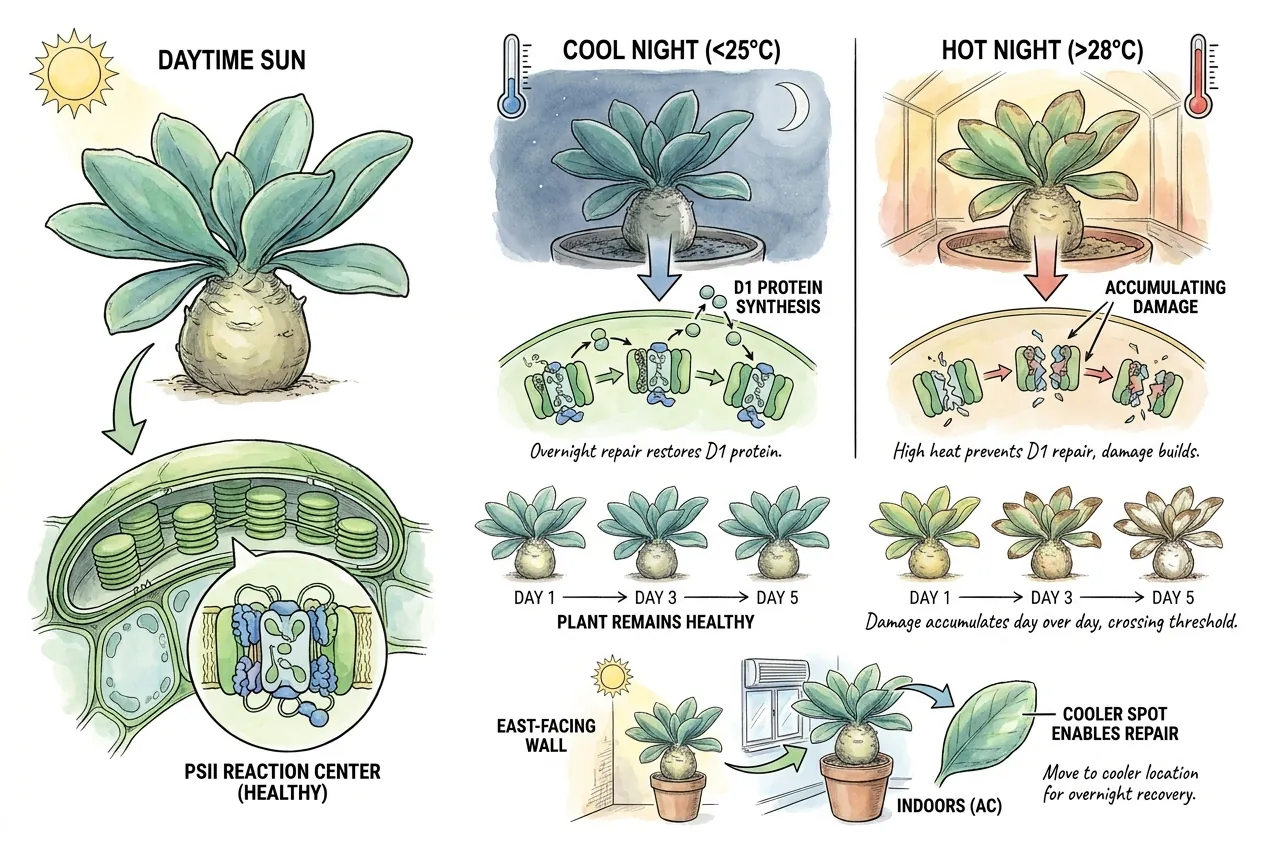
Cooler nights help. Plants repair heat- and light-stressed tissue over time, and a cool overnight period gives them a chance to recover before the next hot day, so damage can build up over a run of hot days and nights.
Some lab work finds repair can be active at moderately warm temperatures, so a single warm night is not automatically catastrophic. The main concern is relentless heat with no recovery.
During a prolonged heat wave, give the plant a cooler resting spot at night.
An east-facing position with morning sun and afternoon shade, or an indoor space with air conditioning, can reduce cumulative stress. Daytime shade alone may not be enough if nights stay hot.
Why does Cyphostemma juttae bark split in summer heat? The actual mechanism
Bark splitting can be a hydraulic event involving the interaction of heat-dried outer cork, hydrated inner cortex, and tissue weakened by prior exposure.
The bark does not have to be thermally burned through for a crack to appear.
One plausible mechanism is that inner cortex tissue swells against outer cork that has lost elasticity.
University of Tennessee Extension’s SP630 publication on bark splitting offers a related tree-bark mechanism. When moisture availability changes rapidly and temperatures cycle, inner tissue can expand against less-elastic outer bark and tension may propagate along a weak line.
Use this as an analogy, not as a measured Cyphostemma mechanism.
On the sun-exposed face of the caudex, such cracks often run vertically.
This is a Southern-Hemisphere plant native to Namibia, while many face-specific warnings come from Northern-Hemisphere sources.
The face that gets the strongest sun depends on your location. In the Southern Hemisphere it is often the north-facing side, and it shifts with season and how your plant is positioned.
Watch the actual sun-facing side rather than assuming a compass direction.
Extension work on trees does show the sun-exposed side of a trunk can run markedly hotter than the shaded side, and that asymmetric heating stresses the bark, but those studies are on thin-barked temperate trees, so treat the mechanism as illustrative rather than a measured C. juttae value.
To anchor each comparison to the actual exposure face, I mark the pot rim where the plant receives the strongest direct sun. Whenever the plant is moved or rotated, I photograph that marked face within the recorded daily time window used for the baseline.
I include the pot rim, nearest intact bark edge, and a metric ruler showing 1 mm divisions in the frame. The ruler stays in the same plane as the bark surface so later photographs preserve the crack’s scale. The rim mark records the actual exposure face at my site instead of borrowing a compass rule from somewhere else.
When I see a new split or loose bark, I compare it with the previous image before touching the surface. A change that has remained inside the same old boundary is different from a crack that is lengthening into intact tissue. If I change the plant’s orientation, I make a new reference image so that a different sun-facing face is not mistaken for sudden disease spread.
Why does the split appear the morning after I watered, not during the heat itself?
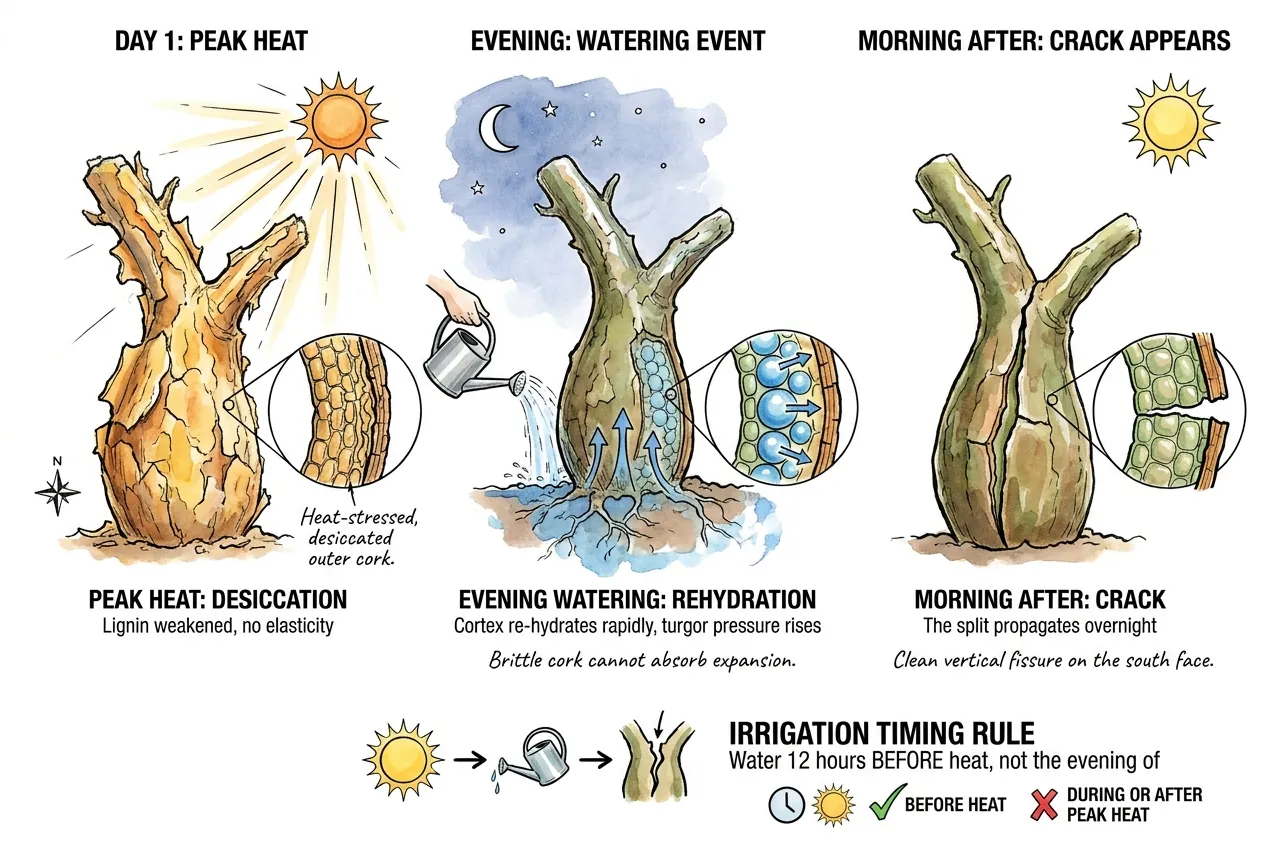
Watering after severe heat may add hydraulic stress to already damaged tissue, but the exact trigger is not established for this species.
A peak-heat day can dry and stiffen the outer cork.
Prior exposure may also have weakened the surface, although the contribution of lignin changes has not been measured for this species.
A plausible chain is that heat dries and stiffens the outer bark, while a large watering afterward rehydrates inner tissue that swells against the less-flexible outer layer and can crack it.
This is a reasonable mechanism rather than a proven sequence for this species. Treat reports of watering at night followed by a morning crack as a sensible caution rather than a certainty.
Check the root zone before a heat-wave soak
Avoid a large, poorly timed soak while the plant and root zone are hottest. First check the mix, roots, and tissue condition.
How should irrigation timing be handled?
Water ahead of a forecast heat event only if the mix has dried to the plant's current growth-state requirement, and choose a cooler period for the root zone. Do not use a fixed countdown or a blanket no-water window.
What does the orientation of the crack tell me?
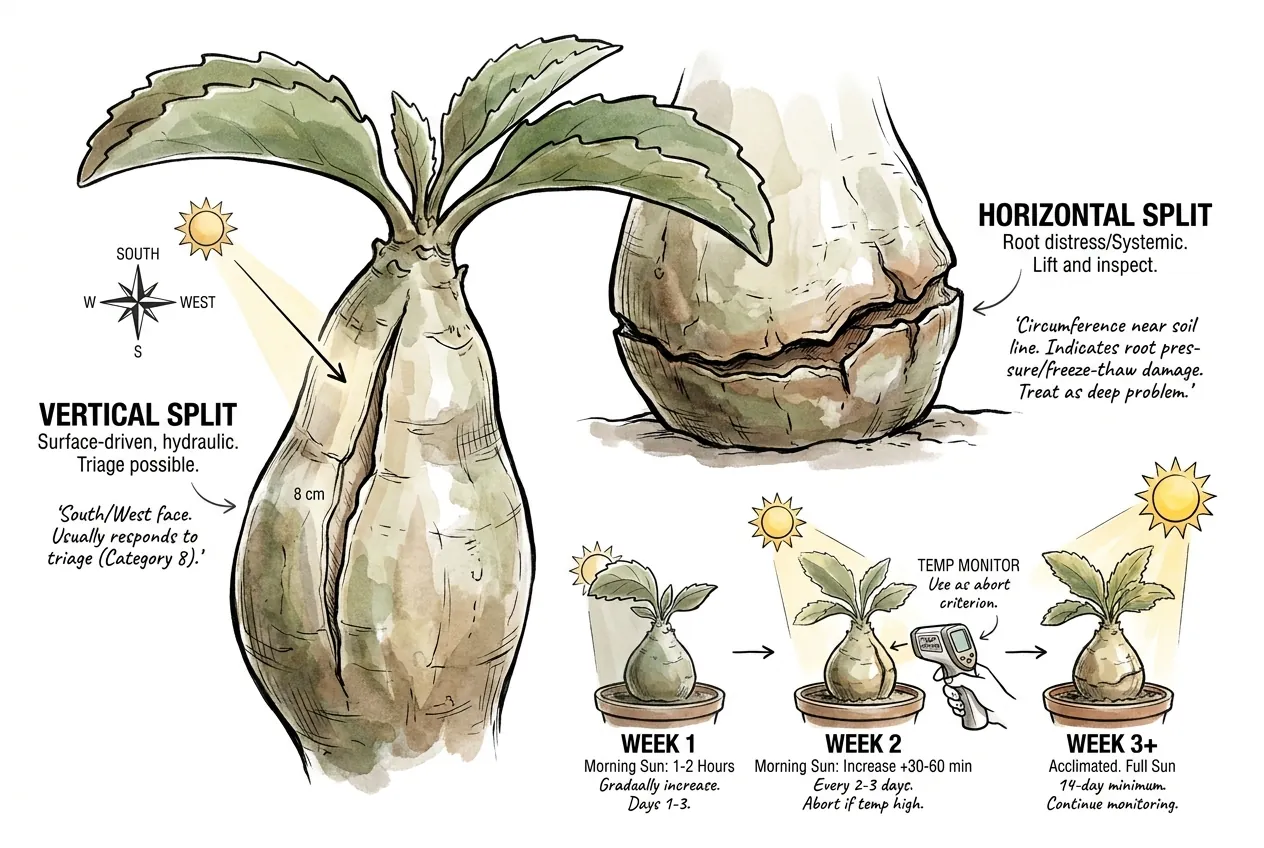
Crack orientation is at best a loose clue, not a diagnosis.
A vertical crack on the sun-facing side is consistent with surface sun and heat stress.
A crack running around the caudex, especially near the soil line, is worth taking more seriously and is a reason to lift the plant and check the roots. Orientation alone is not a validated rule because both patterns can arise from several causes.
Read the whole plant, including recent sun exposure, watering, root condition, and any softening or discoloration.
How do I acclimate Cyphostemma juttae to full sun without burning it?
Increase morning exposure in small steps, pausing whenever the plant shows scorch, softening, or excessive surface heat.
Use the local weather, previous exposure, bark condition, and pot temperature to choose the step size.
An acclimation can take days or many weeks. The calendar is secondary to the response.
Protective wax and pigment changes are gradual and variable, so do not assume a fixed day count creates afternoon-sun tolerance.
Why morning sun and not afternoon?
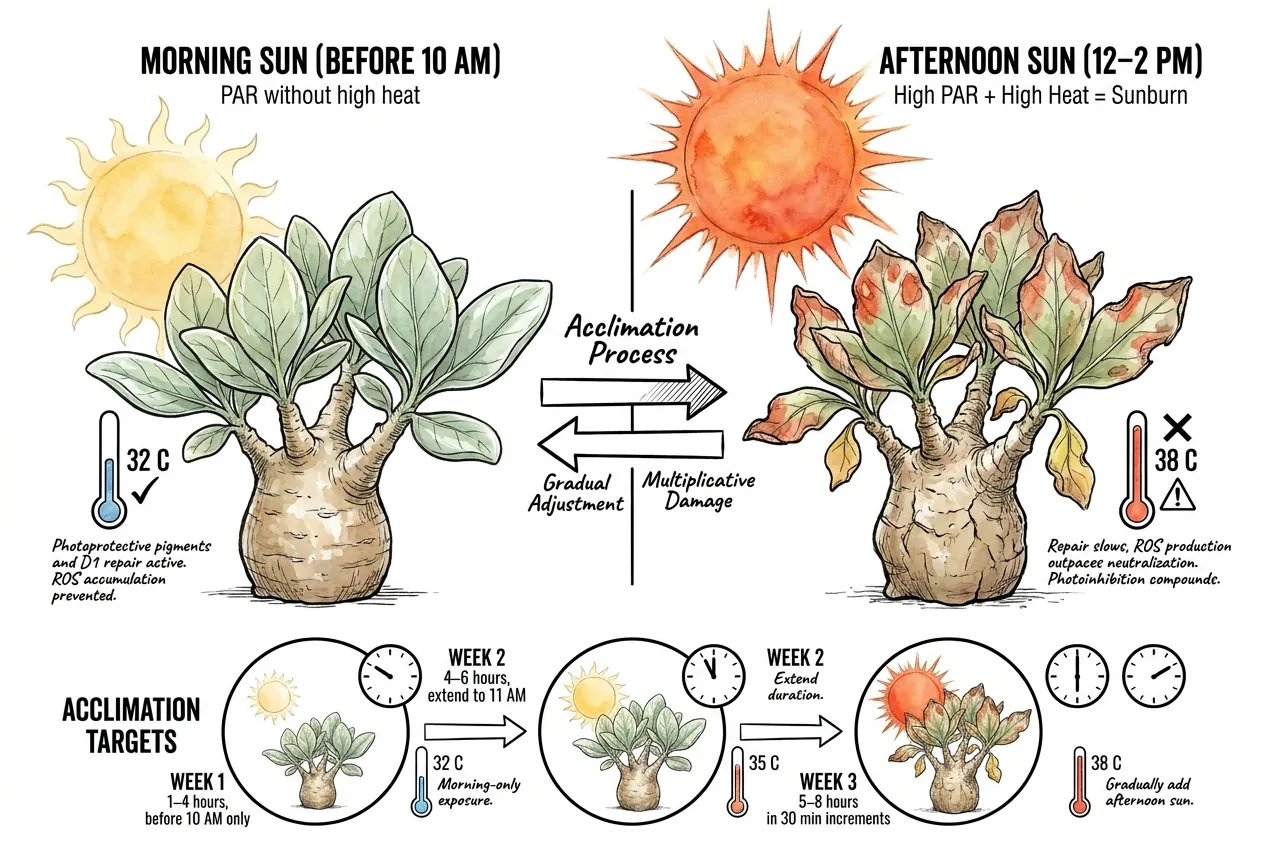
Morning light often combines useful exposure with a lower heat load than late-day sun, but the balance changes with season, latitude, and enclosure.
Use the plant's surface temperature, leaf or bark response, and overnight recovery to decide when to add later exposure.
Do not transfer a clock-time or temperature table from another site.
Acclimation stages
| Stage | Exposure approach | Back-off signal | Next step |
|---|---|---|---|
| Initial | Short, cool-period exposure | Scorch, softening, or surface heat | Hold or add shade |
| Building | Extend only after stable recovery | Color change with tissue stress | Repeat the last safe step |
| Established | Add later exposure cautiously | Persistent heat or new damage | Return to the prior safe exposure |
Which surface-temperature readings should prompt a step back?
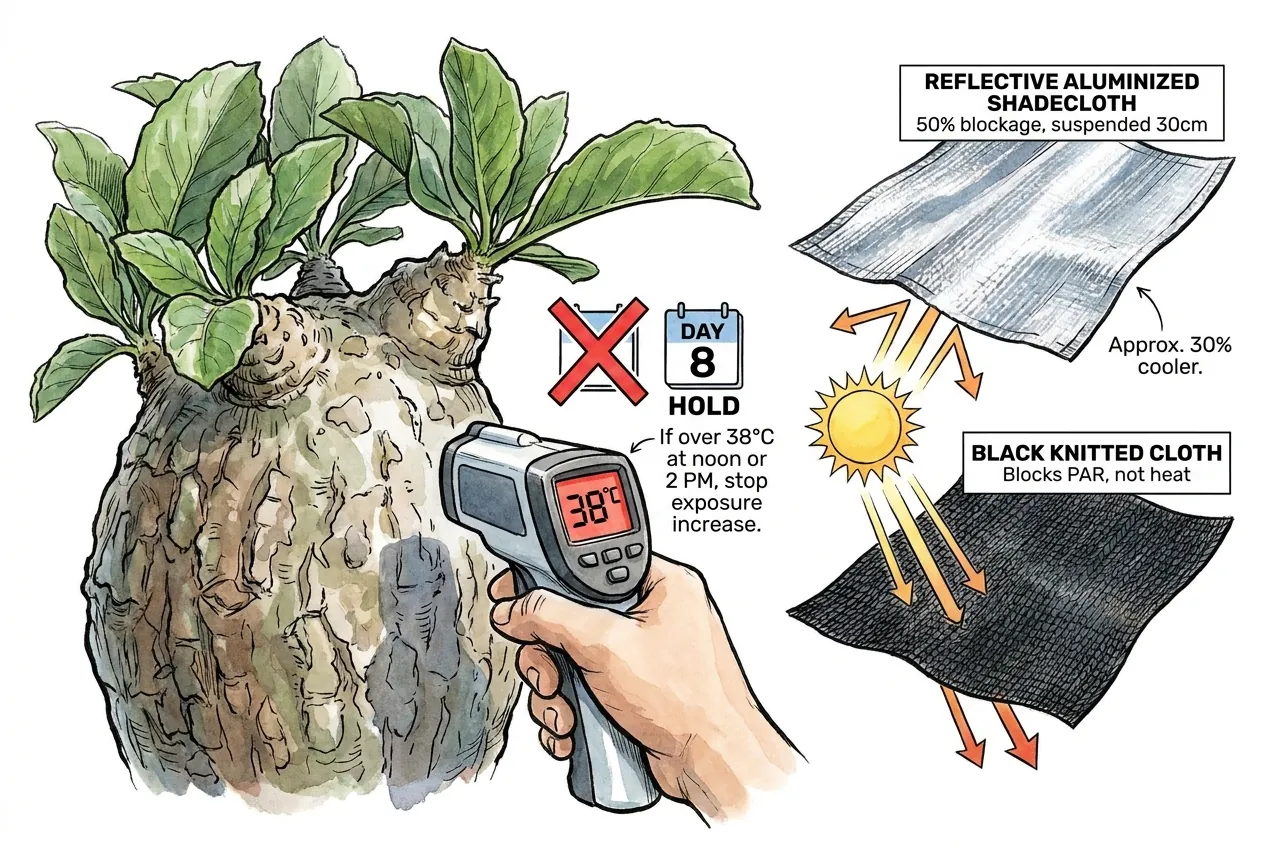
An infrared thermometer can help compare the sun-facing surface with shaded tissue and ambient air.
Use it as a relative warning rather than a species-specific pass or fail value. Angle, distance, emissivity, bark color, and coating all affect the reading.
The real value is that it lets an unexpected heat wave override your calendar.
If the surface is baking, hold that day's exposure regardless of where you are in the ramp.
What kind of shade actually works in summer?
Reflective aluminized cloth can reduce radiant load, while black knitted cloth mainly reduces incoming light. The result depends on material, tension, airflow, and installation.
Comparisons from greenhouse systems suggest reflective cloth may keep the enclosure cooler than black cloth at the same nominal shade rating, but those results are not a Cyphostemma-specific guarantee.
Keep the cloth off the plant, provide an air gap, and measure the actual surface response instead of assuming a fixed cooling amount.
How much shade should I choose?
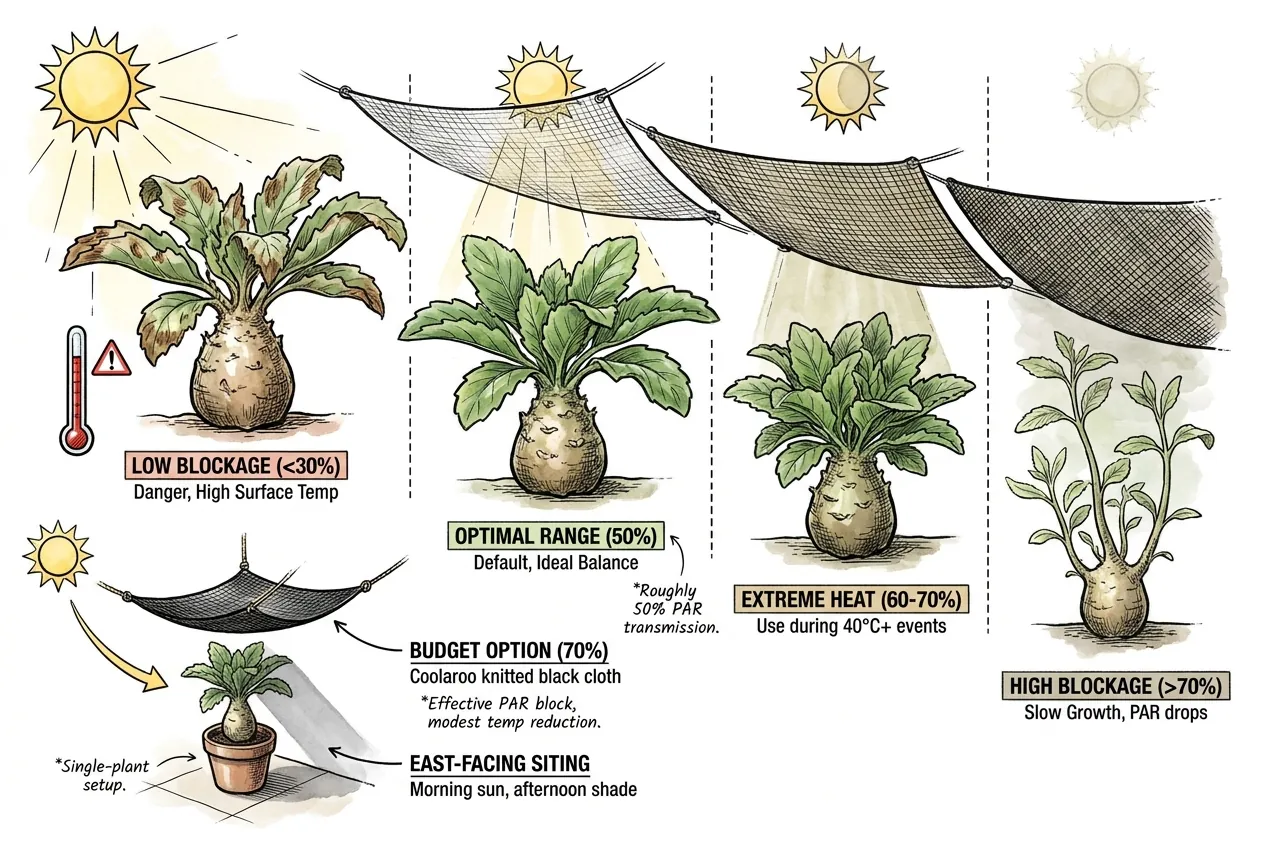
Choose the lightest shade that keeps the plant from overheating and scorching, then increase protection during prolonged heat or after tissue damage.
Nominal blockage does not predict the same result in every enclosure. Assess brightness, airflow, surface temperature, and new growth together.
Black knitted shadecloth option
Coolaroo shade cloth is one black knitted option to compare for coverage, installation, warranty, and current price.
Its heat performance depends on the surrounding structure and airflow.
Reflective cloth option
Reflective cloth is another option for a larger setup. The Be Cool Solutions Aluminet shade-cloth discussion may help compare material and installation choices.
Check current blockage, transmission, dimensions, and price before buying. A reflective product can be unnecessary when a small plant already has cool afternoon shade.
How far above the plant does the cloth need to sit?
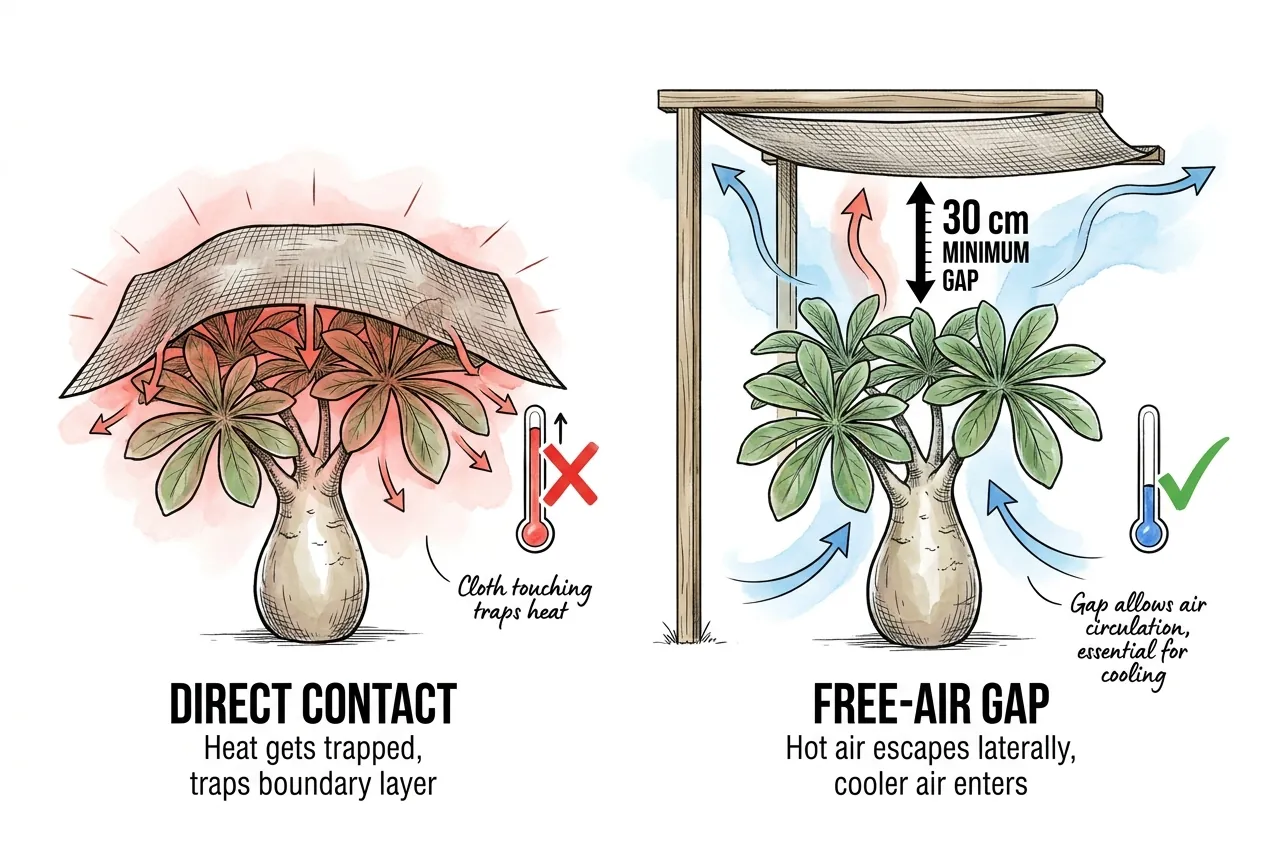
Keep the cloth off the canopy and leave enough space for warm air to escape. The required gap depends on plant size, structure, and wind.
Direct contact can trap heat and rub the bark, so frame the cloth securely and inspect the hottest part of the day.
Should I paint my caudex white? Kaolin clay versus latex paint
Kaolin clay (Bonide Surround WP) can provide a removable particle film, while a compatible light-colored coating may be considered for exposed tissue.
Neither has been validated as a Cyphostemma-specific cure or permanent sunscreen.
Research on other crops shows that particle films can alter reflectance and leaf temperature, but the magnitude varies by crop, coverage, weather, and formulation.
Check the current kaolin-product label and local registration before applying it to caudex tissue.
The Mechanism Behind Kaolin's Reflectance
Kaolin is a hydrous aluminum silicate platelet with reflectance properties that can alter radiation absorption.
How continuous the film is, how much it changes surface temperature, and whether it affects gas exchange depend on coverage, formulation, tissue, and weather. Do not assume leaf-study results transfer directly to caudex bark.
How do I apply kaolin clay to a caudex?
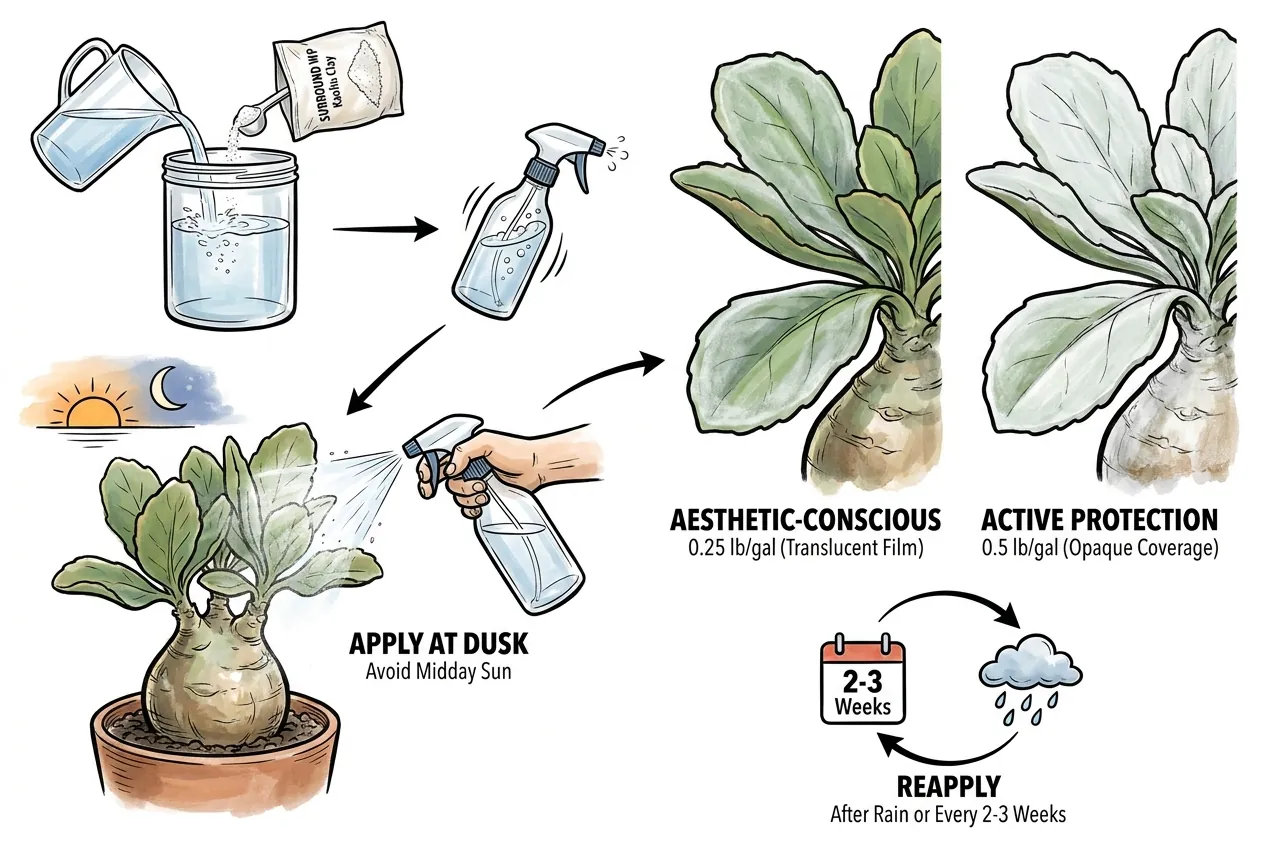
If the current label permits use on the intended tissue, mix and reapply the kaolin product only at its labeled rate and interval.
Test a small area first, apply in conditions that allow the film to dry evenly, and stop if the bark reacts.
Kaolin product details
Compare the current formulation, package size, label, and storage requirements before buying.
Is latex paint safe on living caudex bark?
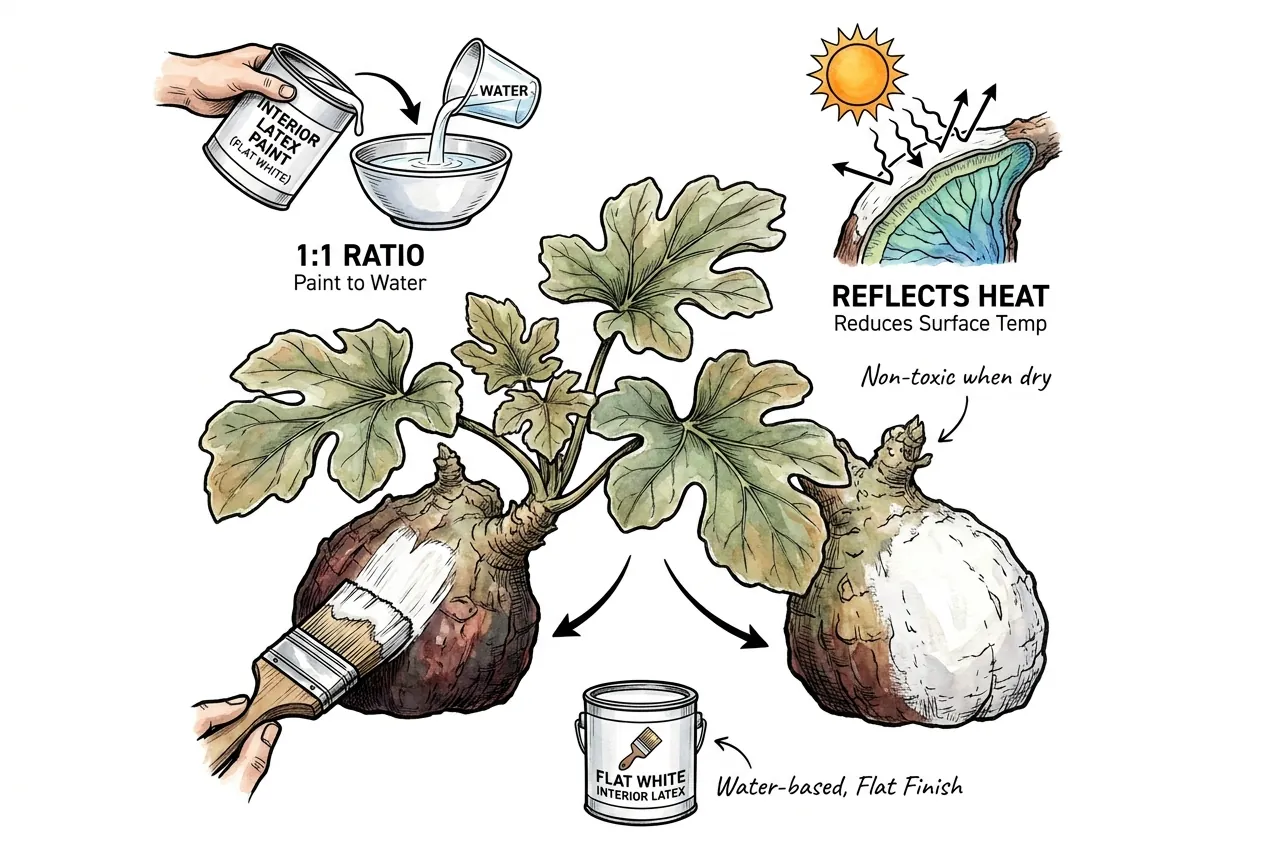
Safety on living caudex bark is not established by the tree-paint literature.
Some extension guidance discusses light-colored interior latex for woody trunks, but that does not make a formulation safe for Cyphostemma tissue.
If a coating is considered, patch-test it, avoid products with unlisted additives, and do not assume a dilution or trunk height transfers to Cyphostemma.
Read the complete label and stop if the tissue reacts.
Reflectance and surface-temperature effects depend on coating, coverage, bark, weather, and airflow. A non-toxic label is not a blanket claim for every formulation.
Example white-latex listing
Do not apply a paint mixture to living caudex tissue without species-specific confirmation.
If a coating is considered, read the full label, avoid antimicrobial or mildewcide additives, patch-test, and monitor for trapped moisture or tissue reaction.
Rust-Oleum white paint is an example of a general-purpose product to compare, not a recommendation for direct caudex use.
Kaolin vs latex paint (quick comparison)
| Treatment | Likely use | Evidence scope | Maintenance | Aesthetic |
|---|---|---|---|---|
| Kaolin clay particle film | Removable particle film if label permits | Other crops and product literature | Reapply only per current label and weather | thin chalky film, rinses off |
| White interior latex (dilution not established) | Woody-plant guidance. Uncertain on caudex tissue | Extension and tree studies | Patch-test and inspect for trapped moisture | may leave a visible coat. Persistence varies |
| Bare bark | Natural surface | Species-specific appearance | Protect through exposure and shade | natural |
When should I water during a heat event?
Water only when the mix and roots indicate a need, and choose a cooler period when the root zone is not being heated.
Avoid using a fixed clock-time prohibition as a substitute for checking conditions.
A hydrated caudex can store heat capacity and support transpiration, but the effect depends on tissue size, water status, airflow, and root function. No general delay or split trigger has been measured.
A large soak applied to heat-stressed tissue may add hydraulic stress. The causal sequence remains a plausible caution rather than a validated rule for this species.
What soil-moisture reading actually indicates safe-to-water?
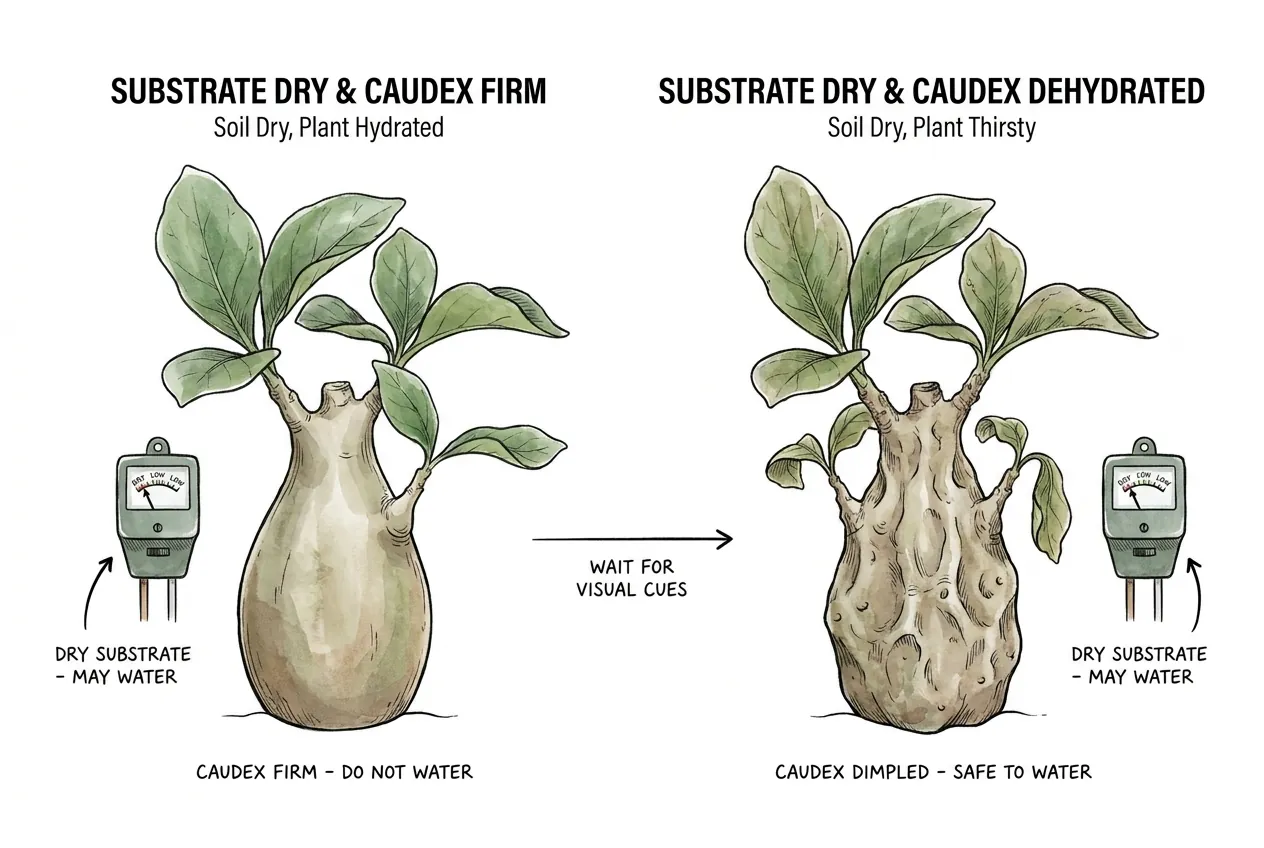
Use substrate moisture as a may-water signal and caudex visual turgor as the must-water signal.
A moisture meter reads root-zone water, but it does not read caudex turgor.
A wet substrate does not guarantee a hydrated caudex if root damage is blocking uptake.
A dry substrate does not guarantee a dehydrated caudex if stored reserves are intact.
Make the decision on what you can see. Caudex surface dimpling, slight surface wrinkling, leaf curl if leaves are present.
If the substrate is dry and the caudex shows progressive water-loss signs, water during a cooler period and reassess uptake.
If the mix is dry but the caudex remains firm, inspect roots and recent conditions before deciding.
What does post-event recovery look like?
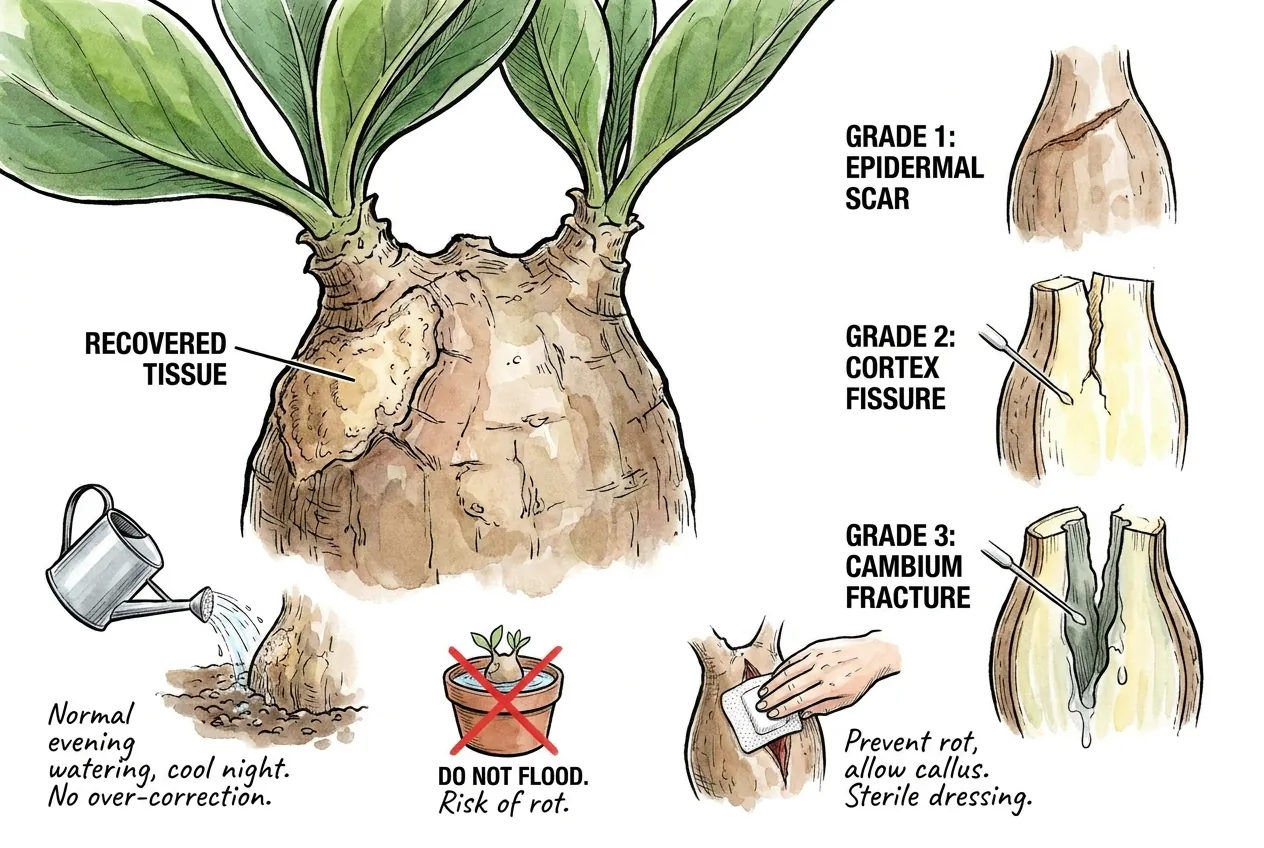
Resume watering gradually once the root zone and weather have moderated.
Do not over-correct with extra water.
The temptation after a stress event is to make it up by flooding. Resist.
Stressed tissue may be more vulnerable to rot, and the root system may not yet have recovered its uptake capacity.
Return to the previous routine only after the plant shows stable uptake and no new tissue damage. Recovery time varies.
How do I treat a bark split on Cyphostemma juttae?
Judge how deep the injury is by looking, then keep the wound clean and dry.
Many superficial splits may stabilize when deeper living tissue is intact and prolonged moisture is avoided, but outcomes vary.
A useful informal framework is to distinguish a shallow surface scar that is often cosmetic, a crack into the outer tissue that needs to callus, and a deep crack reaching living inner tissue that is more serious.
This is a helpful mental framework rather than a formal grading system from a specific source.
Assess by gentle inspection, not by jabbing the wound. Do not push a probe into a fresh split to measure its depth because that can drive the crack deeper and introduce pathogens.
Look at what is already visible and how the tissue behaves over the next days.
What do I do for a Grade 1 sunburn scar?
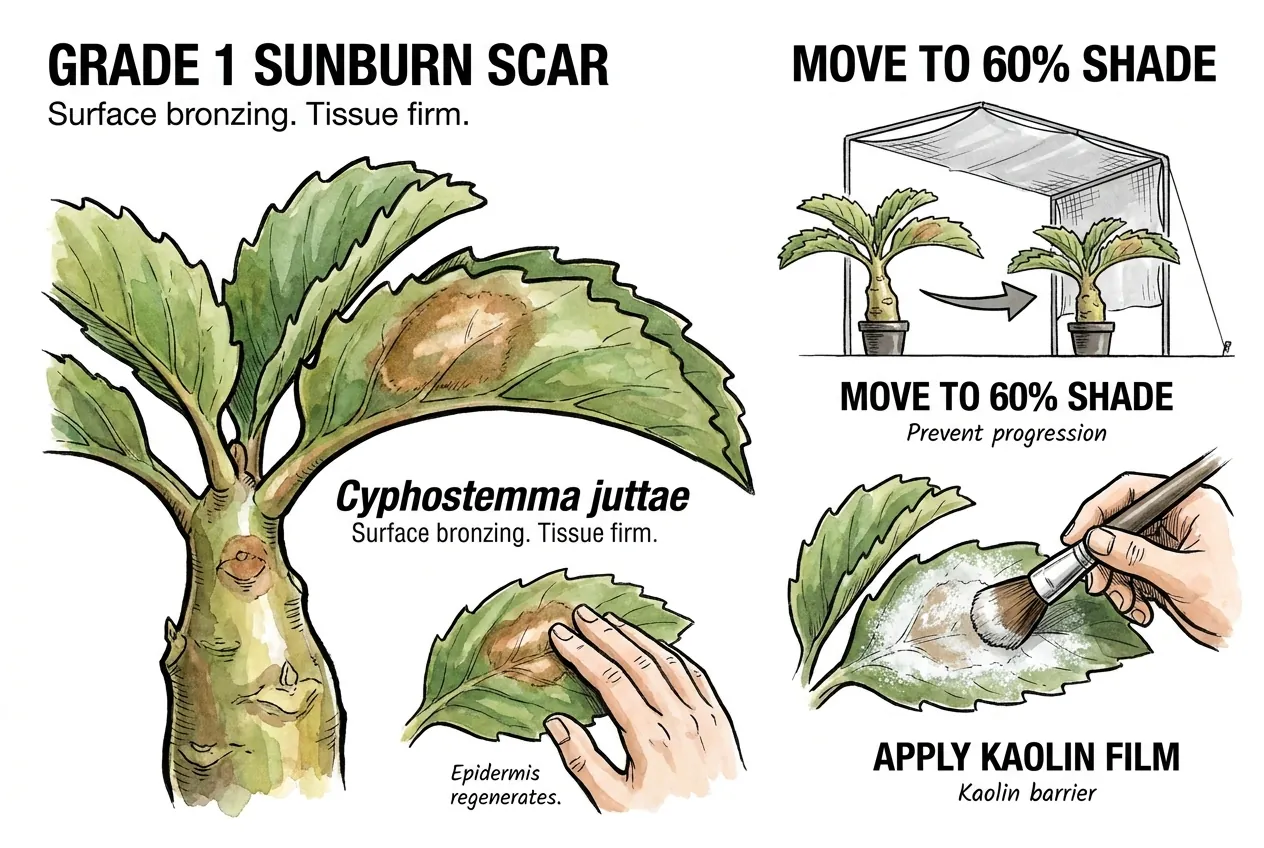
Reduce exposure and add temporary shade while the surface remains firm.
Do not apply a coating unless it is suitable for the tissue and permitted by its label.
Surface bronzing or epidermal scarring is often cosmetic when the underlying tissue remains firm.
Continue checking for softening or spread.
Surface tissue may stabilize without intervention, but monitor for spreading discoloration, softening, or renewed cracking.
What about a Grade 2 cortex fissure?
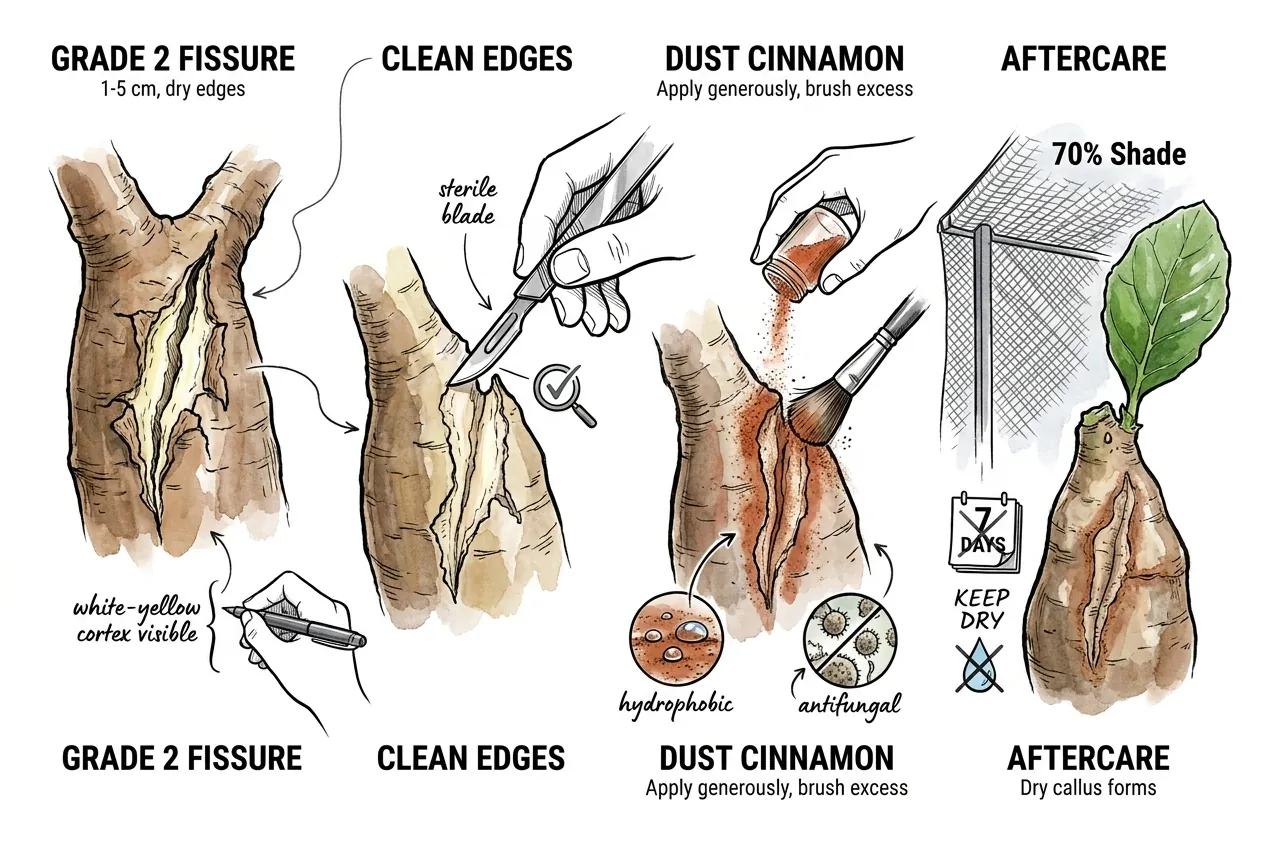
For a crack that reaches into the outer tissue, seek species-appropriate guidance before cutting.
If loose tissue is removed, use clean handling, then keep the wound dry and airy and shade the plant while it calluses. A clean edge may callus more predictably than a ragged one.
Some growers dust such wounds with cinnamon. Cinnamon has some antifungal activity in lab tests and may help keep a surface dry, but it is an anecdotal home remedy rather than a proven treatment.
The more controllable steps are clean handling, dryness, airflow, and shade.
Grade 3 (cambium fracture, clear sap weeping?)
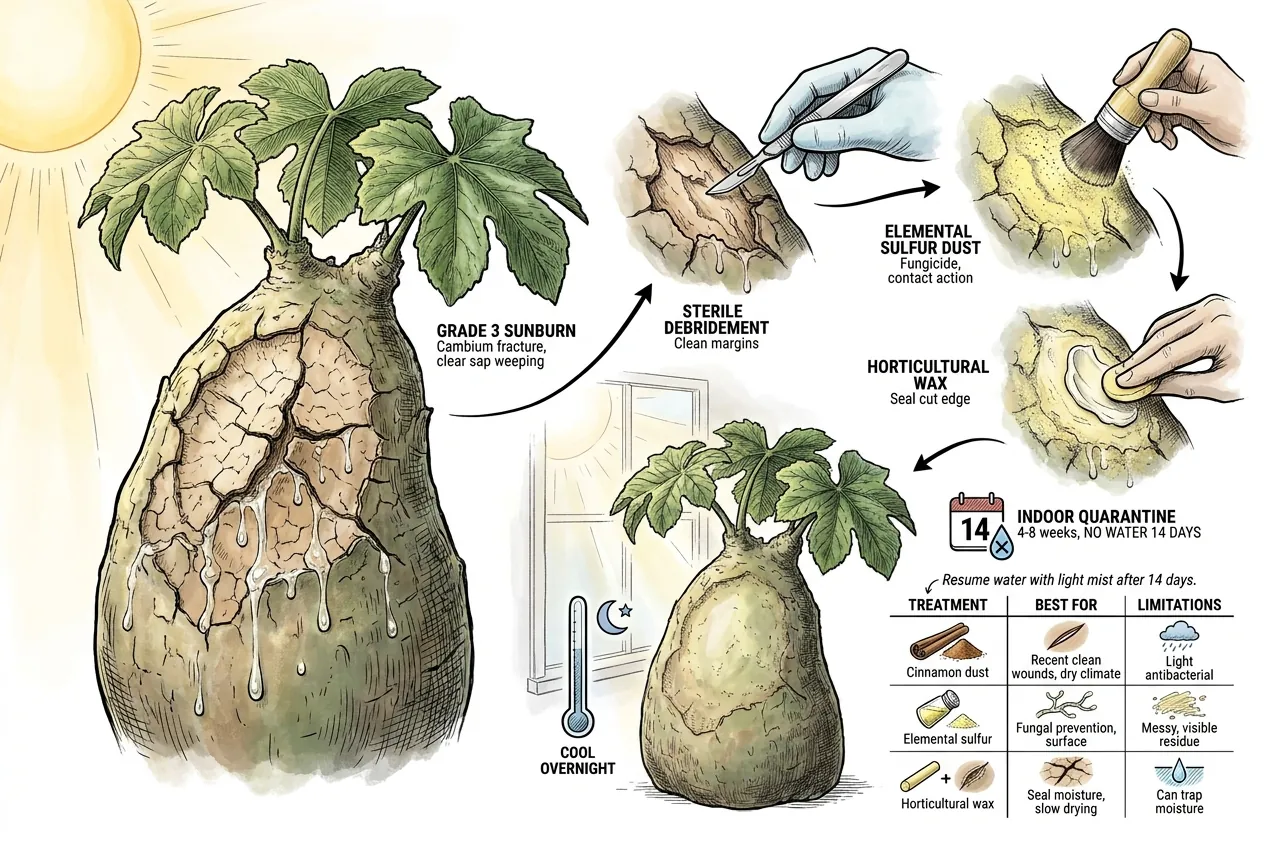
For a deep wound, isolate the plant from contact with others, use clean handling, and seek species-specific advice before debridement or a dressing.
Do not impose a fixed quarantine or no-water interval without inspecting roots and tissue.
For a deep wound reaching living inner tissue, do not debride deeply without species-appropriate or qualified advice.
Keep the wound clean, dry, and shaded while it seals. Move the plant to bright, filtered light in a cool, dry spot and ease off watering while the root zone and tissue recover.
Elemental sulfur and wound sealants are sometimes used here, but be realistic. Sulfur is a garden fungicide labeled for specific diseases and not necessarily for wound dressing. A sealant can trap moisture if applied to wet tissue.
Neither is a proven cure for a caudex split. If considered, use them only within the product label and monitor for spreading rot. Clean handling, dryness, and airflow are the more controllable protections.
Wound dressing comparison
| Treatment | Possible use | Limitations |
|---|---|---|
| Cinnamon dust | Some recent clean wounds in a dry climate | Light antifungal. Not enough for active rot |
| Elemental sulfur dust | Only where the label and diagnosis support it | Can irritate sensitive tissue at high doses |
| Horticultural wax | Edges only if the label and tissue response support it | Traps moisture if applied to wet tissue |
How long until the scar heals?
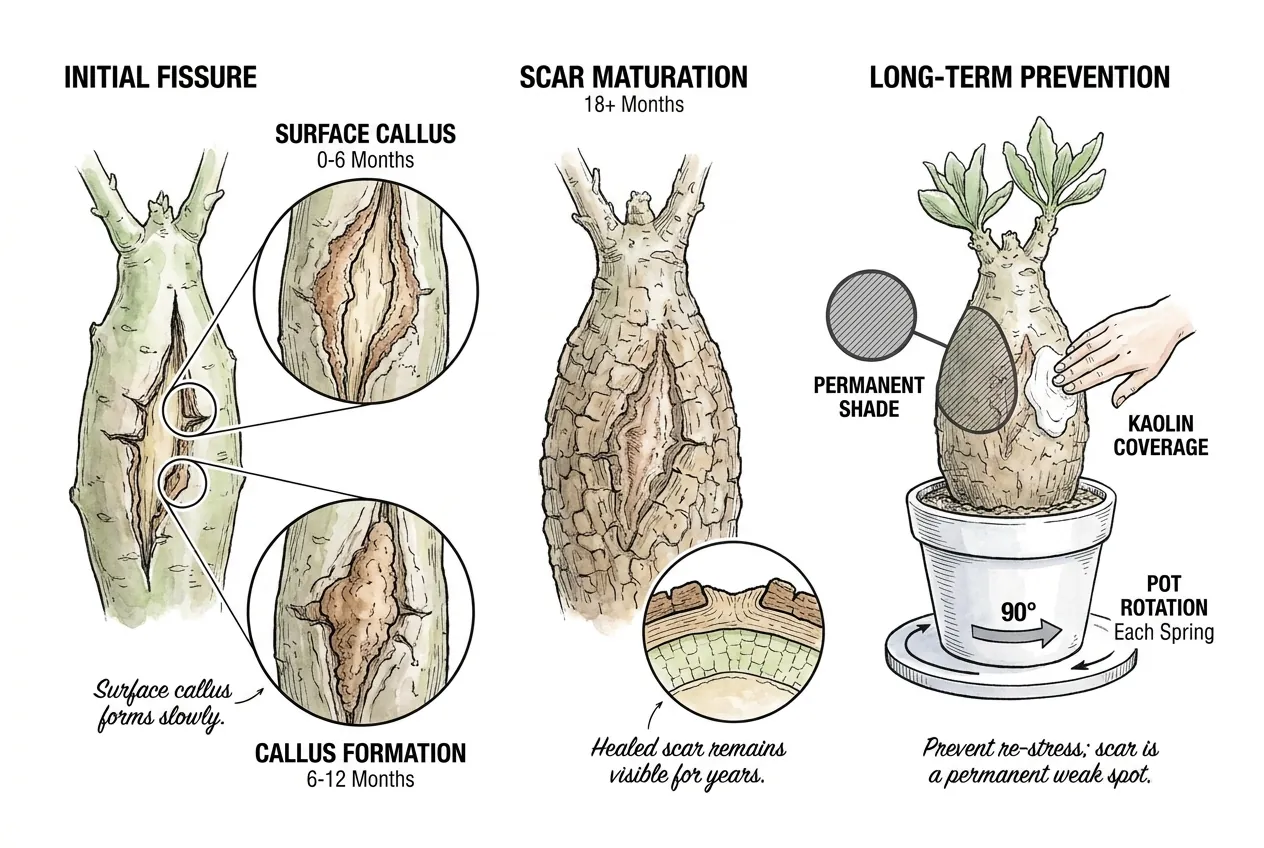
Surface callus can take months to form, and full scar maturation may take substantially longer. Rate and appearance vary with wound depth, season, and plant vigor.
Caudiciforms often heal slowly. New tissue may need to re-establish a cork layer in addition to cambium-level cell division.
Set the expectation early. A healed scar may remain visible for years.
The goal of triage is preventing rot, not erasing the scar.
A scar line can remain more vulnerable than surrounding tissue.
UV and heat may re-stress that surface, so a scar that appears stable can crack again if exposure changes abruptly.
Continue protecting the scar from abrupt, intense exposure, but choose shade or a coating only after observing how the tissue responds. Do not rely on a permanent angle or treatment schedule.
Affiliate Disclosure
This article contains Amazon affiliate links. As an Amazon Associate I earn from qualifying purchases. If you use these links, the site may earn a commission at no extra cost to you. Product availability, price, and specifications can change. Check the current listing before buying.