
Cyphostemma Bainesii Leaf Drop in Heat: What to Do
Cyphostemma bainesii leaf drop in a heat wave is a stress signal to diagnose, not an automatic reason to withhold all water. How to tell heat stress from rot and thirst.
Nathan Brooks · 2026-06-17 · Updated 2026-07-05 · 13 min read
Key Takeaways
- Treat mid-summer leaf drop as a stress signal to investigate, not harmless dormancy. References describe a warm-season growth period and cooler-season rest, so an out-of-season drop needs diagnosis.
- Check caudex firmness together with the roots and soil. A firm caudex is reassuring but does not rule out a dry root ball or rot lower down.
- Losing leaves cuts water demand sharply but not to zero, so water by the actual state of the soil. Do not reflexively drench, and do not reflexively withhold.
- During heat, first reduce radiant load and improve airflow. If the mix is genuinely dry, water when it is cool enough for the root zone to recover rather than following a fixed volume.
- Use a gritty, fast-draining mix so the plant is less likely to sit wet. Match watering to whether it is actively growing.
When Cyphostemma bainesii yellows and drops leaves during a heat event, both drenching and withholding water can be mistakes. Start by checking the plant, roots, and mix together.
This drought-deciduous caudiciform comes from Namibia, where references describe growth during warmer conditions and rest during cooler periods. Container behavior still varies with light, temperature, and root health, so heat-driven leaf drop needs diagnosis rather than a fixed seasonal label.
A plant can shed leaves under heat or drought stress, and soaking hot, wet soil can worsen root problems. Conversely, a genuinely dry plant with functioning roots can continue to dehydrate, so watering should follow the actual root-zone state.
Is it normal for Cyphostemma bainesii to drop its leaves?
It can be. Cyphostemma bainesii is drought-deciduous, which means shedding leaves is part of its normal survival program, but timing and accompanying symptoms still matter.
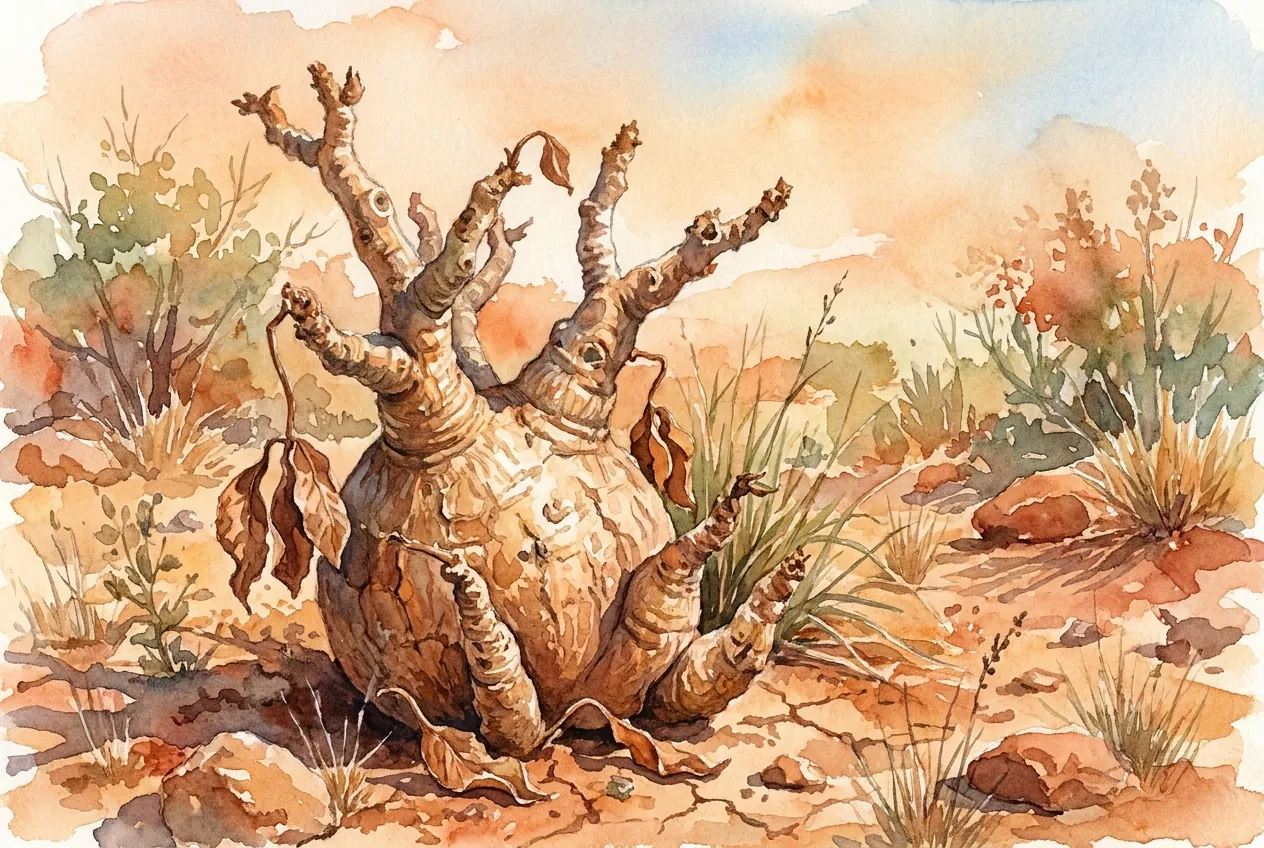
The plant belongs to the grape family, Vitaceae, and stores water and energy in a swollen trunk called the caudex. It comes from dry rocky outcrops of west-central Namibia, a hot, high-light, sharp-draining environment.
In that climate it carries dark green leaves during the warm growing season and goes bare when conditions turn against it. A leafless plant in midsummer is therefore not necessarily dying, but firmness, roots, soil moisture, new growth, and damage must be judged together.
What actually causes the leaf drop in extreme heat?
Heat-induced leaf drop can involve regulated abscission and reduced water loss, but it is a non-specific stress response. Understanding the mechanism helps frame the diagnosis without replacing a check of the roots and soil.
How does the plant physically shed a leaf?
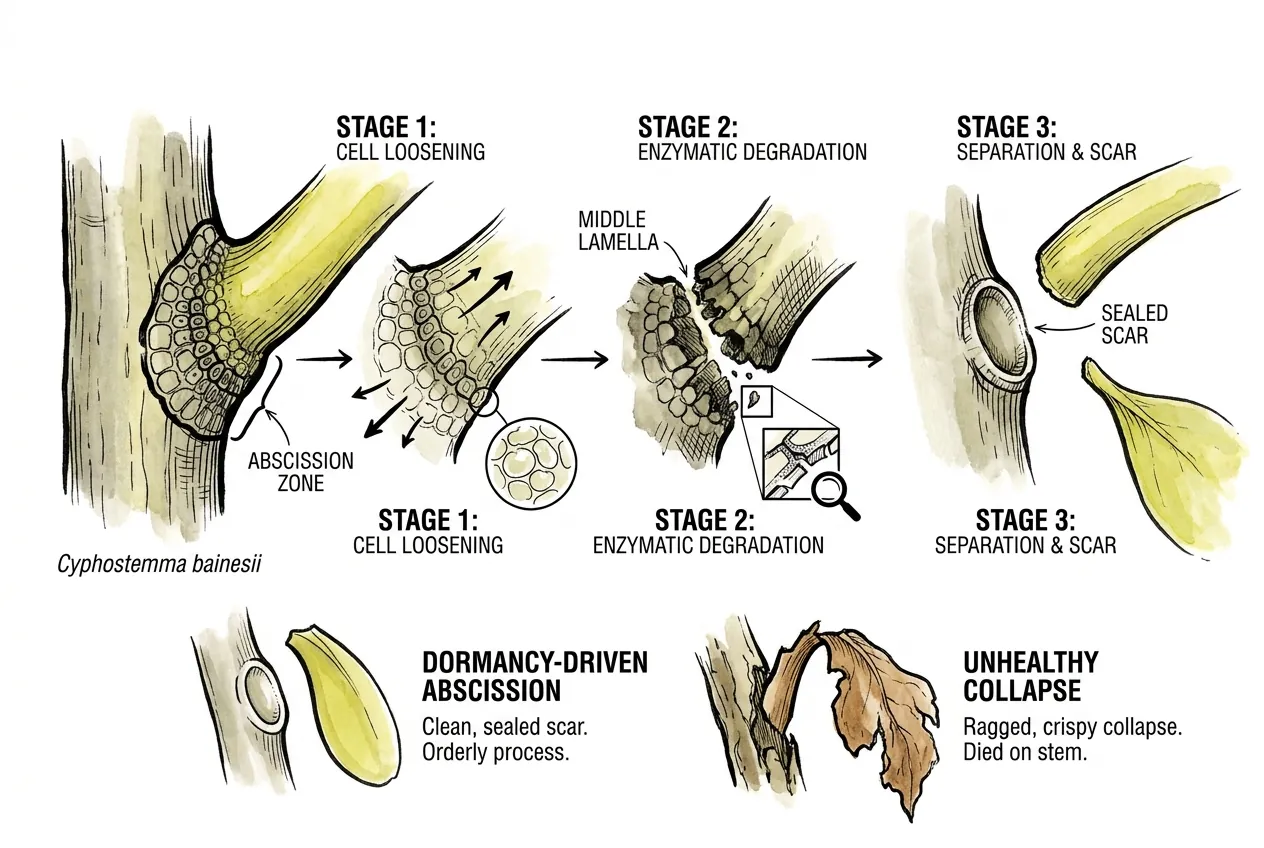
Leaves are released at a dedicated band of cells called the abscission zone, where the plant enzymatically loosens the cell walls and leaves a clean, sealed scar.
This is a modest diagnostic clue rather than a certainty. A clean scar means the abscission zone worked normally, which can happen with developmental cues, drought, heat, or root stress. Weigh it alongside the roots, soil, and whole plant rather than treating it as proof of seasonal rest.
Leaf loss becomes easier to interpret when I number the main shoots on a fixed pot-rim view and record each leaf’s first yellowing and drop date. A fresh petiole-scar photograph on the day of leaf fall shows whether the sequence began with older leaves, the sun-facing side, or scattered leaves. No single sequence serves as my diagnosis.
I pair the leaf map with pre-watering pot mass, caudex firmness, root-zone temperature, and the previous 24-hour maximum and minimum air temperatures at canopy height. This keeps a week of changing symptoms from collapsing into one vague dormancy note.
When my numbered leaf map shows that at least half of the starting leaves are gone, I retire the leafy plant’s previous dry-down interval. I use 50 percent as a visible household switch point, not a biological dormancy threshold. I then compare mass after 30 minutes of free drainage with its 24-hour mass to establish the lower-leaf-area baseline.
What hormone triggers the shutdown?
Treat ABA as one part of the signal
Abscisic acid (ABA) is a central stress signal. It drives stomatal closure to cut water loss and contributes to stress-induced leaf senescence, but calling it a single master switch overstates its role because leaf shedding involves ABA, ethylene, auxin, and other interacting signals.
Under a heat wave, stomata may close to limit water loss, and continued heat or dryness may lead the plant to shed leaves and reduce its transpiring surface. Abscission still reflects interacting signals whose relative roles depend on species, tissue, and stress context.
What is the difference between forced dormancy and seasonal dormancy?
References commonly describe this plant’s seasonal rest as winter dormancy. Dropping leaves out of season during a June heat wave is better treated as a possible stress response to acute heat and dryness rather than automatically labelled programmed dormancy.
Leaf loss is non-specific. Heat, drought, root damage, root rot, or a sudden environmental change can all cause it, and this species’ summer meristem behavior has not been studied in detail.
A bare plant in midsummer is therefore not automatically in a dormant state that should be kept completely dry. Check actual soil moisture and roots before deciding. If the mix is genuinely dry and the plant was actively growing, measured watering in the cool morning may be appropriate. If the mix is still moist, hold off and cool the plant instead.
How do I tell forced dormancy from underwatering, rot, and sunburn?
Use four signals to build the diagnosis. Check caudex firmness, the leaf-fall pattern, soil moisture, and the location and color of any damage.
No single signal is definitive, so weigh the whole pattern before changing care.
What does the caudex tell me?
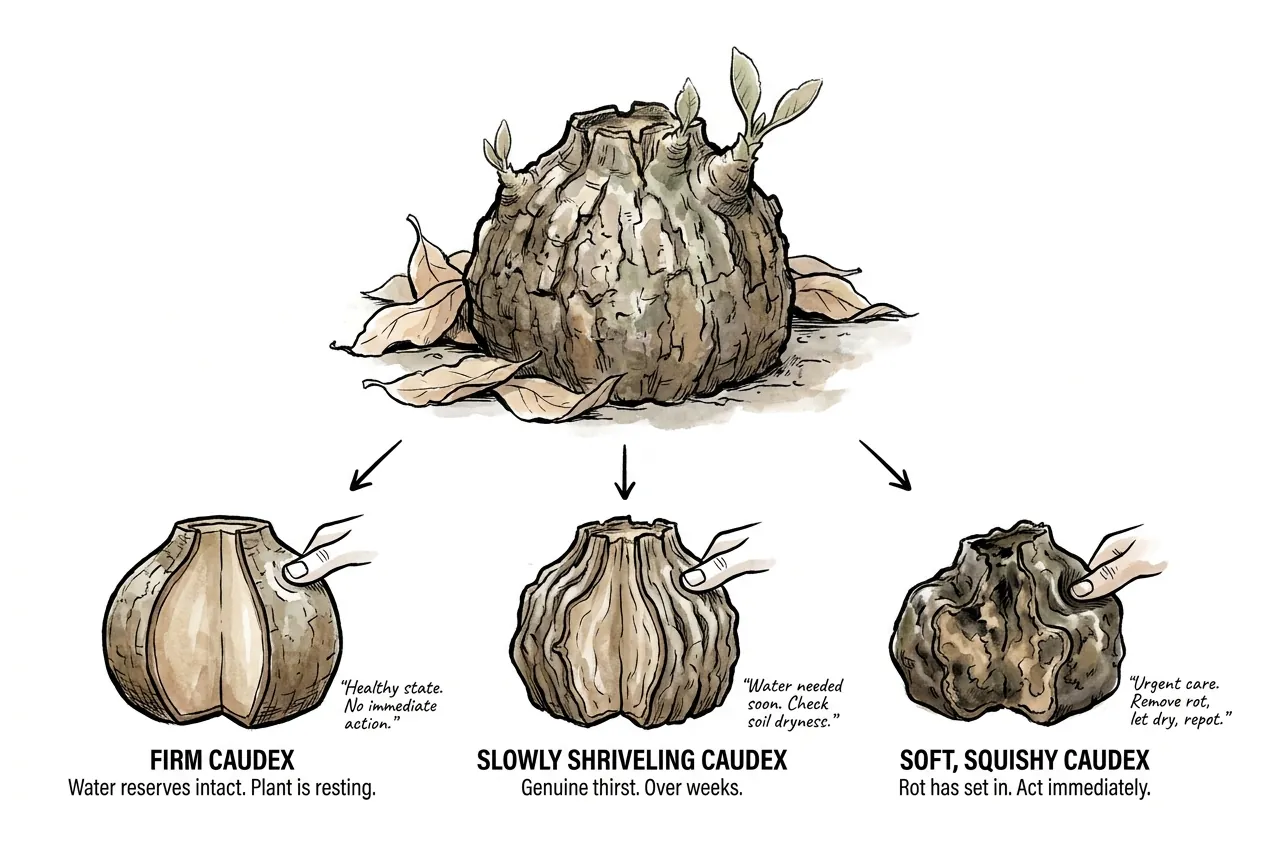
Caudex firmness is a useful clue to the plant’s water reserves, but a firm outer caudex can still hide root rot or a dry, failing root system lower down. Press gently, treat firmness as reassuring rather than proof, and inspect promptly when shrinking, soft tissue, odor, or discoloration appears.
How should I read the rest of the signs?
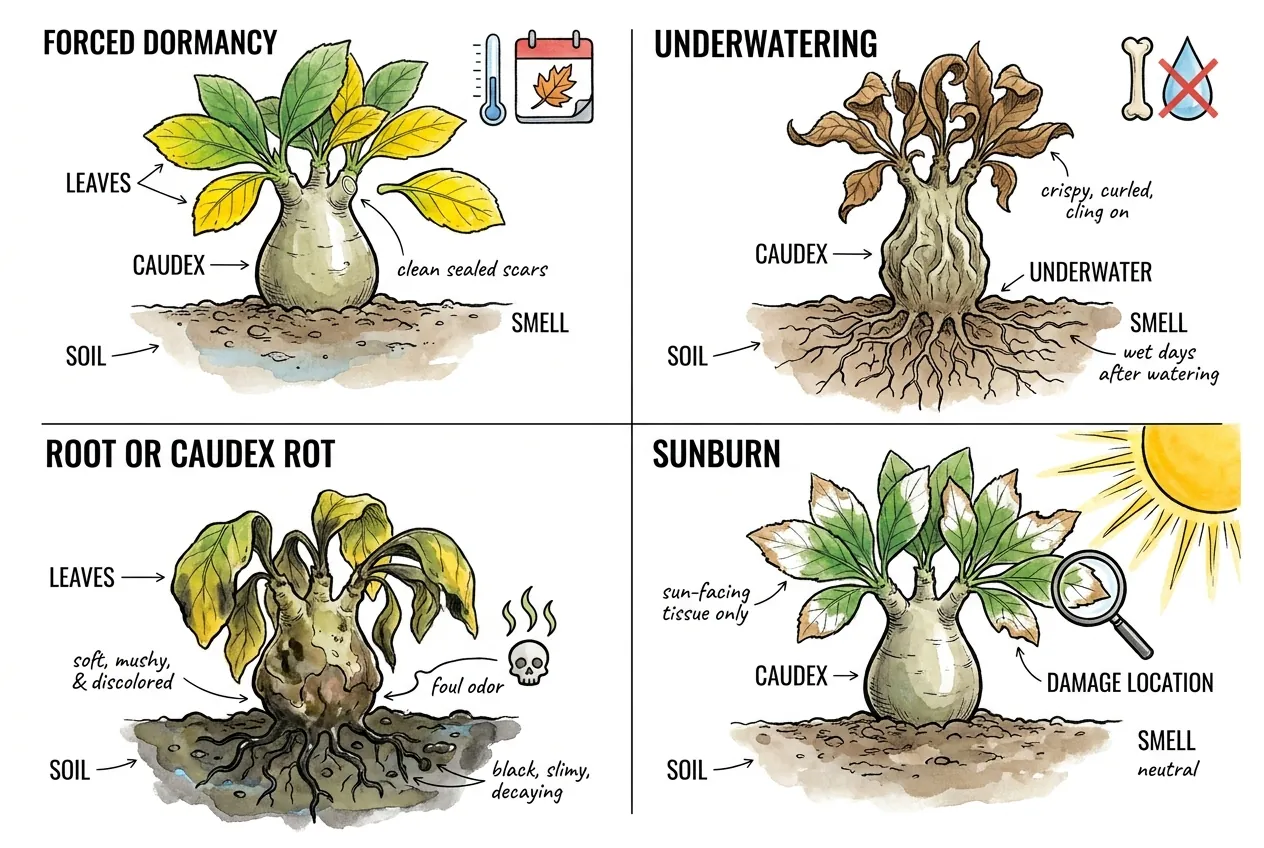
Match the full pattern to the table below before you touch the watering can.
| Signal | Forced dormancy | Underwatering | Root or caudex rot | Sunburn |
|---|---|---|---|---|
| Caudex | Often firm | May slowly shrivel | May be soft or squishy | Often firm at first |
| Leaves | May yellow then drop, sometimes with clean scars | May be crispy or curled | May yellow or wilt with base decline | May show bleached or scorched patches |
| Soil | Often dry to slightly moist | May be very dry through the root zone | May stay wet after watering | Any. Inspect the affected side |
| Smell | Often none | Usually none | May be sour or foul | Usually none |
| Damage location | May involve the whole plant | May involve the whole plant | Often starts at the base or roots | Often concentrated on sun-facing tissue |
The Desert Botanical Garden lists wilting, scorched leaves, yellowing, leaf rolling, stem dieback, defoliation, and root loss as heat-stress symptoms. They can appear together on one plant rather than representing separate diagnoses, so use the table as a starting point and remember the categories overlap.
When does watering make things worse (and when doesn't it?)
The real risk is overwatering. A leafless plant transpires far less and may use water slowly, so repeatedly soaking a warm, wet mix invites rot.
It is also too absolute to say that a leafless plant cannot take up water. Roots still respire, and a genuinely dry root ball on a summer grower can keep losing fine roots if it is never watered. Whether water helps or harms depends on the actual mix, root health, drainage, and temperature rather than leaf presence alone.
Where does the water go if the plant cannot use it?
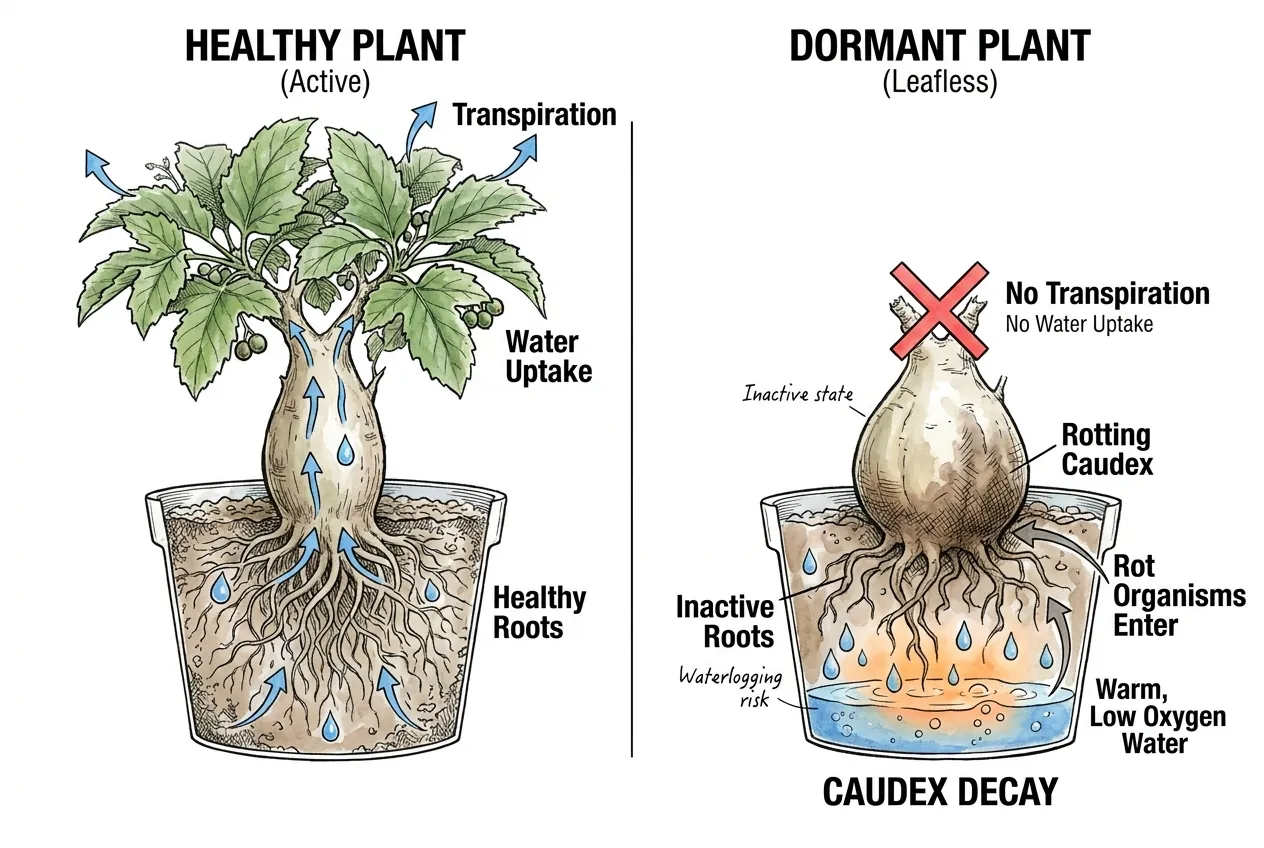
Water moves through a plant partly by transpirational pull. Remove the leaves and close the stomata, and demand usually falls sharply, so the plant uses applied water slowly.
If the mix stays soaked, water sits around a barely active root system. In summer heat, chronically wet soil can lose oxygen, roots may struggle to respire, and rot organisms may reach the caudex. That is the failure to avoid, and it is associated with repeated overwatering rather than one appropriate drink of a genuinely dry pot.
The care literature’s strongest dry warnings concern winter dormancy, while the same sources describe plentiful water during summer growth. The dry rule therefore belongs to winter rest rather than blanket summer withholding.
How do I know if I have already overwatered?
Watch for soil that stays wet days after watering, any softening of the caudex, a sour smell, or discoloration creeping up from the base.
Inspect before watering again
If a leafless plant declines after watering, do not add more water by default.
Inspect the root zone and caudex. Unpot and let the plant drain or dry only when the mix is staying wet or rot is suspected.
If rot is confirmed, excise affected tissue back to firm, clean tissue and repot into a suitable dry, gritty mix.
What should I actually do during the heat wave?
During a heat event, first reduce radiant load, improve airflow, and protect the root zone.
Water only after checking the actual mix and root condition.
How much shade should I add?
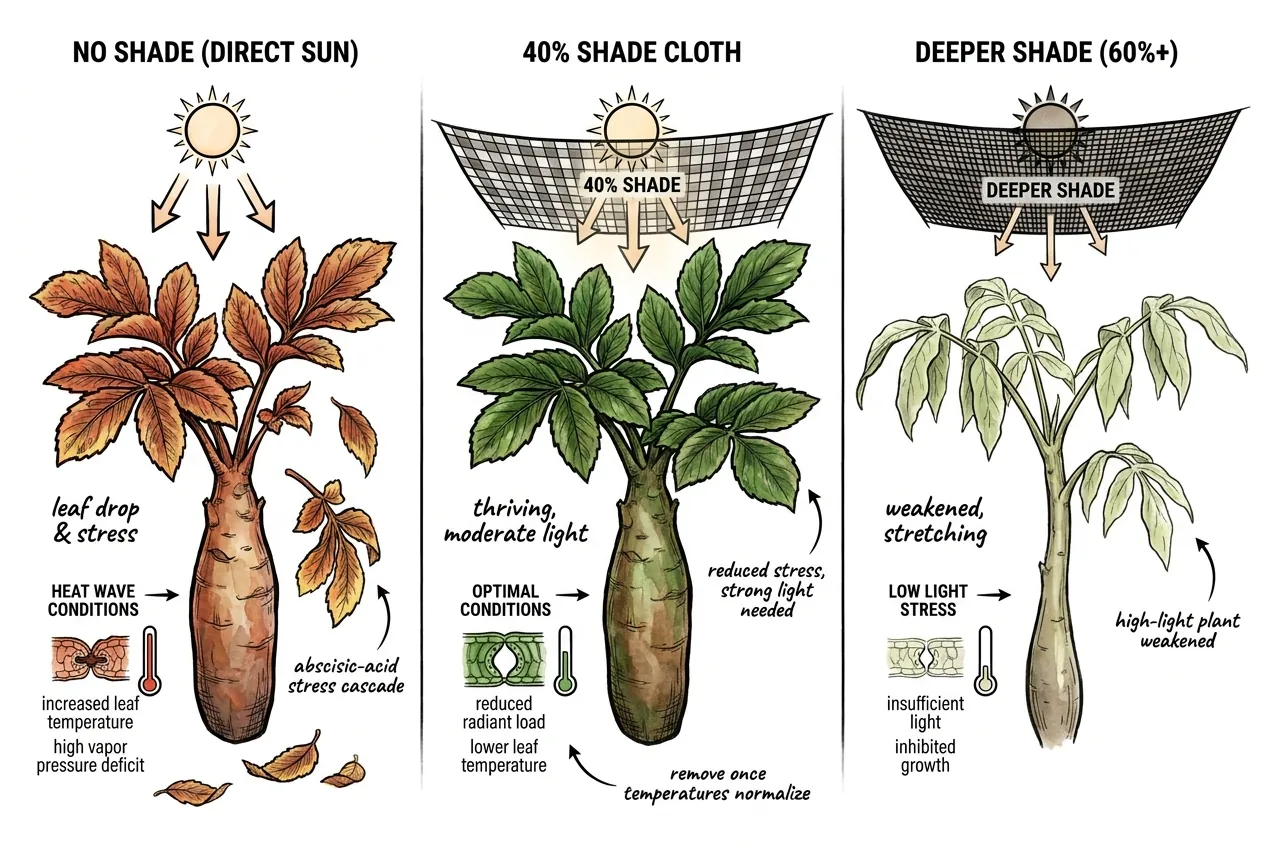
Use temporary shade that lowers radiant load without leaving the plant in stagnant darkness.
The right density depends on existing exposure, cloth, airflow, and duration.
Shade lowers leaf temperature and vapor-pressure stress, but excessive shade can reduce growth, so adjust from leaf condition and local measurements rather than a fixed percentage.
How do I protect the root zone and time my watering?
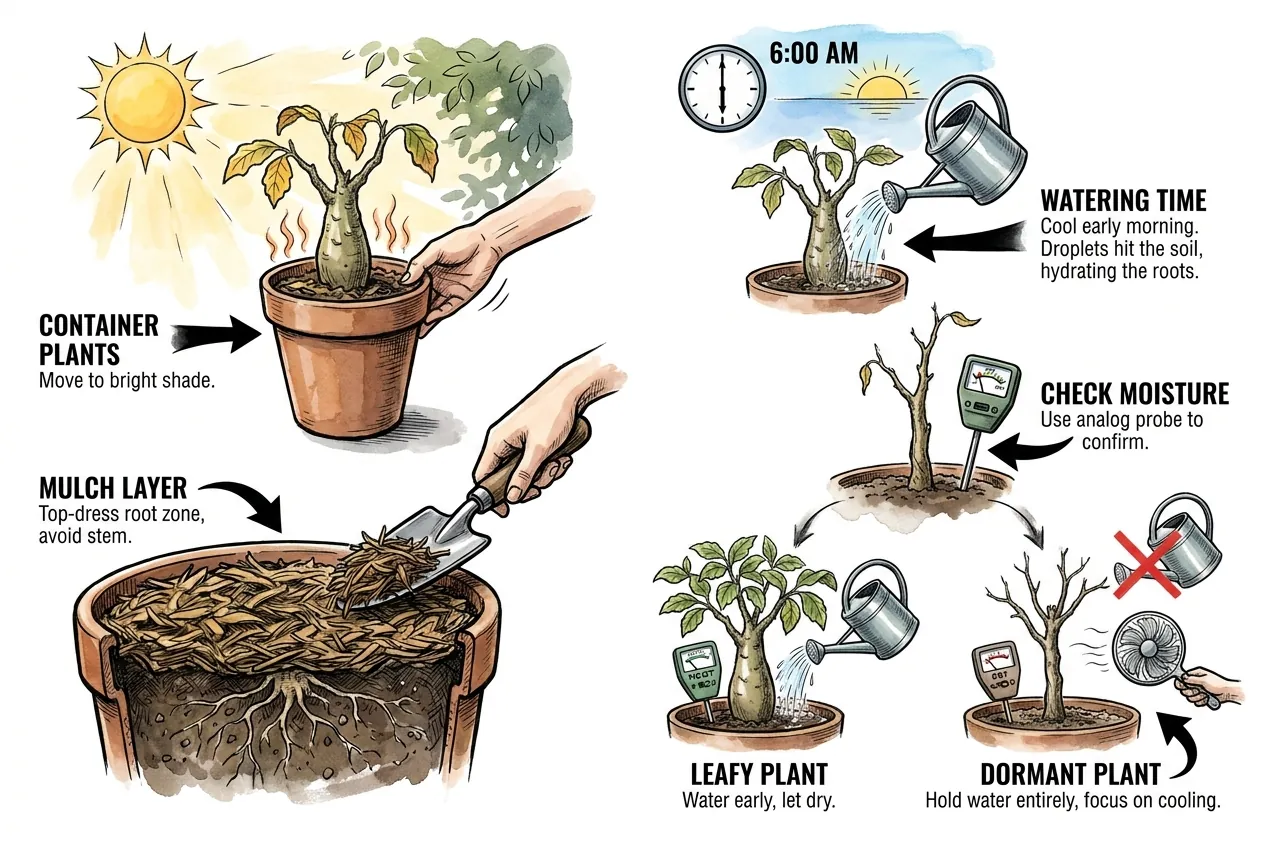
Move container plants into bright shade and top-dress the surface, and if you water a still-leafy plant, do it in the cool early morning.
Pots can overheat faster than ground soil because container walls transmit radiant heat into the medium.
Move containers to a shadier location during the event and, if using mulch, keep it away from the caudex and adjust it to the pot's drainage.
Time water to dry-down
Water at a cooler time of day when the mix has dried to the level appropriate for the plant.
A leafy plant may use water faster, while a leafless plant may use it slowly.
The goal is to avoid chronic saturation without refusing water to a functioning root system.
How to make the hold-water call objectively
To make the hold-water decision reproducible, measure the root-zone condition rather than relying on the calendar or surface appearance.
A no-battery analog moisture probe gives a rough directional check of how wet the mix is at different depths before you act. Cross-check it against pot weight, mix behaviour, and caudex condition rather than trusting the dial on its own. To measure dormant dry-down more objectively, pair the probe reading with those pot-weight and mix checks.
Treat it as a trend check only, because gritty mixes and mineral salts can throw probe readings off.
Honest tradeoff
Simple conductivity probes lose accuracy in very gritty, pumice-heavy mixes.
Use it to confirm dryness rather than to fine-tune wet readings, and never let it override the caudex-firmness test.
What substrate, pot, and tools prevent this in the first place?
A heat event is easier to manage when the pot drains predictably and moisture can be checked before watering.
What soil mix keeps the caudex from rotting?
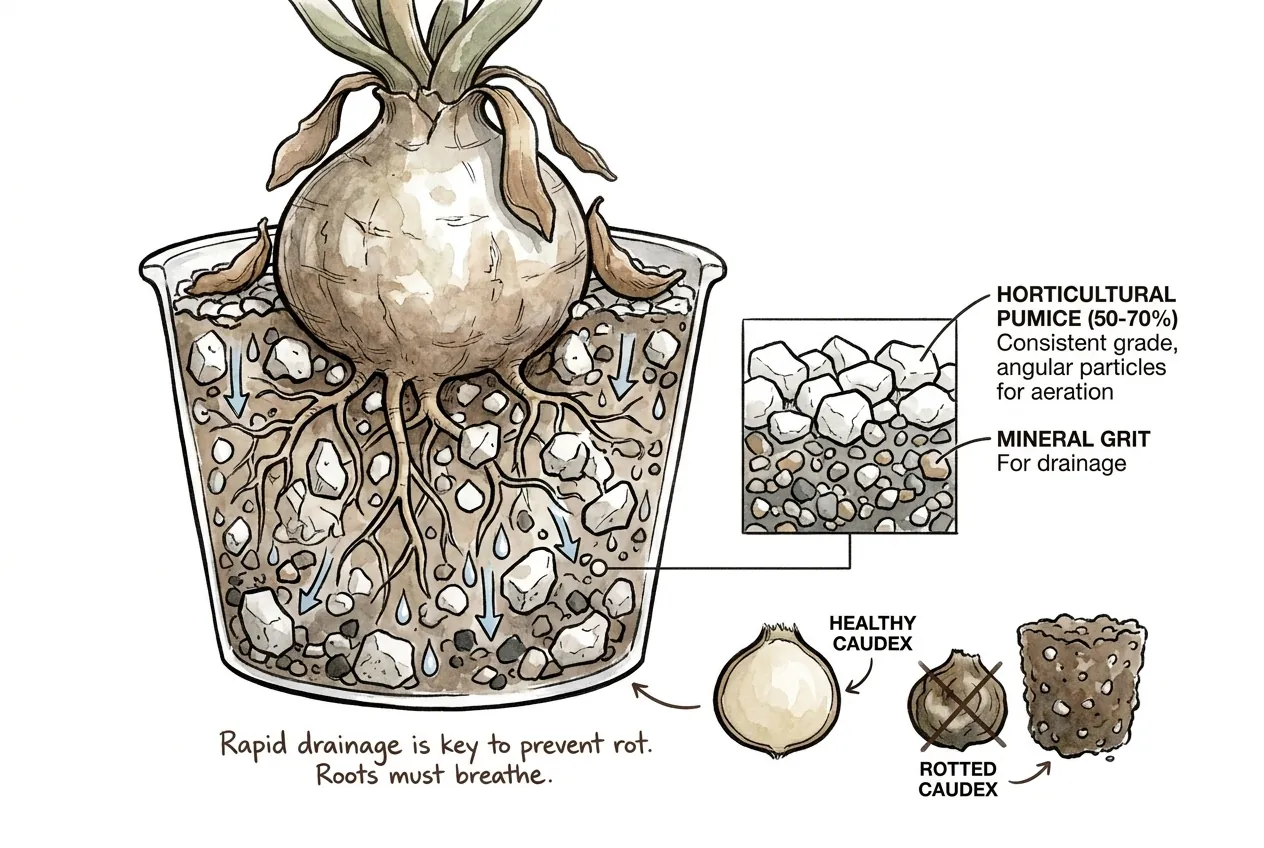
An open, stable mix that drains predictably and lets the root zone re-aerate between waterings reduces the time roots spend warm and wet.
Build air-filled porosity into the mix
The llifle encyclopedia specifies a very well-draining soil mixture with plenty of gritty components.
One plausible mechanism is air-filled porosity. Angular pumice particles can create air space and let water pass quickly, supporting re-aeration around the roots rather than prolonged saturation.
What to look for in a substrate
A porous mineral component such as horticultural pumice does most of the work. When comparing options, look at the graded particle size and the sifted volume you actually get, and choose a grade and proportion that fit the pot, climate, and observed dry-down rather than copying a fixed percentage.
Blend it into a tested mix, then watch how quickly the real pot dries and adjust from there.
Honest tradeoff
Pumice is generally inert, but its chemistry and grade still vary by source. Feeding should follow the plant and the rest of the mix rather than a fixed rule.
It is heavier and often costs more per quart than perlite, while tending to stay in place rather than float.
Does the pot material matter?
It can. Breathable containers may moderate root-zone moisture and can run cooler than dark plastic in direct sun, but location and mix still dominate.
Dark plastic walls can heat substantially in direct sun, while unglazed terracotta wicks moisture and may dry the root ball faster.
Choose a pot that keeps root temperature and dry-down manageable in the actual location.
This pairs with the substrate. A gritty mix in a breathable pot may dry more predictably, which can help a plant that is vulnerable to prolonged wetness.
How do I know when it is recovering, and when do I resume care?
A bare caudex is not automatically a dead plant. When the heat passes and conditions moderate, a viable plant may push new leaves.
That new growth is one useful signal to resume more active care.
What is the safe first-watering rule after dormancy?
New growth is evidence that the plant is reactivating. Increase watering only as the root zone dries and the plant can use it.
Adjust watering after leaf return
While it is leafless, water less often and only after checking the mix and roots.
When leaves return, transpiration rises, but the correct interval still depends on pot, light, temperature, and drainage.
Continue checking caudex firmness and tissue condition during rest. A firm caudex is reassuring, but it is not proof that the plant is healthy or that it can remain untouched indefinitely.
How do I tell recovery from a plant that is actually dying?
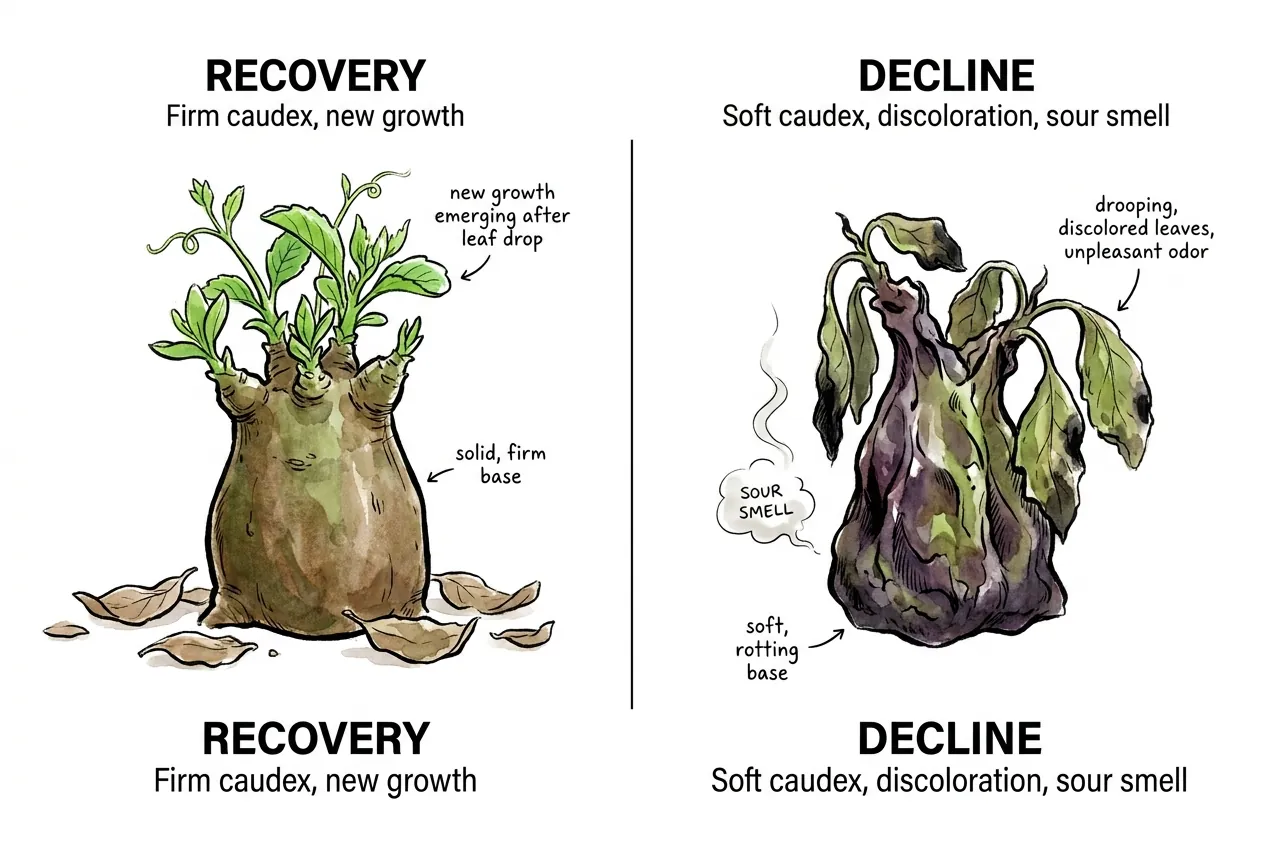
Recovery can look like new growth plus a firm caudex, while decline may include a softening caudex, discoloration, and a sour smell.
Clean defoliation with stable tissue can be compatible with recovery, but the plant still needs root and soil checks.
Softening, foul odor, or spreading discoloration raises concern for rot and calls for inspection rather than routine watering.
How do I prevent this next summer?
Build three habits. Acclimate the plant to sun and heat gradually, water on the plant’s real growth schedule instead of a fixed calendar, and prepare a setup that reduces prolonged wetness before summer arrives.
How should I acclimate it?
Increase exposure gradually whenever the plant moves from shade to stronger sun, watching for scorch or heat buildup rather than following a fixed day count.
Acclimate new leaves gradually
The llifle encyclopedia notes the plant likes lots of sun but may need afternoon shade in hot climates to avoid leaf burn.
Gradual exposure gives new leaves time to acclimate and may improve tolerance, but it does not establish a fixed heat or light threshold.
What watering schedule actually matches the plant?
Water more while the plant is leafy and actively growing, and reduce it when the plant is leafless or cool, but do not turn either state into a universal zero-water rule.
Water demand tracks transpiration and root activity. Tie each watering decision to leaf state, soil moisture, temperature, and drainage, then adjust one variable at a time.