
Caudex Watering Tools: Measure Dormant Dry-Down
Compare pot weight, capacitance sensing, root-zone temperature, and logging so dormant caudex watering decisions use repeatable observations rather than a calendar.
Nathan Brooks · 2026-06-22 · Updated 2026-08-06 · 25 min read
Key Takeaways
- Measure, do not schedule. Dormancy often lowers demand, but species, root health, temperature, and light still change how fast a pot dries.
- A repeatable pot-weight log is your best pot-specific dry-down signal. It is not a laboratory soil-moisture percentage or a direct measure of root uptake.
- Use root-zone temperature as context, not a universal hard stop. A cold or persistently wet pot deserves caution, while a warm reading does not prove that watering is safe.
- Do not trust a cheap two-pin conductivity meter in low-salt mineral mix. It responds to dissolved salts and can read dry while the mix is still damp.
- When in doubt, wait. Re-baseline after any repot and cross-check every probe against pot weight.
Repeatedly watering a dormant caudex while the substrate remains wet can create a serious root-health problem. The safer alternative to a calendar is a measurement routine that can be checked against the plant's condition.
A dormant Pachypodium or Adenium may use much less water than during active growth, so the pot can stay wet for an extended period. Species, root health, temperature, light, and dormancy depth still matter.
What tools actually tell you when to water a dormant caudex?
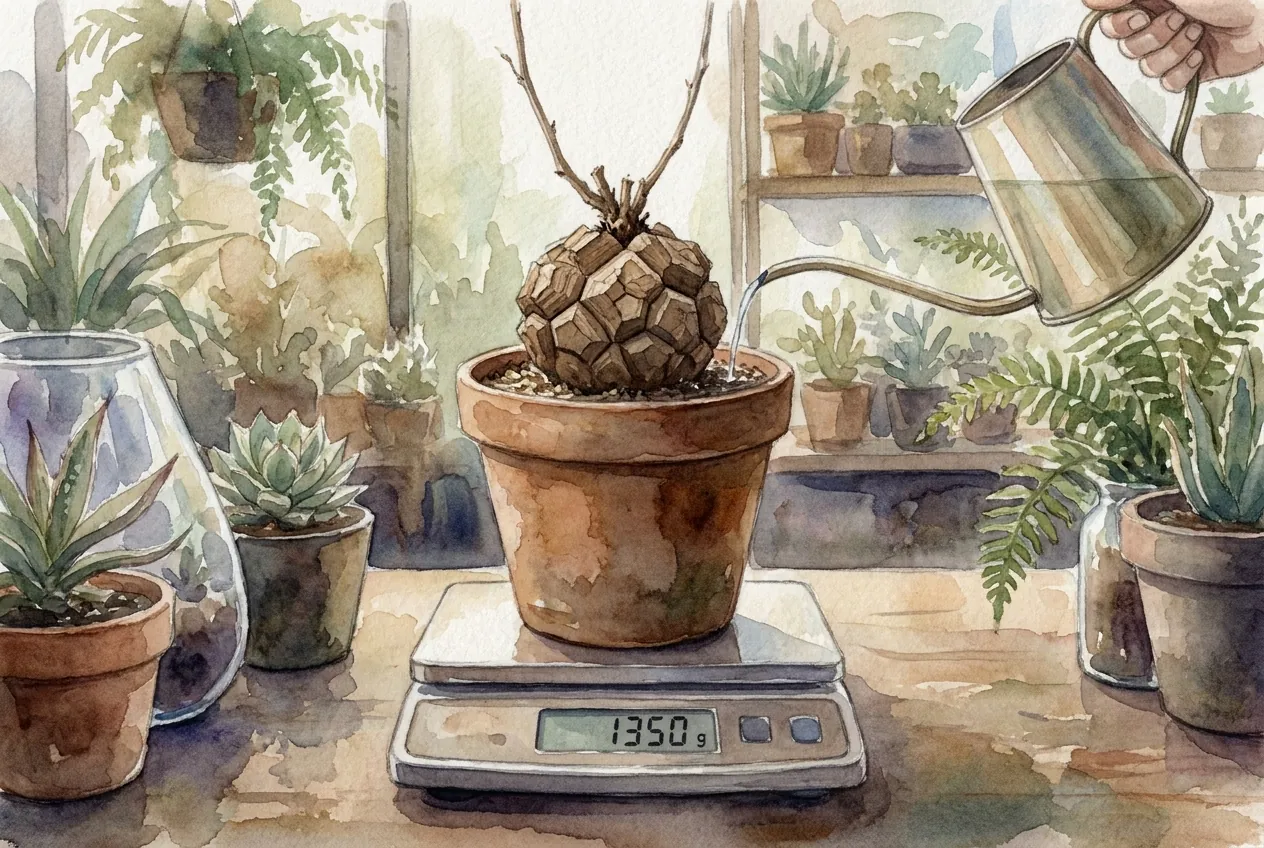
A precision gram scale is the most useful single tool. When you weigh the same pot after the same drain time, its changing mass shows how much water has left across different substrates. It is a practical mass-balance proxy, not a laboratory measurement of exact soil-water content. It answers the everyday question of whether this pot is near its wet end or its dry end, so you measure rather than schedule.
The full kit covers four roles in priority order. A precision scale gives the repeatable mass reading, a soil thermometer adds context because cold conditions can limit uptake, a capacitance probe spot-checks between weighings, and a thermo-hygrometer plus a dated log tracks the air-side demand and the interval.
Why does the scale lead?
Understand scale limits
The laboratory gravimetric method is destructive. You take a soil sample, oven-dry it, and weigh the water lost. Extension sources call that the direct reference for soil-water content. Weighing your whole pot is different. It weighs the plant, pot, and mix together, and its changes reflect total water leaving the system through drainage, evaporation, and transpiration. What it gives you is a very good, low-cost relative read of one pot's dry-down. It is more useful than a cheap meter for this purpose, but it is not an absolute soil-moisture percentage.
Keep readings comparable
When you use the same pot, drain time, and scale consistently, that relative reading becomes your best everyday signal. The scale responds to water mass the same way in pumice, akadama, or peat, so buy the scale first, add the thermometer to gate it, and treat probes and loggers as spot-checks.
Why does a dormant caudex barely use water, and how does wet soil rot it?
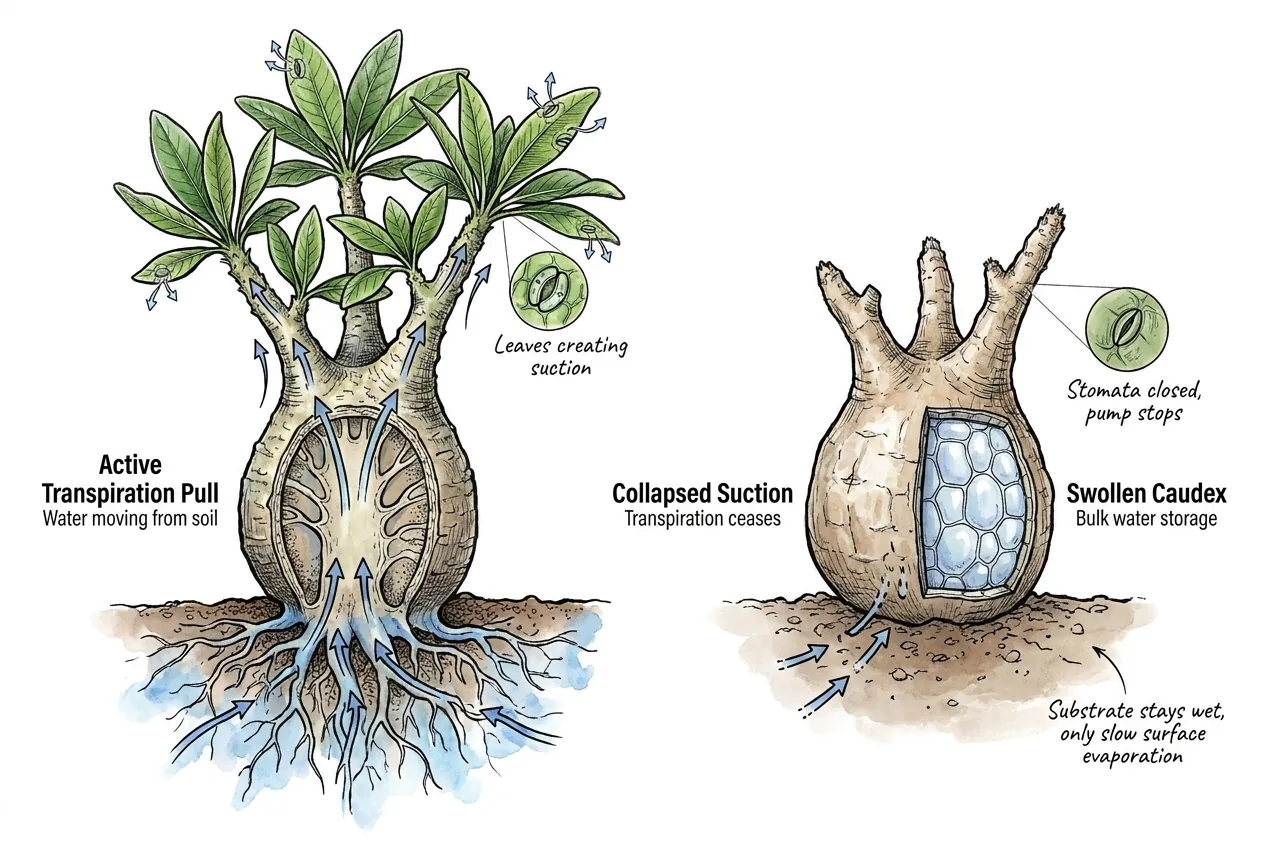
A dormant caudex may draw much less soil water because leaf area and transpiration often decline, but uptake does not become a universal zero. When a low-demand plant sits in wet substrate, drying slows and oxygen availability can fall, which raises root-rot risk without proving a specific pathogen.
What physiologically stops the water uptake?
Read transpiration before roots
Transpiration creates most of the suction that pulls water from soil into the plant, and root uptake is strongly tied to how fast the leaves are transpiring. When a caudex drops its leaves and closes its stomata, that pull falls dramatically (though root uptake also depends on soil–root water-potential gradients and tissue rehydration, so it doesn't drop to a literal zero).
Do not assume identical CAM behavior
Many succulents use CAM photosynthesis and can enter a low-activity idling state under drought, keeping stomata mostly closed and using very little water. Not every caudiciform is a strict CAM plant. Some Pachypodium tissues have been measured doing C3 photosynthesis. Treat very low water demand during dormancy as the reliable practical point rather than assuming identical CAM physiology across every genus.
Use stored water as context
The swollen caudex also carries a large internal water store, which is why a dormant plant can lean on its own reserves rather than needing frequent soil water. One cactus study found that most water lost during a drought came from stored parenchyma. It involved a different plant and did not directly compare stored water with soil water.
Expect slower dry-down
The watering implication is straightforward. The same mix that dried in days during growth can stay wet for weeks in dormancy because the plant may be using much less water and only slow evaporation removes water. That is the situation the tools below are built to catch.
Why is cool or hot wet soil a rot trap?
Understand oxygen loss
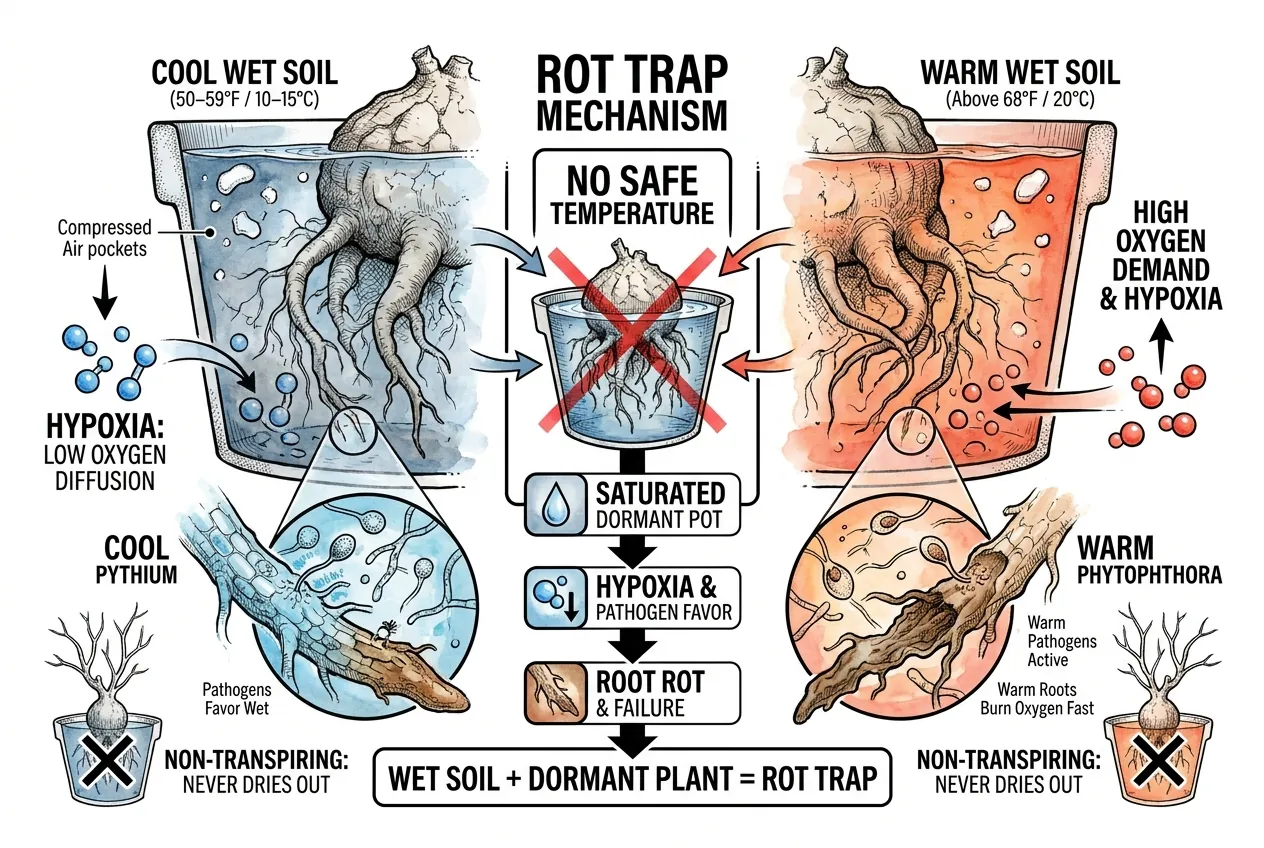
Several risks can stack in a saturated dormant pot. Oxygen diffuses through water about 10,000 times slower than through air, so a poorly draining mix can become oxygen-limited. Wet conditions can favor some pathogens, while a low-demand plant may dry the pot slowly.
Avoid a temperature shortcut
Different root-rot organisms favor different temperatures, so no single warm-is-safe or cool-is-safe rule holds. Some Pythium species are most active in cool soil, very roughly 50–59°F in field studies. Phytophthora can produce infective zoospores in moderately warm wet soil around the high 60s°F, and other Pythium species such as P. aphanidermatum prefer warm soil above about 77°F. These figures come from specific crops and pathogens. Treat them as illustrations that wet soil carries some rot risk across a broad temperature range, not as an exact diagnostic chart for your plant.
Keep saturation as the central hazard
Prolonged saturation is the real hazard, and container guidance commonly treats air-filled porosity around 10 percent or more as an aeration floor. A waterlogged pot can fall below it. The goal is to avoid leaving the mix saturated, not to find a magic temperature at which standing water is fine.
Read root oxygen demand
Root oxygen demand also rises with warmth. Respiratory Q10 for roots and rhizomes averaged roughly 1.7 in the cited study, so warmer roots can consume limited oxygen faster. Cold-root readings still need to be interpreted with the plant, substrate, and species context.
What is the safe-to-water soil-temperature band?
Use temperature as context
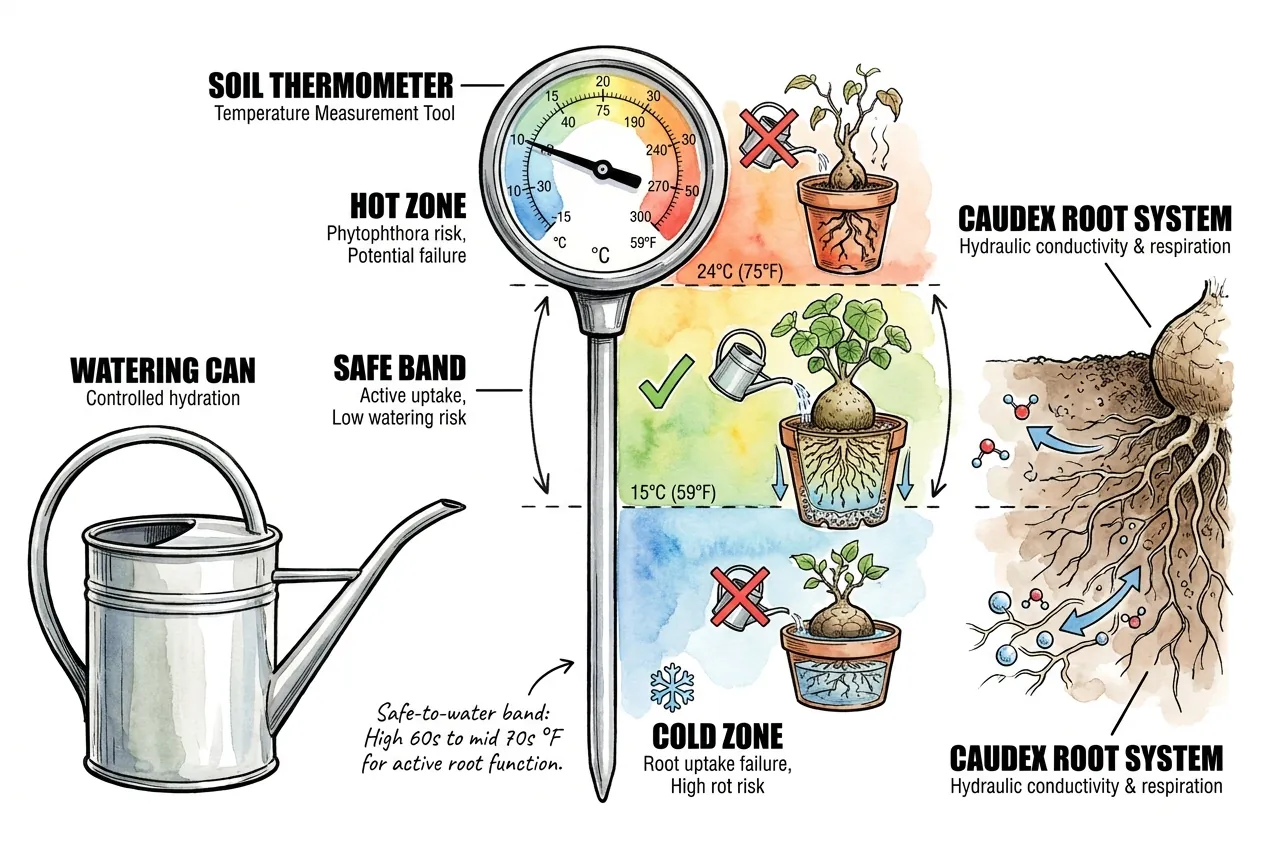
Cold root-zone readings are a reason to pause and check the plant, substrate, and species guidance. They are not a universal zero-uptake threshold. A Plant and Cell Physiology study on rice found hydraulic conductivity declined sharply below a study-specific temperature, but that result does not turn 15 degrees C into a caudex rule.
Avoid a universal watering band
There is no validated temperature band that makes standing water harmless. Use the thermometer to explain a slow dry-down and to detect a mismatch between the plant's stage and the watering plan. Pair that reading with substrate drainage, plant condition, and observed uptake rather than a fixed target.
A matching field failure appears in the Pachypodium lamerei root-rot case, where temperature and wet media interact differently from a simple thermometer rule.
How do you measure caudex soil moisture accurately?
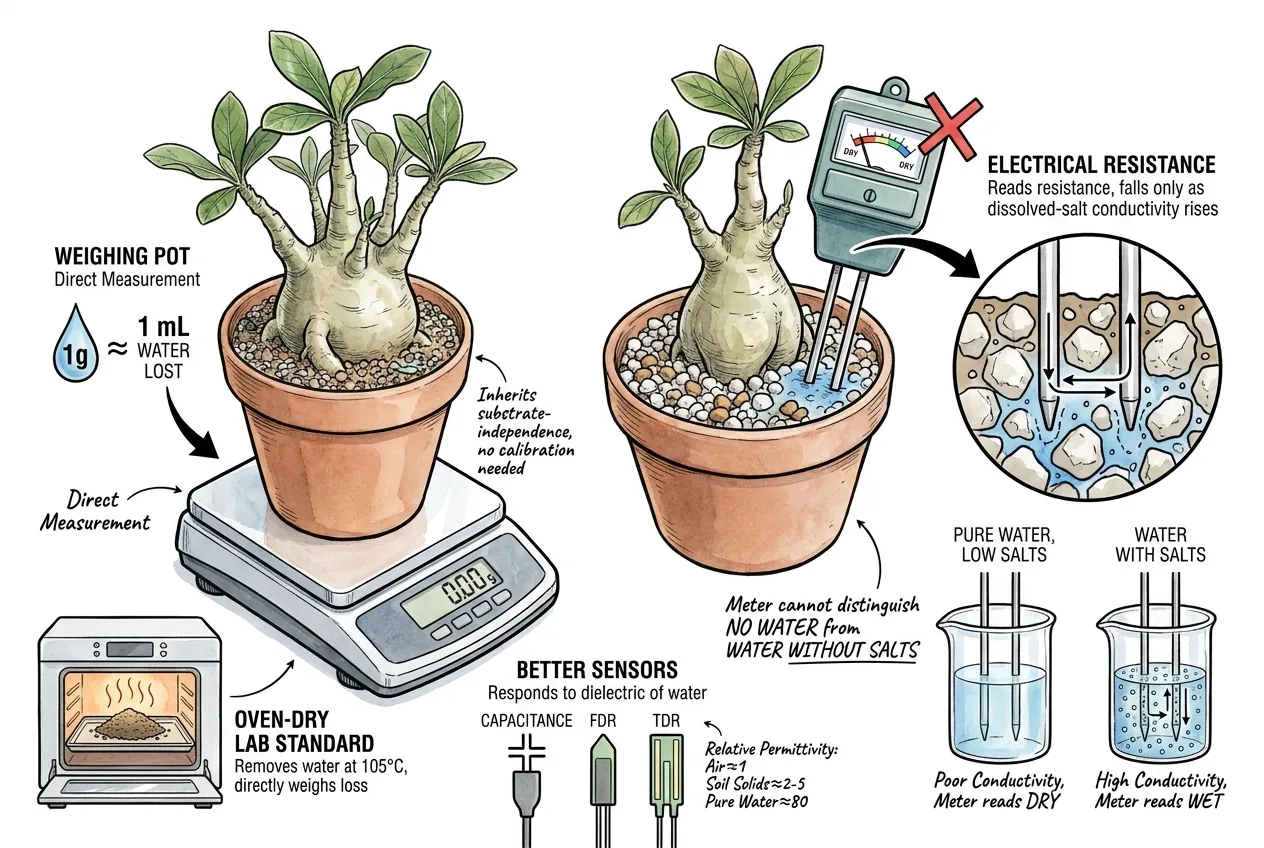
Gravimetric pot-weight is the reference because it measures water mass directly and is substrate-independent. Sensors measure a proxy and need calibration. The decisive split is what each tool actually senses.
Why is pot-weight the reference, and why do two-pin meters fail?
Use pot weight for direct mass
Water has near-constant density, so each gram a pot loses since saturation equals about 1 mL of water gone. The oven-dry lab standard removes water at 105 degrees C and weighs the loss directly. The home pot-weight method inherits that substrate-independence with no calibration curve.
Understand conductivity meter limits
A two-pin or 3-in-1 meter does something completely different. It pushes current between metal pins and reads resistance, which falls only as dissolved-salt conductivity rises. UF/IFAS EDIS states that if no salts are present, the EC is low and the solution does not conduct electricity well.
Recognize low-salt false-dry readings
Rinsed pumice, akadama, and washed gritty mix are deliberately low in soluble salts. Even saturated, they carry little current, so the needle swings to dry. The meter cannot tell no water apart from water without salts.
Use dielectric sensing for water
A capacitance, FDR, or TDR sensor responds to the dielectric of water instead. A peer-reviewed Sensors paper gives the relative permittivity of air near 1, soil solids near 2 to 5, and pure water near 80. More water means higher permittivity and capacitance, regardless of salt level.
Which method should you choose?
Choose by what the tool senses
Choose the scale as the absolute reference, a capacitance probe for relative trend, and never a bare two-pin meter for mineral mix. The table below maps what each method measures against whether it survives a gritty, low-salinity substrate.
| Method | What it measures | Works in gritty mineral mix? | Cost and effort |
|---|---|---|---|
| Gravimetric pot-weight | Water mass directly | Yes, substrate-independent | Low cost, set two baselines once |
| Capacitance / FDR probe | Dielectric permittivity of water | Yes, but calibrate or use for trend | Moderate cost, some setup |
| Two-pin conductivity meter | Dissolved-salt EC, not water | No, reads falsely dry | Cheap, but unreliable here |
Treat capacitance as calibrated trend
In the cited study, a calibrated capacitance sensor closely tracked measured water, with an R-squared value up to 0.989 and an error as low as 0.018 cubic cm per cubic cm. Treat those figures as an example of calibrated performance, not a universal ceiling. Without calibration, use the sensor as a trend tool only.
The substrate itself drives this argument. The caudex substrate comparison of pumice, akadama, and gritty mix explains why low-EC media can mislead cheap conductivity meters.
Which exact tools meet each role spec?
The four roles map to specific, currently-listed products. Each entry leads with the spec the role needs, then names a product that meets it, with one honest tradeoff. All claims are based on listed specifications. A listing confirms identity and listed specifications only, never performance.
What precision scale meets the gravimetric spec?
Match the scale to the container
The spec is resolution at or under 1 g and capacity at or over 5 kg. A potted caudex with dense mineral mix commonly weighs 1 to 4 kg.
Avoid the wrong scale class
So a jeweler's scale is too small and a bathroom scale is too coarse. UF/IFAS rates direct gravimetric methods as accurate to about plus or minus 0.01 cubic ft per cubic ft.
Set capacity before resolution
Pick capacity for your heaviest saturated pot first, then take the finest resolution at that capacity. Use the tare function to zero a tray under awkward terracotta.
Compare heavy-pot scale tradeoffs
The Greater Goods scale meets the capacity requirement with headroom for heavy, saturated mineral-mix pots. Use it when your collection includes heavy or terracotta-potted specimens. The tradeoff is resolution, which is one step coarser than a 0.1 g unit. Very slow dry-down on a tiny pot will therefore appear more gradually.
Compare fine-resolution tradeoffs
The BOMATA scale offers 0.1 g displayed resolution for tracking small day-to-day weight changes in a dormant caudex. Choose it when you have one small-to-medium plant and want finer movement on the display. Skip it if you grow large specimens because a saturated 4.5 kg-plus pot can overrun the 5 kg ceiling. It also relies on a rechargeable battery rather than swappable cells.
What soil moisture meter is honest about gritty mix?
Use capacitance for low-salt mix
The spec is a sensing method that survives low-salinity mineral mix, which means capacitance, not bare conductivity. The cheap two-pin meter is included here as the honest failure case, not as a primary recommendation.
Treat two-pin meters as a failure case
The SONKIR MS02 is a two-pin analog meter with no battery. It senses conductivity, not water, so rinsed low-EC pumice or akadama can make it read dry minutes after a soak. Skip it as your sole watering signal in mineral mix. At best, treat it as a salinity indicator and confirm the decision with pot weight.
Use a remote capacitance spot-check
The ECOWITT WH51L uses a capacitive probe on a 1 m or 3.28 ft PVC wire with an LCD, 915 MHz wireless connection, AA battery, and IP66 rating. Use it when you want a remote spot-check that responds to water's permittivity rather than salt. The catch is that it needs a paired Wi-Fi gateway sold separately. Use its percentage for trends or calibrate it to your exact mix. Pot weight remains the reference.
What soil thermometer reaches the root zone?
Place the probe at root depth
The spec is a range covering 0 to 50 degrees C and a probe long enough to reach mid-pot. The rot-relevant temperature lives at the roots, not the surface, so the watering gate is a mid-pot reading.
Compare thermometer reach
The REOTEMP thermometer reads 32 to 178 degrees F or 0 to 81 degrees C on a 12-inch stainless stem. Use it for a mid-pot temperature check before watering. The analog dial may lag for a few moments and is coarser than a 0.1-degree digital unit. Choose a digital probe instead if you need an instant number.
What thermo-hygrometer tracks demand and the log?
Track ambient demand
The spec is ambient temperature and relative humidity to gauge VPD-driven demand, paired with a dated record. Vapor pressure deficit is a function of air temperature and humidity, and it sets how hard the plant transpires.
Choose manual or logged readings
The ThermoPro TP49 reads temperature from minus 50 to 70 degrees C and humidity from 10 to 99 percent. Its stated accuracy is plus or minus 0.5 degrees C in the 0 to 60 degrees C band and plus or minus 2 percent in the 30 to 80 percent humidity band. Use it as a low-cost ambient sensor beside the plant with a written log. It does not log or export, so you must record the date yourself. It reads room air rather than in-substrate conditions.
Use automatic logging when it helps
The Govee H5179 logs temperature at plus or minus 0.3 degrees C and humidity at plus or minus 3 percent RH. It exports up to 2 years of data to CSV through the Govee Home app. Pick it when you want the dated record to keep itself instead of relying on memory. The cost is Wi-Fi, an app account, and power. It also logs ambient air rather than in-substrate moisture. Growers who distrust apps or have no network may prefer the manual TP49 with a paper log.
Use humidity as demand context
The humidity reading feeds the demand side of the system. The explainer on how VPD for caudex plants prevents rot and shriveling covers why that air-side number governs transpiration.
How do you set up and run the measurement system?
Build it once, then run it from three readings. Use weight position, mid-pot soil temperature, and days since the last watering. The order matters, because you cannot make a weight decision without baselines or a temperature decision without a correctly placed probe.
Step 1. Set the wet (fully-drained) baseline
Set a plant-safe wet baseline
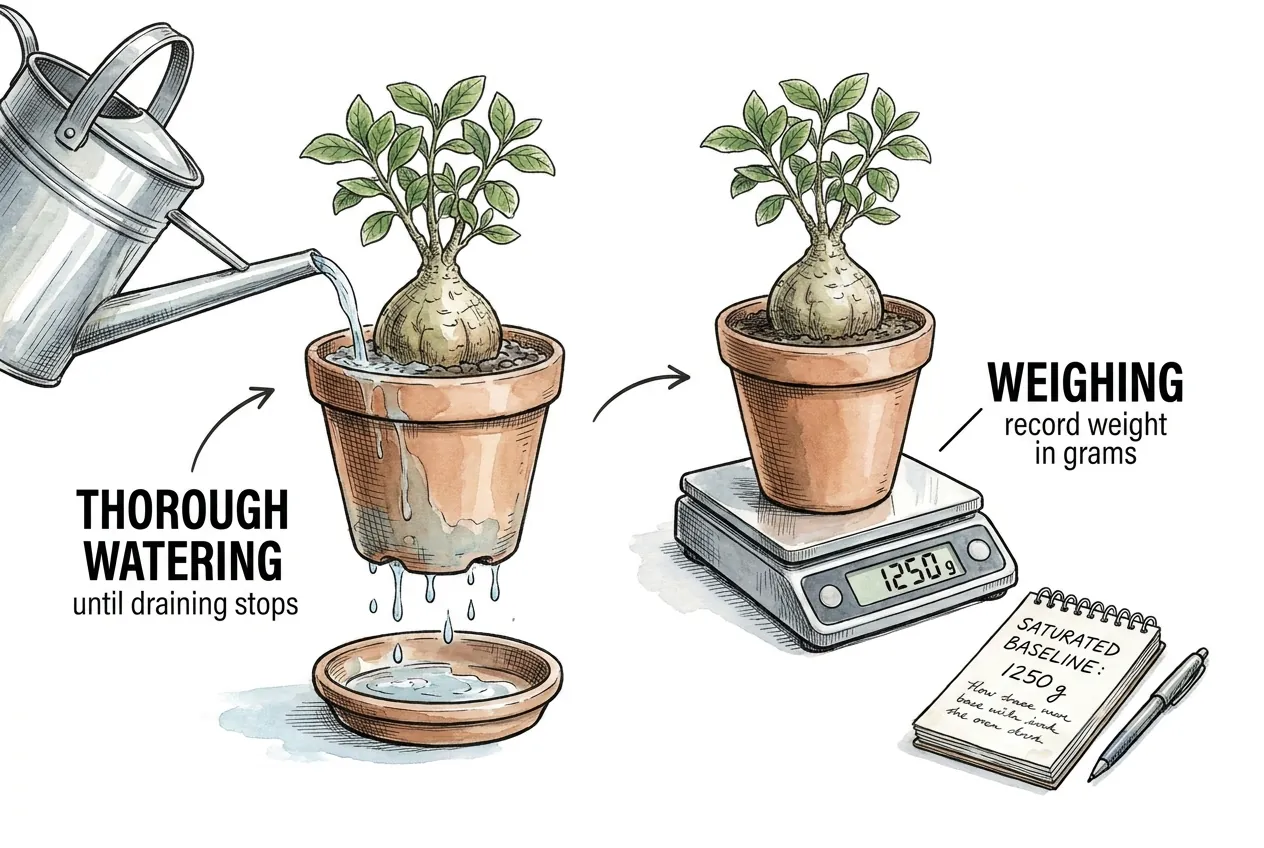
First, make sure a watering is actually appropriate. Do not set this baseline by drenching a plant that is cold, deep in dormancy, or has rotting or absent roots. That is the situation this method is intended to avoid. Establish the wet baseline when the plant is warm enough and healthy enough to take a normal watering, for example at the start of the growing season or when the temperature check below is met. Then water thoroughly, let it drain completely until drips stop, weigh it, and record this fully-drained weight. This is drained to container capacity, not truly saturated. The mix still holds air.
Step 2. Set the dry baseline
Record the dry baseline
Let the pot dry until it reaches the dryness you have decided is time to water, a long dry-down during dormancy. Weigh again and record the dry baseline. The difference between the two is the working water reservoir.
Keep baselines pot-specific
A worked example can show the method, but it is not a target for another pot. Record the drained baseline and a plant-safe dry-down threshold for the actual container. The difference is a local trend range, not a universal water reservoir.
Step 3. Place the thermometer probe
Place the thermometer consistently
Insert the soil thermometer at the pot center, to mid-pot or root-zone depth, not at the edge or surface. Mark the spot for repeatable readings. The roots, not the surface, experience the rot-relevant temperature.
Step 4. Set the soil-temperature gate and start the log
Start the dated log
Use the temperature reading as one decision input. Pause when the mix remains wet, the plant is cold or dormant beyond its normal pattern, or the reading conflicts with the species' care guidance. Do not infer a pathogen from temperature alone. Then start a dated log of watering date, pot weight, mid-pot soil temperature, and observations.
To keep that log clean, I weigh the pot before I groom it, move a support, or clear fallen leaves. I also use the same dry weighing board and consistently include or remove the saucer. That small order of operations prevents normal plant maintenance from masquerading as water loss.
My log has a separate column for events that alter total pot mass. It captures spilled particles, removed leaves, shifted stakes, new top dressing, changed labels, and other tare changes between weighings. The first mass after any such event never enters my dry-down-rate calculation.
If a tare-altering change is permanent, I preserve the earlier readings as history and establish new wet and practical-dry anchors after another safe cycle. This prevents an accessory change from looking like sudden root activity.
Follow a wet-dry cycle
Extension watering practice for succulents is exactly this wet-dry cycle. Iowa State Extension states that a wet-dry cycle, completely wetting then completely drying the soil, is the best way to avoid root rot in succulents.
Choose the watering method after measuring
Once the observations support watering, you still choose how to wet a coarse mix evenly. See the top-down vs bottom-watering method for caudex plants for that mechanics decision.
What is the water-vs-wait decision tree?
When the observations conflict, pause and inspect the plant rather than adding another input by habit. Weight, temperature, root condition, growth stage, and substrate dry-down should agree before a routine watering. A cautious delay can reduce saturation risk, but a severely shriveled or recently rooted plant may need a different rescue threshold.
If the pot is still near the saturated baseline
Usually wait and recheck. The substrate still holds the last watering, and a low-demand plant may not have used enough to justify more. Adding water while the pot remains wet deepens saturation. Confirm the plant's condition before changing the routine.
If the pot is near the dry baseline, check temperature
Read the mid-pot probe before deciding. The weight suggests that the previous water has largely left the pot, but temperature is only context. Root health, growth stage, and species guidance still decide whether a refill fits.
If soil is in the cool band or below
Pause and investigate. Study-specific cold-root and pathogen ranges are not universal caudex thresholds. If a low reading coincides with a wet pot or stalled plant, prioritize warmth, drainage, and diagnosis over a calendar refill.
If soil is hot and not drying
Wait while the pot stays wet and check the plant for heat stress. Pathogen temperature windows differ by organism and host, so heat alone cannot declare a safe or unsafe band.
If soil is in the warm middle band and the mix drains fast
Water only when the plant is actively able to use it, the mix drains predictably, and the observed dry-down supports a refill. Then let the pot return toward its own plant-safe dry threshold before the next watering.
Shift to diagnosis when softness appears
This system is intended to reduce avoidable saturation. If a caudex softens after watering, use the Adenium squishy caudex after watering post to shift from routine measurement to diagnosis.
Who should not buy each tool class?
Buying the wrong tool wastes money on a false signal, so match the tool to your collection size and substrate.
Skip the high-capacity scale if your plants are tiny
A grower with one small plant they can lift by hand may not need the scale. Anyone with pots that exceed its capacity or platform should size up rather than overload it.
Skip the two-pin meter in mineral mix entirely
Any caudex grower in pumice, akadama, or gritty mix should not rely on a bare two-pin meter as the sole signal. It reports salinity, not water, in exactly these media. In a salt-bearing organic mix it is less misleading, but pot weight still beats it.
Skip the logging sensor if you distrust apps
A grower with no home network gains nothing from the Wi-Fi logger. A manual hygrometer and a paper log capture the same dated interval.
Skip the soil thermometer only if your room is stable and warm
If your space holds steadily in the warm middle band year-round, the temperature gate rarely changes the answer. Most growers face cool winters or hot windowsills, so the thermometer earns its place.
What are the failure modes and maintenance intervals?
Every tool here has a documented failure mode that can produce a false reading, and a false reading can encourage overwatering. Cross-check every probe against pot weight.
Probe corrosion and mineral buildup
Clean probes after use
University of Arizona Cooperative Extension lists probe corrosion, mineral buildup, and damaged cables among the common causes of unreliable readings. Clean and dry probes after each use, because a crusted electrode reports its crust, not the water.
Calibration drift
Recalibrate against pot weight
Sensors can drift over time, so recalibration may be needed to avoid inconsistent data, per the same Arizona guide. Recalibrate dielectric sensors whenever a reading disagrees with pot weight. Gravimetric needs no per-medium calibration, which is why it stays the anchor.
Dead-battery false reads
Replace batteries before data gaps
A digital hygrometer or logging sensor with a low cell gives stale or no data. Replace batteries as soon as readings get erratic, and keep a paper fallback.
Placement error
Correct probe placement
A probe at the pot edge or too shallow reads the wrong zone. The Arizona guide warns a single sensor may not reflect the entire root zone. Reposition to mid-pot center at root depth.
Re-baseline after any change
Rebaseline after every change
The saturated and dry baselines are valid only for the pot, substrate, and plant mass that produced them. A repot, substrate swap, or a season of growth shifts both weights.
Record new anchors after repotting
After moving an Adenium into a larger pot with fresh pumice, the old dry baseline is meaningless. Both anchors must be re-recorded.
Frequently asked questions
Are soil moisture meters worth it for a caudex?
Use meters only as spot-checks
Only the right type, and only as a spot-check. A cheap two-pin conductivity meter is unreliable as a moisture signal in low-salinity pumice or akadama.
Prefer capacitance to conductivity
Clean mineral grit carries little current even when damp, so it reads dry while the core is wet. A capacitance probe is more trustworthy because it measures the dielectric response, not salt content.
Buy a probe only for a specific need
For most hobbyists the pot-weight method is cheaper per unit of truth, so buy a capacitance meter only for fast spot-checks.
Is a kitchen scale overkill for watering plants?
Use a kitchen scale when repeatability matters
No, it is one of the most useful substrate-independent tools for a collection you can weigh consistently. Water has mass, so a saturated pot is measurably heavier than a dried-down one.
Use resolution to quantify dry-down
A 1 g-resolution, 5 kg-capacity scale turns the dryness question into a repeatable number. It needs no per-medium calibration routine.
Skip the scale for a truly tiny plant
It may be unnecessary for someone with a single tiny plant they can lift by hand.
How often should I water a dormant Pachypodium or Adenium?
Let measurements set the interval
Do not water on a schedule. Use the measurements instead. A dormant, leafless caudex often has near-closed stomata and much lower transpiration, so it can draw water very slowly and rely on its stored reservoir.
Wait for the dry baseline and plant fit
Consider watering only when the pot weight has returned near the dry baseline and the root-zone reading fits the plant's active conditions. In deep dormancy that interval can be many weeks, or there may be no routine refill.
Can I just use the wooden-skewer trick instead?
Use skewers as a secondary check
As a free sanity check, yes. As your only method, no. A skewer pulled from the mix can show damp clinging at the core, which is useful and costs nothing.
Know the skewer's blind spots
But in chunky mineral mix it often comes out clean even when moisture clings to the grit, and it samples one spot at one depth. It also cannot quantify how much water remains, so anchor the call on pot weight.
Is bottom-watering safe during dormancy?
Treat bottom-watering as conditional
It can be, but it can raise rot risk if the root zone remains wet while demand is low. Bottom-watering wets evenly and avoids disturbing the caudex, which can suit active growth.
Limit the soak and monitor dry-down
During dormancy the danger is leaving the root zone wet while the plant is not pulling water and soil is cool. If you bottom-water a dormant plant, do it only when weight and soil temperature say a drink is warranted.
Let the pot dry well down
Give a short soak rather than a long sit, then let the pot dry well down before the next.
Affiliate Disclosure
This article contains Amazon affiliate links. As an Amazon Associate I earn from qualifying purchases. If you use these links, the site may earn a commission at no extra cost to you. Product availability, price, and specifications can change. Check the current listing before buying.