
Adenium Caudex Grafting: A Cautious Top-Work Guide
Adenium caudex grafting, step by step: top-work a desert rose, protect the rootstock, and interpret study-specific take rates and healing timelines without treating them as a hobbyist guarantee.
Nathan Brooks · 2026-06-23 · Updated 2026-07-30 · 27 min read
Key Takeaways
- Top-working keeps the established caudex and replaces the canopy. A grafted scion may push new growth in weeks, but the first true bloom usually takes months.
- Make a flat cut with a single-bevel blade and offset a thin scion so at least one cambium arc overlaps. A ring centered on a wider disc touches nothing and connects nowhere.
- Graft while the plant is actively growing in stable warmth. Keep humid air around the scion while the cut stays dry, and leave healthy nurse foliage when it helps the rootstock.
- Adenium sap is toxic and irritating, so wear gloves and eye protection. Disinfect the blade between plants, and never use a symptomatic donor because CMV can move through a graft.
- Read published take rates as study-specific context, not a home-grafting forecast. They vary with method, cultivar, scion vigor, sanitation, and environment.
A mature Adenium with an unwanted or damaged canopy does not always need to be discarded. A top-work can replace the canopy while keeping the established rootstock, but it is still a wound with real plant, chemical, and tool-safety risks.
The trade name for this is top-working. The central task is to bring two thin layers of living cambium into clean, dry contact and protect them from drying or rotting while they fuse.
A successful graft may push new leaves before it can flower true to type, on a timeline set by the scion and the next growth cycle. A failed cut, diseased donor, or contaminated tool can cost you the rootstock.
Because the sap is an irritant and the tools are sharp, use gloves, eye protection, a stable work surface, and a clear separation between flammable disinfectants and any heat source.
What Is Top-Working a Desert Rose, and Why Do It?
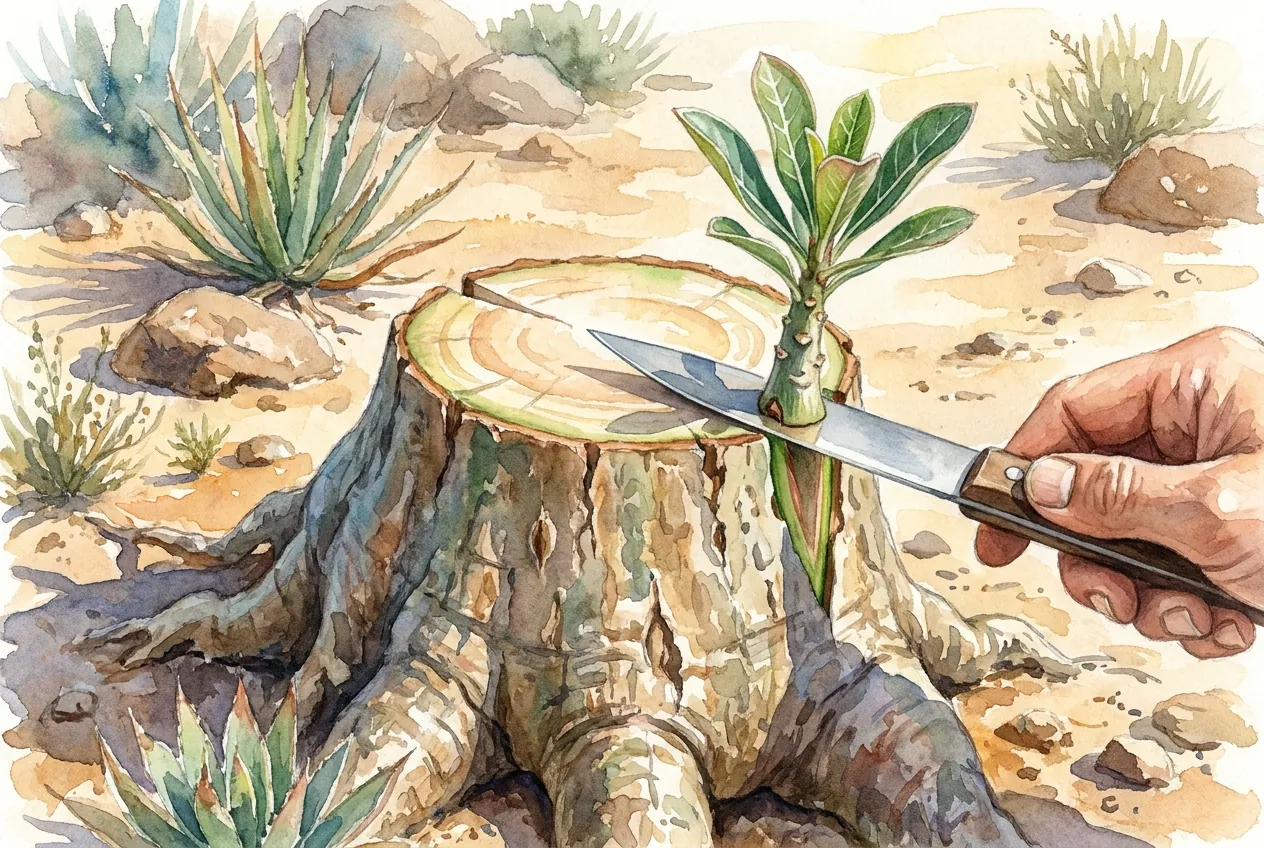
Top-working means grafting a new scion onto the cut-back top of an established plant to change its variety while keeping the mature rootstock. For an Adenium, you keep the swollen caudex and roots you already own and replace only the canopy.
Cornell’s grafting course defines it as grafting new scions high into the canopy of an established plant to change over to a new variety. Picture cutting off the leggy top, exposing a clean face on the woody stem above the caudex, and seating a chosen scion there.
This differs from the two other things hobbyists call grafting. Seedling grafting places a scion on a young rootstock with no established top.
Grafting onto a cutting uses a rooted or unrooted cutting as the base. Top-working keeps the foundation and replaces only the top.
Why graft onto an existing caudex instead of growing from seed?
Top-work to keep an established rootstock, replace an unwanted canopy, or lock in a chosen cultivar. Seed-grown Adeniums vary because of pollination and genetics, while a compatible graft can hold the scion's identity. Neither outcome is guaranteed if the union fails.
A mature scion may flower sooner than a seedling because it already carries adult tissue. But the short nursery timelines people quote describe plants that already have a healed graft and a growing history.
A home top-work still has to form a union and resume growth, so first bloom may wait for months or a later flowering cycle.
Research on grafted avocado shows the scion controls the tree’s molecular maturity through the miR156 and miR172 switch, the internal gene program that moves a plant from its juvenile phase to flowering age.
The other wins are rescue, replacing a leggy or off-type top, and the multi-color plant, since several varieties can share one caudex.
The caudex itself is the prize. It hands the scion an established root system and a built-in water reservoir on day one.
Once the cambium fuses, the scion can use the rootstock's established vascular system. A cutting must build roots first, so a graft's time and flowering advantage still depend on the specific material and conditions.
| What you start from | Caudex quality | Flower outcome | Time to first bloom |
|---|---|---|---|
| Seed | Good caudex | Random, often off-type | Many months to over a year |
| Cutting | Weak, poor caudex | True to type | Slow, builds roots first |
| Graft / top-work | Keeps established caudex | True to chosen hybrid | New growth in weeks. Bloom in months |
When is top-working a bad idea?
Skip the top-work on a caudex that is too small or non-woody, on a plant that is actively diseased, in the cold or dormant season, or when the top is already healthy.
Size the candidate first. The graft-site stem should be firm and woody enough for a clean cut. Diameter and age are plant-specific, so do not treat one fraction-inch or minimum age as a hard requirement.
Disease is a hard stop. Grafting transmits viruses, so you cannot salvage a virused plant by re-grafting its own tissue.
UC IPM gives a direct warning. Do not graft virus-infected parts onto virus-free plants unless you want to introduce the virus, and there is no cure for infected plants.
How Do You Choose the Scion and Rootstock?
Pick a vigorous, slightly woody rootstock graft site large and firm enough to take a clean cut, then match it with a semi-firm scion carrying one to three live buds and no wider than the rootstock cut. The useful diameter and plant age vary with the material.
The graft site should be firm and just-woody, with clean off-gray bark and no blemishes, not green-soft, and not old and corky.
The scion must arrive alive and carry dormant buds, which are the growth points that restart shoot growth once the union begins conducting. A scion with no live bud may form a union but still fail to push new growth.
Avoid the soft watery tip, which may wilt before callus forms, and over-mature wood, which has less active cambium. Some Adenium reports describe new sprouts within roughly one to four weeks after a successful take, but the interval depends on the hybrid, tissue, and environment.
| Feature | Good scion | Bad scion |
|---|---|---|
| Wood maturity | Semi-firm, recently matured | Soft watery tip or dead stick |
| Buds (eyes) | 1 to 3 live eyes | No live bud |
| Diameter | Equal to or smaller than stock | Fatter than the stock cut |
| Source health | Disease-free, screened plant | Mottled or unknown plant |
Can you graft Adenium onto Pachypodium or other relatives?
Stay within the genus Adenium. Treat any cross-genus attempt such as Adenium onto Pachypodium as experimental. Compatibility usually tracks taxonomic closeness.
A peer-reviewed review states that same-species grafts are compatible, same-genus grafts are more or less compatible, and grafts between different families are essentially unsuccessful.
Adenium-on-Adenium, species or hybrid, is the lower-risk option and is commonly used to put multiple hybrids on one stock. Adenium and Pachypodium are both in the family Apocynaceae, but phylogenetic work shows Pachypodium’s nearest relatives are genera like Funtumia, not Adenium. That makes the graft an intergeneric attempt with a less certain outcome.
Incompatibility can show up as deformed tissue at the junction and disrupted auxin flow (auxin being the plant hormone that directs where new water- and food-carrying tissue forms). Reserve cross-genus trials for spare material rather than a prized caudex.
How does virus change which scion you pick?
Source scions only from clean or virus-tested plants. Cucumber mosaic virus is confirmed in desert rose, spreads through grafting and sap, and has no cure.
The first Taiwan report found mosaic, pale ringspots, and line patterns on all eight plants in one garden, with the virus coat protein matching CMV subgroup I at 92 to 96 percent.
Grafting reconnects vascular tissue, so a symptomless infected scion gives the virus a highway into your rootstock and, through shared tools, into the next plant.
Ohio State Extension states that budding and grafting are among the chief ways viruses spread, that infected plants cannot be cleared of the virus, and that the best management is clean or certified stock.
Take scions only from plants you have watched for mosaic and distortion. Never graft from a symptomatic donor.
What Tools and Sterile Technique Do You Need?
A successful Adenium top-work is decided at the blade and the wrap. The only job of your tools is to put two thin, living cambium layers into clean, dry contact and keep them from drying or rotting while they fuse.
Vascular cambium, the thin living layer just under the bark that makes new wood and inner bark, must be present in both pieces for grafting to work.
What knife and blade make a clean cambium cut?
Use a single-bevel grafting knife (or a fresh single-edge razor) for a flat, smooth cut. A grafting knife is sharpened on one side only, so the flat back rides the wood while the single edge leads.
LSU AgCenter describes an edge close to 20 degrees for the knife it discusses. Treat that as sharpening guidance, not a universal Adenium spec.
A clean flat slice maximizes cambium contact. A crushed cut from a dull blade leaves gaps and a thicker dead layer that callus must then bridge.
What to buy
You want a single-bevel grafting or budding knife, or a pack of fresh single-edge razor blades you snap to new when they dull.
The Zenport K106F is one example of a grafting knife listing. Verify the current edge geometry, blade condition, and return information before relying on it. The essential requirement is a sharp, controllable blade that makes a clean cut.
Honest Tradeoff
Several buyers report it ships dull and needs honing to roughly that 20-degree edge before first use. If you graft only one or two plants a year, a pack of fresh single-edge razor blades is cheaper and stays surgically sharp with no maintenance.
How do you sterilize the blade between cuts?
Wipe debris off the blade, then disinfect it between plants and whenever it touches suspect tissue. Alcohol wipes are convenient for routine work.
A bleach-based method needs the correct final concentration, fresh preparation, ventilation, gloves, a rinse, and drying. Follow the product or extension label rather than treating one concentration and contact time as universal.
Do not mix bleach with alcohol, ammonia, or acids. Keep the work area clear of children, pets, and food, and discard contaminated plant material safely.
Do not use an open flame around flammable disinfectants. Some research studies flame-sterilize blades under controlled laboratory conditions, but a home work area may contain alcohol, bleach, dry plant tissue, or vapors. Choose a chemical disinfection method that you can perform safely and keep it separate from heat sources.
What to buy
A labeled tool-disinfectant or isopropyl solution can be used when its instructions fit the material and pathogen risk. Do not infer that one alcohol concentration is effective against every virus or protected pathogen.
70% isopropyl alcohol is one listing example, not a universal pathogen-control specification. Keep any alcohol in its original or clearly labeled container, capped and away from heat, sparks, flames, and poorly ventilated spaces.
Honest Tradeoff
Alcohol does not reliably kill all viruses. If CMV or another graft-transmissible pathogen is suspected, isolate the plant and use a disinfectant protocol supported by current extension or laboratory guidance. Do not improvise a bleach soak beside an alcohol container.
| Disinfectant | Method | Strength | Weakness |
|---|---|---|---|
| 70% isopropyl alcohol | Wipe or dip, no rinse | Fast, residue-free, between every cut | Weak on some viruses and preserved pathogens |
| Bleach-based method | Use only the labeled final concentration and contact time | Can be useful for some tool and pathogen protocols | Fumes, corrosion, and phytotoxic residue require ventilation, rinse, and drying |
How do you protect the cut and handle the latex bleed?
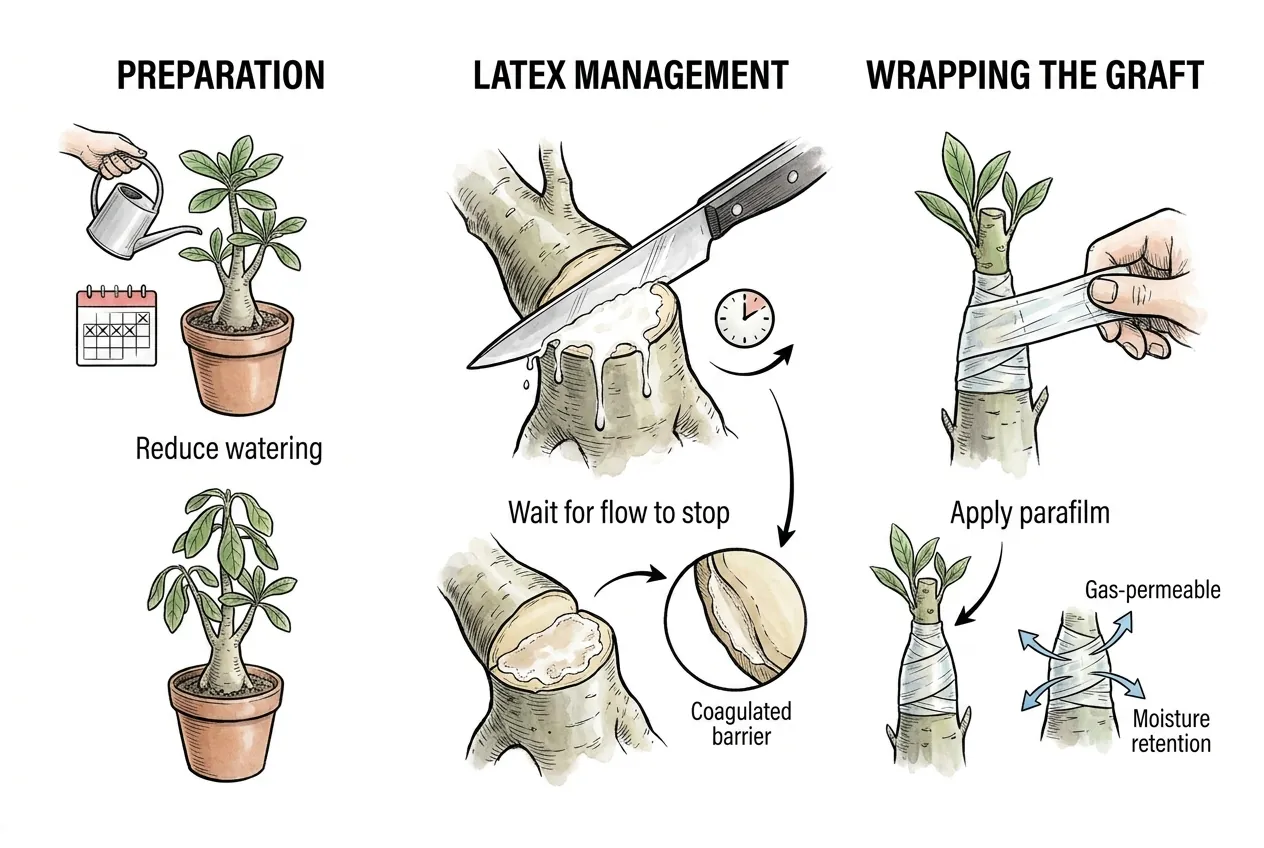
Wrap the union in a self-sealing graft film firmly enough to hold contact, but not tight enough to girdle the stem. The film holds the scion in place and cuts moisture loss, yet the cut still needs checking for trapped condensation and rot.
Parafilm is one option. Product permeability and mechanical hold vary, so follow the material's instructions.
Adenium bleeds a milky latex the instant it is cut, and that latex is toxic and irritating. It contains cardiac glycosides, can cause skin rashes, and is poisonous if swallowed.
Wear chemical-resistant gloves and eye protection, keep the sap off your skin, eyes, and mouth, cut away from your body on a stable surface, and wash any exposed skin. Keep cuttings, sap, and used blades away from children and pets, and dispose of contaminated tissue safely.
Latex may clot at a wound, but it is not a proven substitute for a clean, aligned cut and good moisture control. If the cut is still wet, let it stop flowing enough for clean contact.
Do not deliberately dry the plant out for a fixed number of days, because a wilted rootstock or scion may heal poorly.
What to buy
You want a self-sealing, gas-permeable grafting film about half an inch wide that stretches and clings to itself without adhesive.
Parafilm M tape is one self-sealing film option. Check the current width and handling instructions, and confirm that the wrapped union stays secure without trapped condensation.
Honest Tradeoff
Genuine Parafilm M may cost more than generic budding tape. Other films can provide mechanical contact but may differ in permeability and removal timing, so inspect the union and remove or loosen the wrap when the plant's growth makes it constrictive.
Which Graft Method Should You Use on a Thick Caudex?
Use a flat or apical graft when the scion matches the caudex width, and a cleft or V-wedge when the scion is much thinner so the rootstock grips it. Published method results come from different trials with different cultivars, so read them as proof each method can work, not as a head-to-head ranking.
A flat cut exposes a broad contact area when the diameters match, while a wedge or cleft gives mechanical support to a narrower scion. The best choice is whichever lets you align living cambium without excess wounding.
Place the cut where the rootstock is healthy and woody enough, and size the scion to the material in hand rather than to a universal inch measurement.
An Adenium wedge study at Dapoli reported a best-treatment survival of 88.33 percent and calls wedge and flat the most widely used commercial methods.
| Method | Best when | Adenium result | Tradeoff |
|---|---|---|---|
| Flat / apical | Scion matches the cut width | Study-specific sprouting result. Not a universal ranking | Needs firm clamping on a fat stock |
| Cleft | Scion much thinner than stump | Study-specific result. Depends on cultivar and setup | More wounding, lower take on fleshy stems |
| V / wedge | Skinny scion, want a firm grip | Best-treatment result in a separate trial | More cutting skill to match angles |
Why is cambium-to-cambium alignment the key technical detail?
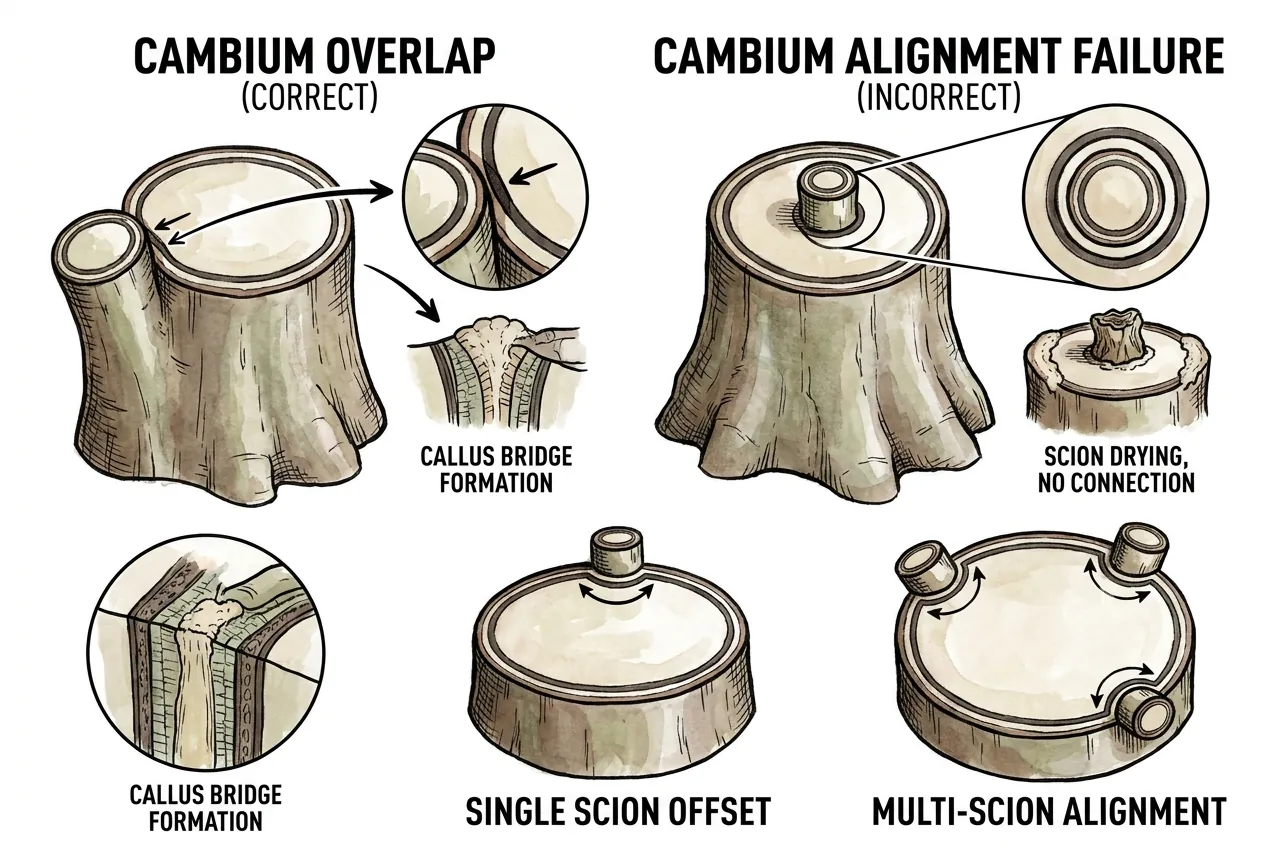
Every method lives or dies on lining up the cambium rings so at least one arc overlaps. The cambium is the thin dividing layer just under the bark. A small ring centered on a big disc touches nothing and connects nowhere.
Both cut faces heal by pushing out callus, soft wound tissue, that grows together into a bridge and then re-forms into new water- and food-carrying tissue (xylem and phloem).
The succulent-society rule is explicit. Do not let one piece's cambium sit wholly inside the other's ring. Offset the scion so the rings overlap.
When the scion is narrower than the stock, offset it so at least one cambium arc overlaps. The rest of the stump can callus over. After seating, apply only enough pressure to hold contact without crushing the tissue.
A large flat cut can host several scions at once, each offset so its own arc meets the stock’s outer ring. That is how growers build multi-color rainbow plants.
Secure a fat caudex with firm external pressure such as rubber bands or a tied plastic strip. Leave a nurse limb where feasible to keep the stock alive while grafts establish.
How Do You Care for the Graft While It Heals?
Heal the graft in stable warmth, keep humid air around the scion but the cut itself dry, and leave some healthy rootstock foliage when practical. The union builds a callus bridge before conductive tissue reconnects, on a timeline that depends on the species, tissue, and environment.
Studies in other grafted plants show that large day-night swings can slow healing, but they do not set an Adenium target. Track the actual root-zone and canopy conditions and avoid abrupt cold or heat.
Extension timelines for other woody grafts are useful context only. An Adenium union may take longer or shorter, so judge progress by callus stability, scion turgor, and new growth rather than a fixed day count.
Before I make the first cut, I label the rootstock and scion separately and photograph their condition, donor history, and intended cambium alignment. I note the date, growth state, recovery-area air temperature and humidity, and root-zone temperature. This preserves information that becomes difficult to reconstruct after the pieces are wrapped.
After securing the graft, I photograph the wrap overlap and adjacent stem with the same pot-rim mark facing the camera. Later checks use that framing, so I do not unwrap a quiet union merely to satisfy curiosity.
At each check, I compare scion firmness, wrap position, discoloration, odor, and new growth with the baseline without lifting the wrap. A shifted wrap, spreading dark area, or new odor triggers inspection, while an unchanged dry union stays covered.
Why must you keep water off the union?
A standing film of water on the cut shuts out the air the wound needs to dry-seal and feeds rot organisms. So you want humid air around the scion but a dry cut surface.
A clear bag traps the scion's own moisture so the leafless stub does not dry out, while blocking droplets from pooling on the raw cambium. Tie or tilt it so condensation runs away from the join.
Before grafting, do not deliberately dehydrate a healthy plant to meet a fixed sap-flow rule. After grafting, keep water off the union, water the mix only when its dryness and the roots call for it, and make sure the pot drains.
Remove the scion’s own leaves at cutting to cut water loss. Keep the surrounding air humid while keeping the wound dry.
Should you strip the rootstock bare or leave some leaves?
Leaving some healthy rootstock foliage can support the plant while the union forms, but treat it as an option, not a survival law. The strongest cited evidence comes from watermelon seed-leaves, not mature Adenium branches, so weigh it against water loss, space, and the health of the rootstock.
If foliage is retained, remove or reduce it gradually only after the scion is clearly growing and the rootstock remains firm. Avoid stripping a stressed plant or using the watermelon timing as an Adenium schedule.
| Rootstock foliage | Callus | Adhesion | Reconnection | Union auxin |
|---|---|---|---|---|
| Nurse leaves left on | More | Stronger | Earlier in the cited watermelon study | Higher in that study |
| Stripped bare | Lower by day 6 in that study | Weaker in that study | Delayed in that study | Lower in that study |
When do you remove the bag and the wrap?
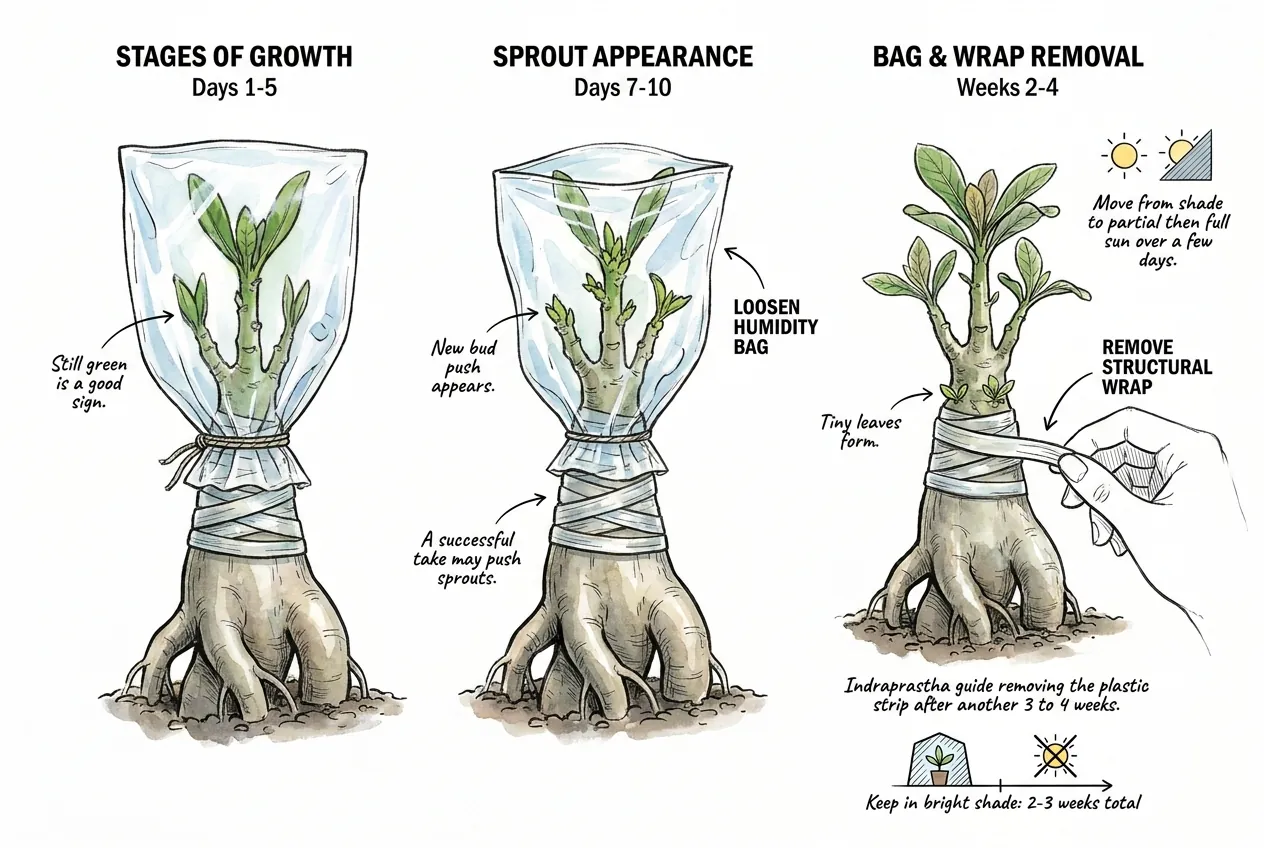
Loosen the humidity bag once the scion shows sustained bud push, then remove it gradually as the plant tolerates ambient air. Remove or loosen the structural wrap when the union is stable and before it starts to constrict new growth. Timing varies with the material and film.
When sprouts appear, acclimate the graft from bright shade toward stronger light over a measured period, watching for heat or sun injury rather than following a fixed day count.
Keep the union sheltered from direct midday sun while the scion is leafless or newly leafed, then increase light only after the tissue and rootstock are responding.
Why Does My Adenium Graft Die or Rot at the Union?
Diagnose a failing graft by the trend over several days, not by a single sign. Rootstock decline, scion drying, incompatibility, and wet rot can all attack the union, and color and firmness are clues rather than a standalone verdict.
A green-but-shriveling scion may be drying, while soft or foul tissue points toward rot.
A graft is functionally failing when the callus bridge to the vascular system does not form. Until the water-carrying tissue reconnects, the scion lives on stored water alone, which is why it can look fine for days then suddenly collapse. Judge a graft on a timeline, not on day one.
How do you tell desiccation from incompatibility, and rot from a non-take?
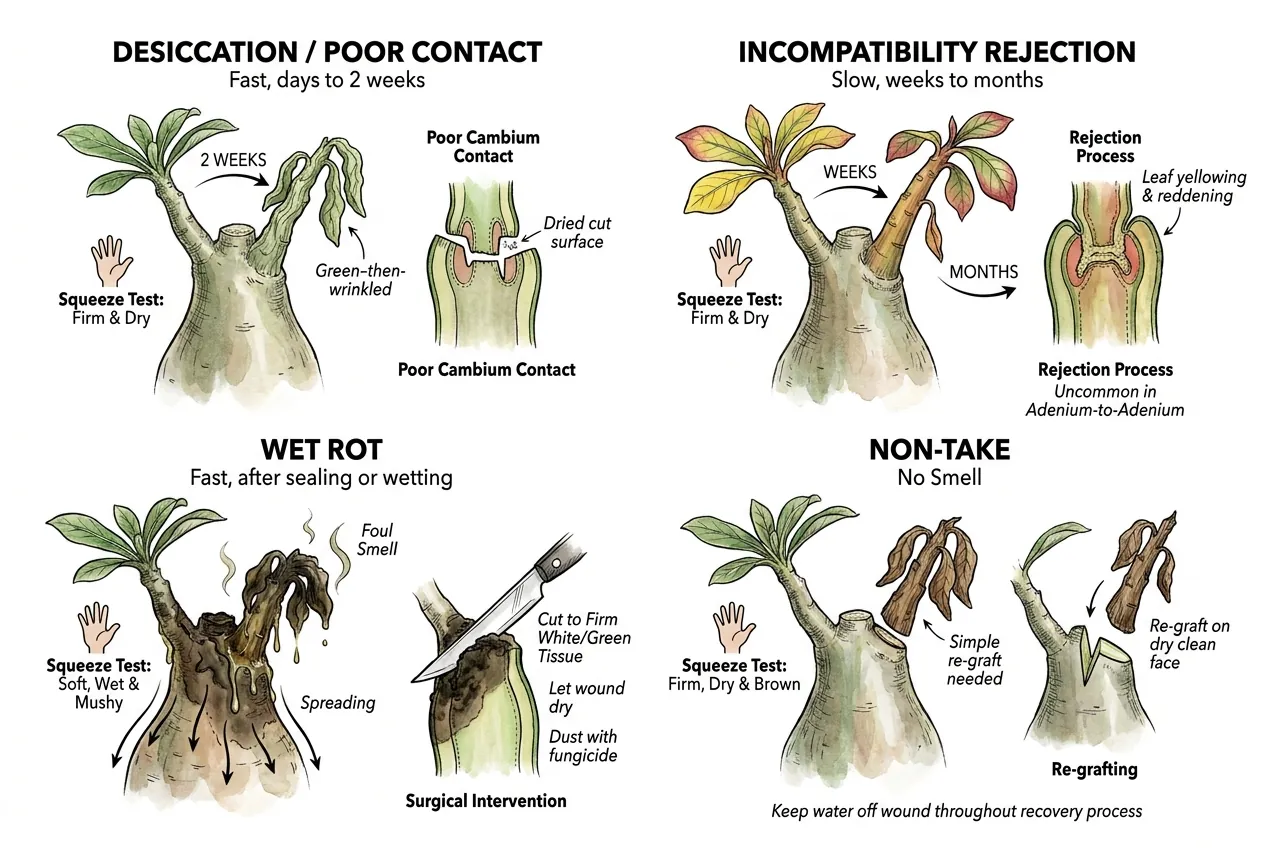
Read the trend in firmness, color, smell, and union stability, not a fixed day window. A green, wrinkling scion suggests water loss or poor contact, while a slow decline can also mean incompatibility, rootstock stress, pests, or disease.
In Adenium-to-Adenium grafts, true incompatibility is probably less common than poor contact or drying. So a fast green shrivel should first send you to check cambium alignment, cut moisture, rootstock condition, and pests.
Then use squeeze and color as clues, not certainties. Firm, dry, brown tissue with no smell is usually a failed take you can re-cut and re-graft.
Soft, wet, black or yellow, mushy tissue points to rot that should come off before it spreads into the caudex. These signs overlap, so watch the trend over a few days rather than deciding on a single squeeze.
For rot, wear gloves and eye protection, cut back into firm white or green tissue with a disinfected blade, and let the wound dry before re-grafting on a clean, dry face.
A clean-looking cut does not guarantee the tissue is pathogen-free. If rot keeps returning, stop and treat the plant as a rescue case rather than re-grafting again and again.
If you use a fungicide, choose one labeled for the use and follow its label. Keeping the wound clean, dry, and airy is the more dependable step.
| Signal | Desiccation / poor contact | Incompatibility rejection | Wet rot |
|---|---|---|---|
| Speed | May be rapid | May be delayed | Fast, after sealing or wetting |
| Look and feel | Green going dull and wrinkled | Leaf yellowing, reddening, drop | Soft, black or yellow, mushy |
| Action | Check contact and tissue before deciding whether to re-graft | Treat as a compatibility question after other causes are checked | Isolate, remove only clearly rotten tissue, and follow safe plant-disease practice |
Why does mottling or ringspots appear weeks after a successful take?
Late mottling, dark-green vein islands, ringspots, or distorted new leaves can signal a graft-transmitted virus rather than a healing failure, and your blade can be the vector. A first report described CMV in Florida desert rose as a mosaic with dark-green islands around the veins, spread by contact and incurable.
Controlled studies in other crop viruses show a correctly prepared bleach (hypochlorite) treatment can reduce this contact spread, but the tested virus, concentration, contact time, and tool condition all matter.
Do not turn a lab dilution into a loose home recipe. Follow current extension or product guidance, prepare it safely, rinse and dry the tools, and keep bleach away from alcohol and acids.
The infected scion is also a route, and aphids can transmit CMV, so isolate symptomatic plants, manage vectors, and never graft from a symptomatic donor. Because mottling has many causes, lab testing is the only way to confirm CMV.
When Is the Best Time of Year to Graft an Adenium?
Graft when the rootstock is visibly pushing new growth in stable warmth, not on a calendar date. Temperature drives callus and vascular reconnection, but the useful range depends on the plant and the actual root-zone conditions.
In oriental melon grafts, raising the night temperature from 18 to 28 degrees Celsius moved callus from four days to three and vascular reconnection from eight days to six. The warm night also raised wound sugars sharply.
Other species show that stable warmth can support healing, but their exact values and observation windows are not an Adenium protocol. Keep the union protected from abrupt cold and heat, and use the plant's active growth and measured conditions as the green light.
What is the dependable Adenium grafting window in the US?
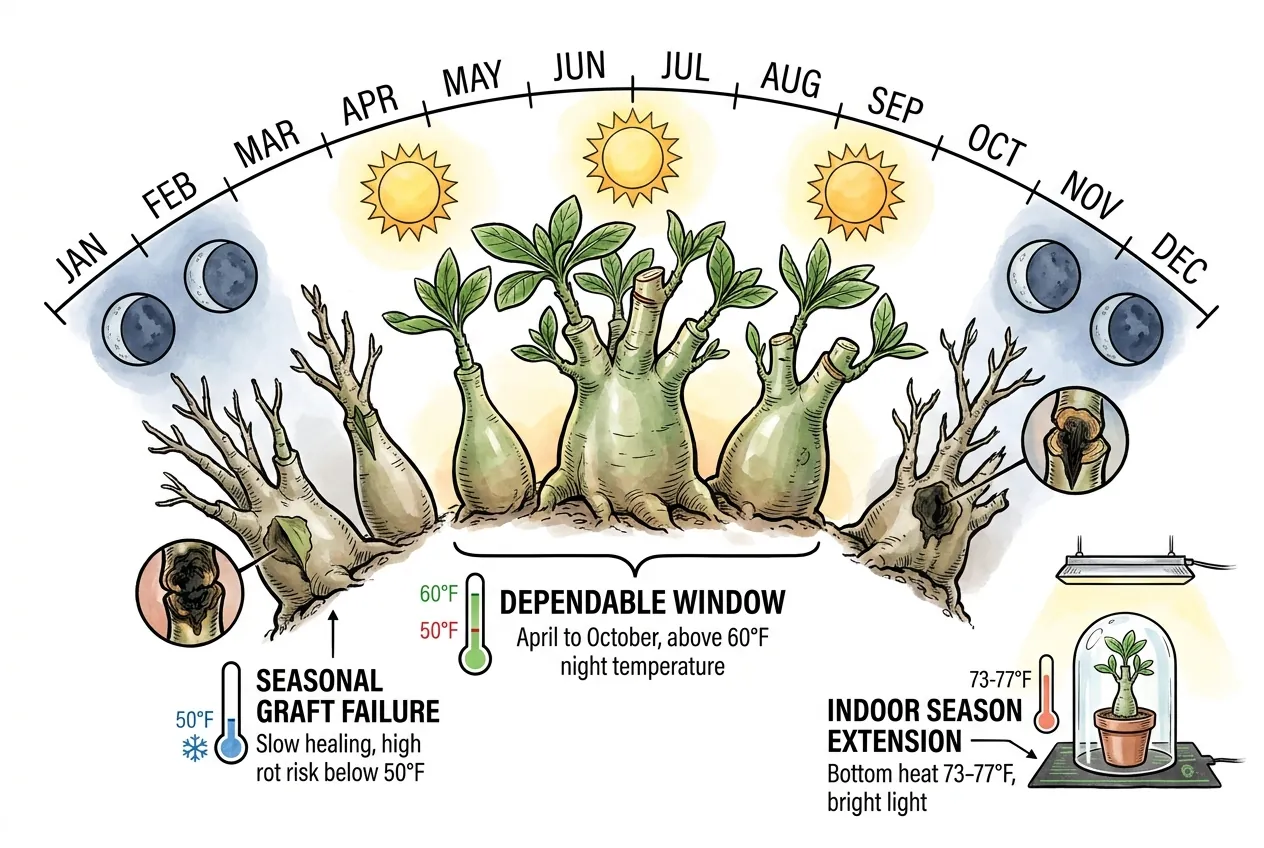
Rather than a fixed calendar, graft when your plant is actively growing in sustained warmth. As one reference point, University of Arizona Extension places the active growth period at roughly April to October in warm desert areas, with growth starting when spring nights stay above about 60°F and cold damage appearing below about 50°F.
That window is specific to a hot-summer climate. It will differ in cooler regions, shift for indoor and greenhouse growers, and reverse entirely in the Southern Hemisphere, so use your plant's growth and your local temperatures as the guide.
Cold-season grafts tend to struggle because the union heals slowly while the wet, sugar-rich wound sits vulnerable to rot during the long delay. Grafting a dormant plant on a chilly windowsill is likely to fail.
If you must graft in a cooler period, recreate summer conditions at the union as described next.
In cooler zones, recreate a stable active-growth environment with bright light, airflow, and monitored root-zone warmth. Avoid a fixed bottom-heat setpoint that has not been tested on the plant in hand.
What Take Rate and Timeline Should You Realistically Expect?
Treat published Adenium take rates as a range that sets your uncertainty, not as a forecast of your own percentage. One controlled wedge trial reported a high best-treatment survival, while a separate multi-factor trial reported lower method averages and broad cultivar differences.
Sprouting can occur before a union is fully functional, and the observed interval varies with scion, rootstock, temperature, and moisture. First true-to-hybrid bloom may take months or a later flowering cycle, so do not use a nursery or study timetable as a promise.
| Conditions | Survival | Source |
|---|---|---|
| Warm, controlled | High best-treatment result in one controlled trial | Hole et al. Study-specific |
| Shade-house, cooler, overall | Lower method average in a separate factorial trial | SHUATS 2022. Study-specific |
| Best hybrid by technique combo | Cultivar-by-method range. Not directly comparable | Separate Adenium trials |
What does a good outcome look like, and how do you iterate after failure?
A good outcome is a firm, slowly fattening caudex and a plump scion flushing true to the chosen hybrid. The union can look clean even with a raised callus ridge, which is normal succulent healing, not a defect.
In the Dapoli trial, the best-performing graft also produced the largest caudex girth at 24.40 millimeters, linking a strong union to caudex thickening.
After a failure, change the timing, technique, scion vigor, and sanitation you control. Research shows auxin signaling in the cambium matters, since blocking it left plants unable to attach, form callus, or reconnect tissue.
Re-graft on the same stock only if the caudex stays firm and dry below the cut. Expect that landing the hybrid you want may take more than one scion across one or two warm-season windows.
The Bottom Line
- Top-working keeps the caudex and swaps the canopy. A mature scion may reach a true-to-type flower sooner than a seedling while preserving the water-storing base. New growth can appear in weeks, but the first true bloom may take months.
- Start with clean, compatible material. Same-genus Adenium grafts are the more established starting point, while intergeneric attempts are experimental. CMV in desert rose is incurable and graft-transmissible, so source clean scions and disinfect the blade between plants.
- Cambium contact is the central technical step. Use a single-bevel knife for a flat slice and offset a skinny scion to one edge. Let the latex stop before joining, and wrap firmly without girdling the stem.
- Heal it steadily and keep the cut dry. Graft during active growth in stable conditions, keep water off the union, and treat nurse foliage as an option rather than a rule.
- Expect uncertainty and be patient. Published take rates and sprouting times vary by trial, cultivar, method, and environment. First bloom may take months and more than one attempt.
Affiliate Disclosure
This article contains Amazon affiliate links. As an Amazon Associate I earn from qualifying purchases. If you use these links, the site may earn a commission at no extra cost to you. Product availability, price, and specifications can change. Check the current listing before buying.