
Lithops Summer Dormancy or Rot? The Squeeze Test
Lithops summer dormancy or rot: distinguish firm seasonal wrinkling from soft, water-soaked decline and use plant cues to time autumn watering.
Maya Ellison · 2026-06-25 · Updated 2026-08-07 · 23 min read
Key Takeaways
- A firm, wrinkled plant in summer may be resting, but firmness alone is not a diagnosis. A translucent window can be normal.
- Use texture, color, odor, seepage, progression, root-zone condition, and dry-down together. Persistent wetness in a poorly aerated mix raises risk.
- Summer rest and annual leaf renewal are related care contexts but not the same event. Internal old-to-young water transfer does not prove that every summer shrivel is leaf replacement.
- Use a gritty mix to achieve suitable aeration and drying, not to copy a universal percentage or particle-size recipe. Air-filled porosity matters more than fast drainage alone.
- Resume water from observed renewal and root cues rather than a fixed calendar date. Treat all products and disease treatments as conditional.
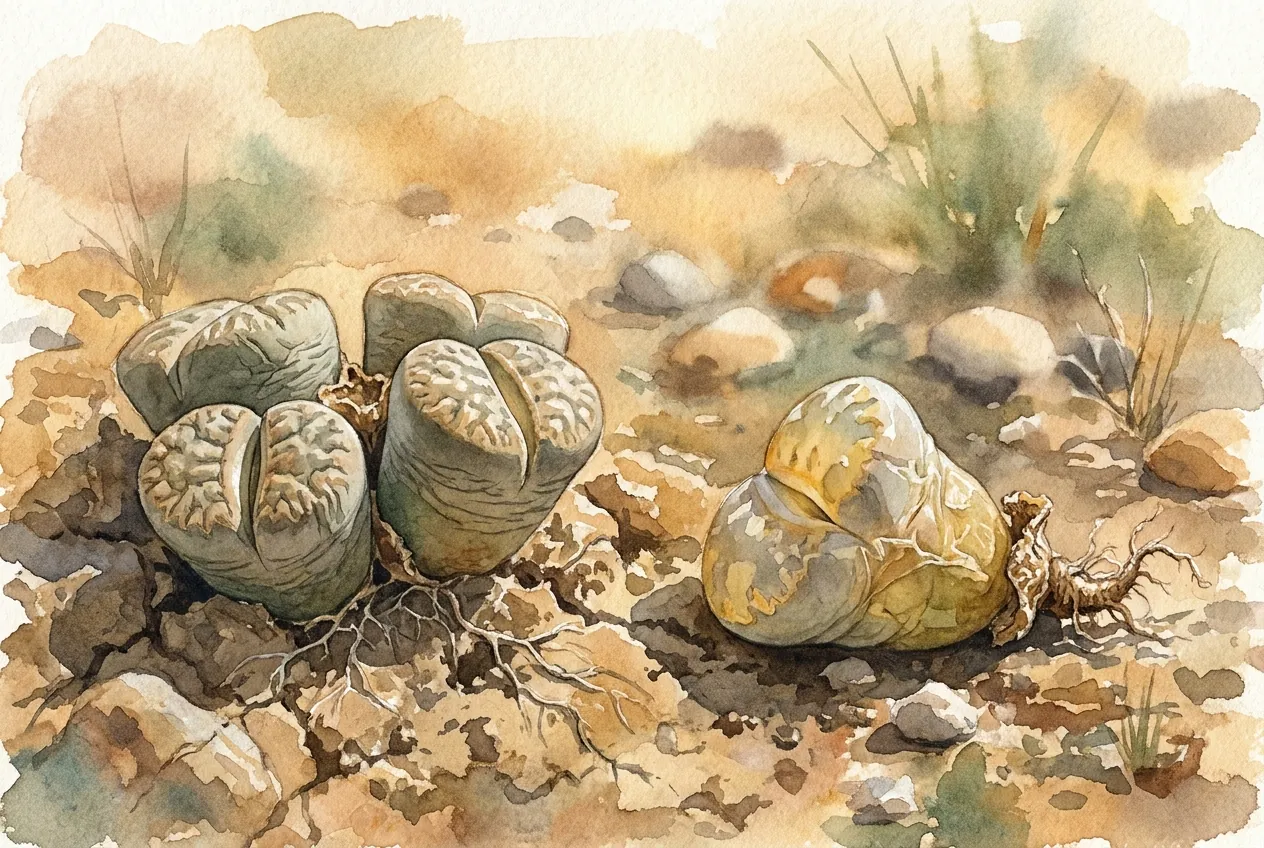
Your living stone has gone wrinkly and sunken in summer, and your hand is hovering over the watering can. Summer wrinkling can be a seasonal heat-rest, but thirst, root loss, and damage can look similar.
Watering a firm plant in hot, poorly ventilated conditions can increase rot risk, so inspect texture, color, odor, and the potting mix before deciding. Use that physical check to separate likely seasonal rest from signs that warrant inspection, then adjust substrate, airflow, cautious rescue steps, and autumn rewatering to the result.
What is Lithops aestivation, and why does my plant wrinkle in summer?
Read Summer Wrinkling as a Seasonal Signal
Aestivation is a summer heat-rest. Your Lithops may reduce visible growth and rely more on internal water reserves through peak heat. Surface wrinkling can reflect lower uptake and heat stress, but it does not by itself prove that annual leaf renewal is underway. This warm-season response can resemble winter dormancy, and its depth and timing vary with species and growing conditions.
Dormancy versus quiescence
The distinction is useful, but indoor Lithops responses do not always fit a single textbook category. Some plants resume activity as conditions improve, while others remain on an internal seasonal schedule. Cooling or watering a resting Lithops may not restart growth and can add rot risk if the roots are inactive or the mix stays wet, so use the plant’s condition and the drying rate of the pot to guide the decision.
How does Lithops survive heat without drinking?
Use CAM context without overgeneralizing
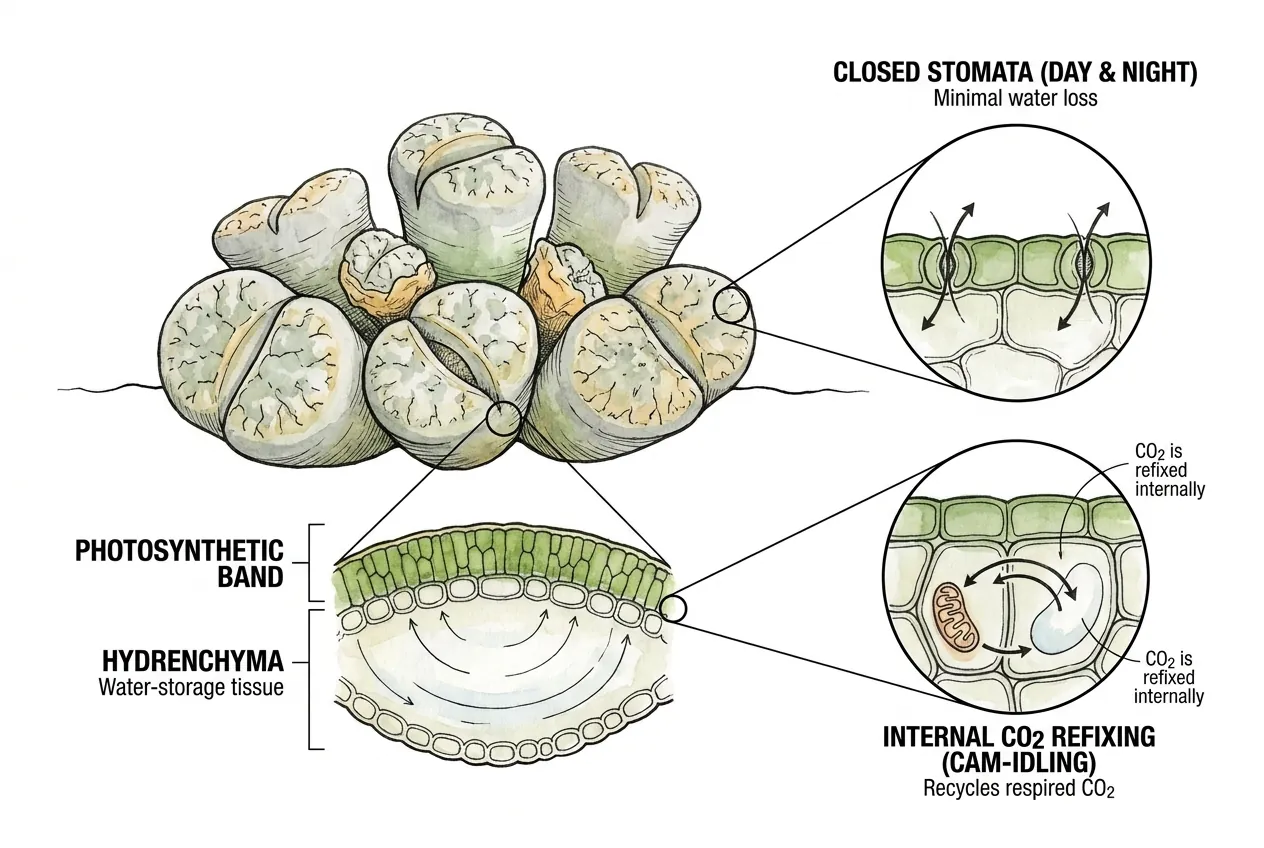
Lithops can use CAM-related carbon-conservation responses, including periods when stomata remain mostly closed and internally respired CO2 is refixed. That can reduce water loss during heat, but it does not make the plant immune to root damage or prolonged dehydration.
A caution on the textbook label is important. Lithops is CAM-capable rather than uniformly CAM across every species and condition, and the cited Lithops aucampiae study is evidence for that species under its test conditions, not a universal care threshold.
The leaf combines a photosynthetic window with water-storage tissue. This anatomy supports water conservation, but it does not justify watering by calendar or ignoring soft, water-soaked tissue.
What environmental cues may accompany Lithops aestivation?
Use temperature as context, not a switch
No single temperature triggers aestivation in every Lithops. A sustained hot, bright period may coincide with reduced activity, especially when a pot stays warm overnight, but species, acclimation, and indoor placement change the response.
South African biodiversity records describe Lithops tolerating intense heat and possibly retreating partly into the soil under stress. Those habitat observations help explain the pattern but do not set a safe home-watering threshold.
Day length can influence seasonal development in some succulents, but the related Plumeria study is not a Lithops dormancy study and cannot establish that long summer days force a Lithops rest period.
Is summer shrivel actually heat damage?
Summer wrinkling can be normal resting, but heat injury remains possible when tissue is bleached, scorched, or soft. The cited high-temperature figures come from other desert succulents and measure different endpoints, so they should not be treated as Lithops thresholds.
Use visible tissue condition, recent light changes, and pot temperature together. Summer deflation may reflect lower uptake, internal reserves, or heat-related stress, but it does not by itself identify the annual leaf-renewal stage.
A practical comparison of heat conditions
| Event | Observed condition | What it means |
|---|---|---|
| Seasonal rest | Sustained hot, bright weather with a firm, shrinking body | Reduce water while checking the plant and mix |
| Heat strain | Leaf or pot surfaces become unusually hot | Increase ventilation and filter or acclimate light |
| Heat injury | Bleached, scorched, or collapsing tissue | Move out of the stress, then assess for secondary rot |
How can a gentle touch help distinguish dormancy from rot?
Use Firmness as a Triage Clue
Press the side of the body gently with a fingertip as one useful check, but treat it as a clue rather than a definitive test. Firmness reflects tissue turgor, and the exact pressure varies by tissue and condition.
Firm with slight give suggests a pressurized, resting plant. Soft, squishy, water-soaked skin, or skin that dents and stays dented, is a warning sign worth investigating, although dehydration, root loss, and heat or cold injury can also soften a plant and early internal rot can hide under a still-firm top.
Read firmness alongside color, odor, seepage, location, and how fast things are changing. A resting Lithops can wrinkle at the surface while the central body remains comparatively firm, so a firm, slightly yielding body is more consistent with seasonal water use than a soft, collapsing one when the color, odor, and root zone agree.
Separate soft rot from simple wrinkling
Rot is different in kind, not just degree. Wet, slimy tissue and foul odor are compatible with bacterial soft rot, in which pectate-degrading enzymes macerate tissue. Fusarium-associated rot follows different fungal processes, and texture alone cannot identify the organism.
What does rot look and feel like?
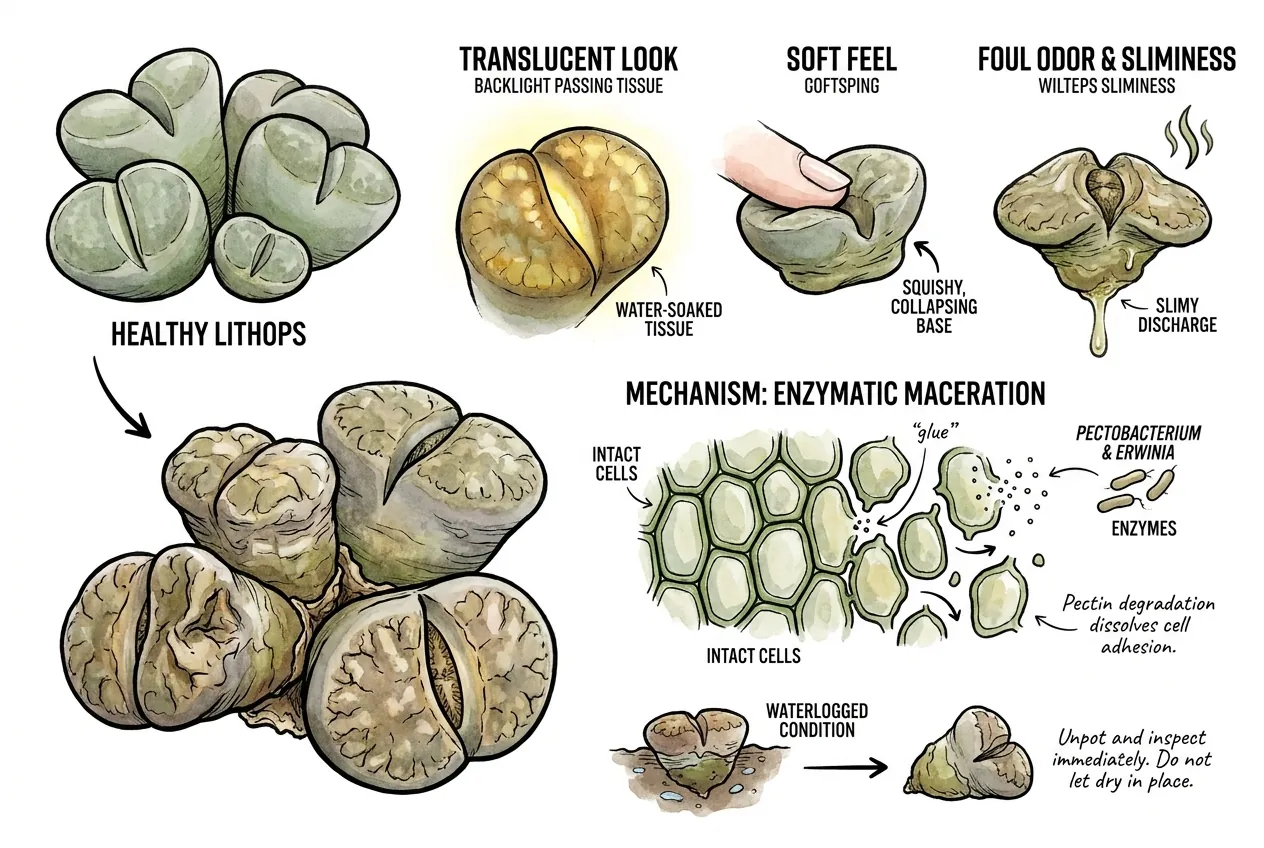
Rot often shows a combination of the following signs.
- A wet, water-soaked, glassy look (different from the plant's normal semi-translucent window, so judge by whether it looks wet and soft rather than merely light-transmitting).
- A soft or squishy feel, especially low on the body near the soil line.
- A sour or foul odor with any sliminess or seepage (usually a sign of advanced bacterial soft rot).
The mechanism is enzymatic maceration. Bacteria such as Pectobacterium and Erwinia secrete enzymes that degrade pectin in the middle lamella, the cement between cell walls. Once that glue dissolves, cells separate and the tissue collapses into the characteristic slimy mass.
Inspect when softness or odor appears
Bacterial decay is favored by low-oxygen, persistently wet conditions, which can occur when a resting plant is watered before the mix has dried. Genuine softness, seepage, or a foul smell, especially at the soil line, is a reason to unpot and inspect promptly. A normal semi-translucent glow when backlit on a firm, odorless plant is not by itself a reason to dismantle a healthy Lithops.
Are there two kinds of rot to watch for?
Texture is a useful clue, not an organism-level diagnosis.
General disease descriptions associate bacterial soft rot with wet, slimy, foul tissue, while Fusarium-type fungal rot may begin as firmer, sunken, discolored patches before softening.
A greenhouse survey of multiple succulent species documented internal rotting, loss of turgor, and dark lesions in inoculated plants.
Those findings support the pattern but do not predict the course of every Lithops infection.
For home triage, combine texture, odor, color, speed of change, and location.
If tissue is clearly soft or spreading, isolate the pot and consider removing all visibly affected material.
Firm-wrinkled versus soft-translucent: a practical comparison
| Sign | Likely aestivation (monitor) | Possible rot indicators |
|---|---|---|
| Feel | Firm with slight give | Squishy, dents and stays |
| Skin | Dry, intact | Water-soaked, slimy |
| Color | Normal stone color | Spreading water-soaked change with discoloration |
| Smell | None | Sour or foul |
| Location | Surface wrinkle | Collapse at base or soil line |
| When pressed | Springs back | Seeps, stays dented |
Are papery old leaves a sign of rot?
Let the old leaf pair finish naturally
A papery old leaf pair is often consistent with renewal rather than rot when the body stays firm and other signs are stable.
Do not peel the old leaves or water simply to change their appearance.
The new growth pulls moisture out of the old growth, leaving the old leaves as a thin desiccated skin.
Judge the plant by the firmness of the body, not the appearance of the spent leaves.
A firm body with papery old leaves is often consistent with renewal when the other signs agree.
Why does the plant water itself, and why can summer water increase rot risk?
Summer aestivation and annual leaf renewal can overlap in timing, but they are not the same event.
A firm, wrinkled body in heat does not prove that the old pair is being reabsorbed, and a leaf split can occur under different seasonal conditions.
Understand Internal Water Recycling
Lithops commonly renews one leaf pair inside the old pair, and the old tissue can be reabsorbed to hydrate and feed the developing body.
During that stage, external water may have little benefit and can leave the mix wet around a plant that is not actively taking it up.
Peer-reviewed measurements support an internal water gradient from older to younger tissue, while tracer studies provide evidence for that movement under their tested conditions.
The strength and timing of the effect can vary with species and stage, so use it as context rather than a calendar rule.
A genus-specific caveat worth keeping honest
The cited water-recycling evidence is specific to Lithops and should not be generalized to every succulent.
Comparative work on other genera found different relationships between old and young leaves.
Why does adding water during the molt cause rot?
Water can increase risk during renewal when uptake is low and old tissue stays damp against the new body.
It may also encourage poorly timed expansion or leave moisture near the central meristem, where fungal and bacterial problems are harder to detect.
Once rot reaches the meristem, recovery becomes less likely.
A conservative dry interval can therefore be useful when the plant is firm, the old pair is still being reabsorbed, and the mix is not drying quickly.
What is the summer watering decision tree?
Keep the Summer Default Dry
During a firm summer rest, a dry interval is usually safer than routine watering.
Overwatering is a common cause of Lithops decline, but an unusually fast-drying setup, root loss, or prolonged severe shrivel may justify a cautious reassessment.
Extension guidance links excess water with yellowing, mushy tissue, spotting, splitting, and root rot.
Use those signs with pot dry-down and local weather rather than a fixed temperature switch.
When a Lithops enters a firm summer rest, I make a baseline with a top view, side view, pot mass, and a note of the old-leaf stage. I use the same pot-rim orientation and diffuse light for later photographs. The goal is to see a slow, even change in one body rather than react to a new camera angle or the normal look of a drying old pair.
I compare the baseline whenever I am tempted to water. A plant that is becoming softer at the base, changing color in one area, or developing an odor has changed category from ordinary summer wrinkling and deserves inspection. A firm body with only predictable surface deflation gives me a reason to leave the watering can alone.
When is a survival sip justified, and how much?
Reserve a test watering for severe shrivel
A small test watering is worth considering only when shrivel is severe and persistent, the body remains firm, and the mix is known to dry quickly.
Do not use it to treat softness, seepage, or a foul smell.
When warranted, wet a limited area of the mix rather than soaking the body or leaving the pot standing in water.
Apply it when the setup can dry promptly, then reassess the plant and roots before repeating.
Fine feeder roots can decline during a prolonged dry interval, but the amount and timing needed depend on pot size, substrate, temperature, and species.
Default rule versus the rare exception
| Situation | Action |
|---|---|
| Firm, wrinkled, normal color | Keep mostly dry. Maximize airflow and reassess cues |
| Severe persistent shrivel, still firm, fast-drying setup | Test a limited edge watering, then allow full dry-down |
| Indoor or AC, sheltered | Usually needs less intervention. Check root and mix condition |
| Soft, spreading, or water-soaked change | Not a watering question. Inspect for rot |
What tool keeps a survival sip from becoming a flood?
Keep a survival sip at the edge
The danger in a survival sip is volume and placement.
Keep water at the soil edge rather than on the body or crown, and let the mix dry before considering another test.
A narrow spout on a small bottle can make edge watering easier, and the Mkono watering bottle is one possible tool.
Its usefulness depends on disciplined, infrequent use and a pot that drains freely.
Any tool that makes small applications easy can also encourage unnecessary watering, so treat it as an aid to placement rather than a reason to water more often.
How can substrate and airflow reduce rot risk?
Build an Airy Mix, Then Observe Dry-Down
Low oxygen in a waterlogged mix is one driver of root and crown rot, and a high-mineral, gritty mix is a useful structural starting point.
It's not the whole story, though, pathogen presence, wounds, temperature, sanitation, and infected stock all matter too, so good substrate reduces the risk rather than guaranteeing immunity.
Water-filled pore space can reduce root-zone oxygen and favor water-mold pathogens, but the time course depends on the actual pot and conditions.
The real lever is air-filled porosity, not just fast drainage.
Container-media guidance shows that a mix can hold both air and water in different proportions, while Lithops generally benefits from the airy, fast-drying end of that range.
A mix can drain fast and still rot a plant if too much pore volume holds water between waterings.
Use predictable dry-down as the practical goal
Free water should drain and the root zone should regain air without remaining saturated.
What mineral mix and particle size should I use?
Choose particle size by the pot
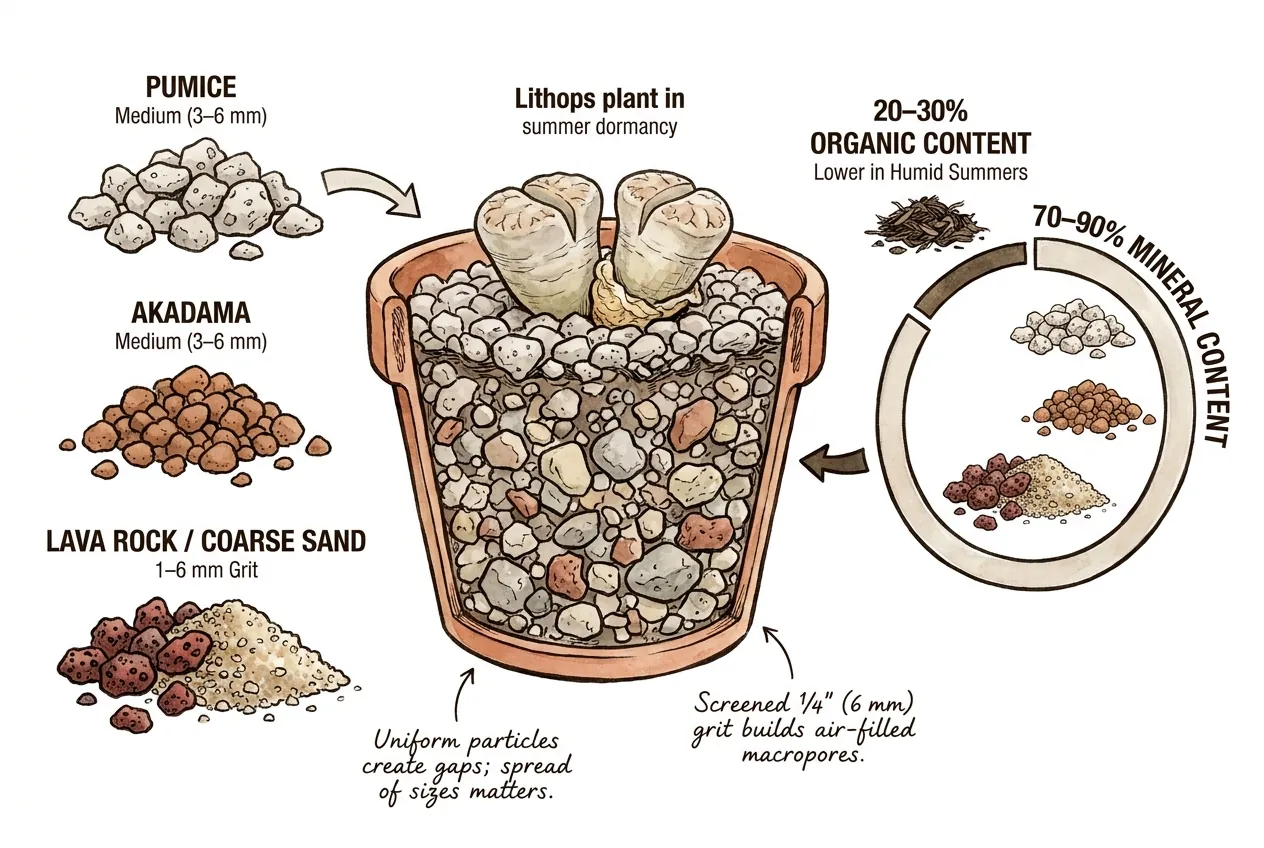
A high-mineral mix with screened grit, limited organic matter, and enough coarse particles to keep air spaces open is a useful starting point.
The right balance depends on pot size, climate, watering method, and how quickly the mix dries.
Particle size and dry-down
Excessive fines can fill air gaps, while a broad mix of coarse components may drain too quickly in a cool or sheltered setup.
Rinse dusty materials and adjust after observing dry-down rather than copying a fixed recipe.
For a mineral backbone, Horticultural pumice is one conditional option.
It can buffer a small amount of moisture while keeping larger spaces open, but it still needs to be matched to the rest of the mix and the growing environment.
Near-pure pumice can dry very quickly in small pots, while a more organic blend may stay wet longer. Test the actual pot rather than relying on a generic percentage.
Can a soil thermometer make the watering call objective?
Use temperature as supporting evidence
It helps, but it does not make the watering call fully objective.
A soil thermometer can show that a dark pot in a sunny window runs hotter at the root zone than room air, which is useful context when deciding how quickly the mix should dry.
Use the reading alongside plant firmness, visible damage, airflow, and the actual dry-down pattern.
Pathogen temperature ranges and seasonal-rest cues come from different studies and should not be treated as one universal switch.
A probe can help compare root-zone conditions, but it cannot diagnose rot by itself.
Choose a probe for the actual pot and decision
Look for a probe long enough for the pot and a readable range for the growing area. The Smart Choice thermometer is one conditional option. Check its current listing, compare it with the pot depth and measurement range you need, and insert it to a representative root-zone depth before changing the watering pattern.
Keep spot readings within their limits
This analog dial shows a spot reading rather than trends and is not a moisture meter. Use it for coarse comparisons, not lab-grade or go/no-go decisions.
How do I rescue a Lithops that has started to rot?
Recognize the Limits of Salvage
If you find soft, water-soaked, rotting tissue, isolate the pot and treat cutting as a high-risk salvage attempt rather than a reliable cure. A Lithops is essentially a stemless leaf pair with its growing point and roots at the base, so if rot has reached that basal meristem an upper leaf body has no growing point from which to regenerate. Chemicals cannot restore infected tissue, and a systemic or surface drench cannot rebuild dead conductive tissue or reliably reach an advancing internal front. Follow local plant-disease guidance for any remaining firm material. Prompt assessment matters because decline can progress quickly, although surveys of other succulents do not establish a Lithops timetable.
What rescue sequence can be considered?
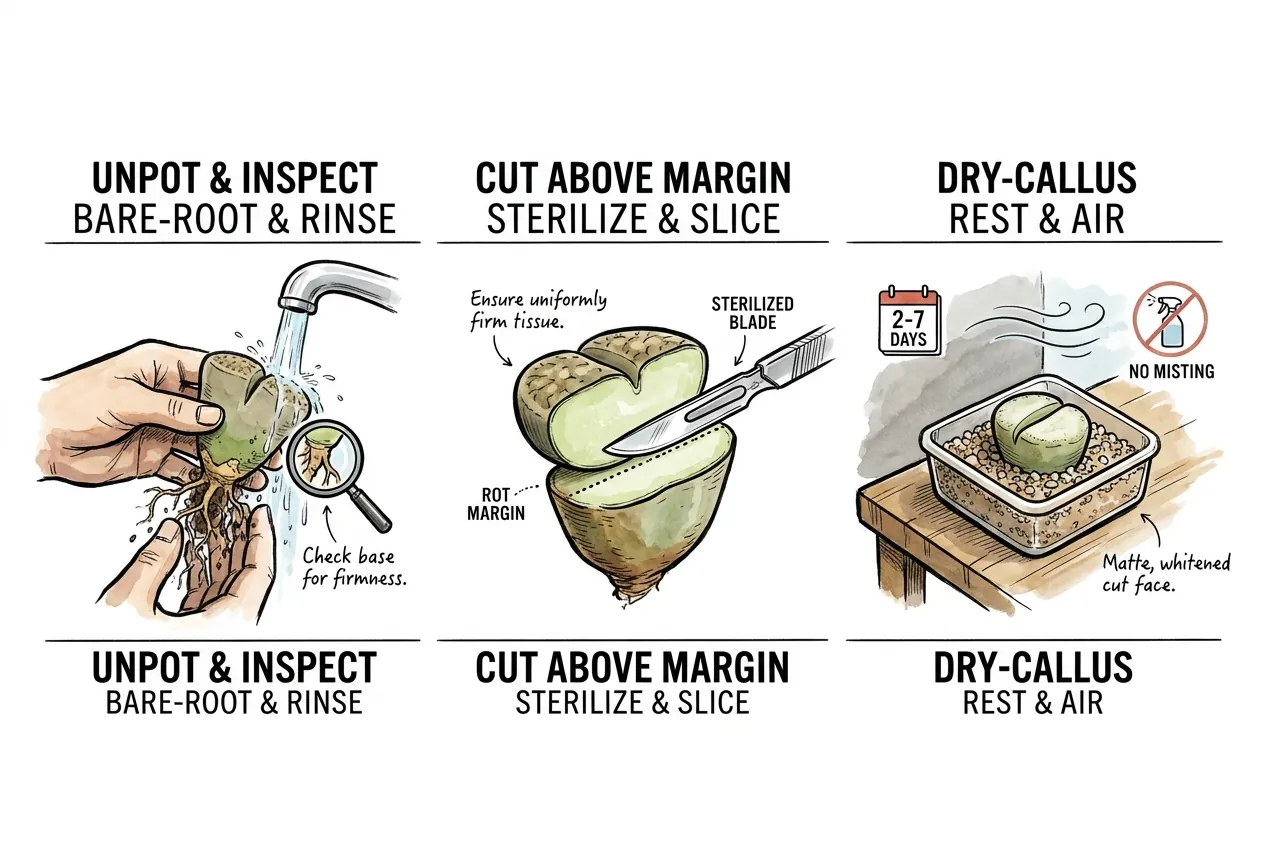
Any suspected rot should first be isolated and documented. Excision is a high-risk salvage attempt, not a validated Lithops protocol.
Step 1. Unpot and inspect
Unpot only when progression or root-zone evidence warrants it. Inspect the basal meristem and roots, and seek expert help if the boundary is unclear.
Step 2. Assess whether removal is justified
Because Lithops is a stemless leaf pair with its growing point at the base, do not assume an upper cut piece can root. If a qualified assessment supports removal, use a clean sharp blade and preserve any clearly living basal meristem. Stop if the cut face remains discolored or the remaining body cannot retain the growing point. Clean visible soil and sap before disinfecting. Disinfection reduces transfer risk but does not create sterility, so follow the current product label for concentration, contact time, and any required rinsing.
Step 3. Dry-callus
Keep any wound clean, dry, and ventilated. There is no Lithops-specific two-to-seven-day callus value, so avoid bagging or misting unless case-specific guidance supports it. A same-family study on Delosperma describes wound sealing under its own test conditions, which informs a related response but not a Lithops rooting or survival protocol.
Step 4. Re-root dry
If a firm body with living basal tissue remains, an experienced grower may attempt a dry re-rooting setup, but no validated success rate or timeline should be promised. If the meristem is gone or the body is broadly mushy, recovery is unlikely. Dispose of infected material responsibly and clean or disinfect tools and the pot according to the product label. Do not describe that process as sterilization.
How do I tell aestivation from sunburn, etiolation, or mealybugs?
Separate the Three Common Look-Alikes
Three common look-alikes need the opposite of withhold-and-wait, so read shape, color, and location before turgor.
Sunburn needs less light, etiolation needs more light gradually, and mealybugs need pest treatment.
Aestivation may appear as uniform, firm wrinkling with otherwise stable color.
Old-pair drainage is a separate renewal cue, so do not infer it from summer shrivel alone.
The look-alikes each diverge on specific, checkable signs.
Differential diagnosis at a glance
| Mode | Key sign | Location | Fix |
|---|---|---|---|
| Aestivation | Uniform firm wrinkle, normal color | Whole body | Keep mostly dry while checking renewal cues |
| Sunburn | Dead bleached-to-tan patch, irreversible | Sun-facing top only | Filter light, let it grow out |
| Etiolation | Pale upward stretch and lean, slow | Whole body elongates | More light, gradually |
| Edema | Corky warty tan-brown blisters | After overwatering in dull weather | Stop water, improve airflow |
| Mealybugs | Slow decline, white waxy insects | Body slit or roots | Treat the pest |
How are sunburn and etiolation different from dormancy?
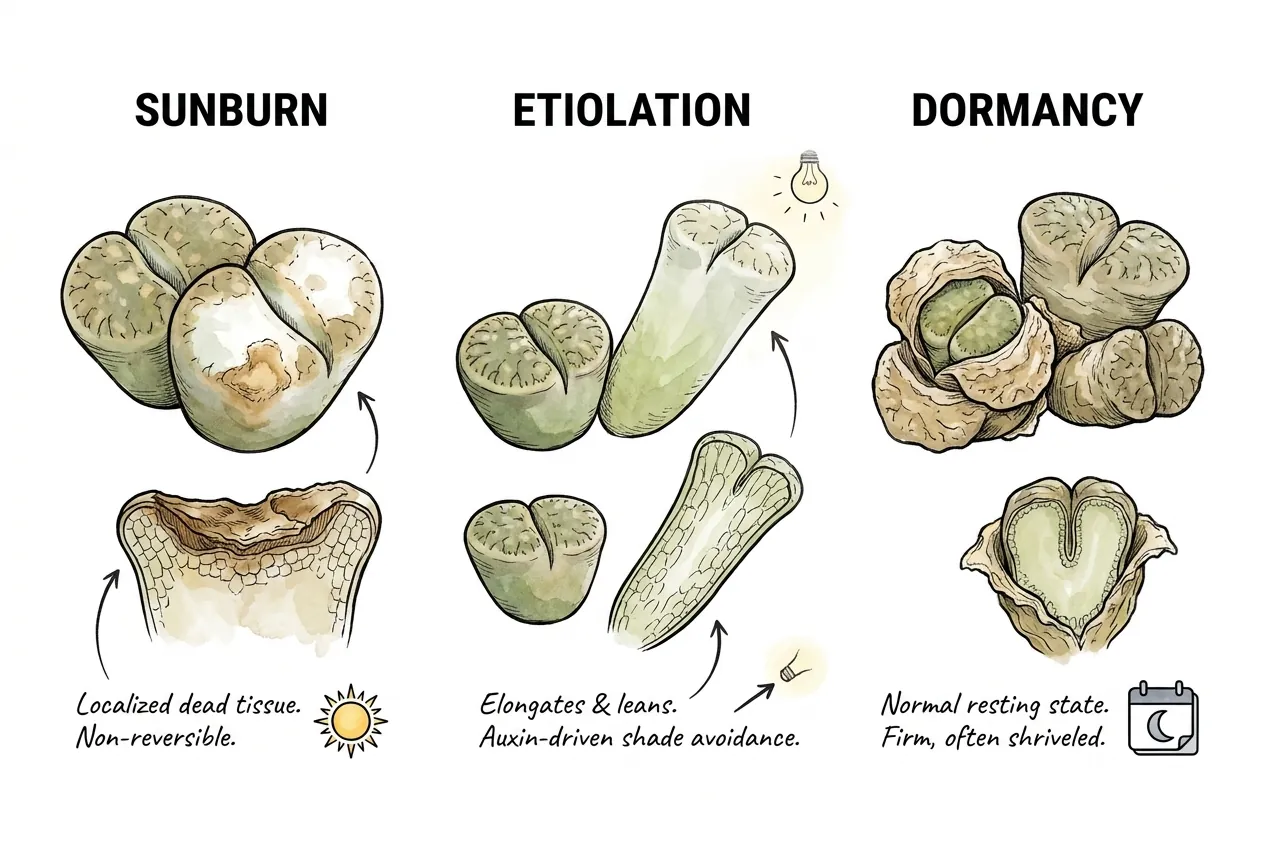
Sunburn is localized dead tissue on the sun-facing top and does not recover.
It can start as a bleached mark and darken as cells die.
Filter or reduce the offending light while the plant acclimates, and avoid cutting tissue that is still firm.
Etiolation is the opposite of shrivel.
The body elongates, leans upward, and fades to washed-out green over weeks.
This pattern is consistent with general auxin-mediated shade avoidance in model species, but it is not a Lithops threshold.
Model-species work links low light with auxin-mediated shade-avoidance growth, but the size and timing of that response are not a Lithops care threshold.
Correct etiolation by increasing light gradually and observing color, posture, and new growth.
The current stretched body will not reshape, while the next renewed pair may be more compact.
Abruptly moving a low-light plant into intense sun can cause sunburn.
How do I spot root mealybugs hiding in the soil?
Inspect for root mealybugs when decline is slow
A Lithops that declines slowly with no top damage may be hosting mealybugs.
Foliar mealybugs sit as cottony white masses in the slit and around the base.
Root mealybugs hide in the soil and roots, causing a baffling slow decline that mimics under-watering or dormancy fatigue.
Look for powdery white wax on the outer rootball and pot wall.
Root mealybugs can lack the marginal filaments seen on some foliar species.
Size and appearance vary, so confirm the pest by location and repeated inspection rather than one visual measurement.
For an unexplained decline, unpot and inspect the roots and pot wall.
If you find root mealybugs, cleaning the roots, repotting into fresh mineral mix, and scrubbing the pot is a possible first step.
A systemic insecticide such as imidacloprid may help in some settings. Read the current product label for permitted crop, site, dose, and method. Indoor-ornamental permission is product- and jurisdiction-specific. Observe pollinator and edible-plant warnings.
Be cautious with hot-water root soaks. Published temperatures for other potted plants have not established a safe Lithops protocol, so do not transfer those numbers to this species.
When do I resume watering after summer?
Resume Watering from Morphology
Resume from physiology rather than a date.
Look for several cues together.
Renewal cues
The old leaf pair is nearly papery, the fissure begins to open, new growth looks active, and the nights or root zone are cooling.
Until the old pair is mostly spent, the new body may still be drawing on internal reserves.
Aestivation is heat- and season-dependent, so the release varies by hemisphere, species, and indoor lighting.
Use the same morphological cues even when the calendar is inverted.
How should I ramp the first autumn watering?
Ramp gradually. Start with a small wetting only after the plant shows renewal cues, then allow the medium to dry while watching for active uptake before moving toward a normal soak-and-dry rhythm.
A mix that remains completely desiccated for a prolonged period can lose fine roots, while a heavy first watering can overwhelm a weakened root system.
Balance those risks with the actual pot dry-down and root condition.
During an extended heat rest, do not add routine sips unless the plant is persistently collapsing, still firm, and the setup is demonstrably fast-drying.
Once the first test watering is tolerated and the old pair is mostly papery, increase only as new growth and local conditions support it.
Southern Hemisphere and under-lights growers should follow the same morphological cues rather than fixed months.
Affiliate Disclosure
This article contains Amazon affiliate links. As an Amazon Associate I earn from qualifying purchases. If you use these links, the site may earn a commission at no extra cost to you. Product availability, price, and specifications can change. Check the current listing before buying.