
Adenia Glauca Vine Dieback: Prune or Panic?
Adenia glauca vine dieback in a summer heatwave is a stress signal, not automatic death. Diagnose the cause first, then decide whether to water, shade, or cut.
Nathan Brooks · 2026-07-02 · Updated 2026-07-25 · 20 min read
Key Takeaways
- Check the caudex and roots together before anything else. A soft, mushy, or foul base points to rot. A firm caudex is reassuring but still calls for a soil-moisture and root check.
- Read July dieback as a stress signal, not normal dormancy. Adenia glauca sheds leaves in winter, so leaf loss during its summer growth needs a cause-based check.
- Cut only clearly dead or rotted tissue. Hard-pruning a stressed caudex adds wounds and can expose it to sunscald, so preserve healthy vines unless the evidence justifies a larger cut.
- Water from the soil and growth state, not habit. When an active plant's root ball is genuinely dry, wet it evenly and let it drain. Use shade and airflow to cut the heat load.
- Protect yourself and the wound. Wear gloves and eye protection around the toxic sap, and let any cut dry and callus before watering.
Your Adenia glauca looked fine last week. Now, mid-July, the vines are browning and leaves are dropping. Before you reach for the shears, it helps to work out what the plant is actually telling you.
July is this plant's active growing season. Summer dieback is usually a stress signal worth investigating, not the calm winter dormancy people often assume. Sometimes the right response is patience. Other times it is water, shade, or a check of the roots.
Is my Adenia glauca dying, or is this normal?
Separate seasonal dormancy from stress
Summer dieback is a stress signal. The cause still needs diagnosis, because heat, drought, waterlogging, and root damage can look similar. Adenia glauca is a deciduous, caudiciform (fat-stemmed) climbing succulent from the summer-rainfall regions of southern Africa. It naturally drops its leaves and lets thin vines die back in winter, its dry resting season, not in the middle of its summer growth.
Read the caudex and vines together
The whole plant is built around the caudex, the swollen water-storing stem base. The leaves and vines are the plant's photosynthetic engine, and shedding them is costly, so the plant does it deliberately when conditions turn hostile.
Match July conditions to the species
Because summer is normally its active season, midsummer dieback tells you something has pushed the plant out of its comfort band (most often heat, a dry or waterlogged root ball, or root damage). The key distinction is that the same leaf-shedding response is routine in winter but a warning sign in July. In cultivation the plant does best in warm conditions (roughly the high 70s Fahrenheit is a commonly cited comfort range), and its caudex is best shaded while the leaves take brighter light.
Why does heat make the vines die back?
Understand heat and water balance
Extreme heat and drought together stress the leaf's water balance, and shedding thirsty tissue is one way plants reduce that strain. When a leaf gets too hot, the plant faces a bad trade.
See the cooling tradeoff
It can open its pores to transpire and cool the leaf, but that burns water. Under drought, that cooling can drain reserves faster than the roots can refill them.
Keep generic heat evidence bounded
Research on heat and drought illustrates how sharp this trade-off can get. A Global Change Biology study of 20 Australasian evergreen trees and shrubs ran a simulated heatwave reaching 40 to 42 degrees Celsius.
Some already drought-stressed plants increased their pore opening rather than closing it, and the authors warned such plants could be driven toward mortality thresholds more rapidly than has been previously recognized.
That study did not test Adenia glauca or deciduous vines, so treat it as background on how heat plus drought endangers plants, not as a measured description of what your Adenia is doing.
Use the practical risk signal
A hot, dry, unshaded plant is genuinely at risk, and leaf drop is one visible sign of that stress.
Is the dieback reversible or permanent?
Look for recoverable stress
Often it is recoverable, but that is not guaranteed, and it depends on why the plant is shedding. If the plant is dropping leaves as a hormonally driven stress response while the caudex and roots stay healthy, it can re-leaf once conditions ease. In general plant physiology, abscisic acid drives stomata to close and conserve water, and ethylene is associated with leaf senescence and drop under stress.
Treat dead tissue as permanent
If tissue actually overheats badly enough, or if roots rot or dry out and die, that tissue does not come back. The exact temperature at which Adenia glauca tissue is permanently damaged has not been established, so there is no reliable number to aim for. Your job is to reduce the load the plant is under (shade, airflow, and appropriate watering based on the actual state of the soil and roots).
How do I tell heat-dormancy from rot, sunscald, or pests?
Press the caudex carefully
Start with a gentle caudex check, but treat it as one clue, not a verdict. Wearing gloves, press the caudex and look for a soft, mushy, sinking, or wet-spongy base. That texture is a strong warning of rot and needs action. A firm base is reassuring, but it does not rule out root rot lower down or a dehydrated, failing root system, so keep checking.
Separate dehydration from rot
Much of the panic comes from confusing slightly-less-firm (thirst) with genuinely mushy (rot). Those are different, but they can also occur together. A plant can be both dehydrated and rotting.
Use texture and smell as clues
A healthy or merely dehydrated caudex keeps its structure and springs back when pressed. Wet rot breaks down cell walls and turns tissue to mush, so a finger sinks in and the surface does not recover.
Weeping or foul-smelling tissue raises concern for rot rather than rest. Not all rot is soft and smelly. Some fungal rots stay dry, and root problems can advance while the aboveground caudex still feels firm, so use these tests to raise or lower your suspicion rather than close the case.
What is the fast home diagnostic checklist?
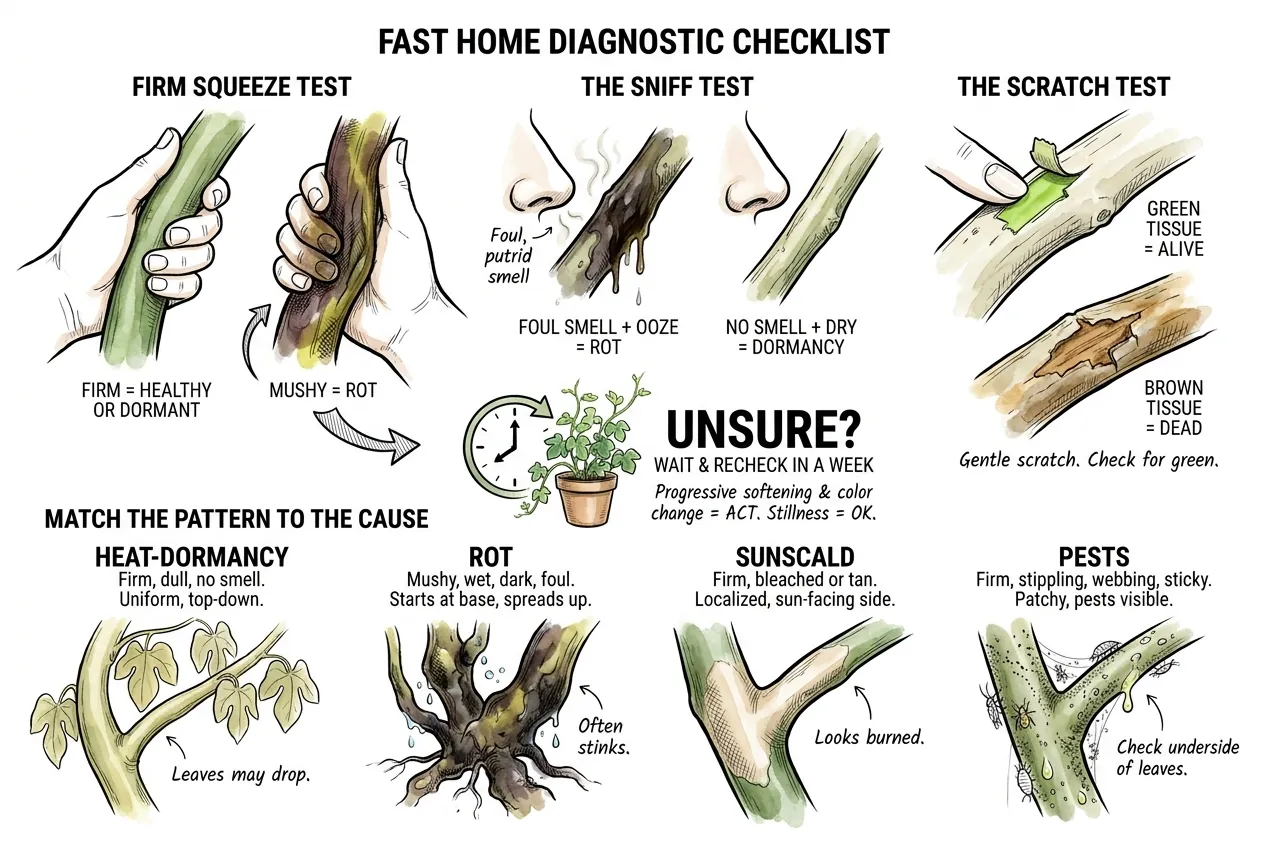
Run the home diagnostic sequence
Three quick tests cover most situations, but read them together rather than trusting any single one. Start with a firmness press, then check for smell.
A foul smell with oozing strongly suggests rot, while no smell on dry tissue makes rot less likely, though not impossible. Because the sap is toxic, wear gloves for all of these.
Scratch only questionable tissue
With gloves on, lightly scratch a questionable stem and look for green tissue underneath, which shows that spot is still alive. Keep scratches shallow and minimal. Every scratch is a small wound and a possible entry point for pathogens, so only test tissue you genuinely doubt.
Wait when the plant is stable
When you are unsure and the plant is stable (firm, not worsening), it is often safest to leave it undisturbed, keep it shaded, check the soil moisture, and recheck in a few days to a week. Progressive softening, spreading discoloration, or a foul smell is a reason to act sooner.
At the first sign of summer dieback, I mark the pot rim and photograph the plant from the four cardinal sides before moving it. On a duplicate image, I mark each wilted tip, exposed caudex face, and still-green vine. The card also carries pot mass, root-zone temperature, and the previous 24 hours of five-minute air readings from a shielded logger at vine height.
After shading, watering, or moving the plant, I update its existing card. Separate air and root-zone records prevent one temperature from being mistaken for the other, while fixed views reveal actual vine change. A firm caudex with an unchanged mapped pattern supports patience, while a new soft zone or spread across several views is a reason to inspect more closely.
Match the pattern to the cause
Use this table to read the likely symptom pattern before you touch anything. These patterns overlap in real life. A plant can have more than one problem, and hidden root rot or dehydration can look mild on the surface. Treat the table as a starting point for investigation, not a definitive diagnosis.
| Cause | Texture | Color and smell | Pattern |
|---|---|---|---|
| Heat/drought stress | firm to slightly soft | dull, no smell | often broad. Leaves fade or drop |
| Rot | mushy, wet | dark, foul, weeping | starts at base or crown, spreads up |
| Sunscald | firm | bleached or tan | localized, on the sun-facing side |
| Pests | firm | stippling, webbing, sticky honeydew | patchy, pest visible |
Prune or panic: what do I actually do?
Delay aggressive pruning
Do not rush to cut. If the caudex is firm and there is no sign of rot, trim only clearly dead tips, then address the underlying stress by checking the soil moisture, shading the plant, and improving airflow. Aggressive pruning is mainly reserved for active rot.
Preserve shade and stored energy
The reason to hold off on heavy cutting is that a plant shedding leaves under heat stress can often re-leaf once conditions ease and its roots recover, provided the caudex and roots are still healthy. Cutting does not fix the underlying stress.
Count the cost of each cut
Every cut is an open wound and a possible rot entry point, and healing costs stored energy the plant is already rationing. Hard-pruning also strips the vines that shade the caudex, exposing it to sunscald.
Before trimming a fully dry section, I photograph the vine base and nearest living node with a metric ruler showing 1 mm divisions in the same plane. I draw the planned cut on a duplicate image and record whether the dry section had been shading the caudex. This gives me a reference when a dormant bud later appears near the old vine base.
I keep the removed segment with its dated record until the plant remains stable after the cut. I do not interpret a new shoot elsewhere as proof that the cut caused recovery. The log distinguishes replacement growth from an unrelated bud that was already present and keeps me from repeatedly shortening a still-living base.
Cut only active rot
So the common instinct to cut it all back to help can turn a recoverable dieback into a decline. The exception, again, is tissue that is already rotting (that needs to come off).
When should I do nothing versus cut?
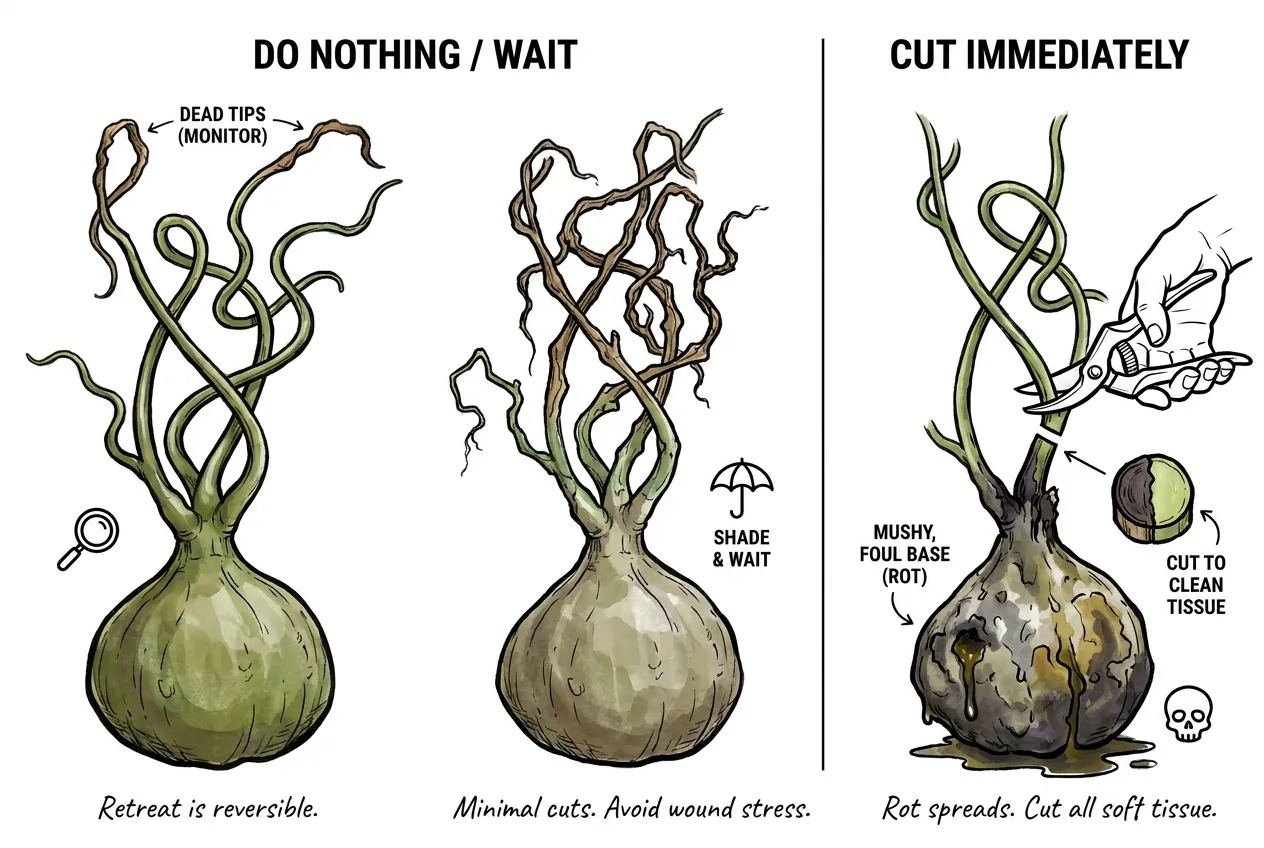
Use the table before cutting
This decision table covers the common cases. When the picture is mixed or unclear, slow down and check the roots and soil before cutting.
| Situation | Action | Why |
|---|---|---|
| Firm caudex, a few dead tips | Trim only the dead tips, then fix the stress | Stress-related loss can recover if roots are healthy |
| Firm caudex, lots of dead vine | Minimal cuts, shade, wait | Live-tissue cuts add wound and sunscald stress |
| Mushy, foul, blackening base | Cut to clean tissue now | Active decay can spread and threaten the plant |
Act when rot is active
The situation that calls for the knife is active rot. If the base is mushy or foul, this is usually not a wait-a-week case.
Remove soft tissue and dry the wound
Wearing gloves and eye protection, cut away the soft, discolored tissue back to firm, healthy tissue, disinfecting the blade between cuts. Then let the cut surface dry and keep the mix on the dry side while it heals.
Leaving soft, infected tissue behind can let rot advance into the caudex. If the rot is extensive or reaches deep into the caudex or roots, recovery may not be possible even with clean cutting.
How do I prune safely without inviting rot?
Protect yourself and the wound
Protect yourself first, then protect the wound. Adenia glauca is a toxic plant, so gloves and eye protection are strongly advised. After that, clean cuts plus a dry callus keep a wound from becoming a rot doorway.
Treat toxicity as real
The safety point is not boilerplate. Chemical analysis of Adenia glauca found cyanogenic glucosides (tetraphyllin B and epi-tetraphyllin B) throughout the tuber, leaves, stems, and bark, and classes it as a highly toxic plant.
Some other Adenia species contain potent ribosome-inactivating protein toxins, but those were isolated from different species, so do not assume A. glauca's chemistry matches theirs.
Treat all parts of the plant as poisonous if ingested.
Apply the toxicity warning practically
Wear gloves when handling the plant, particularly when pruning.
Use gloves and eye protection
Wear nitrile gloves and eye protection, keep sap away from your eyes, mouth, and any broken skin, wash tools and hands afterward, and keep cuttings and sap away from children and pets. If sap contacts skin or eyes, rinse thoroughly, and contact poison control or a doctor if any is ingested.
What tools and technique prevent a cut from rotting?
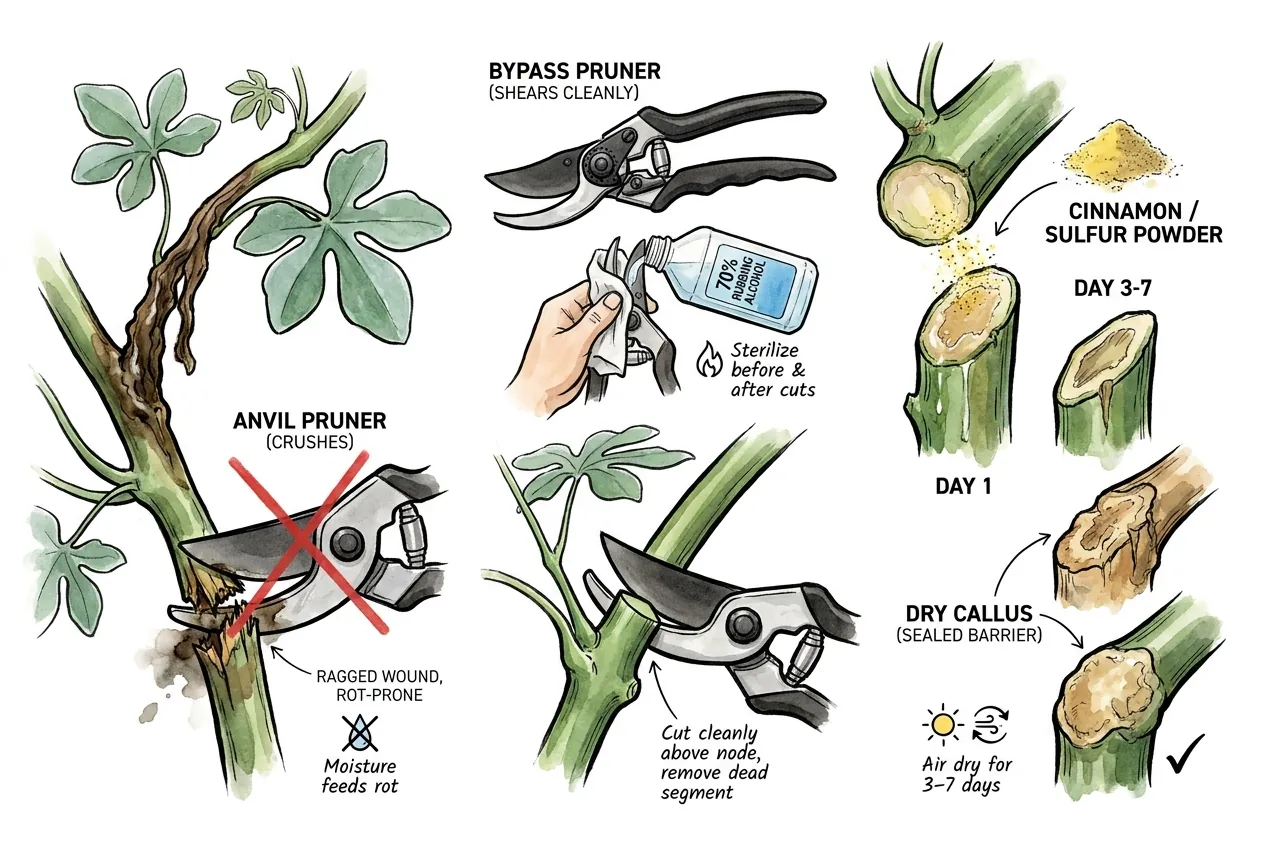
Clean tools between cuts
Clean, sharp, and dry is the aim. Clean any debris off the blade, then disinfect it with 70 percent isopropyl or ethyl alcohol, giving it enough contact time to wet the surface (around 30 seconds) and letting it dry before cutting.
Alcohol is flammable, so keep it away from flame. Re-disinfect after every cut into questionable tissue so you do not spread rot from a diseased vine to a healthy one.
Disinfecting reduces the risk of spreading pathogens. It does not make the blade truly sterile.
Let cuts callus
Cut cleanly just above a node, removing whole dead segments rather than leaving partial stubs. Then let the cut surface dry and callus before any water contact. On healthy succulent cuttings this typically takes several days, but a diseased caudex wound in dry air can take longer to seal, so keep it dry and watch it rather than assuming a fixed number of days.
Keep the wound dry and open
A dry, callused surface is more resistant than a fresh wet wound, which can feed rot organisms. Some growers dust large cuts with cinnamon or powdered sulfur. These have some antifungal activity in lab tests, but there is no strong evidence they reliably protect this kind of wound, and keeping the cut clean, dry, and airy is the more dependable step.
Choose a clean cutting tool
You want a sharp bypass pruner because it shears cleanly. Anvil pruners crush tissue and leave a ragged wound that is harder to seal. A corrosion-resistant steel blade with a cut capacity of about 5/8 inch (roughly 15 mm) is typical for hand pruners and is plenty for Adenia vines. The useful feature is the clean bypass cut, which gives the wound a better surface to dry and callus.
Match capacity to the actual vine
A roughly 5/8-inch capacity suits vines and small stems, but it will not cut a thick, mature caudex limb, so match the tool to what you actually need to remove. If you only need to snip dead tips, a smaller craft snip can be enough, provided it is sharp enough to leave a clean cut rather than a crushed, slow-healing one.
How do I manage watering and heat during the heatwave?
Water from soil evidence
Water based on the actual state of the soil, and lean on physical cooling.
The mistake to avoid is chronic overwatering. Keeping the mix constantly wet around inactive roots invites rot.
But the opposite mistake matters too. Withholding water from an active summer grower whose root ball has actually dried out will worsen dehydration and can kill roots.
Both errors are common, which is why you check the soil rather than follow a blanket rule.
Use a soak-and-dry cycle
Water thoroughly when the mix has dried out, then let it dry again before the next drink. In a heatwave, container soil can dry surprisingly fast, so check moisture more often, not less.
If the root ball is dry, water deeply in the cooler morning. If it is still moist, wait and focus on shade and airflow.
Extension guidance for plants in extreme heat makes the same practical point. Do not let plants dry out, water early in the day when the soil is dry, and use shade to reduce heat load.
What actually cools the plant safely?
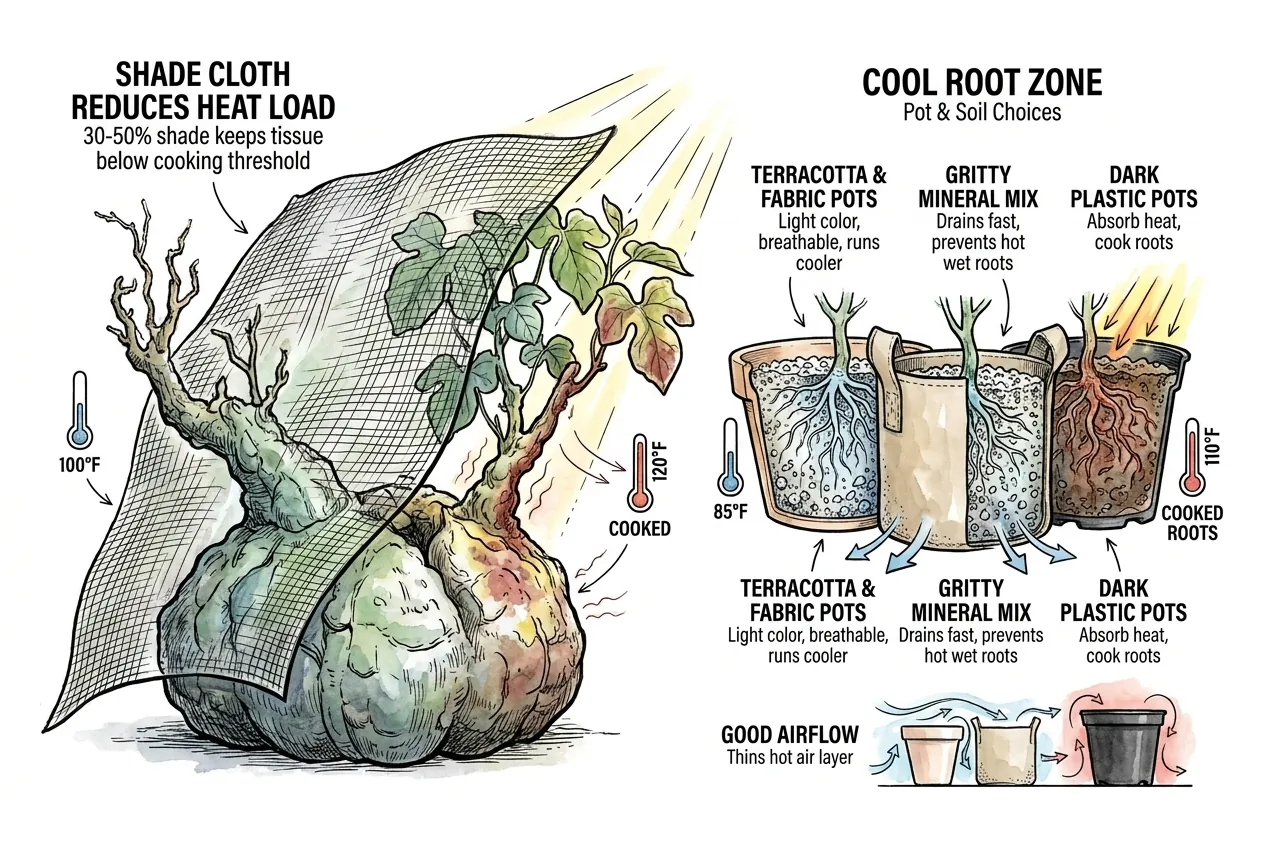
Choose shade for heat load
Shade cloth is a practical heat-load lever, but its density and placement must fit the exposure. Choose a level that lowers leaf and caudex temperature without causing weak, stretched growth, and confirm the effect on the actual plant.
Protect the exposed caudex
Reducing incident sunlight lowers leaf and caudex surface temperature and eases the heat load. Deploy the cloth over patio plants during heat events, and specifically shade the caudex if vine dieback has newly exposed it. Do not black the plant out entirely for the long term, though, because too little light causes weak, leggy growth.
Cool the root zone, not just the leaves
Pot and soil choices control root-zone temperature, which is invisible to the eye. Dark plastic pots can run hotter in direct sun, while light-colored, unglazed terracotta or breathable fabric pots may run cooler and dry faster.
Keep roots draining and aired
A gritty, pumice-heavy mineral mix drains fast so roots are not sitting hot and wet. Good airflow thins the still-air layer around the plant and helps surfaces cool and dry.
Measure the root zone directly
Root-zone temperature and soil moisture both matter and are hard to judge by eye, so a couple of cheap instruments help. A soil thermometer lets you see when a pot is running hotter than expected. A moisture check with a finger, wooden skewer, or meter tells you whether it actually needs water. They measure different things, so neither one replaces the other. If you want to build a repeatable setup, it helps to measure dry-down with the right watering tools.
Read the thermometer number
A long-stemmed dial soil thermometer, pushed into the root zone, can flag a pot that is overheating in full sun. If you repurpose a compost thermometer, confirm that its numerical range covers the temperatures you need to compare. Ignore color bands labeled for composting and read the actual number because those zones do not represent plant-safety thresholds. The probe measures temperature, not moisture.
Separate temperature from watering
A higher-than-expected afternoon root-zone reading is a cue to shade and move the pot to bring the temperature down. It is not, by itself, a reason to withhold water. Decide watering separately based on how dry the soil actually is.
Fit the probe to the pot
Match the probe length to the pot. A compost probe may be longer than a small pot needs, so use it only if you can place the sensing area at root depth without forcing the stem through the drainage hole or damaging roots. A dial soil thermometer is single-purpose, so if you already have a reliable instant-read contact probe that you can position safely and read consistently, use that instead.
How long until it recovers, and how do I monitor it?
Expect caudex-first recovery
Recovery is caudex-first, and it runs on the plant’s clock, often weeks after the heat eases. As long as the caudex stays firm, the plant can rebuild foliage. New shoots emerge from dormant growth points on the caudex once conditions improve.
Check weekly, not daily
Adopt a weekly recheck cadence rather than fussing daily. Each week, squeeze the caudex, look for new buds, and confirm there is no rot.
Resume water with growth
Resume light watering only as the plant re-engages growth and the soil dries fully between drinks. Do not water frequently to force regrowth, because that can recreate hot-wet rot conditions.
How do I tell a dormant caudex from a dead one?
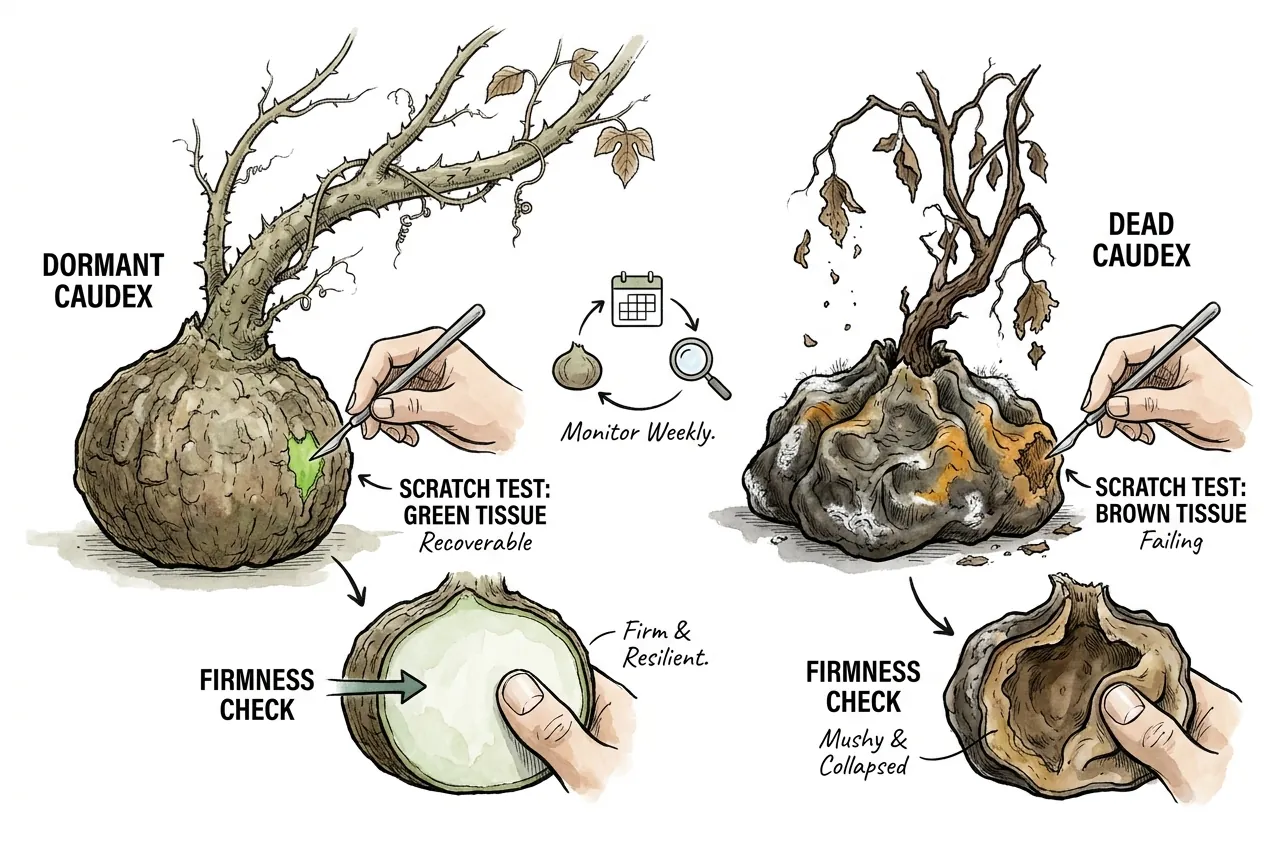
Check firmness and green tissue
The same two tests inform it. Check firmness and scratch for green tissue. A firm caudex with green tissue under a light scratch may be dormant and recoverable, even if it is completely bare. A mushy caudex, or one that is brown and dry all the way through under the scratch, raises serious concern.
Give recovery a real window
So do not toss a firm-caudex plant just because it has not re-leafed yet. Keep monitoring weekly and give it a real window of several weeks before you conclude it is gone.
How do I prevent this next summer?
Prevent stacked stress
Harden off gradually, pre-shade before forecast heat, and build a cooler root zone. Severe outcomes often follow when avoidable watering, light, or pruning mistakes stack on top of heat.
Remove the four avoidable risks
The four avoidable risks are overwatering the stall, moving a plant into intense sun without hardening, hard-pruning while stressed, and fertilizing during dormancy. Reducing those risks improves the odds of recovery. Feed only during active spring and summer growth, not during a dormant stall.
What setup builds long-term resilience?
Build long-term resilience
Acclimate any plant to stronger light in measured steps, allowing the plant’s response to determine how quickly exposure increases. Never jump a shade-grown plant straight into a heat dome.
Prepare before a heatwave
Re-pot in the cool season into a pumice-heavy, fast-draining mix and a light-colored or porous container. Site the plant for morning sun and afternoon shade in hot climates, and keep the caudex shaded year-round. Before a forecast heatwave, pre-shade at 30 to 50 percent, ensure airflow, ease off water, and check your soil temperature.
Top mistakes to avoid
| Mistake | Consequence | Fix |
|---|---|---|
| Overwater the heat stall | Rot | Water by dryness and firmness, not panic |
| Sudden full sun | Sunscald | Harden off over 1 to 2 weeks |
| Hard-prune while stressed | Wound and decline | Minimal cuts, shape in the cool season |
| Fertilize during dormancy | Salt stress on inactive roots | Feed only during active growth |
Practical conclusion
Diagnose before pruning
A soft, mushy, or foul base points to rot. A firm caudex is reassuring, but it still calls for a soil and root check.
Read the season correctly
Summer dieback is a stress signal rather than this summer-growing plant's normal winter dormancy. Diagnose the cause before assuming the plant is fine.
Keep cuts proportionate
Cut only clearly dead or rotted tissue. Hard-pruning a stressed caudex adds wounds and sunscald risk.
Water from actual soil state
Water by the state of the soil rather than the calendar. An active plant with a dry root ball may need a deep morning soak, while shade and airflow reduce heat load.
Protect the handler and wound
Wear gloves and eye protection because Adenia glauca is toxic, and let any cut dry and callus before watering.