
Pachypodium Watering by Growth State: Summer and Winter Patterns
Use native-season context, current growth, and mix dry-down to decide when Pachypodium needs water. A comparison of summer-pattern plants and Pachypodium namaquanum, with limits on calendar rules.
Rachel Torres · 2026-07-07 · Updated 2026-07-19 · 23 min read
Key Takeaways
- Native rainfall season suggests a starting hypothesis, but a calendar label does not establish the current growth state of a cultivated Pachypodium. Read the plant, not the month.
- Summer-pattern growers often resume growth in Northern-Hemisphere conditions, while P. namaquanum commonly follows a different rhythm. Imported plants can still be out of phase.
- Combine leaves, shoot activity, caudex condition, root-zone dry-down, and recent temperature or light changes, and water only when the mix and plant support it. No single signal decides it.
- Pot weight gives a repeatable wet-versus-dry trend for one setup. Conductance meters are only supplementary in coarse, low-salt mixes. Prefer measurements over calendars.
- During heat, cool and ventilate the container, then check actual moisture. An actively growing, dry plant should not be denied water by a blanket rule.
Pachypodium care charts often divide plants into summer and winter growers. That distinction can describe native rainfall and leaf phenology, but it does not by itself prescribe a July watering schedule for every cultivated plant.
Most commonly grown Madagascan and southern African plants can shift their active season in cultivation. P. namaquanum is a well-documented exception in its native range, while imported or recently moved plants may show a different phase. Use native-season context as a starting point, then check current leaves, shoot activity, pot dry-down, and caudex condition before choosing a watering response.
Is the pachypodium summer vs winter grower watering split real?
Check the Plant Against the Label
The split is useful as a hypothesis, not as a universal prescription. The South African National Biodiversity Institute (SANBI) describes seasonal shifts in much of the genus after relocation to the Northern Hemisphere and treats P. namaquanum as an exception.
That evidence supports checking summer-pattern plants for active growth in the local summer, then watering after the mix dries. It does not verify one interval, volume, or response for every species and container.
P. namaquanum may retain its native winter-growth rhythm, so a Northern-Hemisphere July can be either active or resting depending on provenance and conditions. Recently imported plants can leaf out out of phase, so read the plant and its root-zone trend instead of treating the month as a switch.
Which pachypodium are summer-growers vs winter-growers?
Confirm the individual growth phase
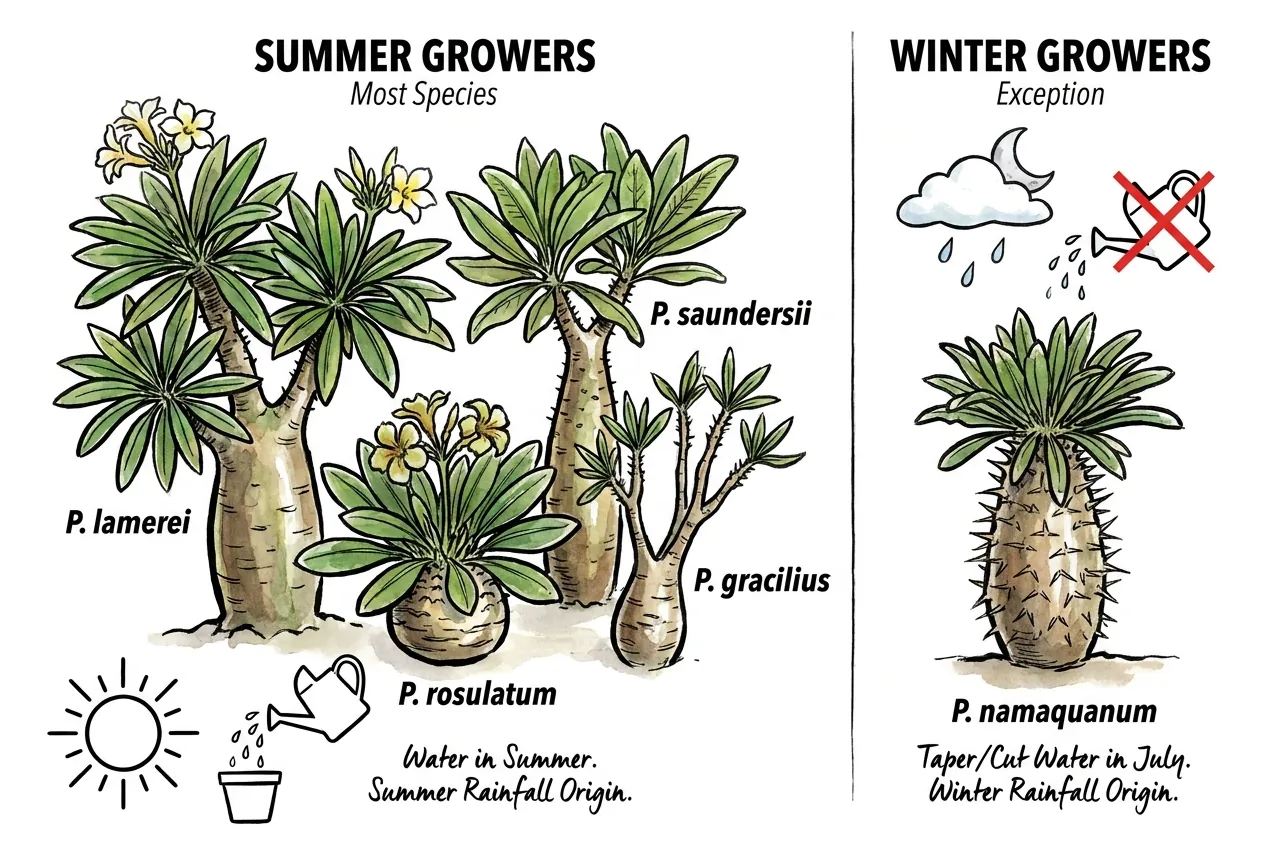
Commonly cultivated Madagascan and summer-rainfall taxa are reasonable candidates for summer activity in the Northern Hemisphere. Because direct species-level cultivation data is uneven, use that classification as a starting hypothesis and confirm it against the individual plant.
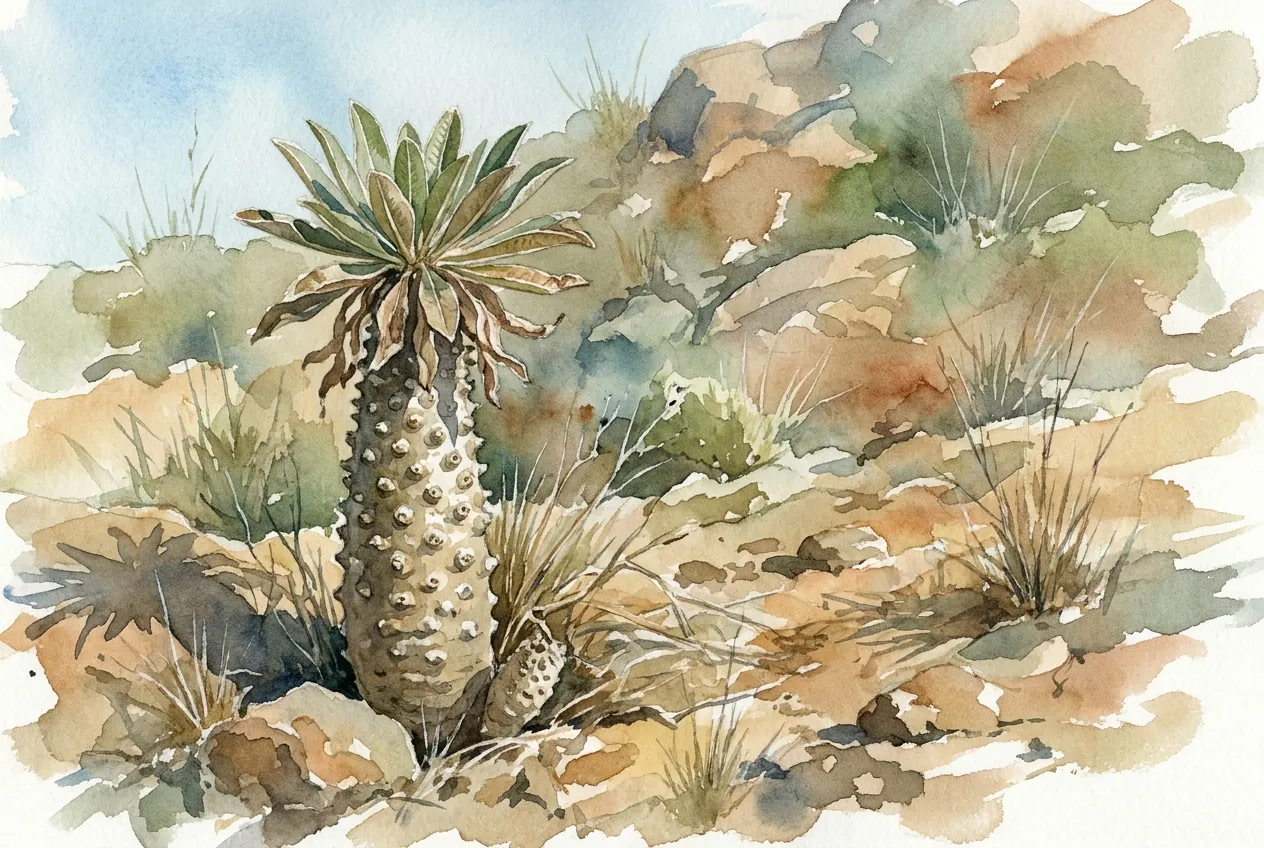
P. namaquanum is the clearest winter-rainfall example. Native plants grow in cooler, wetter months and rest through the hot, dry season, which makes reduced summer watering plausible when the cultivated plant is actually resting rather than an automatic instruction for every July specimen.
A useful clue for any species is its native rainfall season. A summer-rainfall origin generally points to summer growth, while namaquanum stands out as coming from a winter-rainfall region. Native rainfall patterns provide useful context, but they do not replace observations of the pot, roots, light, temperature, and recent acclimation.
A context-first comparison table
| Species | Origin | Habitat rainfall season | Growth type in the US | July starting point |
|---|---|---|---|---|
| Summer-rainfall and commonly cultivated Madagascan taxa | Madagascar or southern Africa | Often summer rainfall | Frequently summer-pattern in cultivation, but individual phase varies | Check leaves, shoot activity, and dry-down. Water only when the mix is dry |
| P. namaquanum | Northern Namaqualand / southern Namibia | Winter rainfall | Often winter-pattern in habitat. Imported plants may be out of phase | If resting, extend the dry interval. If actively growing, follow the same dry-down checks |
The table is not a list of calendar commands. Some small-leaved or highland plants are described as needing a drier winter rest without becoming summer-dormant, while taxonomy and cultivation conditions can vary.
Check for active growth and a dry root zone before watering, and do not withhold water from a plant that is visibly growing simply because a chart uses a different label.
Why do so many charts get succulentum and brevicaule wrong?
Separate winter-rest caution from summer dormancy
The confusion comes from mixing a winter-rest caution with a summer-dormancy label. A recommendation to avoid prolonged winter saturation does not establish that the same plant is dormant in the Northern-Hemisphere summer.
Use the cited species schedules as source-specific context, then check the plant in front of you. Leaf production, a moving shoot tip, and a repeatable dry-down are stronger local signals than a copied category.
Why can watering a dormant Pachypodium increase rot risk?
Connect Water Use to Current Root Activity
A resting plant usually uses water more slowly than a leafed-out plant, so a wet root zone can persist after watering. That persistence matters most when drainage, airflow, temperature, or pathogen pressure are already unfavorable.
Root hydraulic resistance can rise during drought or dormancy, but this does not mean every root stops absorbing water. Use the plant, pot, and dry-down trend together. An actively growing plant can still suffer if the mix remains saturated or the container overheats, because active growth lowers risk only when the root zone can drain and re-oxygenate.
Why do dormant roots stop drinking?
Keep dormancy physiology bounded
Dormancy changes allocation and water use but is not a universal physical seal. Many succulent woody plants rely on stored water, while the rate of root uptake still depends on species and conditions. During dormancy and drought, roots can increase suberization in their outer layers, raising hydraulic resistance and slowing uptake without rejecting all water.
Pachypodium is often assumed to run CAM photosynthesis, but published measurements in P. brevicaule, P. horombense, and P. lamerei found C3 photosynthesis in leaves and stems. The simpler explanation is that a leafless, resting plant transpires very little and pulls water more slowly, which raises the risk of prolonged saturation around the root crown.
Warm, poorly aerated media can favor root-rot organisms, but disease depends on the pathogen, host, injury, temperature, and duration of wetness rather than one universal threshold. If the mix stays wet longer than this plant and container normally require, improve drainage and airflow and reassess the next watering instead of relying on a calendar rule.
How does warm wet soil trigger rot?
Manage the warm-wet risk combination
Pathology references consistently point to warm, wet, poorly aerated media as a higher-risk combination, but their temperature and saturation findings are pathogen- and host-specific. Do not turn a greenhouse study into a universal Pachypodium cutoff.
Reduce the conditions you can observe
Free water helps some water molds move toward roots, while heat can increase root oxygen demand and reduce oxygen availability. Those mechanisms explain why persistent saturation is undesirable, but they do not identify disease from a single reading or hour count.
Let the mix drain, avoid stagnant saucers, provide airflow, shield dark containers from extreme radiant heat, and adjust watering to the plant’s current uptake.
How do I tell if a pachypodium is dormant or just thirsty?
Diagnose Growth State from Several Signals
Watch the plant, not the calendar. A Pachypodium can show dormancy through yellowing and dropped leaves, a stalled growing tip, and a pot that stops getting lighter between waterings. Water when the plant is in active leaf and ease off when it is truly resting, but do not equate leaflessness with thirstlessness.
A plant can be leafless because of dehydration, root loss, transplant shock, or cold or heat damage and may need attention rather than a bone-dry pot. Confirm dormancy from the whole picture, including a stalled tip, firm caudex, gradual leaf loss, dry-down, and root condition. One or two dropped leaves on an otherwise growing plant is not dormancy.
P. namaquanum can resist re-entraining to the Northern-Hemisphere calendar, so a recently imported plant may be out of phase. Leafing and shoot activity suggest current growth, while progressive leaf loss and a stalled tip support a resting interpretation.
How does the pot-weight method confirm it?
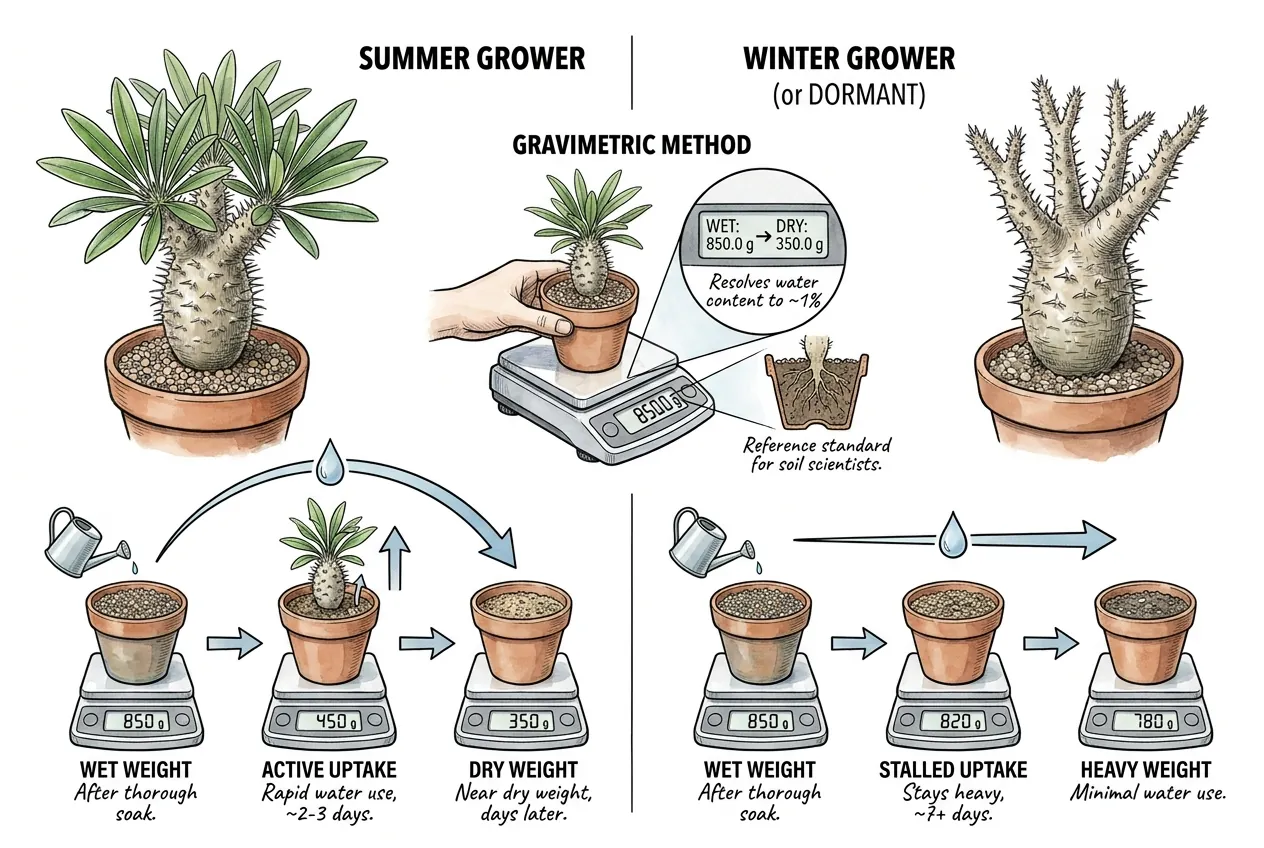
Pot weight turns the question of whether a plant is using water into a repeatable observation. A resting plant may lose weight more slowly than an actively growing one, but roots, mix, container, and weather all affect the rate, so there is no universal dry-down interval.
Weigh the same pot after drainage and again as it dries, then use that trend for the pot rather than borrowing a percentage or interval from another setup. A stalled weight trend alongside a stalled plant is a reason to inspect the root zone.
This adapts the gravimetric idea used in soil science, but whole-pot weight blends drainage, evaporation, transpiration, and growth rather than isolating plant uptake. As a repeatable wet-versus-dry trend for one pot, it remains more useful than guessing.
What scale actually works for this?
The useful spec is fine resolution over a suitable range so you can see the swing between wet and dry. A small-to-medium caudex pot may change by only a few hundred grams, so gram-level resolution can make the trend easier to see.
The Ozeri scale offers gram-level display resolution within its rated capacity and a tare function for a saucer. Log several wet-to-dry cycles for each pot, then use the pattern as one input to the next watering decision.
Check the current capacity and the weight of the complete pot before buying.
A larger container may need a higher-capacity scale, while a smaller pot is easier to repeat under stable conditions.
Why should I not trust a cheap conductivity reading here?
Cheap analog meters measure electrical conductance rather than water, and gritty succulent mixes have few dissolved salts to conduct current. In a pumice-heavy mix the meter can read dry while the root zone is wet, while fertilizer salt buildup can make it read falsely wet. An isolated dial value is therefore not a watering command.
Use a moisture meter only as a supplementary depth or trend check after testing it in the actual mix. The XLUX long-probe model reaches root depth, but resistance readings still respond to salts, contact, temperature, and particle size, and probing can damage fine roots.
Do not make a watering decision from the absolute number alone. Compare it with pot weight, visible growth, and a cautious depth check.
How do I tell dormancy apart from death or rot?
Use several clues, not leaf count alone
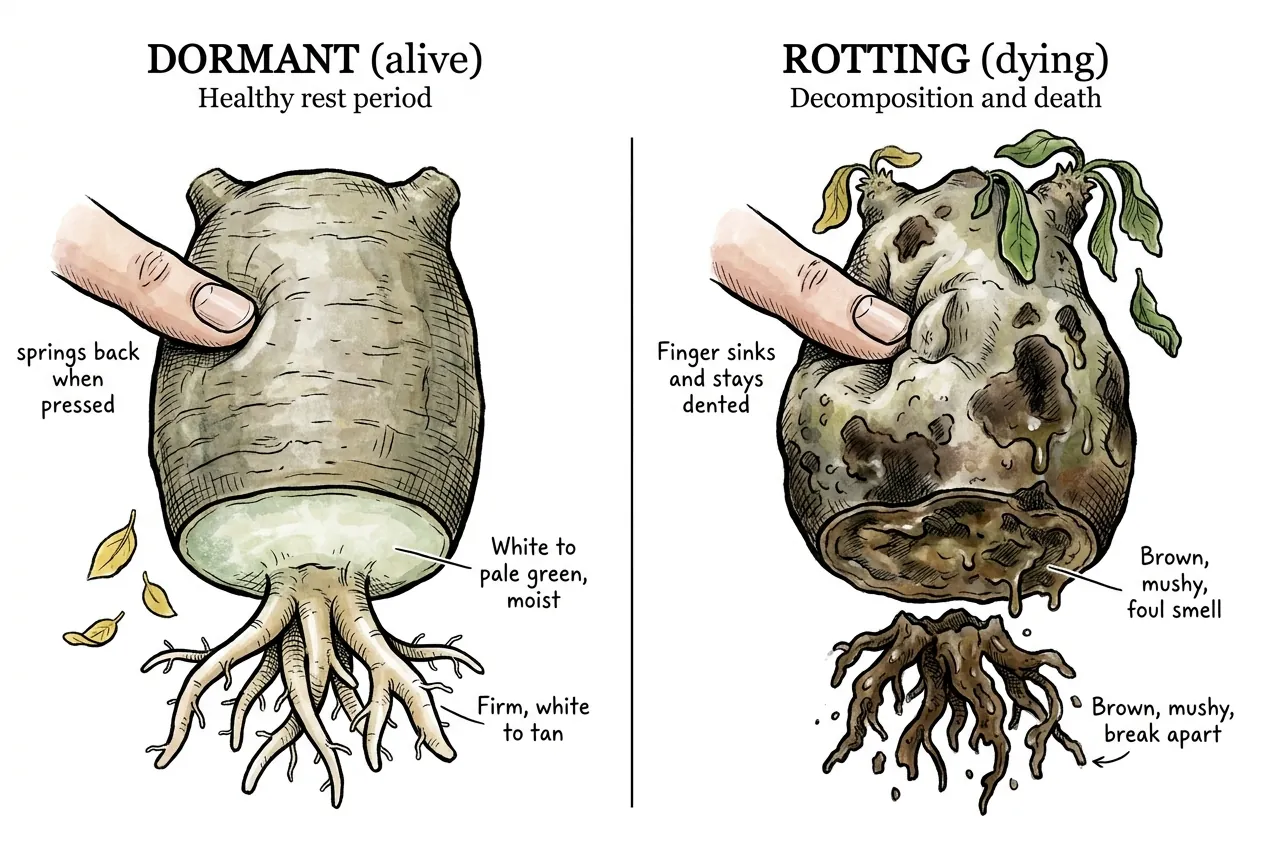
A dormant plant and a stressed or damaged plant can all be leafless, and firmness by itself cannot confirm the cause. A healthy resting caudex may become less turgid while remaining structurally firm, whereas soft, spreading discoloration, foul liquid, or tissue that collapses under gentle pressure is more concerning.
A shallow scratch and root check can add context. Healthy tissue under the skin is white to pale green and firm, while rotted tissue is brown and mushy, but early internal problems can remain hidden. Pachypodium is spiny and its milky sap is toxic and irritating, so wear gloves and eye protection, keep sap away from skin and eyes, and press gently rather than gouging.
A firm result is reassuring but not a guarantee. Check the mix, recent temperature and light changes, roots when accessible, and any odor or spreading discoloration before deciding how to respond.
| Sign | Likely resting | Concerning for rot |
|---|---|---|
| Firmness | May remain structurally firm | Soft or collapsing tissue is concerning |
| Surface | May lightly wrinkle | Soft, spongy, dark patches |
| Under a scratch | Color and texture vary. Avoid deep sampling | Brown, water-soaked, or mushy tissue is concerning |
| Roots | Firm, white to tan | Brown, mushy, break apart |
| Leaf drop | Gradual change can fit rest, but is not diagnostic | Rapid collapse with other symptoms is concerning |
Firmness reflects turgor and tissue structure, but the value changes with hydration, species, and measurement pressure.
A slightly wrinkled caudex can be resting or dehydrated, while early rot can remain firm on the surface.
Do not answer a bare or soft plant with an automatic soak.
Check the mix, recent temperature and light changes, roots if accessible, and any odor or spreading discoloration.
When the diagnosis remains unclear, isolate the plant and seek species-specific advice rather than treating a hand check as proof.
How do I water summer-grower pachypodium in July?
For an actively growing plant, use a thorough water-and-drain cycle, then wait until the root zone has dried to the level this container normally reaches before watering again. Do not borrow a fixed July interval because pot size, substrate, airflow, light, temperature, and root mass can change the dry-down substantially.
A dry surface is not proof that the core is dry. Use pot weight, a cautious depth check, or a validated sensor as complementary clues, and avoid probing where it could damage roots. Water at the cooler part of the day when practical, especially during heat, but let actual moisture and drainage determine the decision.
When should I pause watering an active summer-grower?
Change watering while cooling the pot
Do not ban watering outright. In a heat wave, a root ball that is simultaneously hot and saturated can lose oxygen and favor rot, while a dark nursery pot in full sun can become much hotter than ambient air.
Do not swing to the opposite error of letting an actively growing plant bake bone-dry. Check the soil often, use shade and airflow to reduce root-zone heat, and water a genuinely dry mix in the cooler morning rather than onto a midday-hot root ball. Hold off only when the mix is still wet and the pot is hot.
What shade cloth density works for a heat wave?
The useful target is enough shade to cool the root zone without starving a high-light plant. A moderate cloth in the 40–50% range is one option, but the right density depends on light intensity, airflow, and the actual pot temperature.
A moderate shade cloth can meaningfully lower under-cloth and pot temperature during a heat spike while still leaving ample light for these sun-lovers. The exact reduction depends on the cloth, its height and air gap, orientation, and ground radiation, so treat any specific degree figure as approximate.
Knitted mesh is breathable and water-permeable, so you can water through it.
Treat shade as a heat-wave tool
Use 40–50% shade as a temporary heat-wave tool rather than year-round cover. Leave dense shade up permanently and these sun-lovers will etiolate.
Shade also cuts radiant load but does little for a pot already sitting on hot concrete, so pair it with a light-colored pot and get the pot off the hot surface for the worst spikes.
What substrate makes the July call predictable?
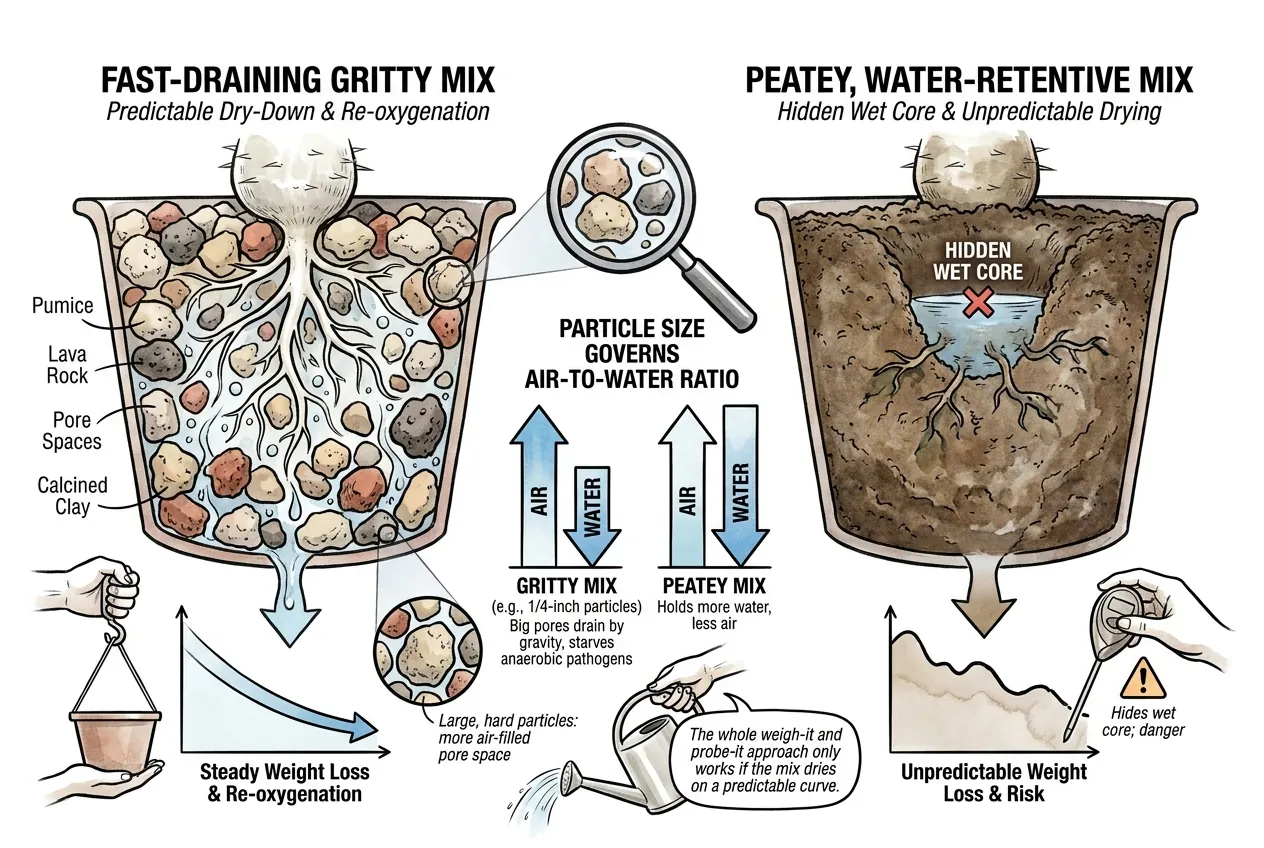
A coarse, stable mix can make dry-down easier to observe, but no recipe is automatically correct. Particle-size distribution, organic fraction, compaction, pot height, and drainage holes all affect air and water. Large particles do not guarantee high air-filled porosity, and a fine mix is not equally wet in every container.
Test the finished mix in the actual pot and adjust it when the root zone stays wet longer than the plant can tolerate. The Bonsai Jack Gritty Mix #111 is one commercial option, but its current ingredients and performance still depend on pot, climate, and roots. A ready-made mix may save preparation time but dry too quickly for a small pot, while DIY components require consistent grading and monitoring.
How do I handle namaquanum in July?
Let Current Leaves Set the July Response
If a P. namaquanum is resting, reduce watering gradually and keep the container cool, bright, and ventilated. The native pattern supports a drier summer, but the cultivated plant still determines whether that pattern is present. Habitat phenology does not set a universal temperature, interval, or volume for every pot.
Move from a normal soak-and-dry cycle toward longer dry intervals as leaf loss and shoot inactivity become clear, but do not force a multi-step schedule. Sources differ on whether a resting plant should ever receive a small drink, so use the least disruptive approach that prevents prolonged saturation while watching for progressive wrinkling, root loss, or renewed growth.
If a recently imported plant is leafed out and producing new growth in July, do not impose the dormant protocol solely because of the species name. Use its current phase and the pot’s dry-down instead.
| Factor | Summer-grower (active) | Namaquanum (dormant) |
|---|---|---|
| Watering | Soak, drain, and recheck the root zone | Extend dry intervals while rest is supported by several signs |
| Trigger | Mix dry to the bottom | Rest signs plus a dry mix. Reassess before watering |
| Where to water | Water evenly after the root zone dries | Avoid wetting the crown. Follow the chosen conservative method |
| Light | Bright, strong | Bright shade, out of hot afternoon sun |
| Roots | Avoid overheating and stagnant saturation | Keep cool and ventilated where possible |
Watch the plant, not the date.
P. namaquanum may resist seasonal re-entrainment, yet a recently imported specimen can still be leafing in a Northern-Hemisphere July.
When it is actively growing, use the same dry-down checks as for other active plants.
What if I already over-watered a resting plant and it is rotting?
Diagnose Before Reaching for Chemicals
When rot is genuinely suspected, prioritize diagnosis and sanitation over a chemical shortcut. Leaf drop alone does not establish that infection has moved from roots into the caudex.
Softening at the base, spreading discoloration, foul liquid, or a persistent wet mix with declining tissue warrants isolation and prompt assessment. If those signs are absent, rushing a healthy dormant plant out of a brittle root ball can cause new damage.
Compare the whole pattern. Gradual leaf loss can fit rest, while rapid collapse with soft tissue or odor is more concerning. None of these signs is a stand-alone diagnostic test.
How do I cut and cure a rot rescue?
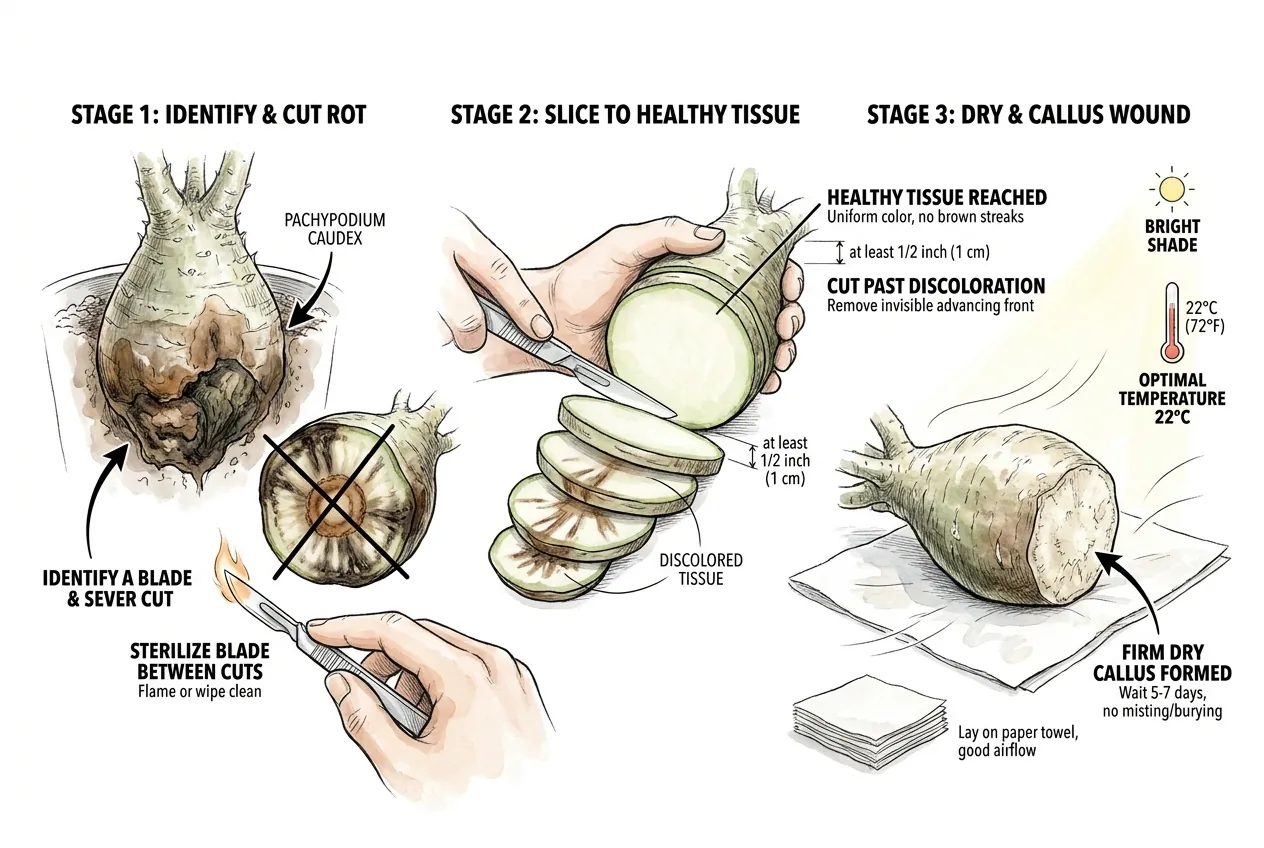
Cut only while healthy tissue remains
Rot rescue may require surgery because soft, discolored tissue can continue to break down. Wear sturdy gloves and eye protection because the caudex carries sharp spines and the milky sap can seriously injure eyes. Keep sap off skin and out of eyes and mouth, work away from children and pets, and wash up afterward.
If surgery is appropriate, use a clean, suitable blade and a documented sanitation method between cuts. Remove visibly compromised tissue in small increments and reassess every cut face. There is no universal margin, so stop only when the remaining tissue is consistently firm and healthy-looking. Seek specialist help if discoloration persists or the caudex is extensively involved.
Follow the disinfectant label, keep alcohol away from flame, and do not use an open flame near toxic sap, dry tissue, or flammable materials.
Let the wound dry under controlled conditions
Let the wound dry in clean, airy shade before it contacts moisture. Wound-healing studies in other fleshy tissues show that temperature, humidity, wound size, and tissue type change the timeline, so Pachypodium callusing cannot be assigned a fixed number of days.
Keep the plant supported and protected from children, pets, sap exposure, and accidental contact while the cut face dries. Do not bag, mist, or bury a fresh wound.
If you use a fungicidal dust, choose a product whose label authorizes that purpose and follow its directions and PPE. Kitchen cinnamon is a folk remedy with only modest lab evidence. A bark extract reached partial inhibition of one fungus at high concentration, which is not the same as ground spice on a wound. Clean cutting and thorough drying do the real work, and any powder should be applied lightly in open air without inhaling it.
Repot into a clean, dry medium suited to the remaining roots, then wait for a stable callus and signs that the plant can resume uptake before reintroducing moisture. The interval varies with wound size, tissue, temperature, airflow, and whether roots remain. Discard infested mix and clean the pot according to a suitable sanitation label.
Stop when the caudex cannot be saved
Sometimes the caudex is hollow, collapsed, or still shows brown rot in the core after you have cut as far up as you can. At that point it may be unsalvageable. Seek a diagnosis if valuable material remains. Otherwise discard it and sanitize the pot and soil appropriately.
When do I resume watering, and what mistakes are common?
Resume Watering from New Growth and Uptake
Resume on a cue, not a date. The cue often differs between the two groups.
Namaquanum commonly resumes in fall, while summer-growers often wind down in fall and resume in spring.
For P. namaquanum, cooling conditions together with new leaves or a swelling apex can support a return to active growth.
Use the plant’s response and local root-zone conditions rather than a fixed temperature threshold.
Reintroduce water gradually after a long rest, allowing each application to drain and checking for renewed uptake before increasing it.
Leaves can appear before roots are fully active, so avoid assuming that a new leaf automatically supports a heavy soak.
For summer-pattern plants, reduce watering when growth actually slows and the mix remains wet longer, then resume as new growth and dry-down return.
Repotting is generally easier during active growth, but confirmed disease or failed media may require earlier intervention.
What are common July watering mistakes?
Audit the calendar rule before changing water
A blanket schedule is an avoidable mistake.
Use growth state, dry-down, and container conditions for each plant. The species label is supporting context, not the final decision.
Cutting water from a summer-grower because of a mislabeled chart
A leafed-out summer-pattern plant may wrinkle or stall when water is withheld, but first confirm that the mix is dry and roots are functional.
Then restore an appropriate water-and-drain cycle rather than following a fixed July rule.
Treating a small-leaved highland species as summer-dormant
A winter-rest caution for a highland taxon does not by itself establish summer dormancy.
Check current growth and root-zone moisture before changing the schedule.
Panic-watering a leafless or soft plant
Do not rescue a bare plant with an automatic soak.
Check firmness, the mix, roots where accessible, temperature history, and any odor or discoloration. A firm, odorless surface is reassuring but not proof of dormancy.
Repotting mid-dormancy
Unnecessary disturbance can damage brittle resting roots, but confirmed rot, pests, or failed media may justify intervention at any season.
When repotting is elective, active growth usually provides a better recovery context.
Practical conclusion
Summer and winter labels are useful context, not complete watering schedules. Confirm each plant’s current phase through leaves, shoot activity, caudex condition, and repeatable dry-down.
Water after the root zone dries for that container. Use pot weight as a trend, and treat resistance meters as supplementary unless they are locally validated.
During heat, cool and ventilate the container without imposing an unnecessary drought. If rot is suspected, isolate the plant and use a sanitation-aware diagnosis before deciding on cutting, callusing, or rewatering.
To keep unlike seasonal states from sharing one schedule, I give each pot a short line in a seasonal log. It includes the current leaf state, apex activity, pot mass trend, and usual number of days for the mix to dry in that position. I update it after a real change instead of copying last year’s calendar date.
My side-by-side history is especially useful when different Pachypodium species share a shelf. It shows whether a slower dry-down follows a resting phase, a cooler root zone, or a problem that deserves inspection.
Affiliate Disclosure
This article contains Amazon affiliate links. As an Amazon Associate I earn from qualifying purchases. If you use these links, the site may earn a commission at no extra cost to you. Product availability, price, and specifications can change. Check the current listing before buying.