
Caudex Sunburn Prevention: Shade, Pot Heat & Kaolin
Prevent caudex sunburn by diagnosing exposure first, shading plants gradually, cooling dark pots, and using kaolin only when the current label fits.
Nathan Brooks · 2026-08-07 · Updated 2026-08-11 · 13 min read
Key Takeaways
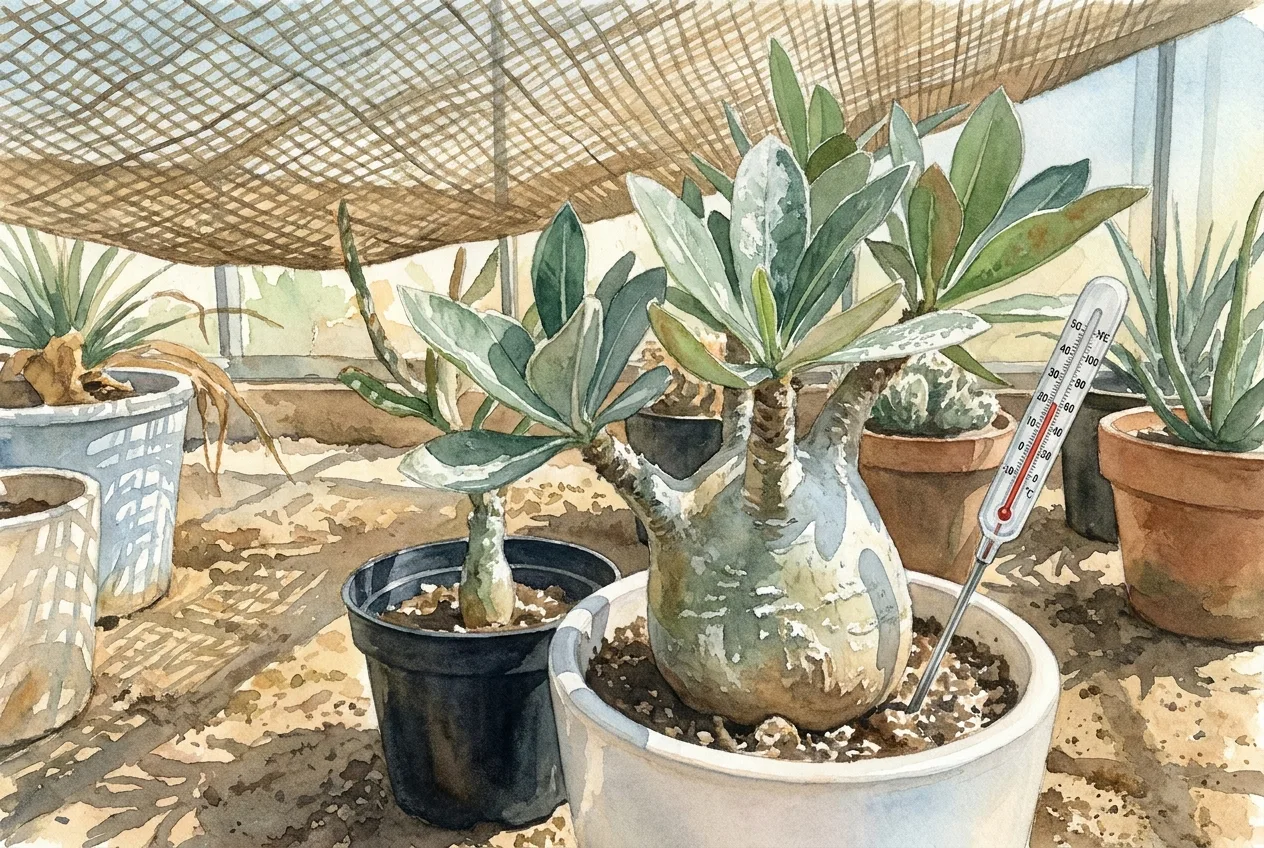
- Fresh sunburn follows a sudden increase in direct light and appears on the most exposed side as bleached, tan, or corky tissue. The sheltered side stays unchanged, and the scar will not turn green again.
- Move the plant out of harsh exposure, add temporary overhead shade, and re-acclimate in steps. Do not chase a universal leaf-temperature cutoff.
- Check the pot separately, because root-zone heat is a different hidden stress. Shade or sleeve a dark container, and put a probe in the medium if you need the actual root-zone temperature.
- An IR thermometer is for repeatable surface comparisons, not for seeing inside the pot. Use it to compare the same spot before and after a change, against a baseline.
- Use kaolin only when the current label covers your plant and site, and only if a persistent white film is acceptable. It fits a large outdoor collection far better than one indoor display plant.
A sunburned caudex is hard to ignore. The pale patch faces the afternoon sun, then turns tan or corky while the sheltered side remains unchanged. What makes the problem expensive is not just the scar. It is the urge to buy four fixes before working out whether the plant needed slower acclimation, a cooler pot, or temporary shade.
A plant moved from a shipping box, greenhouse, winter window, or shaded bench into hard summer sun is vulnerable even if the species eventually tolerates full sun. Root-zone heat deserves its own check, but it should not be used to explain away every scorched leaf.
How Do You Confirm Caudex Sunburn?
Match the Surface Pattern to Exposure
Look for a pattern that matches light exposure. Check for damage on the upper or sun-facing side, a sharp boundary where another stem or leaf cast shade, and onset after the plant was moved, unwrapped, pruned, or exposed during a heat wave. Bleaching may precede tan, brown, or corky tissue. Existing damage will not turn green again, although a stable dry scar can remain harmless.
Check competing causes before adding products
A soft, spreading, wet, foul-smelling, or shaded-side lesion does not fit simple sunburn as neatly. Check for rot, mechanical injury, chemical spray damage, cold injury, or disease before covering the plant with another product. Sunburn and dehydration can occur together, but watering a damaged plant on a fixed schedule can create a second problem.
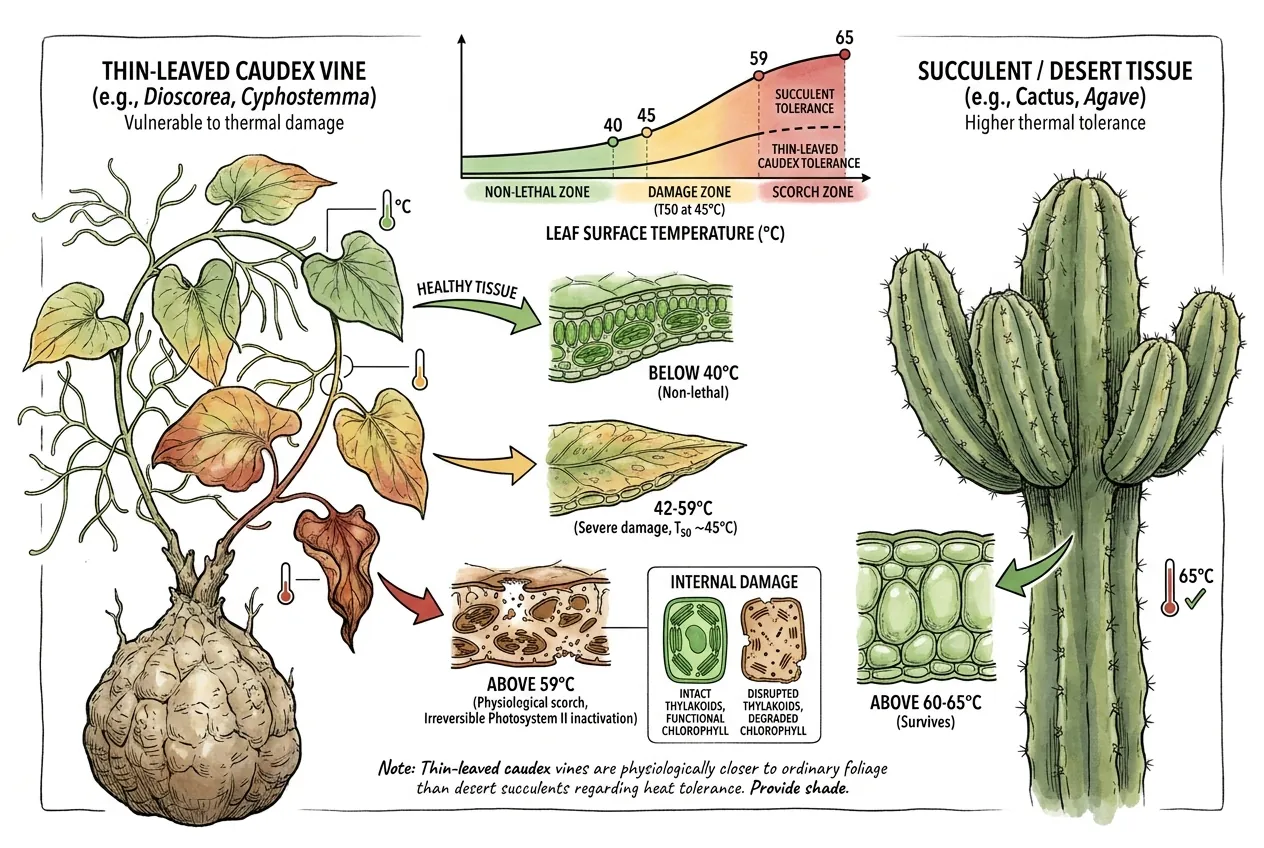
Published leaf heat-injury thresholds are useful context, not a universal caudex alarm. Studies often place irreversible photosynthetic damage for ordinary foliage in the mid-40s°C, yet the value changes with species, tissue, exposure duration, water status, and prior acclimation. Thick succulent stems and thin seasonal vines should not be assigned the same heat ceiling.
Is Root-Zone Heat the Same Problem?
Separate Surface and Root-Zone Stress
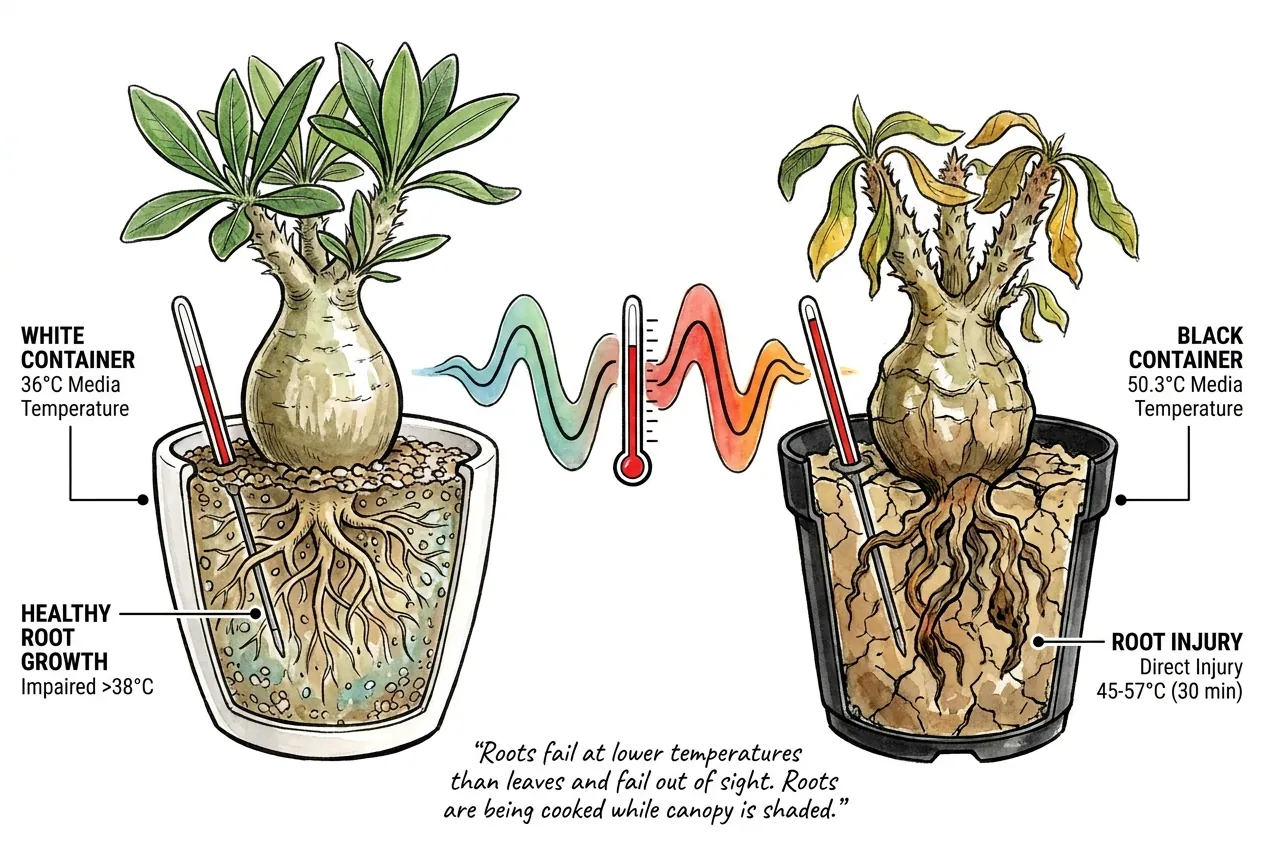
No. Sunburn is visible damage from excessive radiation and heat at exposed tissue. A hot container can stress or injure roots without producing that same surface pattern. Both may happen during one heat wave, but they call for different measurements and fixes.
Separate pot heat from tissue sunburn
Container-nursery research shows why dark pots deserve attention. In woody nursery crops, sustained root-zone temperatures around 38–40°C impaired root performance, while higher exposures caused direct injury. A recent field study reported about 50.3°C at the sun-facing side of black-container media versus roughly 36°C in white containers. Those are crop- and setup-specific results, not proven caudex death points.
Know what a surface thermometer can measure
An IR gun reads only the surface in its field of view. It can compare a black pot wall before and after shading, but it cannot tell you the temperature around roots in the middle of the mix. For that, place a suitable probe at a repeatable depth without damaging the roots. Use both tools only if the result will change your action.
What Should You Buy First?
Buy Only When a Measurement Changes the Decision
Often, nothing. Move one newly exposed plant into bright shade, protect it during the hottest part of the day, and acclimate it gradually. Buy a tool when the collection is large enough, the exposure is fixed, or you need a repeatable way to compare interventions.
| Problem you actually have | Best-fit purchase | Why it earns a place | Skip it when… |
|---|---|---|---|
| Several benches and no consistent surface readings | Etekcity Lasergrip 774 | Fast leaf, caudex, bench, and matte pot-wall comparisons | You will move the only affected plant regardless of the number |
| Dark pots receiving direct afternoon sun | Viagrow white grow bags | A light exterior reduces solar absorption around the container | The root zone is already cool or the bag's drainage and drying behavior do not suit the plant |
| A fixed, high-radiation bench | AIIOW 50% Aluminet | Medium shade across a bench where individual moves are impractical | Plants already stretch, or temporary 30% shade would be enough |
| A very exposed mixed bench or short emergency period | Rovey 70% Aluminet | Deep temporary protection for material that cannot yet take full exposure | Sun-loving caudex will remain under it long enough to etiolate |
| A large outdoor collection needing a labeled particle film | NovaSource Surround WP | Label-listed nursery and ornamental sunburn/heat-stress protection | You have one display plant, dislike white residue, or cannot meet label requirements |
The first purchase for most fixed outdoor collections is shade or a cooler container, not a chemical. The thermometer moves to the front when you manage several microclimates and want to know whether those changes worked.
Does an IR Thermometer Help?
Use Surface Readings for Comparison
It helps when you use it as a comparison tool. Measure the same matte leaf or caudex area, at the same distance and angle, before and after moving the plant, shading the bench, or sleeving the pot. Record air conditions at the same time. A single reading without a baseline says much less.
A removable rim mark lets me photograph the plant from one fixed position in the morning, around midday, and late afternoon. I include the whole pot, the bench, and the shadow boundary in each frame. This shows which face of the caudex and which pot wall actually receive direct radiation instead of relying on where I remember the sun being.
For reflective or glazed containers, I place matching matte-tape squares on the exposed and sheltered pot walls. Each IR reading targets the center of a square from the recorded lens-to-tape distance and a near-perpendicular angle. The tape stays off the plant, and I still use a buried probe when the root zone is the question.
After moving the plant or adding shade, I repeat the three photographs and paired pot-wall readings at the same clock times, recording any pot rotation to preserve the exposure face. During each 30-minute window, I record shielded air temperature and handheld wind speed every five minutes.
I compare sessions only when mean air temperatures differ by at most 2°C and mean wind speeds by at most 0.5 m/s. These are repeatability limits, not plant-safety thresholds.
Check the Measurement Limits
The current Lasergrip 774 manufacturer page lists a twelve-to-one distance-to-spot ratio, fixed 0.95 emissivity, and a -50 to 450°C measurement range. The ratio means the target circle widens with distance, so move close enough that the reading does not include the bench or sky. The laser marks the aim. It does not perform the temperature measurement.
Leaf emissivity is often close to the device's fixed setting, which makes leaves a reasonable comparative target. Shiny metal, reflective film, and some pale glazed pots are not. The gun also cannot see below a pot wall or through the medium. If your real question is root-zone temperature, buy or use a probe instead.
Should You Cool the Pot?
Cool the Pot Only When Heat Is Measured
Shade the container or change its exterior when a dark pot spends hours in direct sun and a probe confirms excessive root-zone heat. Moving the pot behind a low screen, clustering pots so the sidewalls shade one another, or placing the nursery pot inside a ventilated light-colored cachepot may solve the problem without disturbing roots.
White containers reduced maximum root-zone temperature in several nursery studies, but the size of the reduction varied by crop, pot, substrate, spacing, irrigation, weather, and sensor location. Do not promise your caudex the 14.3°C difference measured in one experiment. Measure your own setup.
Viagrow white grow bags are a low-cost option when their size and drainage suit the plant. The tradeoff is faster drying and less rigidity than a heavy glazed pot. A bag that cools the sidewall but leaves the plant repeatedly wilted is not an upgrade, so compare watering behavior during the first heat cycle.
What Shade Cloth Works for Caudex Plants?
Use the Lowest Effective Shade
Use the lowest shade percentage that prevents new damage while the plant acclimates. University of Arizona guidance suggests temporary 30% shade for cacti and succulents during extreme heat, then removal after the event. Iowa State recommends starting around 30–50% for many garden plants and keeping the cover above, not against, the foliage.
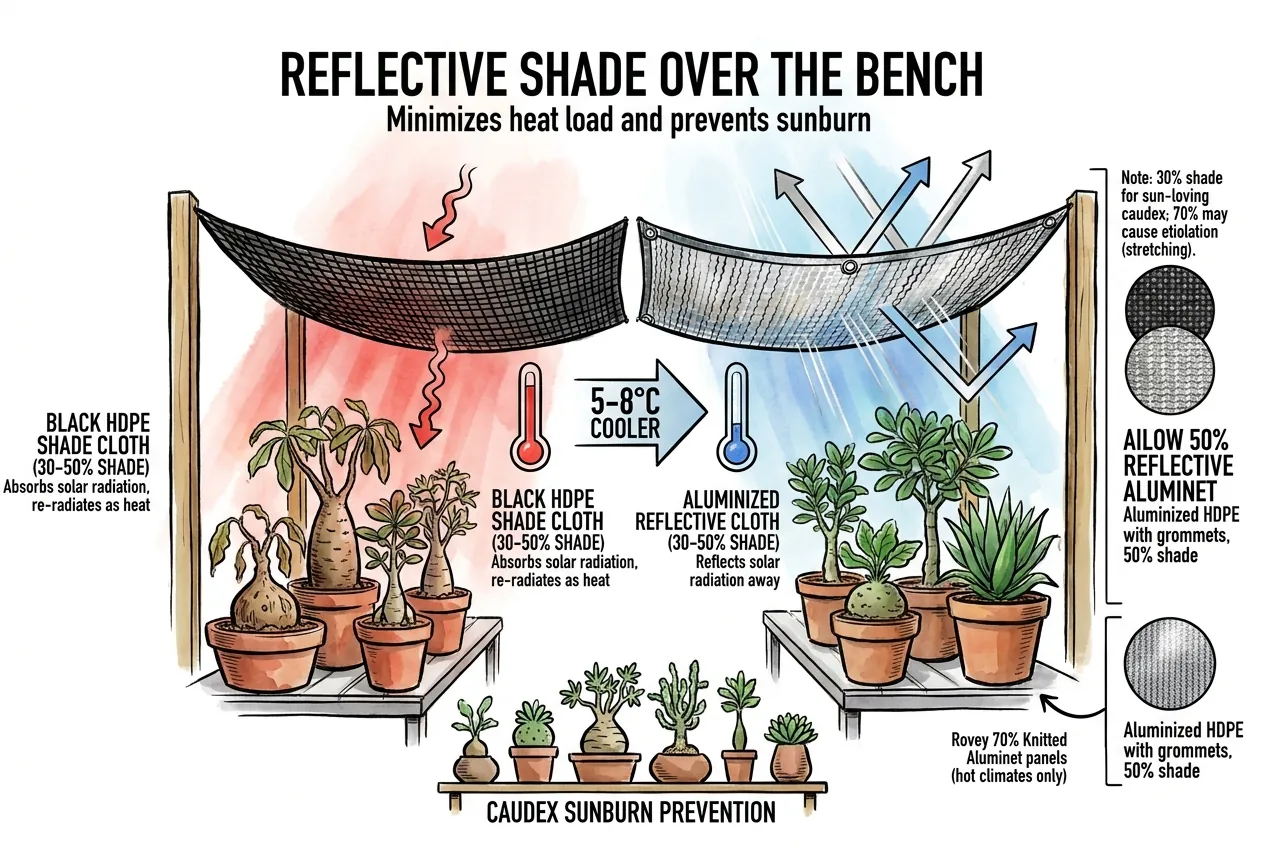
Mounting matters. Exterior or overhead shade intercepts radiation before it reaches the plant, and open sides preserve airflow. Alabama Extension notes that white and reflective materials may reduce heat more efficiently than black cloth, but shade percentage is not the same as temperature reduction. A Delaware vegetable trial found no advantage from colored cloth over black in those crops. Do not promise a fixed 5–8°C benefit from Aluminet on a caudex bench.
Match Shade to the Bench
The AIIOW 50% panel could be the more practical of the two shade choices for a high-exposure bench. Even 50% may be more than an established full-sun caudex needs, so use a removable frame and watch the new internodes. The Rovey 70% panel belongs to temporary rescue, propagation, or a mixed bench with genuinely shade-sensitive material, not permanent cover for compact sun-grown specimens.
The dedicated caudex shade-cloth guide covers percentage and installation in more detail. A plant that has just moved outdoors also needs a gradual light ramp. Treat the Adenium sun-scald acclimation guide as a framework to adapt, not a guarantee that every plant is ready after exactly seven days.
Is Kaolin Film Right for a Caudex?
Treat Kaolin as a Labeled Surface Film
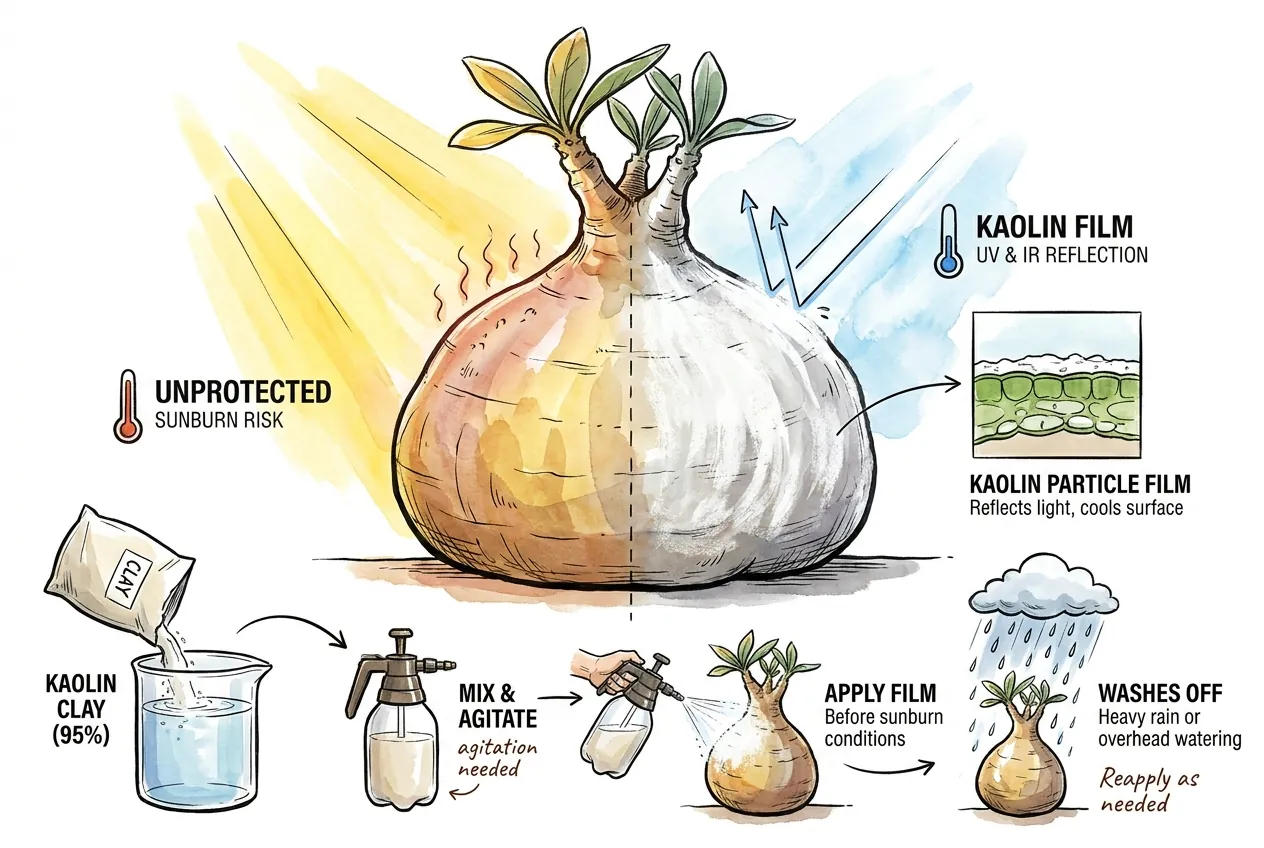
Surround WP is not ordinary craft clay. It is an EPA-registered crop protectant containing 95% calcined kaolin, and its US label includes nursery and ornamental plants and trees for sunburn and heat stress. The film reflects radiation, but crop studies show variable cooling and plant responses. Evidence from apples, walnuts, and peppers does not establish a caudex-specific temperature drop.
Follow the Current Product Label
Buy the 25lb product only if the scale of the collection justifies it, the current label and local registration cover the use, and a chalky white coating is acceptable. The label calls for thorough coverage, personal protective equipment, a restricted-entry interval in agricultural settings, and specific rates and intervals. Use the directions on the current container. Do not convert an acre rate into an improvised one-plant recipe.
Weigh Residue and Reapplication
Surround can be difficult to keep suspended, may need reapplication after coverage is lost, and can be hard to remove from some surfaces. It is a poor fit indoors, on a single display specimen, or where the film could hide a developing lesion. On a large outdoor nursery collection, however, the big bag and labeled ornamental use can make more sense than repeatedly improvising small batches of unformulated clay.
The same surface-exposure question appears in Cyphostemma juttae bark-split prevention, but do not assume every thick caudex tolerates the same coating.
How Do You Deploy the Setup?
- Record the starting point. Note recent exposure changes, which side is damaged, air conditions, and repeatable surface or root-zone readings if you have the appropriate tools.
- Stop the new exposure. Move the plant to bright shade or add temporary overhead cloth while leaving airflow around it.
- Address the pot separately. Shade a dark wall, add a ventilated light-colored sleeve, or repot only when the benefit outweighs root disturbance.
- Choose the lowest workable shade. Increase light again in steps while checking new growth and new lesions. Do not use an exact calendar as proof of acclimation.
- Add kaolin only when justified. Confirm the label, test a small subset if the label permits, and apply before the damaging exposure rather than painting established dead tissue.
- Repeat the same measurements. Compare the same locations under similar conditions. A lower pot-wall reading is useful, but a probe remains the evidence for the root zone.
Change One Intervention at a Time
Make one change at a time so the result remains readable. If you change the pot, add 70% shade, spray kaolin, and alter watering on the same afternoon, you will not know which change helped, or which one caused stretching or rot.
Who Should Skip These Products?
- Skip the IR thermometer when you care for one or two movable plants and the reading will not change the decision to shade them. It is a useful collection-management tool, not a required badge of serious growing.
- Skip the grow bag when the plant needs the stability and slower drying of a heavy pot, or when root disturbance during peak heat would add more risk. Shading the existing container may be enough.
- Skip 50–70% cloth when the plant is already pale, stretched, or adapted to full sun and the heat event is brief. A movable 30% cover or afternoon-only screen may preserve compact growth better.
- Skip Surround WP for indoor plants, a small display collection, or any use not covered by the current label. OMRI-listed status does not remove the need to follow pesticide directions, and the word kaolin does not make every clay product an equivalent substitute.
Leaf drop can also be a seasonal response rather than sunburn. The Cyphostemma bainesii heat-dormancy guide helps separate a normal cycle from injury.
How Do You Care for a Sunburned Caudex?
Protect Green Tissue While Scars Stabilize
Prevent new damage first. Keep the plant in bright, moderated light and maintain airflow. Do not peel a dry scar or remove healthy leaves simply because they look marked. Remaining green tissue is still useful. Adjust watering to the plant's actual water use and root condition rather than trying to rehydrate a burn with constant moisture.
Track Stability Before More Light
Mark the lesion edge or photograph it with a date. A dry, stable patch that stops expanding supports the original sunburn diagnosis. Spreading softness, dark wet tissue, odor, or collapse calls for a new rot assessment. Heat and water stress can interact, as the Euphorbia obesa summer-splitting guide explains.
Keep temporary cloth removable. Once the heat event passes and the plant is stable, step the light back up according to new growth and surface response. The goal is not permanent shade. It is a plant that reaches its appropriate mature exposure without acquiring another scar.
Affiliate Disclosure
This article contains Amazon affiliate links. As an Amazon Associate I earn from qualifying purchases. If you use these links, the site may earn a commission at no extra cost to you. Product availability, price, and specifications can change. Check the current listing before buying.