
Caudex Hard Water and Salt Buildup
A white crust is only a clue. Separate soluble salts from hardness and alkalinity, run a repeatable EC test, and decide whether RO is worthwhile.
Nathan Brooks · 2026-08-08 · Updated 2026-08-11 · 16 min read
Key Takeaways
- A white rim only shows that dissolved material dried in place. It does not identify the source. Check whether the plant is actually declining before you buy anything.
- "Hard-water buildup" bundles three separate problems: hardness (calcium and magnesium), alkalinity (which pushes mix pH up), and salinity (total dissolved ions). A TDS pen rolls them into one number and cannot tell them apart.
- Start with a repeatable substrate EC test and your water supplier's report. Buy an EC meter to track soluble salts, and add a pH pen only when you also need to follow substrate pH.
- Do not buy reverse osmosis from a single TDS reading. RO fits a narrow set of persistent, measured problems and brings filter maintenance, reject water, and a new nutrient calculation with it.
- Correct the cheapest reversible cause first: fertilizer math, softened water, drainage, then a measured leach. Only then decide whether alkalinity, a specific ion, or source salinity still needs treatment.
Do you need to buy anything for the white crust?
Check the plant before buying equipment
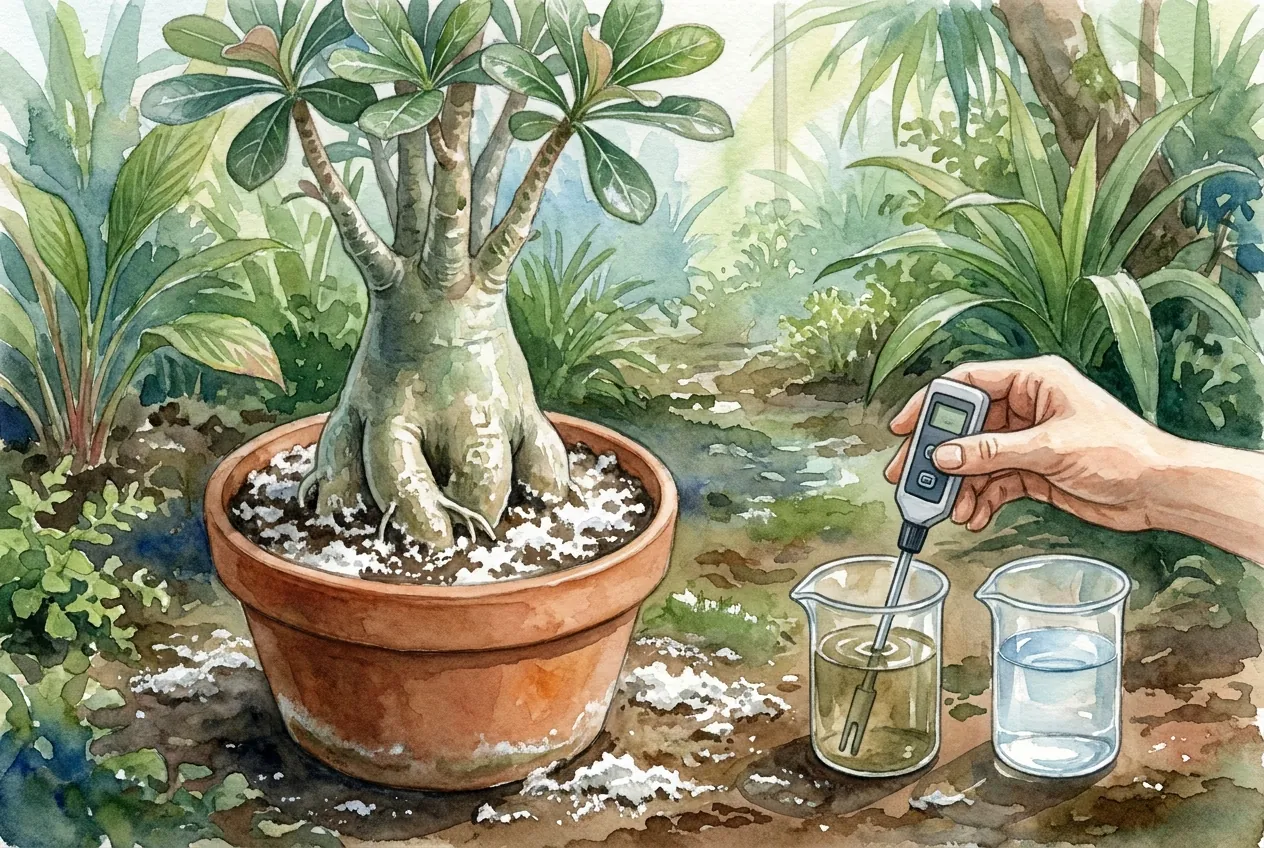
Not necessarily. First ask whether the plant is declining, whether the deposit returns quickly, and what you have been putting into the pot. A white deposit is evidence of evaporation, not a diagnosis by itself.
| What you see | What could explain it | Useful next check |
|---|---|---|
| Dry white ring on the pot or gritty mix | Calcium carbonate, fertilizer salts, or other dissolved minerals | Record source-water EC and run the same substrate test twice |
| Brown tips or margins | Salt stress, but also drought, root loss, heat, or fertilizer injury | Check roots, watering history, fertilizer dose, and substrate EC |
| New leaves yellow between green veins | Possible iron or manganese availability problem | Measure substrate pH and review the complete nutrient program |
| Plant stalls while the mix stays wet | Root damage, low oxygen, dormancy, cold, or salinity | Inspect the plant before treating this as a water-quality problem |
Set a baseline before escalating
If the plant is growing normally and the deposit is only cosmetic, wipe the pot and establish a baseline. Buying a treatment system before that baseline is more likely to complicate care than improve it.
What does high soluble salt do to roots?
Read salt stress through the root response
When soluble salts become excessive, roots have more difficulty taking up water. Plants can look drought-stressed even while the substrate is damp. Specific ions such as sodium or chloride can also injure sensitive plants, and a high substrate pH can reduce the availability of some micronutrients.
Do not diagnose from leaf tips alone
Those mechanisms are real, but the symptoms are not caudex-specific. Tip burn cannot tell you whether the cause was chloride, a strong fertilizer mix, damaged roots, or a hot dry spell. EC narrows the question to total soluble salts. It still does not identify the ion.
What can EC and TDS tell you (and what can’t they tell you?)
Use EC for repeatable comparisons
EC measures how well a solution conducts electricity. A consumer TDS meter measures EC first, then converts it to an estimated parts-per-million value. The conversion factor varies by meter, so two TDS pens can show different ppm values for the same cup.
- EC can track total dissolved ionic load. It is useful for comparing water sources, checking fertilizer solutions, following substrate trends, and checking whether an RO membrane is still rejecting ions.
- EC cannot identify hardness, alkalinity, sodium, chloride, or fertilizer. Different mixtures can produce the same EC.
- TDS is not a universal RO trigger. A reading of 180 ppm could be mostly useful calcium and magnesium, while a lower reading could still contain an ion that matters to a sensitive plant.
Record the unit and meter mode
Use EC units when possible because greenhouse interpretation tables are normally written in mS/cm or dS/m. The units are equivalent. One mS/cm equals one dS/m and one mmho/cm.
Why do ppm conversions disagree?
Keep the conversion beside the result
A basic TDS meter may use an average 0.5 NaCl conversion, while a true-EC meter can offer selectable EC and TDS scales. If a meter reads 200 ppm on a 0.5 scale, its underlying EC is about 0.40 mS/cm. A different conversion can display another ppm value from that same conductivity.
For that reason, record the meter mode beside every result. A notebook entry that says only 450 ppm is incomplete.
How do you separate hardness, alkalinity, and salinity?
Start with a water report
Start with the annual water-quality report from a municipal supplier. If it does not include the plant-relevant values, use an irrigation-water lab panel. At minimum, look for EC, pH, alkalinity, hardness, calcium, magnesium, sodium, and chloride. Well water deserves a current test rather than an assumption based on taste or scale in a kettle.
| Parameter | What it answers | What it does not answer |
|---|---|---|
| Hardness | How much calcium and magnesium the water carries | Whether substrate pH will rise |
| Alkalinity | How strongly the water neutralizes acid and tends to raise media pH over time | The complete salt load |
| EC | The combined concentration of dissolved ions | Which ions are present |
| pH | How acidic or basic the sample is at that moment | Its acid-neutralizing capacity |
Use alkalinity to plan acid treatment
Water pH alone is a poor basis for acid dosing. Purdue’s guidance distinguishes alkalinity from the starting pH because alkalinity determines how much acid is needed. If a water report shows problematic alkalinity, use a calculated treatment or professional recommendation and follow the product label. Do not add acid by guesswork.
Is sodium-softened water safer than hard water?
Check what the softener adds
Usually not for container plants. A conventional softener exchanges calcium and magnesium for sodium. The water leaves less scale on plumbing, but the added sodium can be a worse irrigation input. Use an unsoftened bypass, rainwater, distilled water, or tested RO water instead.
Do not borrow a field-soil shortcut
Sodium adsorption ratio is useful in field soils where sodium can damage soil structure. It is not a shortcut for diagnosing a small, mostly mineral caudex mix. For a container grower, the direct lab values for sodium, calcium, magnesium, chloride, alkalinity, and EC are easier to act on.
How do you test salt buildup in a caudex pot?
Keep the extraction method consistent
Use one extraction method the same way each time. Method consistency matters more than producing a dramatic number from a random saucer of drainage.
A repeatable pour-through check
- Measure your inputs. Record the EC of plain irrigation water and the finished fertilizer solution. If you already track watering by gram, add water source, fertilizer dose, and EC to the same log.
- Water normally. Bring an actively growing plant’s mix to container capacity and allow it to drain. Do not run this test by soaking a cold, dormant, or root-compromised plant.
- Wait consistently. About 30 to 60 minutes is practical. Use the same interval in later tests.
- Displace a sample. Add a small, recorded volume of distilled or other low-EC water to the surface and collect enough leachate for both probes. Record the displacement water’s EC.
- Read immediately. Measure leachate EC and pH, then rinse the probes as their manuals direct.
- Repeat before escalating. One unusual result can come from uneven fertilizer granules, a dry pocket, or inconsistent sample volume. A trend from the same method is much more useful.
NC State developed the pour-through procedure for non-destructive nursery monitoring. UMass cautions that casual drainage checks are variable and that a one-to-two extract, saturated-media extract, and pour-through all have different interpretation ranges. Never apply a threshold from one method to a result from another.
To keep each reading tied to the right liquid, I line up four identical clean cups for source water, finished fertilizer, displacement water, and leachate. I add the pot identifier, date, and collection time to the leachate cup. This keeps a convincing number from being attached to the wrong liquid after the bench becomes busy.
Each cup receives a small working sample so a used probe never enters the watering jug or fertilizer bottle. I measure from the cleanest input water toward the leachate, rinse as the meter manual directs, and discard every tested sample instead of returning it.
I photograph each stable display beside its labeled cup before copying the number into the log. If a handwritten entry later looks implausible, the image lets me check the unit, decimal place, and sample identity instead of repeating an unnecessary watering test.
What EC is too high for a caudex?
Use warning bands instead of universal cutoffs
There is no well-supported universal pour-through cutoff for caudex plants. Adenium, Pachypodium, Dioscorea, seedlings, dormant plants, and actively fertilized specimens should not be assigned one borrowed greenhouse number.
Use method-matched horticultural ranges as warning bands, not species guarantees. More important, compare a plant with its own earlier readings, fertilizer program, growth stage, and symptoms. If EC rises across repeated tests while growth worsens, correct the likely source and re-test. If the number is stable and the plant is thriving, do not chase a lower reading merely because another extraction method’s table looks different.
Which measurement tool is worth buying?
Match the tool to the question
| Tool | Best fit | Reason to skip |
|---|---|---|
| True EC/TDS meter | Repeated substrate tests, fertilizer mixing, and RO monitoring | You only want a rough comparison between two water sources |
| Basic TDS pen | Low-cost source-water and RO before/after checks | You want to use EC-based horticultural tables without conversion |
| Calibratable pH pen | Repeated substrate-pH tracking after evidence of drift | You only want to test tap pH or will not calibrate and store the probe correctly |
How should you compare EC and TDS meters?
Choose true EC for repeat testing
The HM Digital COM-100 is the better fit for a grower who plans to test leachate more than once. It displays true EC as well as converted TDS, can be digitally calibrated, and has a replaceable sensor.
HM Digital’s current specification for the COM-100 lists an EC range of 0–9.99 mS, ±2% accuracy, selectable µS/mS and 0.5/0.7 ppm scales, automatic temperature compensation, and IP67 housing. Buy it for repeatable EC work. Skip it if your only question is whether one jug of water has fewer dissolved ions than another.
Use a TDS pen for simple comparisons
The cheaper HM Digital TDS-3 is reasonable for simple comparisons. Its official specification lists a 0–9990 ppm range, ±2% accuracy up to 5000 ppm, and an average 0.5 NaCl conversion. It does not display true EC, so every horticultural EC range requires a conversion and a note about the scale.
When is a calibrated pH pen useful?
Use a pH pen only after pH becomes the question
The Apera PH20 makes sense when repeated substrate tests show pH moving in the wrong direction or when you are evaluating a carefully calculated water treatment. It does not measure alkalinity, and a tap-water pH reading from it cannot tell you how much acid to add.
Apera lists the PH20 at 0–14.0 pH, 0.1 resolution, ±0.1 accuracy, automatic one- to three-point calibration, and temperature compensation from 0–50°C. The electrode is not replaceable. Buy it if you will calibrate it, keep the sensing bulb wet in proper storage solution, and log results. Skip it for an occasional uncalibrated dip.
When is reverse osmosis worth buying?
Buy RO only for a persistent measured problem
A practical RO decision is not based on a tap TDS above 150 ppm. Consider it when a water report identifies a persistent problem that RO can reduce, such as excessive salinity, sodium, or chloride, and the collection is large enough that rainwater or purchased distilled water is impractical. Repeated media tests should also show that fertilizer adjustment and sensible leaching have not solved the problem.
Compare the ongoing cost
A small collection may need only a few gallons of low-mineral water each month. In that case, RO hardware, replacement filters, feed-pressure requirements, and reject water are hard to justify. A large indoor collection on unsuitable source water can reverse that calculation.
What should you verify before buying the linked RO unit?
Verify the live listing, not only the headline capacity
The linked four-stage countertop 100-GPD RO listing is most relevant to a grower who wants a faucet-connected unit without permanent under-sink plumbing. Treat 100 GPD as a nominal membrane rating, not a promise of daily output under every home’s pressure and temperature.
Treat this model’s performance as unverified until the current seller, faucet compatibility, minimum feed pressure, replacement-cartridge availability, tested rejection, and waste-to-product ratio are confirmed on the live listing.
Skip the unit if those facts are missing. A lower headline price is not a bargain when the replacement filters or performance data are untraceable.
All RO systems produce a reject stream. EPA says typical point-of-use systems may waste five gallons or more for each gallon treated, while WaterSense-labeled models must stay at or below 2.3 gallons rejected per gallon treated. This plant-focused countertop listing may not carry that label, but the comparison shows why recovery data belongs in the buying decision.
Does every RO user need Cal-Mag?
Review the whole nutrient program first
No. RO removes most of the calcium and magnesium that source water might have supplied, but your base fertilizer and substrate may already provide them. Add a supplement only after reviewing the complete nutrient program. Do not turn RO water into an automatic extra dose.
Use a supplement only for a demonstrated gap
General Hydroponics CALiMAGic is a 1-0-0 calcium-and-magnesium supplement. The manufacturer positions it for RO or soft water, coco, and high-demand crops and directs users to add it with the base fertilizer, then check EC and pH. For a slow-growing caudex, that last check matters. This supplement adds ions and does not replace a complete fertilizer.
The smaller bottle is the sensible trial size for a modest collection. The one-gallon CALiMAGic size fits a larger collection with a known, recurring Ca/Mg requirement. Skip both when the water report and base fertilizer already cover calcium and magnesium, or when you have not diagnosed a deficiency.
How should you correct a confirmed salt problem?
Correct the cheapest reversible cause first
- Check the fertilizer math and make sure no one has been adding both a complete feed and unnecessary supplements.
- Stop using sodium-softened water.
- Confirm that the pot drains freely and that the mix has not collapsed.
- Leach an actively growing, healthy-rooted plant with lower-EC water, then repeat the same substrate test.
- Use the water report to decide whether alkalinity, a specific ion, or source-water salinity still needs treatment.
- Compare rainwater, distilled water, blending, and RO by the actual volume your collection uses.
How do you flush without creating a rot problem?
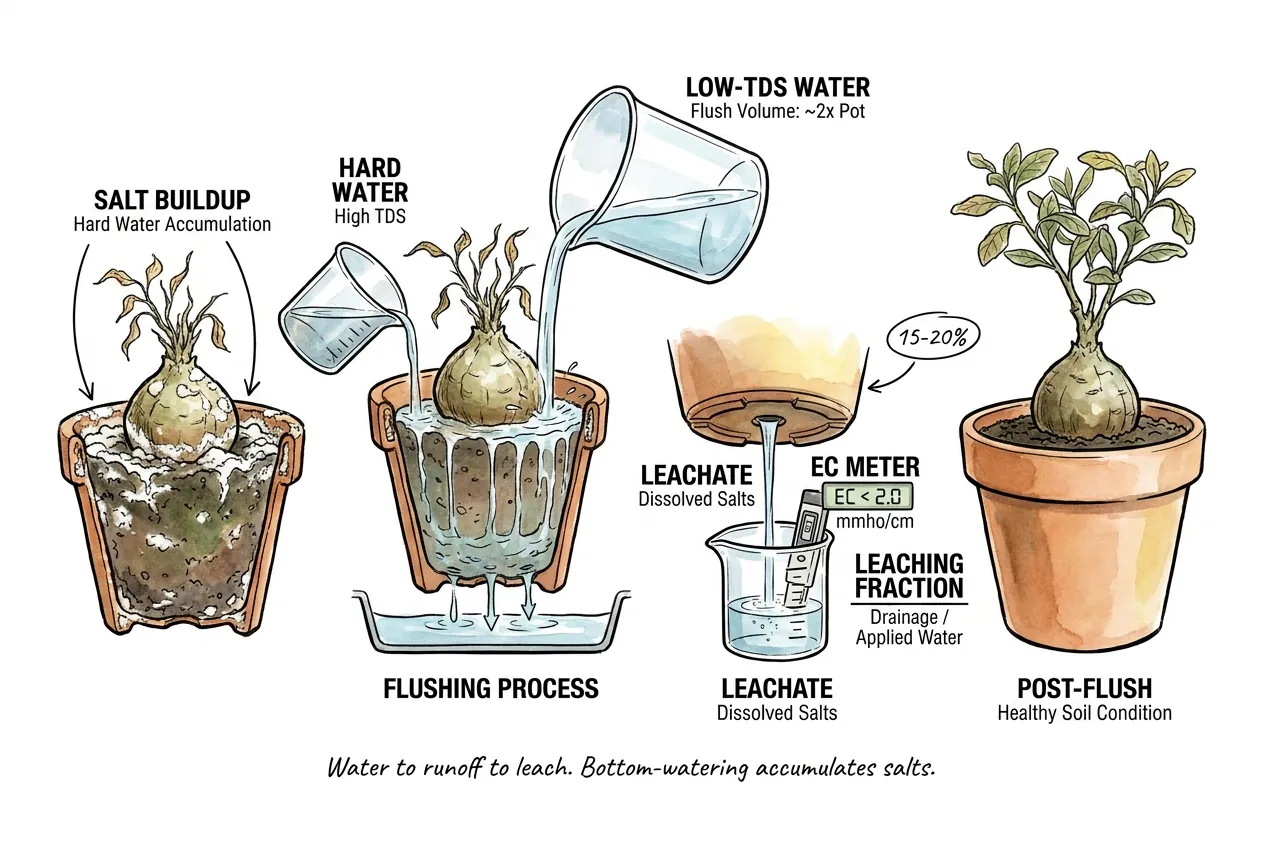
Choose a warm period when the plant is actively growing and the mix can drain and dry normally. Apply low-EC water slowly across the whole surface, let it drain completely, and discard the leachate. Re-test with the same method after the pot has returned to its normal watering cycle.
Use the flush as a measured trial
A flush equal to twice the pot volume is a rough horticultural rule, not a command to drown every caudex. Pot geometry, channeling, substrate age, and initial salinity change how much water is needed. The endpoint is a meaningful downward trend without leaving compromised roots cold and saturated.
Make room for periodic leaching
Routine bottom-watering does not export salts because no water leaves the drainage holes. If you bottom-water, include periodic top-watering to free drainage when the species, season, and root condition allow it. The same logic applies to accumulated fertilizer salts. The watering method determines whether dissolved material can leave the pot.
What needs maintenance?
- Check and calibrate the EC meter before trusting a trend. Use a fresh conductivity standard near the working range and rinse the sensor after dirty leachate.
- Keep the pH pen calibrated and stored correctly. Use fresh buffers and the specified storage solution for the glass bulb. Distilled water is for rinsing, not long-term electrode storage.
- Compare RO feed water and product water under similar conditions. Rising product EC or falling rejection can flag exhausted prefilters, pressure problems, or membrane decline.
- Repeat the same substrate test as the plant changes. Compare similar growth stages because a number without the plant’s season and fertilizer history is easy to misread.
Frequently asked questions
Is tap water with visible scale automatically bad for caudex plants?
No. Scale suggests calcium carbonate chemistry, but moderate calcium and magnesium can be useful nutrients. Check alkalinity, sodium, chloride, EC, and the plant’s substrate trend before replacing the water source.
Can I use distilled water or rainwater instead of RO?
Yes, especially for a small collection. Test stored rainwater for cleanliness and use a covered collection system. When low-mineral water becomes the main source, make sure the complete fertilizer program, not necessarily a separate bottle, supplies calcium and magnesium.
Does a carbon pitcher remove hardness or salinity?
Usually not. Carbon is useful for compounds it is designed and certified to reduce, but it is not the same process as RO or distillation. Measure before and after if dissolved minerals are your concern, and check the filter’s certified reduction claims.
Is bottled spring water better than tap water?
Not by category alone. Spring water intentionally contains minerals, and brands differ. Distilled or purified water produced by RO is more predictable for dilution, but the label and an EC check are still more useful than the marketing name.
How often should I flush a caudex pot?
Use the plant’s growth stage, drainage, fertilizer history, and repeated EC trend rather than a fixed calendar. Do not flush a dormant or root-damaged plant merely because a generic monthly schedule says to.
Does high leachate EC prove the tap water is bad?
No. Fertilizer, supplements, controlled-release granules, and salts concentrated by evaporation all contribute. Test the source water separately and review everything added since the last leaching irrigation.
Can a pH pen measure alkalinity?
No. It measures pH. Alkalinity requires a titration, test kit, utility report, or lab analysis. Do not calculate an acid dose from the pH number alone.
Should I add Cal-Mag to hard water?
Only if the water analysis and complete fertilizer program still leave a demonstrated calcium or magnesium gap. Adding it automatically can raise EC without fixing the original problem.
Affiliate Disclosure
This article contains Amazon affiliate links. As an Amazon Associate I earn from qualifying purchases. If you use these links, the site may earn a commission at no extra cost to you. Product availability, price, and specifications can change. Check the current listing before buying.