
PAR Meter for Caudex Plants
Measure PPFD before replacing a grow light. Compare phone apps, lux meters, quantum meters, and DLI loggers for a caudex shelf.
Maya Ellison · 2026-08-09 · Updated 2026-08-10 · 15 min read
Key Takeaways
- Map the canopy before replacing a light, and choose the least expensive meter that answers the actual decision. Record fixture height, dimmer, photoperiod, and the bright and weak points.
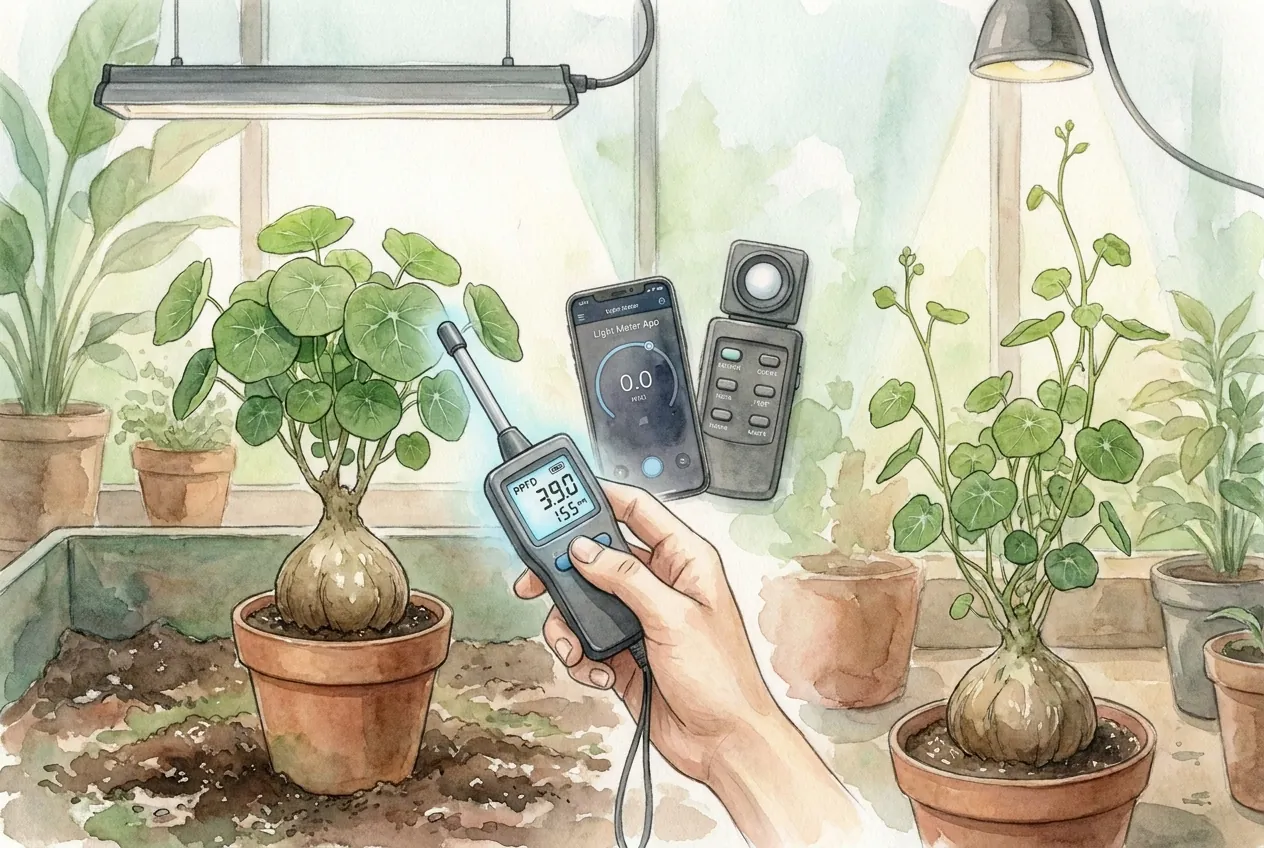
- For one shelf, start with a validated phone app or a lux meter for relative comparisons. Borrow or buy a full-spectrum quantum meter only when an absolute PPFD number will change an expensive setup.
- A dedicated DLI logger earns its price mainly where daylight, clouds, dimming, or a changing schedule make the daily dose hard to calculate. A fixed lamp on a timer does not need one.
- There is no single PPFD or DLI target proven for every caudex species. Longer internodes hint at low light but are not a meter reading (species, season, temperature, water, and spectrum all shift growth).
- Choose the meter by how accurate the decision needs to be, then use a reading method you can repeat. The best meter resolves the uncertainty you actually have.
Which Light Meter Do You Actually Need?
| Your actual job | Start here | Buy only if | Skip when |
|---|---|---|---|
| Find bright and dim zones on one fixed shelf | Validated phone app or lux meter | The readings are repeatable under the same lamp | You need a defensible absolute PPFD value |
| Map relative uniformity with a separate sensor | Dr.meter LX1330B | You use one known light source and understand that lux is not PPFD | You want one conversion factor for mixed or adjustable-spectrum LEDs |
| Measure absolute PPFD across LED, sunlight, and different fixtures | Apogee MQ-500 | You manage several lights or valuable plants and will act on the number | A borrowed meter can answer your one-time question |
| Consider a discounted older quantum meter | Apogee MQ-100 | The seller proves model, condition, and calibration history | You need current support or good accuracy under narrow-band LEDs |
| Log changing light over full days | Apogee DLI-500 | Daylight, clouds, dimming, or changing schedules matter | A fixed-output lamp and timer make DLI easy to calculate |
Use the Least Expensive Meter That Changes the Decision
The point of a meter is to reduce purchase uncertainty, not to become another expensive object on the shelf.
What Do PAR, PPFD, Lux, and DLI Actually Tell You?
Separate PAR, PPFD, Lux, and DLI
PAR names the conventional 400–700 nm photosynthetically active radiation waveband. It is a range, not a measurement unit.
PPFD is an instantaneous photon rate
PPFD reports how many photons in that band reach one square meter each second, in µmol·m⁻²·s⁻¹. By definition those photons are counted without weighting them for human brightness. A real sensor is not perfectly spectrum-neutral. Its spectral response and calibration determine how closely it follows that ideal.
Lux follows human vision
Lux measures light as human vision perceives it, with greatest sensitivity around green. That does not make green light useless to plants. It means two lamps with the same lux can deliver different PPFD when their spectra differ.
DLI combines intensity and time
DLI is the total PAR photon dose accumulated through a day, in mol·m⁻²·d⁻¹. It combines intensity and duration. It is useful, but it does not replace species, temperature, spectrum, or plant-response observations.
Why Lux Cannot Use One Universal PPFD Conversion
Apogee publishes different conversions for sunlight, cool-white fluorescent, high-pressure sodium, and metal-halide sources. For example, its current table multiplies lux by 0.0185 for sunlight but by 0.0135 for cool-white fluorescent light. The factor changes because the spectra change.
Those figures can be useful with the named sources. They are not a license to apply one borrowed factor to an LED whose diode mix, color temperature, or channel settings are unknown. Under an unfamiliar grow light, use lux for relative mapping such as comparing a weaker corner with the center unless you have validated a conversion against a quantum meter.
When DLI Adds Information
Use the fixed-light formula only when output is stable
DLI = PPFD × hours on × 3,600 ÷ 1,000,000.
A stable 300 µmol·m⁻²·s⁻¹ for 12 hours is about 13.0 mol·m⁻²·d⁻¹. The formula works because the output is being treated as constant. Sunlight through a window varies with time, weather, season, and glass angle, so a noon reading cannot represent the whole day. That is where logging or repeated measurements become useful.
Is There One PPFD Target for Every Caudex?
Caudex describes a growth form, not one physiological group. A seedling, a dormant plant, a leafy vine, and a sun-adapted Pachypodium should not inherit the same target just because each stores water in a swollen stem or root.
Published horticultural DLI ranges can provide context, but they do not establish a universal threshold for caudiciform plants. Nor does a compact shape prove that one DLI number caused it. Genetics, spectrum, day and night temperature, watering, nutrition, and growth stage also affect morphology.
Use a Plant-Specific Test Loop
- Identify the species and whether it is actively growing, newly rooted, acclimating, or dormant.
- Record a canopy light map before changing anything.
- Note new internode length, leaf color, orientation, and surface temperature over the next growth interval.
- Change fixture height or dimmer setting modestly, then repeat the same measurements.
- Keep the lowest setting that produces healthy, appropriately compact growth without bleaching or heat injury.
The Pachypodium brevicaule PPFD article discusses one species-level working estimate. Treat it as a hypothesis to test against your plant and setup, not as a site-wide prescription. For the broader relationship between lamp distance, photoperiod, and compact growth, see the LED and caudex compactness guide.
Which Meter Specifications Matter?
Match the meter's unit, spectral response, and calibration to the decision, not to a listing that mentions plants.
| Check | Why it changes the decision |
|---|---|
| Unit | A PPFD meter reports µmol·m⁻²·s⁻¹. A lux meter does not become a PAR meter because a listing mentions plants. |
| Spectral response | Compare the sensor response and stated error with the lamps you use, especially narrow-band or adjustable LEDs. |
| Calibration uncertainty | This bounds the confidence of an absolute reading. Repeatability alone only shows whether the device gives similar results. |
| Angular response | A canopy receives light from several angles. Quantum meters should document cosine response rather than merely show a white diffuser. |
| Logging | Spot readings suit fixed electric lights. Variable daylight and schedules benefit from time-series or DLI logging. |
| Support status | A cheap discontinued meter may cost more after recalibration, repair, or an unverifiable used-sensor history. |
Which PAR Meter Is Worth Buying?
Apogee MQ-500 for Absolute PPFD Across Different Lights
Choose a meter by the accuracy you need
Apogee MQ-500 can be a defensible choice when one absolute number must remain comparable across sunlight, white LEDs, and other electric sources. Apogee lists ±5% calibration uncertainty, less than 0.5% repeatability, less than 2% per year long-term drift, and a 0–4,000 µmol·m⁻²·s⁻¹ measurement range.
Its handheld meter offers spot, sample, and logging modes, including an integrated daily total. The detachable sensor is rated IP68, but the handheld display is not waterproof.
When this choice makes sense
Choose it when you manage several fixtures, compare spectra, document recommendations for other growers, or have a collection valuable enough that an uncertain reading is the expensive option.
When a simpler tool is enough
Skip it when you have one fixed shelf and only need to find its dim corners. Borrowing one for a baseline, then using a cheaper repeatable tool, is often the better purchase.
Apogee MQ-100 as a Legacy Listing
Apogee MQ-100 was a genuine quantum meter, but Apogee now places it in its retired-products archive. Its original sensor was calibrated to ±5%, with less than 1% repeatability and less than 2% per year long-term drift. Its narrower spectral response also carried more spectral error under some LED sources than the current full-spectrum sensor.
When a legacy meter can be justified
Consider it only when the price is meaningfully lower, the listing identifies the exact model, and the seller can establish condition and calibration history. A broad-spectrum comparison job is a better fit than a narrow-band LED audit.
When to avoid the legacy listing
Skip it when you expect current manufacturer support, do not know how the sensor was stored, or would need to pay for service immediately. A lower price is not enough reason by itself.
Dr.meter LX1330B for Relative Mapping on a Budget
Dr.meter LX1330B is a lux meter, not a quantum sensor. The manufacturer lists a 0–200,000 lux range, ±3% ±10 digits accuracy through 20,000 lux, ±5% ±10 digits above that, and ±2% repeatability.
Its strongest caudex-shelf use is inexpensive uniformity mapping. If the center is 30,000 lux and the edge is 15,000 under the same unchanged lamp, the edge receives half the measured illuminance. That result can guide pot placement without pretending the device measured PPFD.
When a lux meter is useful
Choose it when a separate sensor is easier to position than your phone, you want repeatable relative readings, or your known source appears in a reputable conversion table.
When lux is not enough
Skip it when the absolute PPFD value controls a costly change, or your LED spectrum is mixed, adjustable, or unknown. Do not apply the sunlight or fluorescent factor merely because it produces a convenient answer.
Apogee DLI-500 for Daylight and Changing Schedules
Apogee DLI-500 records PPFD, DLI, and photoperiod instead of relying on one snapshot. Apogee lists ±5% calibration uncertainty, a 0–4,000 µmol·m⁻²·s⁻¹ range, three-minute measurement frequency, and IP65 protection.
It can retain 99 days of DLI and photoperiod summaries, plus 10 days of 30-minute PPFD averages, with CSV download over USB-C. Those records make sense where a window supplements the grow light or a controller changes output through the day.
When a logger earns its place
Choose it when your real question is how light accumulates through changing days, not how bright the lamp is at one moment.
When a spot reading is enough
Skip it when your electric light runs at one output for a fixed number of hours. In that setup, one reliable PPFD measurement and the DLI formula usually answer the question. The MQ-500 also has an integrated daily-total logging mode.
Can a Phone App Be Good Enough?
Use a Phone App Only for Repeatable Screening
Sometimes a phone app is useful for screening and relative comparisons. The result depends on the phone sensor, diffuser, app, light spectrum, angle, and any external calibration. Treat broad claims about all phone apps as unreliable in either direction.
A University of Hawaiʻi Extension evaluation tested two Android apps against a reference quantum sensor under full-spectrum LEDs. On the tested Pixel 6, external calibration reduced average error to roughly 19–21 µmol·m⁻²·s⁻¹ across the study range. That is useful evidence for a validated phone-and-lamp setup, not a guarantee for every device.
Check the app against the actual lamp
- Follow the app’s diffuser instructions exactly.
- Compare it with a known quantum meter under your actual lamp if possible.
- Repeat the same point several times and reject a setup with unstable readings.
- Use percentages and before-and-after differences unless calibration supports an absolute value.
- Borrow a proper quantum meter before an expensive fixture change if the app result is near your decision boundary.
How Should You Measure Light at the Canopy?
Run the Same Measurement Loop Each Time
- Define the setup. Record the fixture model, height above the canopy, dimmer or channel settings, photoperiod, and whether daylight is included.
- Stabilize it. Let the light reach normal output and measure with other room lights in the same on or off state each time.
- Choose the plane. Measure at the height of the growing points, not the bench or pot rim.
- Map the area. Use center, corners, and edges, or a denser grid for a large shelf. Record minimum, maximum, average, and the locations of weak zones.
- Repeat after one change. Move the fixture, change output, or rearrange plants. Do not change all three and then guess which helped.
Keep the Sensor Horizontal at Canopy Height
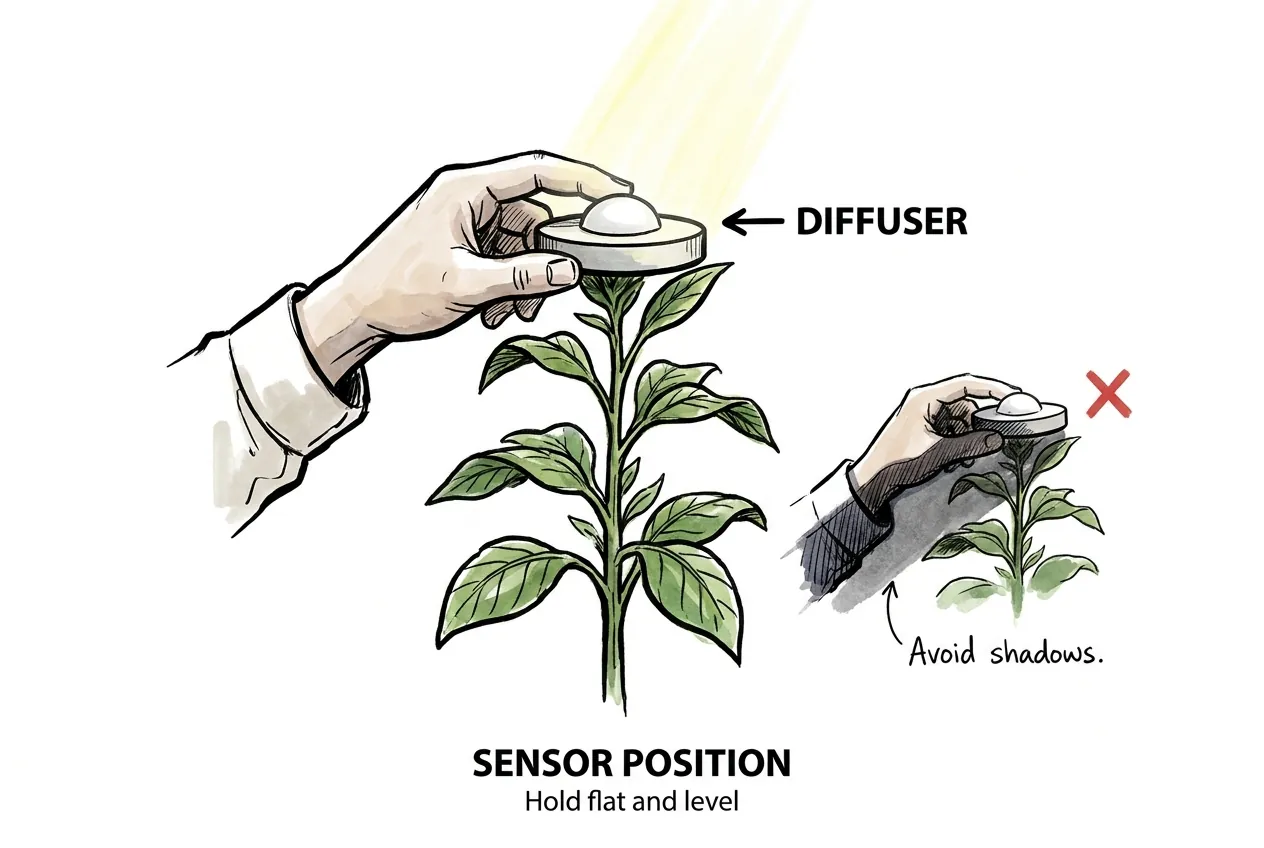
Measure at canopy height
Keep the sensing surface level with the measurement plane and parallel to the canopy. Do not aim it at each diode as though it were a camera. A cosine-corrected sensor is designed to account for light arriving at different angles while it remains horizontal.
Move your hand, head, and phone out of the light path before saving the reading. If the number changes when you step back, your body was shading the sensor.
Map the Shelf, Not Just Its Brightest Point
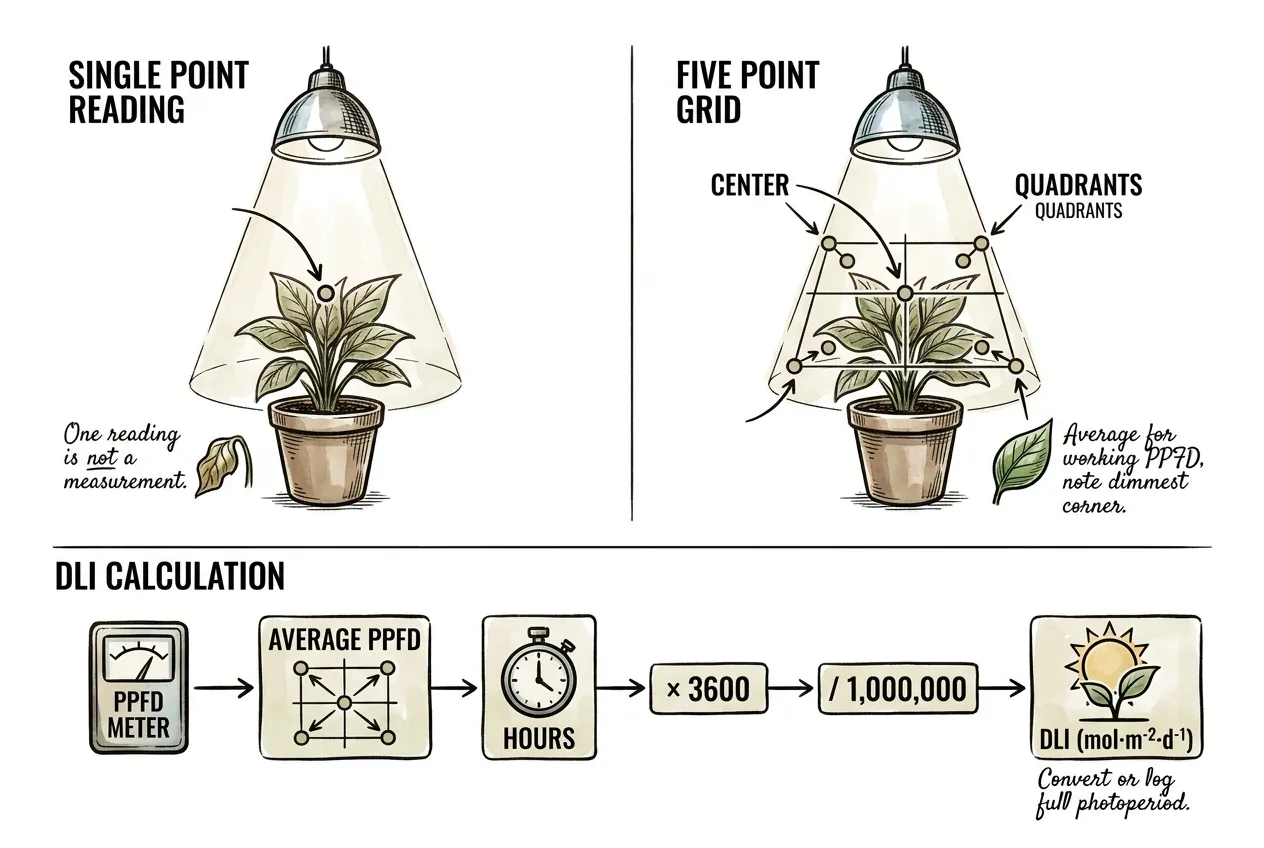
Map the shelf instead of its brightest point
Five points, center and four corners, are a useful minimum for a small rectangular shelf, not a universal rule. Add edge and intermediate points when the fixture is long, the shelf is large, lenses create hotspots, or several lamps overlap.
The minimum often matters more than the center. A high center average can hide a corner where a compact plant is slowly leaning toward the fixture. Record each location so the next map compares like with like.
A removable shelf grid gives every measurement point a fixed name and lets me compare like with like. I also mark the canopy-height reference on the support so I can recreate the sensing plane after plants grow or move. Each map includes the fixture height, dimmer setting, timer, sensor mode, and whether window light was present.
I keep the original map even when a plant is moved. That shows whether new stretching belongs to the plant, its position, or a changed fixture setting. A PPFD reading from the same named point at the recorded fixture height, dimmer setting, and ambient-light state is more useful than a higher number from a convenient bright spot.
Convert to DLI Only When the Assumption Fits
For a fixed-output electric light, use the measured PPFD at each point and the scheduled hours in the formula above. For window light or a changing program, use a logger or enough time-based measurements to integrate the day. A single midday value multiplied by daylight hours can misstate the total.
After raising output, watch the plant and the leaf or stem-surface temperature. Increase exposure gradually, especially for imported, recently shaded, or newly rooted plants. The grow-light selection guide covers fixture placement after you know what the current setup delivers.
How Do You Keep Readings Comparable Over Time?
Dust or mineral film on a diffuser changes the light reaching the detector. Clean it only as the instrument manual directs, protect it from scratches, and store the sensor with its cap or case when provided.
Do not turn a manufacturer’s drift specification into a universal recalibration schedule. The right interval depends on required accuracy, use, storage, and the maker’s current service guidance. For casual shelf mapping, periodic comparison against a stable reference may reveal a problem. For measurements used as evidence, follow the manufacturer’s recommended calibration or recertification process.
Check Conditions Before Blaming the Plant
When a result suddenly changes, check sensor height, angle, shadows, dimmer setting, daylight, diffuser cleanliness, battery warning, and measurement mode. A number without its conditions is difficult to reproduce.
Frequently Asked Questions
Is a phone PPFD app good enough?
It can be good enough to map relative differences or screen a fixed setup if readings are repeatable and the phone-and-lamp combination has been checked. It is not automatically an accurate reference meter. Near an expensive decision boundary, compare it with a calibrated quantum sensor.
Can I use a lux meter instead of a PAR meter?
Use it for relative mapping under one unchanged source. Convert lux to PPFD only when a reputable factor matches that specific light source. There is no universal conversion for every white, mixed, or adjustable LED.
Why can a plant stretch when lux looks high?
Lux alone does not diagnose the cause. The spectrum may differ from the source behind your comparison, the edge of the canopy may receive less than the measured center, or temperature, water, nutrition, season, and genetics may be affecting growth.
Do I need a DLI meter if I know PPFD?
Not for a stable electric light with a fixed timer. Calculate DLI from PPFD and hours. Logging earns its keep when daylight, clouds, dimming, or schedules change the intensity over time.
What PPFD should I use for a caudex?
There is no defensible number for all caudiciform plants. Start with species and growth stage, document the current light map, and adjust gradually while tracking new growth and heat or bleaching symptoms. Treat species-specific published data as a starting range, not a guarantee.
Should I buy a cheaper MQ-100 listing?
Usually not without more information. The MQ-100 is a retired model, and its original sensor has larger spectral limitations under some LEDs. Consider it only when the exact model, condition, calibration history, use case, and discount all make sense.
How many points should I measure?
For a small shelf, center plus four corners is a practical start. Add edges and intermediate points wherever fixture geometry or overlapping beams could create a hotspot or weak zone. Keep the same map for later comparisons.
Should the sensor point directly at the lamp?
No. Hold the sensing surface horizontal at the canopy measurement plane. Keep yourself out of the light path and let the sensor’s documented angular response account for light arriving from different directions.
Will a bigger grow light fix etiolation?
Only if insufficient usable light is actually the limiting factor. Map the canopy first. You may find that lowering the existing fixture, moving one plant out of a weak corner, extending a suitable fixed photoperiod, or correcting a non-light cause is the better solution.
Affiliate Disclosure
This article contains Amazon affiliate links. As an Amazon Associate I earn from qualifying purchases. If you use these links, the site may earn a commission at no extra cost to you. Product availability, price, and specifications can change. Check the current listing before buying.