
When to Stop Fertilizing Caudex Plants: A Climate- and Growth-Based Cutoff
How to stop fertilizing caudex plants as growth and light decline, using local cold and indoor conditions to set a cautious cutoff and recovery plan.
Rachel Torres · 2026-08-10 · 20 min read
Key Takeaways
- For summer-growing caudiciforms, end routine feeding before declining growth, light, or temperature leaves new tissue difficult to harden. Local cold or the indoor move-in date is a cautious anchor.
- Nitrogen can support continued growth, but the timing and size of any dormancy delay depend on the species and conditions. Do not treat one fertilizer application as resetting the calendar.
- Unused fertilizer salts concentrate during dry-down, so measure or leach only when the medium and drainage can handle the added water. Salt peaks just before the next irrigation.
- Cold, wet media and damaged roots increase rot risk, but no single temperature or moisture value applies to every species or container. Treat cold and wetness as a combined risk.
- If feeding ran late, stop, assess salts and moisture, then protect the plant early while monitoring the caudex and roots. Late tender growth and leftover salts raise winter stress.
Late-season fertilizer can leave a caudiciform producing tender growth or carrying soluble salts as light and temperature decline. Those conditions can raise winter stress and rot risk, but the timing is not a universal calendar date.
Set the fertilizer cutoff from growth, local cold, and the indoor environment. Check how late feeding interacts with dormancy and salts before deciding what to do if feeding continued too long.
When Should You Stop Fertilizing Caudex Plants?
Translate Cutoff Signals into a Local Plan
For summer-growing caudex plants, stop routine fertilizing before the plant is expected to slow or before you must protect it from cold and low light. A first-freeze date can provide a conservative planning anchor, but species, local microclimate, and indoor conditions may move the cutoff earlier or later.
University extensions use weeks-before-frost rules for some outdoor crops. That evidence is a planning analogy, not a validated caudex protocol. Add more margin where cold, wet media, weak light, or an early indoor move would make late growth difficult to harden.
New growth needs time to mature and acclimate before cold or low light. Feeding while the plant is still actively growing can be reasonable. The risk rises when a late flush cannot finish before protection or dormancy.
How Do You Calculate Your Own Cutoff Date?
Look up a local first-freeze estimate, then count back a conservative buffer that matches the species and your ability to move or shelter it. NOAA’s climate normals are useful for planning, but a median date is not a guarantee and does not replace a forecast.
Regional freeze windows vary widely, and some warm locations have little frost exposure. In those places, use the indoor move-in date, declining light, night temperatures, and actual growth as the stronger signals.
| Your median first freeze | Your last-feed date |
|---|---|
| Early October (illustrative local date) | Set a conservative buffer before that date |
| Mid-October (illustrative local date) | Set a conservative buffer before that date |
| Early November (illustrative local date) | Set a conservative buffer before that date |
| December or no typical freeze | Use cool-rain, light, or move-in signals |
Note
Median means half of the historical years freeze earlier than that date. Treat any weeks-before-freeze buffer as a planning aid, not as a universal safety margin.
What If Your Plants Overwinter Indoors?
Indoor overwinterers should key the cutoff to the move-in date and the light available after the move, not to frost alone. A large change in light can reduce growth and nutrient demand, but the size of that change depends on the window, lamps, and plant.
Extension guidance on houseplants is broadly consistent here. Fertilize actively growing plants, usually stop in fall, and restart when spring growth resumes.
Use the same planning logic with your actual move-in date. Allow enough time for the final flush of growth to mature before the plant enters a dimmer or cooler environment.
Why Does Late Feeding Invite Winter Rot?
See Late Feeding as a Chain of Risks
Late fertilizer can contribute to winter rot through a linked set of conditions. Continued growth, insufficient hardening, concentrated salts, and cold or wet media can reinforce one another. The strength of each link varies by species and setup, so the chain is a risk model rather than a guarantee.
What Does Nitrogen Do to a Plant Preparing for Dormancy?
Nitrogen can act as a growth signal and postpone senescence in some plants. Aspen trials reported measurable delays under high fertilization, but those results do not establish a fixed delay for caudiciforms.
In the same research, nitrate supplied directly to the xylem also delayed senescence. The useful takeaway is that nitrate can signal continued growth, not that every fertilizer application resets a caudex plant’s calendar by a fixed interval.
Dormancy is a staged program influenced by photoperiod, temperature, water, and plant condition. A late feed may prolong growth in some circumstances, but it does not automatically restart the entire program.
Why Is Unhardened Growth So Vulnerable?
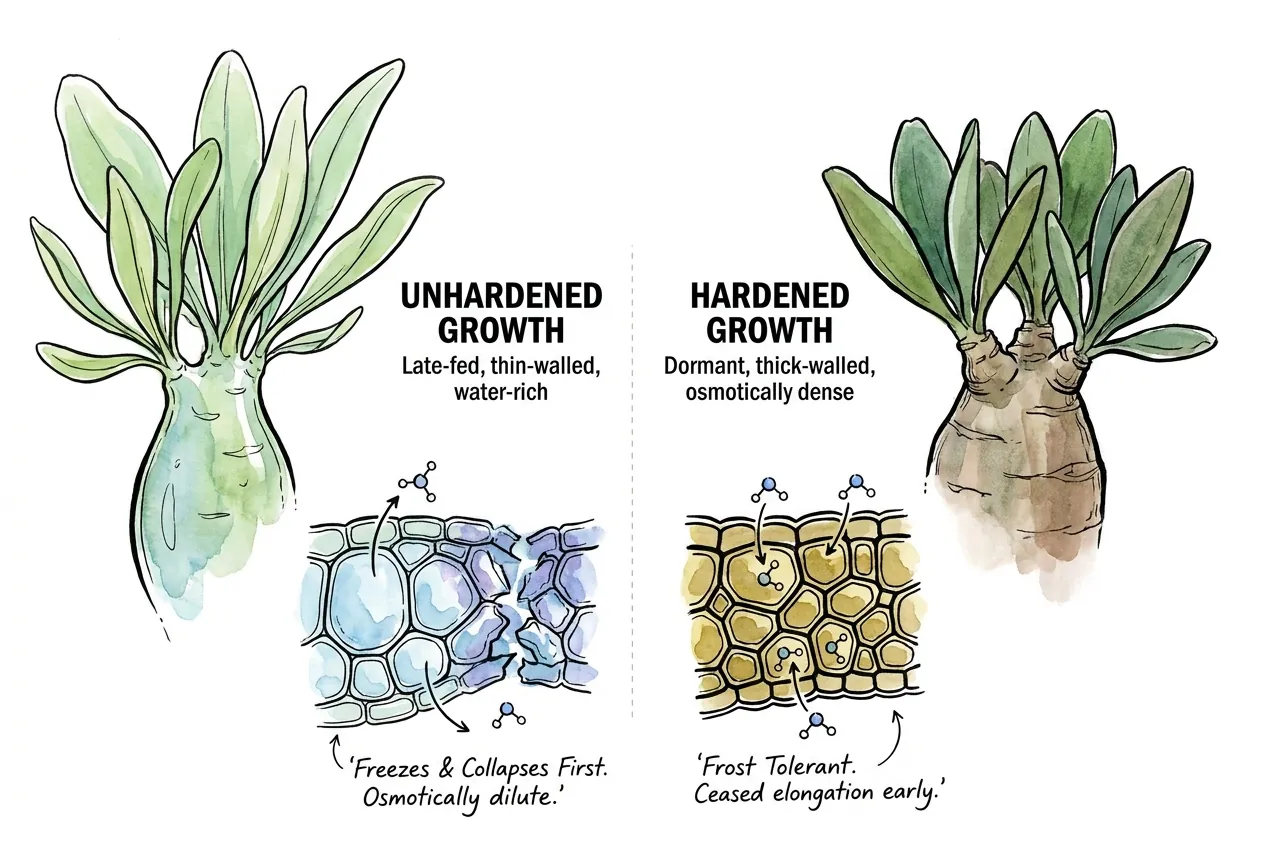
Because frost tolerance tracks how early growth stops. In a four-species pine study, high nitrogen before hardening reduced frost tolerance in the Mediterranean species. The most frost-tolerant species were the ones that ceased elongation earliest.
Late-fed tissue can differ from hardened tissue. It may be thinner-walled, more water-rich, and less acclimated, which can increase freeze injury risk.
The counterexample shows why species and growth habit matter. A three-year trial on 200 landscape trees found fall nitrogen mostly safe for dormant, determinate hardwoods. Yet crapemyrtle, a species that keeps responding to feed, tested hardy to only -20.5°C fertilized versus -31°C unfertilized.
A plant that has already entered rest may tolerate fall feeding differently from a tropical caudex that is still producing tissue. The response remains species- and condition-dependent.
How Does Leftover Fertilizer Become Root-Burning Salt?
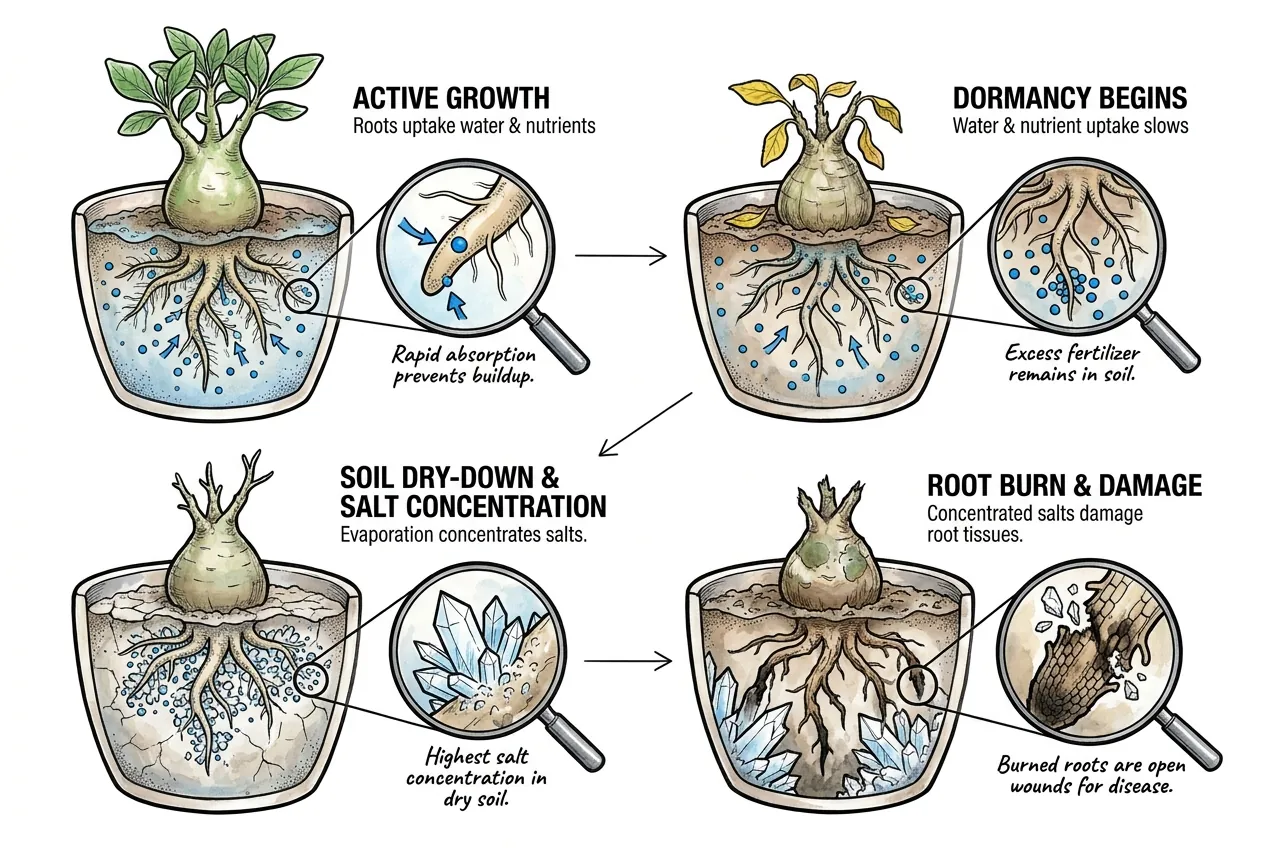
Watch salts during slow dry-down
Fertilizer contributes soluble salts, and a resting plant may remove them more slowly. Container guidance from Texas A&M gives an electrical-conductivity hazard example above 2.0 millimhos per centimeter. The reading is medium- and crop-dependent. Injury can run from leaf chlorosis to burned tips and margins, plus root damage that predisposes plants to disease.
The timing detail matters most for dormant pots. Rutgers notes the highest salt concentration occurs right before the next irrigation, because dry-down concentrates the pore solution.
A resting caudex is often watered less and may take up nutrients more slowly. If the pot dries substantially between waterings, salts can concentrate before the next irrigation, and injured root tips may be more vulnerable in persistently wet media.
What Actually Rots Your Caudex in Winter?
Phytophthora and Pythium are important causes of root and crown rot, but pathogen prevalence depends on the crop and environment. Wet media and cool conditions can favor disease. The cited temperature and moisture ranges are source-specific examples, not a universal caudex threshold.
Pythium risk increases as media stays wet, and some species remain active at lower soil temperatures. Cold can also slow root recovery, so the balance may tip toward infection when moisture persists.
Some water-mold pathogens produce zoospores that move through free water toward roots, and damaged tissue can be easier to colonize. Salt-burned root tips and cold-injured feeder roots may therefore add risk without proving that infection is present.
Rotted roots often become soft and lose their outer layers before foliage shows severe symptoms. That is why prevention includes feed timing, moisture control, and inspection rather than relying on a late fungicide drench alone.
How Do You Run the Taper From Mid-August to First Frost?
Run the Taper from Multiple Signals
A practical taper has three parts. End routine feeding by the locally chosen cutoff, address salts only if the pot and plant can safely be leached, then let watering follow dry-down and the plant’s seasonal state. The table below is an illustrative planning pattern, not a universal calendar.
| Date | Action |
|---|---|
| Before the chosen cutoff | Last routine feed, if the plant is still actively growing and the label permits |
| After the final feed, if salts are suspected | Leach with compatible low-salt water and adequate drainage. Repeat only when evidence and plant condition justify it |
| As light or temperature declines | Extend dry-down and stop feeding while growth slows |
| Before forecast cold or the indoor move | Allow the medium to approach the plant’s safe dry state, then protect it |
| During rest | Use species- and condition-appropriate watering. Do not feed a plant that is not actively growing |
What Should the Last Feed Look Like?
Do not assume a special late-season ratio is required. If a final feed is appropriate, follow the plant’s normal label-directed program and avoid stimulating growth that cannot mature. Potassium supports several stress responses, but it is not a substitute for light, temperature, or moisture control.
Research links adequate potassium with several stress responses, including changes in freezing behavior and electrolyte leakage. Those findings do not establish a universal high-potassium recipe or make a tender caudex frost tolerant.
A balanced fertilizer such as Dyna-Gro Foliage-Pro is a product option for active growth, but its label ratio is not evidence for a universal cutoff or dose. A bloom-oriented product such as Dyna-Gro Bloom may suit a specific feeding program, yet switching products solely to chase cold tolerance adds complexity and does not replace timely cessation. Follow the label and the plant’s growth state.
On the day I stop feeding, each active tip gets a fixed-side photograph with a small ruler held behind it. My note identifies the newest fully opened leaf and the next visible bud or folded leaf. No wire, thread, or tag touches tender growth.
At later checks I compare that exact tip rather than asking whether the plant still looks green. Existing leaves can remain present after extension has stopped. Before recording continued growth, I look for a longer internode, a newly unfolded leaf, or visible enlargement of the same bud.
I keep the last-feed date, product, concentrate volume, dilution, and finished solution volume delivered to that pot on its tag until active growth returns. This prevents one late-fed pot from disappearing into a collection where neighboring plants entered slowdown at different times.
How Do You Flush the Pot Before Winter?
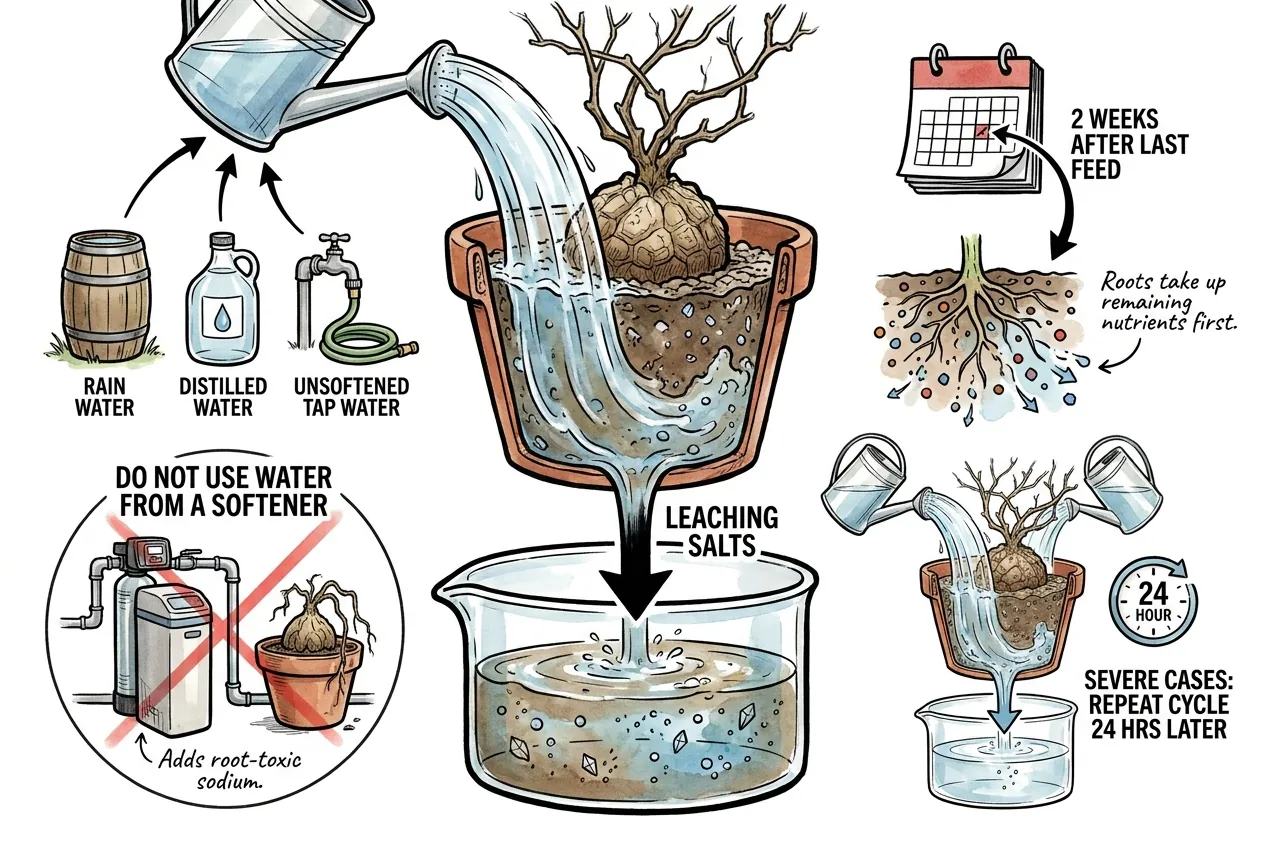
If salt buildup is supported by crust, an EC reading, or a recent heavy feed, leach slowly with compatible low-EC water and ensure the container drains freely. Extension protocols often use a container-volume reference and a repeat cycle for severe cases, but the amount must fit the pot, medium, and plant.
Schedule leaching when the plant is hydrated enough to tolerate it and the medium can dry afterward. A fixed number of days after feeding is not required.
Warning
Avoid water whose quality would add more problematic salts. Some softeners exchange calcium and magnesium for sodium. Use a source compatible with the plant, medium, and local water analysis rather than assuming one source is best everywhere.
How Should Watering Change After the Cutoff?
Watering should follow dry-down and growth after feeding stops. While the plant is still active, do not withhold water solely because the calendar changed. As light and temperature decline, extend the interval and avoid keeping the root zone wet.
Some Adenium guidance describes a prolonged dry winter rest, but the length and leaf response vary with species, warmth, light, and plant condition. Use that guidance as a reference, not as a fixed schedule for every caudex.
Remember
Plain water does not supply nitrogen, but moisture and dry-down still interact with dormancy, root health, and temperature. Aim for a safe dry cycle appropriate to the species and setup rather than a universal number of dry weeks.
Which Plants Follow Different Rules?
The earlier cutoff described above is a summer-grower planning example. Caudiciforms follow different seasonal calendars, and some species grow during the cooler part of the year.
| Group | Genera (examples) | Feeding window | Rest period |
|---|---|---|---|
| Summer growers | Adenium, Pachypodium, Fockea, Operculicarya, Cyphostemma, most caudex Euphorbia | Warm, bright active growth. End before local decline | Cool or dim rest varies by species |
| Winter growers | Tylecodon, many Othonna, winter Pelargonium, Dioscorea elephantipes (erratic) | Cool-season active growth, dilute and label-directed | Warm-season rest varies by species |
Which Caudex Plants Are Summer Growers?
Use species-specific seasonal cues
Adenium is a useful summer-grower example. Extension guidance feeds during active warm-season growth, then reduces water and avoids freezing during rest. The exact transition depends on light, temperature, and plant response.
Pachypodium, Fockea, Operculicarya, and Cyphostemma can follow a similar broad pattern, but cultivar, climate, and indoor conditions matter. Leaf drop is not proof that every plant should receive the same fertilizer or water schedule.
For these genera, use the local cutoff calculation only as a starting point. Keep the plant above its species-appropriate chilling range and protect it from freezing. Do not treat a single temperature as a universal rule.
What About Winter Growers Like Tylecodon and Othonna?
Winter growers may invert the broad seasonal pattern, but not every date. SANBI’s PlantZAfrica describes Tylecodon paniculatus as summer deciduous, with leaves present through much of winter and a summer rest.
That cultivation guidance uses more frequent winter watering than summer watering. The useful principle is to align feed and water with active leaf growth, not to copy a weekly or monthly interval into another climate.
For Tylecodon, many Othonna, and winter-growing Pelargonium species, stop feeding as their active season ends and warm-season rest approaches. Feeding a winter grower while it is dormant carries the same salt and moisture risks in reverse.
Do Grow-Light Collections Need a Cutoff?
Only if growth actually stops. A caudex under strong LEDs at warm room temperature may receive enough light and warmth to continue growing, while another collection may still enter rest.
The test is visible, sustained growth rather than the calendar. If the plant is demonstrably pushing new leaves under lights, a cautious, label-directed feed may be appropriate. Monitor growth and salt accumulation instead of copying a fixed strength or interval.
A dim windowsill is a different scenario. Growth may slow sharply even while the room stays warm. Let measured light and plant response determine whether feeding should pause.
What If You Already Fed Too Late?
If feeding continued too long, stop further fertilizer, assess the medium and plant, and protect earlier when forecast cold or low light would prevent hardening. First, measure what you are dealing with rather than assuming the pot is salt-loaded.
How Do You Check How Much Salt Is in the Pot?
Use the PourThru test that nurseries use, with a basic EC meter. It reads the actual solution your roots sit in, without disturbing the plant.
Follow a validated PourThru or equivalent EC procedure that matches the container size and medium, allowing adequate drainage before collecting leachate. Published protocols use different volumes for different pots.
Measure salt accumulation before leaching
Read the leachate with a calibrated EC meter and compare it with the meter, medium, and crop guidance. Do not treat a single mS/cm value as a universal caudex threshold. A high reading or visible salt injury supports corrective leaching, while a low reading does not prove roots are healthy.
A meter like the HM Digital COM-100 reads EC directly in mS/cm with automatic temperature compensation. Check its current range and calibration guidance against the reading you need.
Honest tradeoff
The meter costs more than bare TDS pens, though any basic EC pen also works for this reading. A grower with three pots can skip the meter entirely by flushing on schedule and watching for crust.
What Is the Recovery Protocol After a September Feed?
If testing or visible crust supports a salt problem, leach while the plant can tolerate the added water and allow the pot to drain and dry. A repeat cycle may be appropriate for a severe load, but use the cited extension protocol and the medium’s drainage rather than a fixed calendar.
Then adjust the protection plan for a plant that may harden late. Research in other plants shows that nitrogen can delay shutdown, but it does not quantify the delay for a given caudex. Move the plant indoors or under protection ahead of a cold-wet spell rather than relying on a median date.
Indoors, provide the strongest suitable light and avoid conditions that keep the medium wet. Do not feed again until active growth and the product label support it. Allow leaf drop or continued growth to follow the plant’s actual response.
How Do You Spot Trouble Through the Winter?
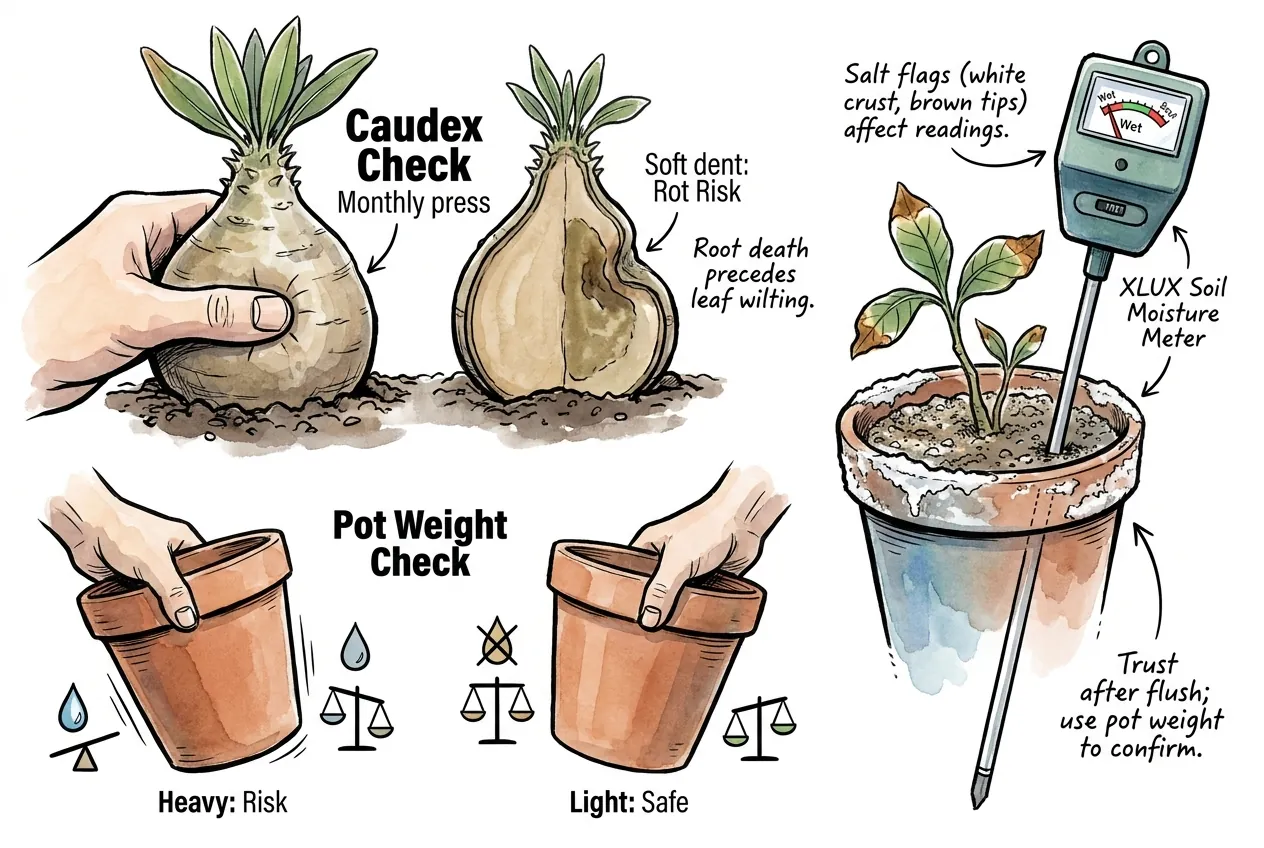
Inspect the plant and pot periodically, because foliage can lag behind root symptoms. Root damage may develop before severe yellowing or wilting, so combine the caudex feel, pot weight, moisture at depth, and any salt crust.
Press gently at and just below the soil line, without injuring firm tissue. Lift the pot when practical and compare its weight over time rather than relying on one reading.
Look for salt crust on the rim or surface and browning tips on retained foliage. Test EC again when the plant is next safely watered, and leach before feeding only if the reading and plant condition support it.
A resistance probe such as the XLUX moisture meter adds a deep-pot reading through its roughly 8-inch shaft. It can help compare a gritty mix that looks dry on top with conditions deeper in the root zone.
Honest limit
Resistance meters can read salty media as wetter than reality. Trust the probe more after the flush, and use pot weight as the tiebreaker.
A confirmed soft or collapsing area warrants isolation and a root or caudex inspection. If surgery is needed, remove compromised tissue with clean tools, follow appropriate wound care, and repot into a suitable fresh medium. The urgency depends on the extent of damage and the species.
Wear nitrile gloves and eye protection for the cutting, because Adenium sap is toxic and caudex Euphorbia latex is caustic. Keep the sap off your skin and away from pets.
Keep the cutoff conditional
The cutoff is a planning decision. Align the end of routine feeding with declining growth, local cold, and the indoor environment. Nitrogen can delay dormancy in some plants, while cold and wetness increase the cost of late growth. Winter risk is shaped by the interaction of feed timing, light, temperature, moisture, and root health, so use those signals to keep the resting plant stable.
Affiliate Disclosure
This article contains Amazon affiliate links. As an Amazon Associate I earn from qualifying purchases. If you use these links, the site may earn a commission at no extra cost to you. Product availability, price, and specifications can change. Check the current listing before buying.