
Caudex Soil Temperature and Autumn Watering Checks
Measure overnight root-zone temperature alongside pot dry-down, protect cold-sensitive plants, and set a watering review point without a universal 15°C cutoff.
Nathan Brooks · 2026-08-23 · Updated 2026-10-24 · 8 min read
Key Takeaways
- Read both root-zone and canopy-air temperature. Warm soil does not protect leaves from a cold night.
- A 15°C response measured in rice is not a universal watering stop for caudex plants.
- Use the coolest overnight reading and the pot's actual drying pattern together.
- A warm afternoon, a dry surface, or a single low reading does not establish dormancy or water demand.
- Protect tender plants before a damaging cold spell and distinguish resting summer growers from actively growing winter growers.
Before an autumn watering, check whether the plant is growing, whether moisture remains around the roots, and whether the coming nights are suitable for that species. Soil temperature helps explain a change in drying speed. It cannot answer all three questions by itself.
Simple check before the next watering
- Check the plant's growth stage. New leaves or extending shoots support active growth. Leaf loss can reflect rest, stress, or damage, so compare it with the plant's normal seasonal pattern.
- Lift the pot and check deeper moisture through a known safe path beside the root ball. Do not repeatedly stab into a buried caudex. A dry surface over damp lower mix is a reason to wait.
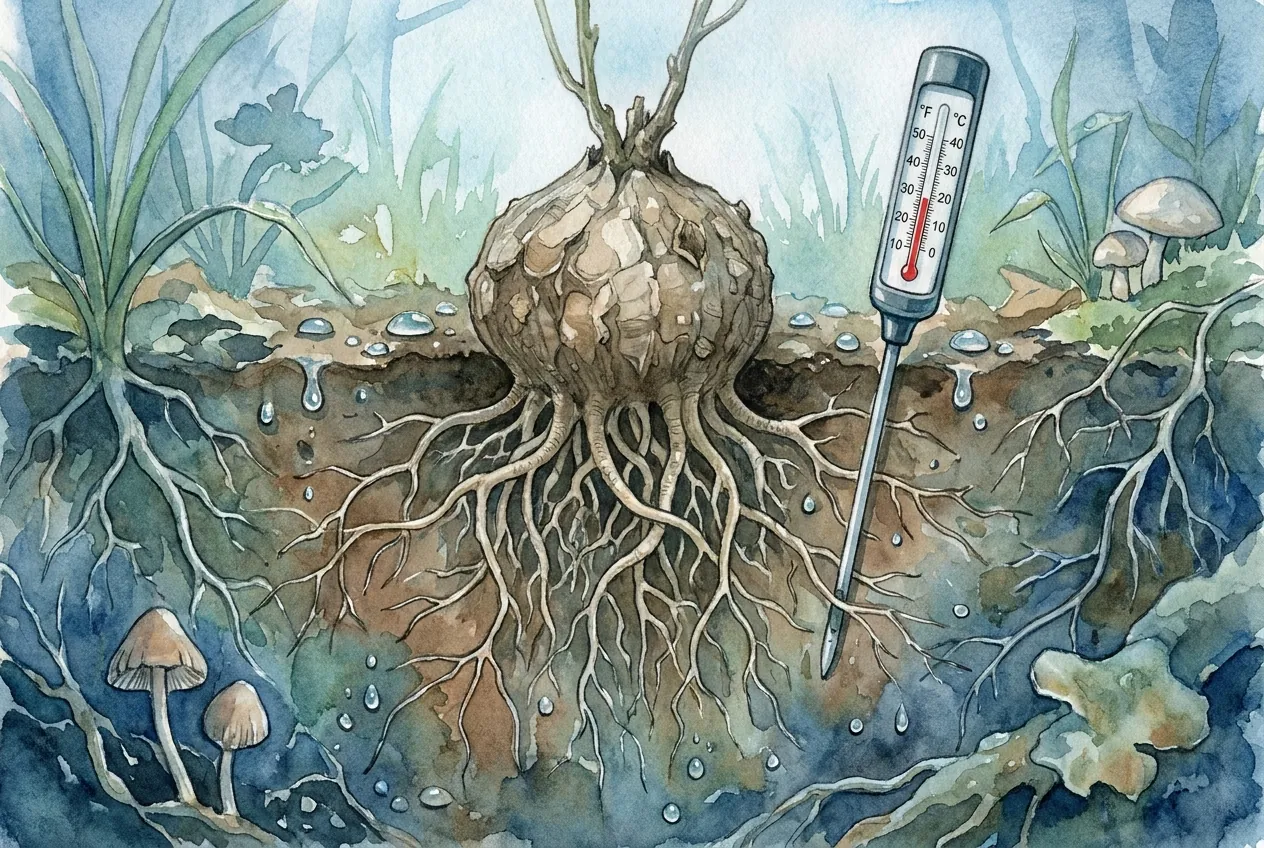
- Read a substrate probe near feeder-root depth and a separate air thermometer near the canopy. Keep the air sensor shaded. Use the plant's cold-protection guidance for the overnight forecast as well as the readings.
- If a healthy, active plant is due for water and has suitable conditions, water and let it drain freely. If it is still damp, wait. If damaging cold is forecast, move it to a suitable protected location before adding water.
Dry soil reduces one risk, but it does not make a cold-sensitive plant frost-proof. NC State advises bringing Adenium obesum indoors when outside temperatures reach 55°F, about 13°C, and reducing water during dormancy. That is a protection cue for the plant, not permission to leave its canopy cold whenever the root probe reads warmer. See NC State's species guidance.
Why the pot reading can disagree with the room
A container receives heat from sun, surrounding air, and the surface it stands on. It also loses heat through evaporation and its walls. Size, moisture, material, and exposure change the timing, so one pot can be warmer than the air at one hour and cooler later. A small pot cannot be assumed to retain summer warmth for days after a cold front.
NC State reports substantial daily temperature swings in outdoor containers and highlights the effects of exposure and container choice. The useful implication is to measure representative pots, not infer a week of stored warmth from field-soil temperature curves. See the container-growing handbook.
Choose a small exposed pot and a larger sheltered pot for comparison if your collection varies. Keep their records separate. The larger one may dry more slowly even if its overnight temperature is similar. A warm sun-facing wall also does not establish the temperature at the center of the root ball.
What the 15°C research result does and does not mean
A controlled rice study found a marked change in the temperature sensitivity of root hydraulic conductivity around 15°C. The researchers proposed changes in aquaporin activity as an explanation. They did not test Adenium, Fockea, Pachypodium, or Dioscorea, and did not establish that all roots stop taking up water below 15°C. See Murai-Hatano and colleagues' rice experiment.
Use that result as a reason to pay attention to root temperature. Do not turn it into a rule to keep summer watering above 15°C or give token drinks below it. Light, leaf area, growth stage, substrate, and species can change water demand while the thermometer stays at the same number.
Measured check linking cold nights to slower drying
Use this for an established summer-growing plant that is slowing in autumn. It requires a substrate-rated minimum/maximum probe or logger and a scale that can resolve the water-related weight change. Seedlings, newly rooted cuttings, recently repotted plants, and plants with suspected rot need their own care decisions rather than this baseline comparison.
Make the temperature readings comparable
- Use a safe existing probe path into the growing medium near the fine roots, away from the wall and swollen storage organ. In a small pot, about 5 cm below the surface can be a starting position if that depth actually lies within the root ball. Record the depth rather than forcing every pot to use 5 cm.
- Leave a substrate-rated probe in place without watering solely to improve sensor contact. Reset minimum/maximum memory at the same time each morning, or log every 15 minutes. Fifteen minutes is a practical interval for observing overnight changes, not a guarantee of catching every brief extreme.
- Record a separate shaded canopy-air minimum, location, and any heat-mat use. Check three consecutive nights as an initial review window. Keep the lowest value as well as the trend, because an average can hide a damaging cold night.
- With only a handheld probe, use the same depth and time each morning, waiting for the manufacturer's stabilization criterion. Call it a morning spot reading. It may miss the true overnight minimum, so use the forecast and a separate minimum air thermometer for protection decisions.
Before relying on a one-degree difference, compare both temperature sensors side by side in shaded room air after they stabilize. If their disagreement exceeds their stated combined tolerance, investigate the sensors. This checks consistency, not calibration of the buried reading. Do not offset an unexplained difference and assume it is solved.
When moving a min-max probe to another pot, reset its memory only after it stabilizes at the new depth. Write the installation time beside the first minimum. A low retained from the previous location can otherwise be mistaken for the new pot’s overnight temperature.
Use the next complete night for comparison and keep earlier partial-night records labeled as partial. For example, a probe moved at 6 a.m. cannot establish what the new pot experienced at 3 a.m.. This matters most when a warmer shelf is being checked after a cold night.
Use the water gain, not a percentage of the whole pot
At the plant's normal appropriate dry stage, confirmed by deeper moisture inspection, weigh the same pot without its saucer and record D. After the next genuinely needed active-growth watering, let it drain freely for 60 minutes, wipe the exterior, and record W. Sixty minutes standardizes the comparison and reduces the effect of immediate drainage. If it is still dripping, wait longer and record that interval for future measurements.
Weigh at the same time daily with labels and supports unchanged. Re-seat the pot for three readings and use the middle value. If the spread is more than 5% of W minus D, fix the weighing setup before using a 10% review band. That practical noise check helps prevent measurement variation from overwhelming the decision margin.
Set an initial near-dry review point at D + 0.10 × (W − D). For D of 1,100 g and W of 1,300 g, review at 1,120 g. The extra 20 g is 10% of the measured 200 g gain, not 10% of the entire 1,300 g pot. This is an operational reminder to inspect moisture and growth, not proof of a particular water content or an automatic watering trigger.
Do not drench a resting plant to create W. If no active-growth baseline exists, use temperature, deeper moisture, and growth observations until calibration becomes appropriate. Rebuild the baseline after repotting, major leaf loss, pruning, or a change in watering amount. Weight loss combines evaporation and transpiration and cannot tell you whether roots are healthy.
The underlying lift-and-deep-moisture approach follows Maryland Extension's watering guidance. The formula and repeatability checks above are a practical recording method for one pot. They are not a published caudex moisture threshold.
Set a review rule from the plant's own change
Record how many days the pot took to return to its review point during two healthy active-growth cycles. If the next comparable cycle takes at least twice as long and nights are cooler, stop following the old calendar and inspect conditions before the next pour. For example, a pot previously reviewed on day 5 should be reassessed if it remains above that point on day 10. Doubling is a deliberately obvious change flag, not a rot diagnosis.
For an established Adenium approaching rest, three nights with root-zone lows around or below 16°C can serve as an early prompt to review drying and growth. This is a conservative working reminder before colder conditions, not a demonstrated physiological cutoff. Follow a higher protection minimum when required by the particular plant, and move immediately if the forecast threatens its safe range. Do not wait three nights to confirm damaging cold.
| Combined observation | Action | Reason |
|---|---|---|
| Active growth, usual dry stage reached, suitable nights ahead | Water as needed and allow free drainage | Temperature alone need not cancel active-growth care |
| Cooler nights, heavy pot, damp lower mix | Wait and review drainage, light, and location | The previous watering has not dried sufficiently |
| Firm resting summer grower with no new growth | Withhold routine calendar watering and monitor condition | A warm afternoon does not establish renewed demand |
| Cold-sensitive plant facing a damaging overnight forecast | Move to suitable protection now | Dryness cannot prevent all chilling or freezing injury |
| Active winter grower with fresh growth and drying mix | Follow its active-season requirements | A summer-grower cutoff can cause avoidable drought |
Keep cold injury, waterlogging, and infection separate
Persistent waterlogging can restrict oxygen and damage roots. Root pathogens can also attack living roots, and they do not all favor the same temperature. UC IPM describes both cool-active and warm-active Pythium species. Warming a wet pot is therefore not proof that infection risk has disappeared. See UC IPM's Pythium guidance.
Watering early in the day makes drainage easier to observe but cannot guarantee the lower root ball will be dry by night. Empty standing water and check the actual dry-down. If a caudex develops a spreading soft area, dark wet tissue, or an unusual smell, stop the routine comparison and assess the plant promptly. Neither pot weight nor temperature identifies the cause on its own.
Use growth to distinguish the winter growers
Dioscorea elephantipes normally grows during the cooler season in its native habitat and rests during the hot dry season. Local cultivated timing can vary. Fresh vine and leaf growth should prompt an active-growth assessment, not an automatic drought treatment at a summer-grower's temperature reminder. See SANBI's species account.
Keep a species and growth-stage label beside each pot's measurements. For a mixed collection, the Fockea and Dioscorea winter-watering comparison helps separate those decisions. Use the dormancy measurement routine for recording tools and consistent weighing.