
Fockea Edulis Flowers but No Pods? Check the Pair and Pollen Route
Track flowering overlap, keep honest parent labels, avoid the wrong pollination technique, and catch Fockea seed without forcing a green pod open.
Rachel Torres · 2026-08-28 · Updated 2026-10-24 · 6 min read
Key Takeaways
- No pods does not identify a male plant. Keep an unknown plant unsexed until there is reliable evidence.
- Use distinct plants with overlapping open flowers and, where possible, documented successful breeding roles.
- Fockea has an unusual pollen pathway. A generic milkweed guide-rail technique is not a verified shortcut.
- Tag the flower cluster, count attempts, and record developing pods separately from mature seeds.
- Fit a loose mesh catcher while a pod is still closed. Let it split naturally before collecting.
A flowering Fockea edulis without pods needs a check of its breeding partner, flowering overlap, and pollen transfer before a change in fertilizer. A second pot helps only if it supplies a suitable partner at the right time. Two cuttings from one parent still represent the same clone.
Simple check for a pair that can actually meet
Give each plant a permanent label such as F1 and F2. Record whether it was raised from seed or propagated from another plant, and whether it has previously carried a mature pod or supplied pollen in a documented successful cross. Keep a photograph of the original plant label with that record.
- Check both plants once each morning during flowering. Record open flowers, unopened buds, and fading flowers separately. Buds on one plant and spent flowers on the other do not count as overlap.
- When both have open flowers, place their pots beside each other in the same suitable growing conditions, with flowers near one another but vines on separate supports. This makes the pairing easy to observe and keeps later pods traceable to the correct plant.
- If using outdoor insect visits, retain the plants' accustomed light exposure and suitable temperatures. Do not put an indoor plant straight into hot sun just to attract pollinators.
- If the flowering dates never overlap, look for a documented flowering partner that matches your plant's season. Do not increase water or heat solely to force two plants onto the same date.
Use successful breeding history to choose a partner, rather than buying several unsexed plants on an assumed 50–50 sex ratio. A grower who can identify the pod parent, pollen source, and flowering dates provides more useful information than a photograph labeled male or female.
What a flower or pod can establish
A mature seed-bearing pod documents that plant's fruit-bearing role. A podless season does not establish a pollen-bearing role, because failed transfer, lack of overlap, and fruit abortion can also leave no pods. An open-pollinated pod does not identify the pollen parent.
| Observation | Useful label | Limit |
|---|---|---|
| Mature pod with seeds on a tagged plant | Fruit-bearing plant, with date and photo | Pollen parent is unknown unless the cross was controlled |
| Pollen used in a documented cross that produced seeds | Recorded pollen donor | Open insect access makes parentage uncertain |
| Flowers but no pods | Breeding role unconfirmed | Do not convert absence of fruit into a male label |
| Different flower color, size, or shape | Photographed flower variation | Use an expert species-specific key before assigning sex |
For a useful photo record, photograph three newly opened flowers on different days, each with the plant label and a millimeter scale beside the flower. Three is a practical comparison set that reduces reliance on one damaged flower, not a diagnostic sample size. Keep the same angle and magnification. A 10× loupe helps document the flower but does not make hidden anatomy easy to interpret.
The pollen pathway is the easily missed detail
Fockea pollen is grouped into pollinia. Microscopy shows two pollinia attached to a small carrier in each pollinarium, with structural differences from many familiar milkweeds. A brush touching the outer flower does not demonstrate that pollen reached a receptive surface. See the Fockea pollinium study.
Bruyns and Klak's systematic study found germinating pollinia at the base of narrow channels leading toward the nectary openings. They reported that the rudimentary guide rails apparently help pollen removal but do not serve the usual insertion-and-holding role seen in other asclepiads. This is a reason to avoid pushing a pollinium into any visible slit or copying a swamp-milkweed procedure. The evidence describes floral mechanics, not a tested home hand-pollination recipe. See the Fockea revision, page 545.
If you cannot distinguish the relevant structures under magnification, leave the live flower intact and ask an experienced Fockea breeder to demonstrate on a spare flower. Do not use insertion depth, petal damage, or next-morning swelling as proof of success. Record an uncertain attempt as uncertain.
Measured check for flowering overlap and fruit retention
Use this when two plants flower together but still produce no mature seeds. The aim is to locate the failure between flowering, transfer, pod development, and ripening without changing several growing conditions at once.
- Keep a daily row for each plant with its ID, number of open flowers, and any observed insect visits. A day with open flowers on both plants is an overlap day. Seven consecutive daily checks are a convenient first review window, not a minimum biological requirement for pollination.
- If a demonstrated hand method is available, label up to five newly opened recipient flowers and record donor ID and date for each attempt. Leave up to five similar flowers on the same plant untouched for comparison. Use all available flowers if fewer exist and record the actual counts.
- Keep pot location, watering, and light unchanged unless the plant needs corrective care. Note any change. If insects can reach either group, call the comparison open-access because it cannot prove which pollen produced a pod.
- Photograph tagged flower bases beside a ruler every seven days while retained. Record a visible enlarging pod, a dropped flower, or an unresolved result. Seven days keeps the routine manageable without repeatedly handling delicate flowers.
- Continue the record through pod ripening. Count mature pods and seeds separately. Stop handling a flower if it tears, leaks sap, or wilts after manipulation, and record that damage instead of calling it failed fertilization.
For example, two growing pods from five tagged attempts are a provisional pod-set result of 2/5. If only one reaches maturity, the mature-pod result is 1/5. Neither number is a germination rate. With such a small sample, use the result to decide what to repeat next season, not to announce a reliable success percentage.
Keep each flowering date together
Record flowers attempted on the same day as one dated group. A flower still attached without a visible pod remains unresolved, while a dropped flower is a recorded loss. Do not count unresolved younger flowers as failures beside older flowers already carrying pods.
At each weekly review, keep the original attempt count and update the number in each state. For five attempts, a useful entry is one growing pod, two dropped flowers, and two unresolved. When the last two resolve, the record shows whether transfer or later retention needs attention.
If there were no overlap days, solve timing first. If flowers overlapped but transfer was unconfirmed, improve access or technique before changing nutrition. If pods began and then shriveled, review plant stress and physical damage. That sequence prevents a watering change from obscuring a pollination problem.
Catch the seeds without testing the pod by force
Once a developing pod can be covered without bending it, fit a light, breathable mesh sleeve with expansion room. Support the bag's weight from the plant support and keep the closure from constricting the stalk. Inspect it daily while checking the plant, and after rain or watering that wets the sleeve.
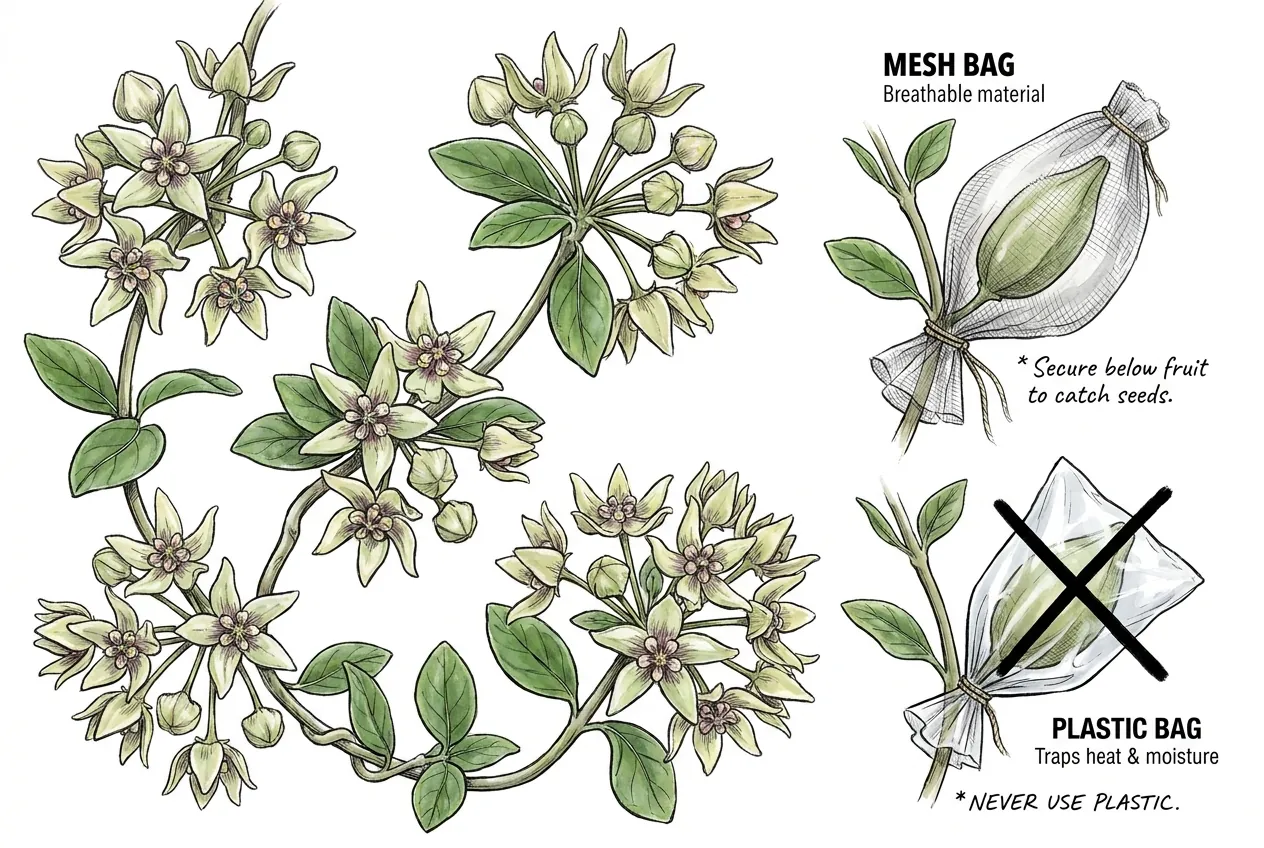
Check the seam, mesh, and closure for escape gaps. Replace a wet or clinging sleeve with a dry one over a tray. If the pod has begun splitting, enclose the entire existing sleeve in a larger catcher before moving it. Do not squeeze a green pod until it opens or use a milkweed pressure test as a Fockea maturity test.
Let natural opening release the seeds into the bag, then collect over a clean tray indoors away from fans. Leave another closed pod attached if it shares the same stalk. The Adenium seed-catcher checks are useful for bag fit and handling, but its ripening calendar does not transfer to Fockea.
Keep seeds from each pod in a separate labeled paper envelope while they finish surface drying. For a small sowing comparison, count ten seeds if available, record the date and growing conditions, and record emergence as a count out of ten. Keep untested seeds labeled untested. Mature appearance and a full pod do not guarantee viable seedlings.