
Caudex Seedlings First Winter Dormancy: Skip or Rest?
Choose first-winter care by species, current growth, and a verified warm shelf. Use size as a monitoring cue, with repeatable light, moisture, and growth checks.
Maya Ellison · 2026-08-30 · Updated 2026-10-24 · 10 min read
Key Takeaways
- Small seedlings have less reserve, but no universal diameter decides when dormancy is safe.
- A 2 cm marker is a monitoring rule, not permission to force growth or impose drought.
- Verify light and overnight temperature before attempting continued winter growth.
- Water by the actual depth and drying of the seedling pot, not a fixed top inch.
- Track new leaves and repeatable size readings, then reduce watering if growth slows.
An actively growing Adenium seedling may continue through its first winter if light and warmth remain suitable. A species with a strong rest cycle needs a different plan. Size helps judge how closely to monitor reserves, but does not override the plant’s season.
Why seedlings need closer checks
Small storage organs contain less water than large ones and usually expose more surface relative to their volume. That makes a long, unobserved dry rest a poor default. It does not prove that every first-year caudex must be forced to grow.
Dormancy varies by species
Quiescence lifts when external limitations improve, while endodormancy can persist despite favorable conditions. A grower cannot distinguish these from leaf loss alone. Adenium taxa and other caudex genera differ, so check the named species and its actual response.
Small reserves need closer observation
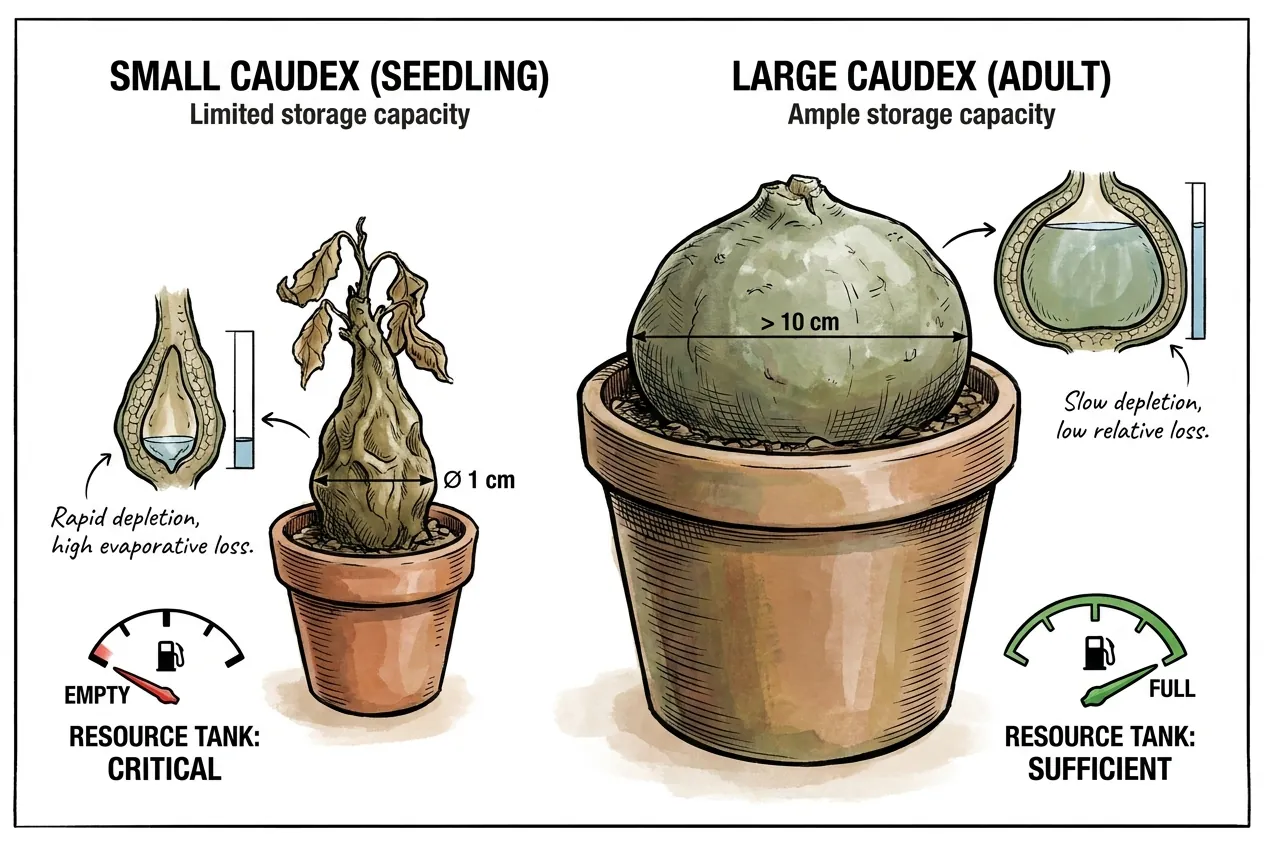
Research on stressed temperate-tree seedlings and the geometry of succulent stems explains why reserve size matters. Neither establishes how long an Adenium seedling can rest safely or a minimum diameter for survival. A small pot also changes temperature and moisture quickly, which makes observation more useful than a rigid seasonal schedule.
Use size as a monitoring cue
Simple check with a size and growth tag
Record species, sowing date if known, diameter at a fixed point just above the mix, and whether new leaves are expanding. Use a ruler photograph if calipers would press soft tissue. Mark the measuring height on the pot tag, not by scratching the plant.
Below 2 cm, check moisture and reserve loss at least twice weekly through a seasonal change. Larger established seedlings still get a weekly check, and all actively growing trays need watering checks as often as their drying requires. The 2 cm marker is a convenient attention threshold because smaller bodies have less reserve. It is not a proven safe-rest diameter.
If the plant is extending and suitable warmth and light are available, continue its growth-based care. If it sheds leaves despite suitable conditions, first check pests and roots, then support its actual resting state rather than adding heat or water to force it awake.
Route by Species Before You Route by Size
Winter growers and summer growers need separate plans. Within Adenium, Dimmitt’s cultivation observations describe differing rest tendencies. These observations are useful, but do not guarantee that every hybrid or seedling follows the same schedule.
| Species group | Seasonal program | First-winter call for a small seedling |
|---|---|---|
| Adenium obesum, A. swazicum | Often able to continue in suitable warmth and light | Support growth while new leaves continue |
| Adenium arabicum, A. somalense | Rest tendency varies by taxon and plant | Follow observed growth and reserves |
| Pachypodium (Madagascar summer species) | Summer grower | Check the species before continuing winter growth |
| Operculicarya, Fockea | Summer grower, often semi-evergreen indoors | Support active plants and reduce water if growth slows |
| Cyphostemma | Summer grower, strong internal leaf-drop clock | Do not force. Idle when it defoliates |
| Dioscorea elephantipes | Winter grower | Water according to active growth and drying |
| Tylecodon, Othonna | Winter growers | Same inversion. Winter is the growing season |
Dioscorea elephantipes often grows through winter and spring. A seedling actively expanding leaves then should not be put on an Adenium dry-rest schedule. Confirm its growth rather than making the month the deciding factor.
What Skipping Actually Requires
Declining dormancy is a commitment to three conditions held all winter. Light that resembles a growing season, warmth that never dips into shutdown territory, and water matched to a plant that is actually growing.
Give fourteen hours of light with real intensity
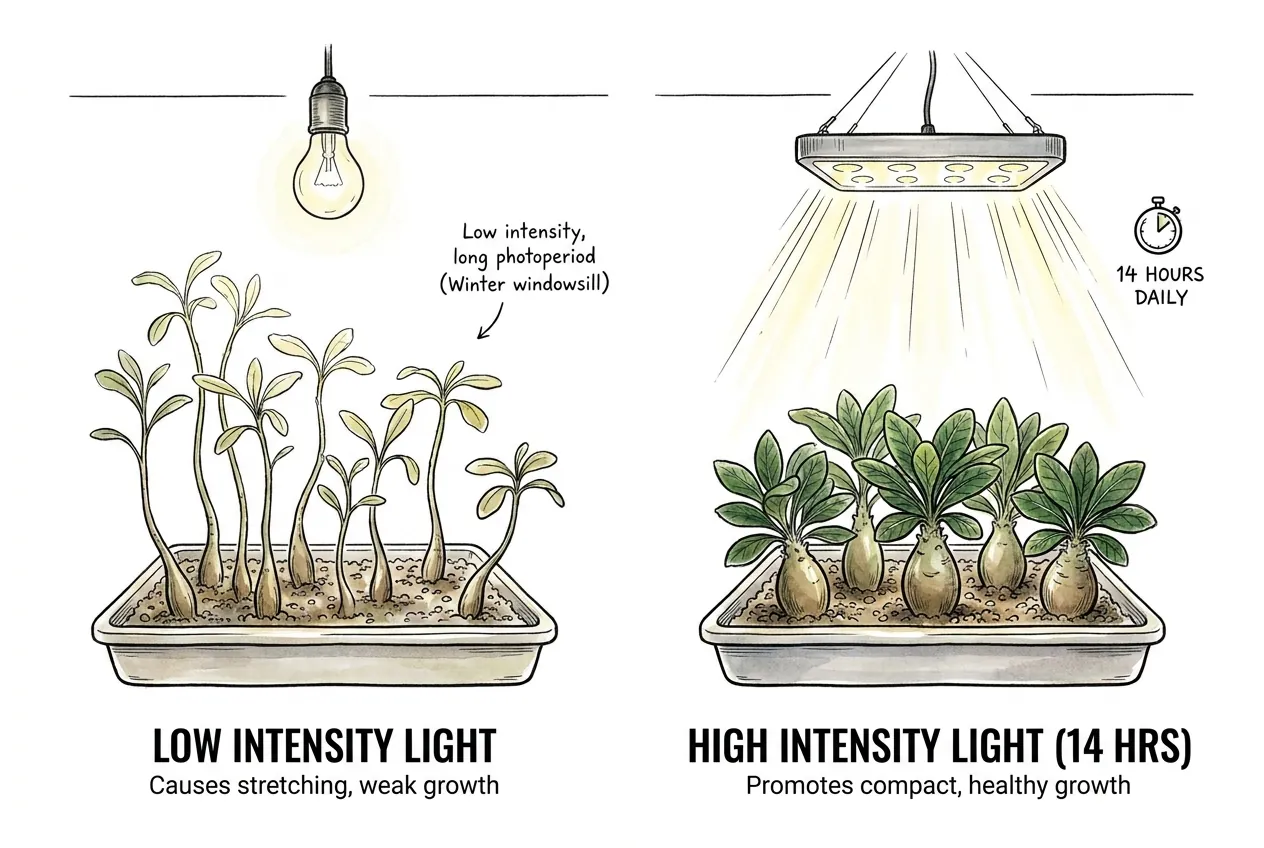
Use a 14-hour timer as an initial schedule for an actively growing summer seedling, within Iowa State’s supplemental-light guidance. Duration alone cannot guarantee enough light. Keep lamp height and output within the fixture instructions, and assess new growth each week.
If using a PAR meter, a trial of 150–200 µmol/m²/s for 14 hours supplies about 7.6–10.1 mol/m²/day from the lamp. This is a modest acclimation starting point, not a proven optimum for all caudex seedlings. Change one setting at a time if new growth stretches, and step back if bleaching develops.
Measure the light at seedling height. The guide to grow lights for caudex plants explains fixture selection and light measurement.
Verify the overnight minimum at shelf level
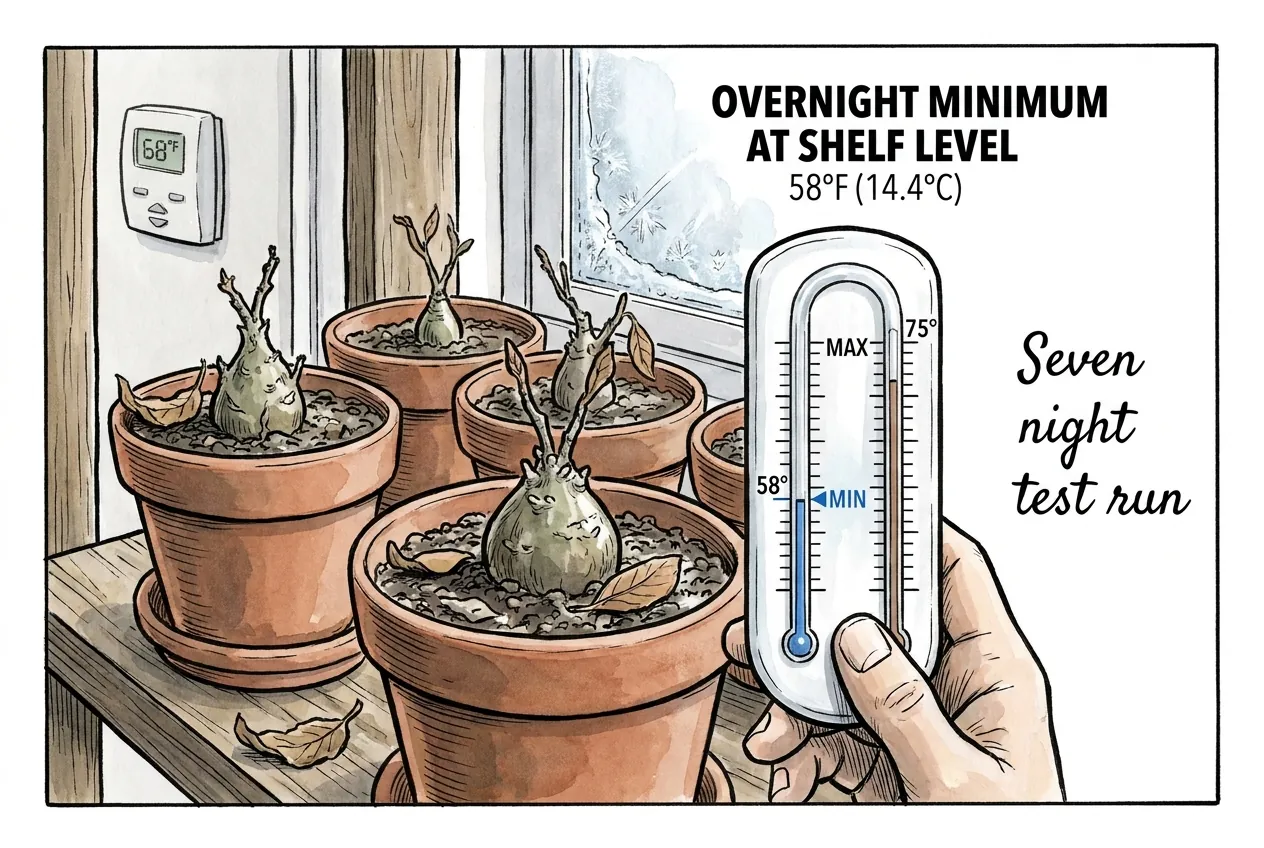
The number that ends grow-throughs is the overnight minimum at the shelf, not the thermostat reading.
A rack near a window can run well below the room while you sleep.
For Adenium seedlings in their first six months, specialist guidance uses nights no cooler than 65°F, about 18°C. A trial minimum of 20°C at canopy height adds about 2°C of working margin. This is a minimum check for those young Adenium, not a complete growing temperature prescription or a target for winter-growing species. Maintain suitable daytime warmth too.
Test the planned shelf for seven nights with a min-max meter and check root-zone temperature separately. Read and reset the meter each morning. If the shelf drops below the planned minimum, move the tray to a suitable location or correct the heat before continuing the growth routine. A failed shelf test is not a reason to impose adult dry dormancy on a tiny seedling.
Keep the young plants somewhere suitable during a trial of an unknown location. The overwintering setup separates root heating from air heating.
Water by the actual pot depth
A top-inch rule can dry most of a shallow seedling cell while missing a wet core in a deep pot. For an established leafy Adenium seedling, inspect the surface and lift the pot daily. Use an accessible edge check below the surface when uncertain, without probing through its small root system.
Water when the medium approaches its usual lightly dry stage, while the seedling is still firm. Let excess drain. Keep a note of the pot’s normal prewatering feel or mass from a healthy cycle and use it as a comparison, not a reason to dry the roots completely.
If warmth or light fails, move the plant to suitable conditions and reassess moisture before another dose. Neither a two-week calendar nor fungus-gnat advice for adult houseplants determines what a small seedling needs.
Check the edge cell and the center cell
Choose one established seedling at the tray edge and one in the center as daily moisture references. Lift their individual pots if removable, keeping labels in place. A light edge pot and a heavy center pot mean the whole tray should not receive one blanket dose.
Water only the cells that need it and let them drain separately before returning them. Do not pull rooted plugs out of a fixed tray to weigh them. Mark persistently wetter cells on a tray sketch and check blocked drainage, shading, and plant size before changing the entire tray’s schedule.
Problems to Watch During Continued Growth
Skipping dormancy trades one risk set for another. The forced-rest risk is physics, while the grow-through risks are management.
Warm and dark is the worst combination
Insufficient light can produce weak, elongated growth. Spectral balance also matters, but dim indoor light is not automatically far-red enriched. Check lamp distance, duration, and actual output before adding more heat to a stretching seedling.
Wet trays breed gnats, damping-off, and cold rot
Continuously moist warm media is an incubator. Damping-off pathogens including Pythium, Thielaviopsis, and Acremonium favor damp media, overcrowding, and overwatering, and announce themselves as a water-soaked lesion at the soil line followed by collapse.
Fungus gnat females seek the same wet peaty surface to lay eggs.
Keep young Adenium out of cold, waterlogged trays. Verify warmth at both canopy and root depth, remove standing runoff, and inspect water-soaked stem lesions or collapse promptly.
If the plant enters rest
If leaf loss follows the species’ usual cycle and the plant remains sound, reduce watering to match its lower use. Keep appropriate ambient light and a species-suitable temperature. Small seedlings need close observation rather than an unattended adult-style dry winter.
Check reserves before a rescue watering
Check at least twice weekly for a small seedling. Gradual uniform shrinkage in confirmed dry mix calls for a species-appropriate hydration adjustment in suitable warmth. A local dark or soft lesion, or shrinkage while mix stays wet, calls for a root and rot assessment first.
Do not water automatically every month and do not leave a dehydrating seedling cold simply to obey a no-water rule. Correct the temperature before deciding on water. The firmness map helps distinguish uniform reserve loss from advancing damage.
Measured check of whether growth is continuing
Once a month, measure the same marked axis just above the mix immediately before a normally due watering. Keep the pot’s orientation and hydration stage comparable. Take three gentle readings without compressing the stem and use the middle value. If their spread exceeds 0.5 mm, repeat the setup or use a ruler photograph instead.
Count a diameter increase only if it exceeds 1 mm and appears again at the next comparable prewatering check at least seven days later. The 1 mm rule is twice the allowed reading spread, chosen to reduce false growth from placement error. It still cannot completely separate growth from hydration.
Record newly expanded leaves alongside diameter. No confirmed increase and no new leaves for eight weeks is a practical prompt to stop escalating heat, light, or water and reassess the plant. Eight weeks allows several observations, not permission to ignore earlier wilt, pests, or lesions.
Continue suitable light and temperature while matching water to the slower drying. Do not force a rest solely because the plant crosses 2 cm or a particular month arrives. Resume stronger watering only with healthy roots, expanding growth, and a matching drying rate.