
Last Watering Before Caudex Dormancy: A Dry-Down Rule
Use a repeatable pot-weight record to review autumn watering. A doubled drying interval means reassess the next dose, not give an automatic final soak.
Derek Kim · 2026-09-07 · Updated 2026-10-24 · 12 min read
Key Takeaways
- Time the last watering by how fast the pot dries, not the calendar date.
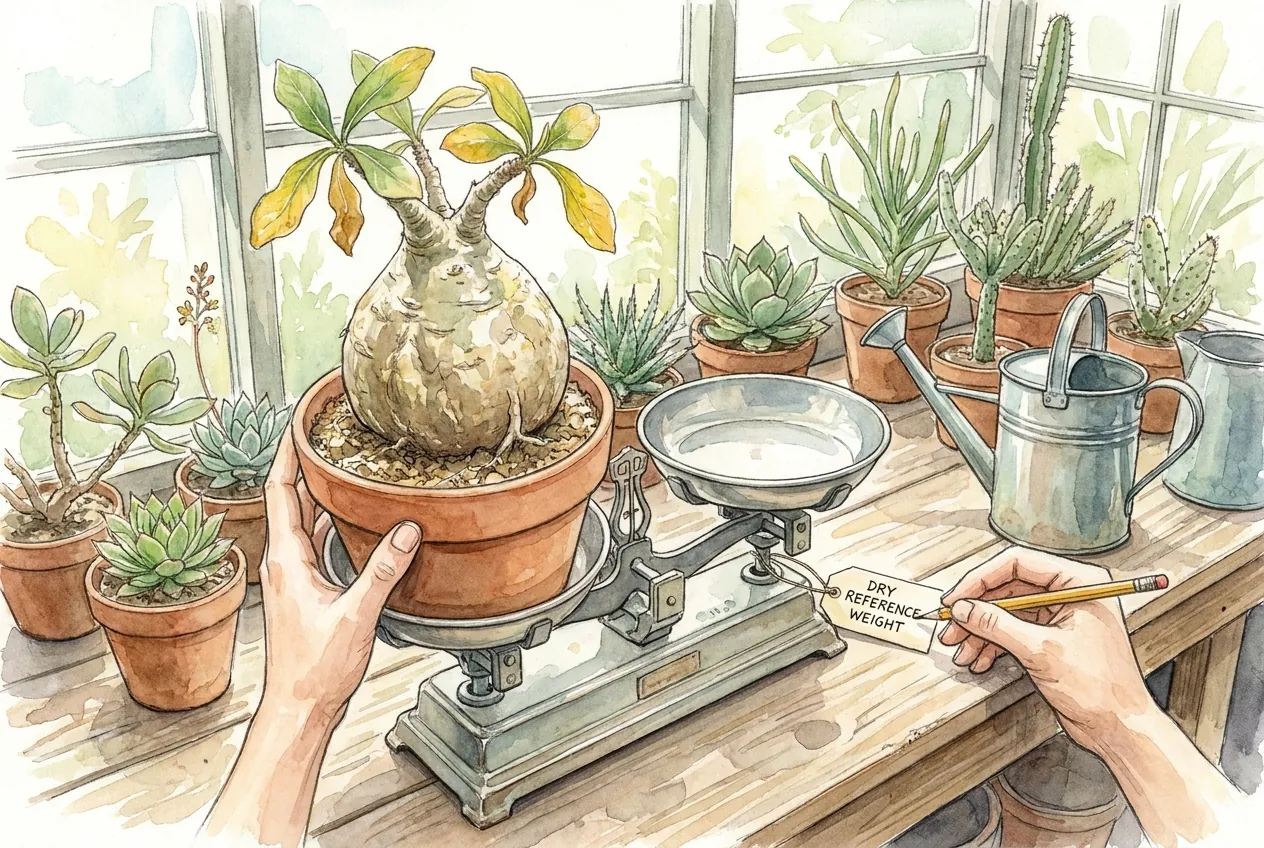
- Weigh the pot and set a dry reference weight so dry is a number in grams.
- A doubled drying interval is a review trigger, not an instruction for one final watering.
- Keep resting summer growers dry enough for their needs and protect them from chilling.
- Water active winter growers according to growth and deep-mix drying.
A pot that dried in six days in summer may still be wet on day twelve in autumn. That is a reason to reassess the next watering, not a reason to give one final soak. The last watering is often recognized afterward, when the plant no longer needs another one.
What the pot-weight trend can tell you
Light, warmth, humidity, air movement, and leaf area all change water loss. A slower dry-down can reflect reduced uptake, lower evaporation, or both. It does not prove dormancy or identify a pathogen.
How Autumn Changes Water Loss
After drainage, a pot loses water through evaporation from the medium and transpiration from the plant. Both can decline in autumn, but the scale records their combined effect.
Cold roots can reduce uptake
A controlled rice experiment found a change in temperature sensitivity near 15°C. That is evidence for the importance of root temperature, not proof that every caudex stops drinking below 15°C. Do not transfer the rice threshold to an actively growing winter species.
Species differ in cold response
Experiments on temperate trees also show different responses to cold roots. They do not establish a universal warm-grower cutoff. Use the named species’ care requirements alongside the measured pot trend.
Slow Evaporation Finishes the Job
Cooler, dimmer conditions often slow evaporation, while indoor heating can increase it. Check the actual shelf. If a comparable water load takes twice as long to leave, its average net loss rate has roughly halved. That does not mean uptake and evaporation have each halved.
Simple check before the next dose
For an established summer grower approaching rest, check three things before watering. The deep mix should be dry, the plant should show a reason for water such as active extension or gradual reserve loss, and its location should remain within its suitable temperature range. A firm leafless plant in dry mix usually needs no farewell soak.
If the mix is wet, wait. If softness is local, darkening, or expanding, assess rot before adding water. Tiny seedlings, rootless plants, and active winter growers need separate decisions.
Measured check with two weight references
During a normal active-growth cycle, record D when the established plant reaches its usual dry stage, confirmed by a deep check. After its normal watering and 60 minutes of free drainage, record W. Weigh without the saucer and keep labels, supports, and the pot unchanged. Do not oven-dry a living root ball or water a dormant plant to obtain a reference.
Use D + 0.10 × (W − D) as a consistent near-dry review line. For D at 1,100 g and W at 1,400 g, the line is 1,130 g. The 10% allowance makes cycles comparable despite small weighing differences. It does not prove the core is dry or order the next watering.
Take three readings and use the middle value. If their spread exceeds 5% of the 300 g water gain in this example, or 15 g, resolve the scale setup first. Note major leaf loss and re-establish the reference after repotting or changing supports.
Why Weight Beats the Finger Test in Gritty Mix
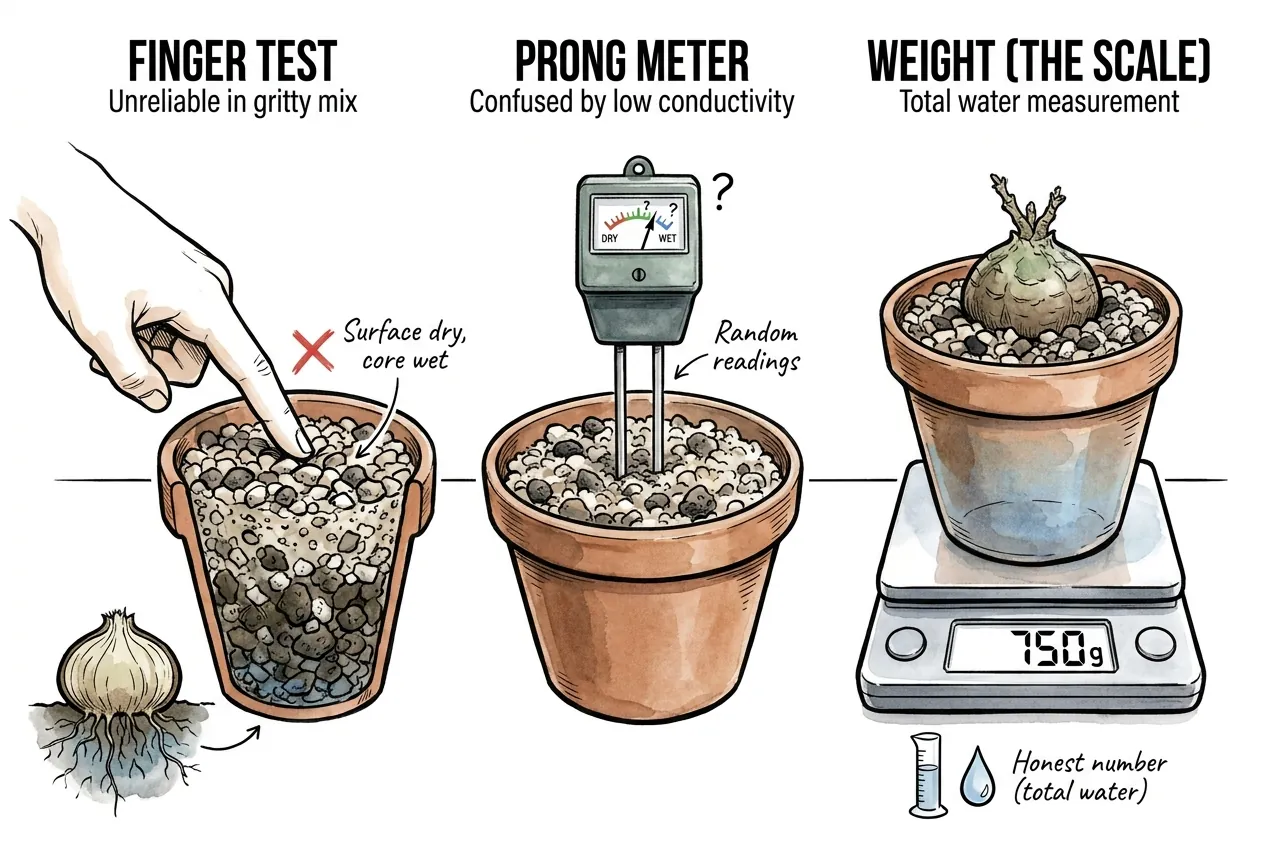
Caudex growers run gritty mixes of pumice, lava, and akadama for good reason, but those mixes lie to your finger.
The top half-inch dries and crumbles while the core stays wet, so the surface says dry when the root zone is soaked.
A deep wooden-skewer check and pot weight complement each other. The scale records total mass, while a carefully placed skewer samples one part of the root zone. Neither alone maps every wet pocket.
Use a doubled interval as a review point
Record the days from the drained W reading to the near-dry review line, weighing daily at the same hour. Use the middle duration from three healthy active-growth cycles as the baseline. Keep the watering method and amount retained comparable. A smaller water dose is a different trial.
Suppose the three baseline cycles took five, six, and seven days. The baseline is six days. At twelve days, a comparable cycle that still has not reached the review line has crossed the doubling trigger. Recheck drainage, deep moisture, root temperature, and growing tips before adding water.
Check the starting water load first
A cycle retaining 600 g of water cannot be compared directly with one retaining 300 g. Even at the same average net loss, the larger load can take twice as long to reach a comparable endpoint. Record W minus D beside each drying duration.
If the retained load changed, flag that cycle as a different watering event and use its actual deep-moisture check. Do not add a corrective pour to make it match the old cycle. This prevents an uneven soak from being mistaken for a seasonal shutdown.
Doubling is a practical signal large enough to stand out from a one-day reading difference. It is not a tested dormancy threshold and does not prove root failure. Act sooner if there is standing water, an expanding soft lesion, or unsuitable temperature.
If you have no earlier weight record, skip the ratio. Use the simple check and begin logging only when normal watering resumes. Do not manufacture a baseline with repeated autumn soaks.
| Current dry-down time vs summer baseline | What it means | Action for a warm-grower |
|---|---|---|
| About the same (1x) | Drying is similar under comparable conditions | Check deep moisture and growth before watering |
| Around 1.3 to 1.5x | Drying is slowing | Wait for the appropriate dry stage and check conditions |
| About 2x (doubled) | A substantial change needs review | Reassess before adding water, with no automatic final dose |
| Barely dries at all | Persistent moisture or a changed water load | Withhold more water and inspect drainage and plant condition |
Keep a compact pot-side record
Record the date, mass, root-zone low, new growth, and any removed leaves. Write the review line on the pot tag so another person can repeat the check. With a six-day baseline and a 1,130 g line, a 1,200 g pot on day twelve calls for investigation, not another drink.
Use a scale that can resolve the water-gain band and a probe suited to the medium. The caudex watering tools and measurement setup guide compares those instruments.
Cold and wet are separate risks
Waterlogging can injure roots through oxygen shortage and can favor root pathogens. Cold can injure tender tissue even when the pot is dry. Withholding water does not replace protection from chilling or freezing.
Virginia Cooperative Extension explains why prolonged wetness harms container roots. The practical goal is a suitable wet-dry cycle for a growing plant and an appropriately drier rest for a dormant one.
The Rot Organisms Love the Cool, Wet Autumn Pot
Growers assume rot needs heat, but the main culprits are happy in exactly the cool, wet conditions an autumn pot occupies.
Cool-season Phytophthora species prefer cool soils, not just warm ones. Some Pythium species are pathogens only above 77 Fahrenheit, but others are active only in cold soil, so the cool autumn pot never leaves the danger zone.
Water films allow motile spores to move, and some pathogens can infect after relatively short saturation periods. Drying reduces that opportunity but does not sterilize a pot or erase an existing infection.
The Failure Is Silent, Then Sudden
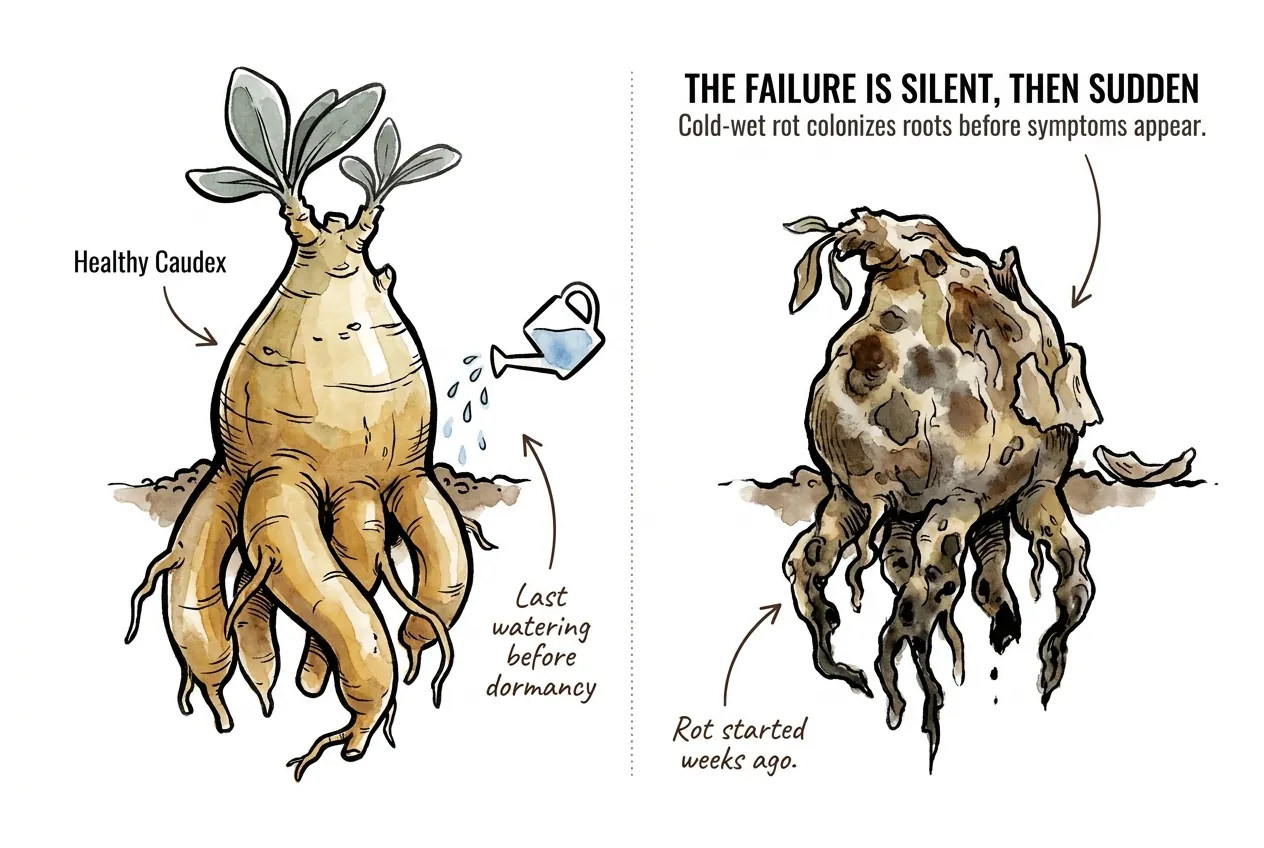
Cold-wet rot rarely shows the day it starts. The pathogen colonizes the roots and creeps into the crown while the caudex still looks and feels fine, then the plant seems to collapse overnight. That lag is why growers blame the wrong thing.
Visible collapse can lag root damage, so a firm trunk does not excuse persistently wet mix. At the same time, a delay cannot date the start of an infection or identify the cause.
Check conditions during the wet spell as well as the plant’s appearance. The soft caudex firmness map helps interpret a change in tissue.
When water is still needed
A firm resting summer grower usually needs no extra dose. If an established plant still has active extension or gradual uniform shrinkage with confirmed dry mix, first check that roots are healthy and temperatures remain suitable.
A limited trial on a suitable morning
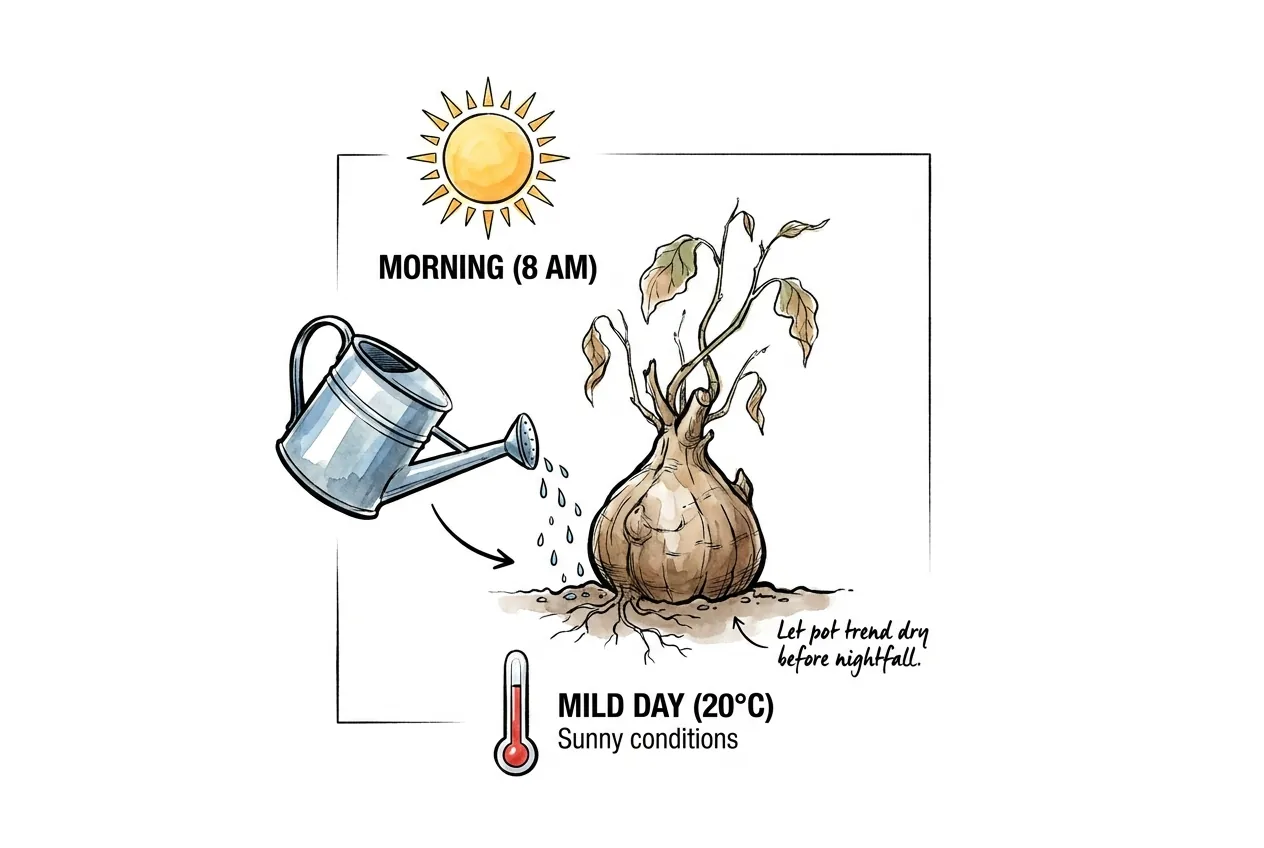
For an established small summer grower approaching rest, a trial dose equal to 5% of mix volume is a concrete starting ceiling, such as 50 mL for 1 L of mix. Apply it around the root-bearing perimeter and drain freely. This limits the added water load while you reassess response. It is not a validated species dose or a way to hydrate an entire dry root ball.
Record the dose and pot mass, then check after 48 hours and again before any repeat. Wait for the wetted area to dry. Stop this trial if the plant develops new local softness or the mix remains wet. Do not use this small-dose routine for seedlings, rootless imports, confirmed rot, or vigorous winter growth.
Morning watering provides an observation window, not a promise that the pot will dry before night. Cancel the trial if the plant’s location will become too cold. The Cambridge glasshouse guidance also skips plump plants and pauses watering during very cold, overcast periods.
When a warm spell returns
For a summer-growing Adenium, verify root-zone lows around 16°C or higher on three mornings and check for active growth before reconsidering normal watering. This is a conservative observation rule near common winter-care guidance, not proof of restored uptake. Prefer the species’ higher requirement where applicable, and check the coming nights as well.
Which Plants Follow This Rule and Which Ones Invert It
The drying trend applies to every pot, but its interpretation depends on growth. A resting Adenium and an extending Dioscorea should not share a shutdown schedule.
Summer growers approaching rest
Many Adenium, Cyphostemma, and Pachypodium reduce growth in cooler seasons. Fockea can retain active vines in suitable conditions, and Euphorbia covers species with very different habits. Confirm the individual plant’s growth state instead of ranking whole genera by one temperature cutoff.
Winter growers with new growth
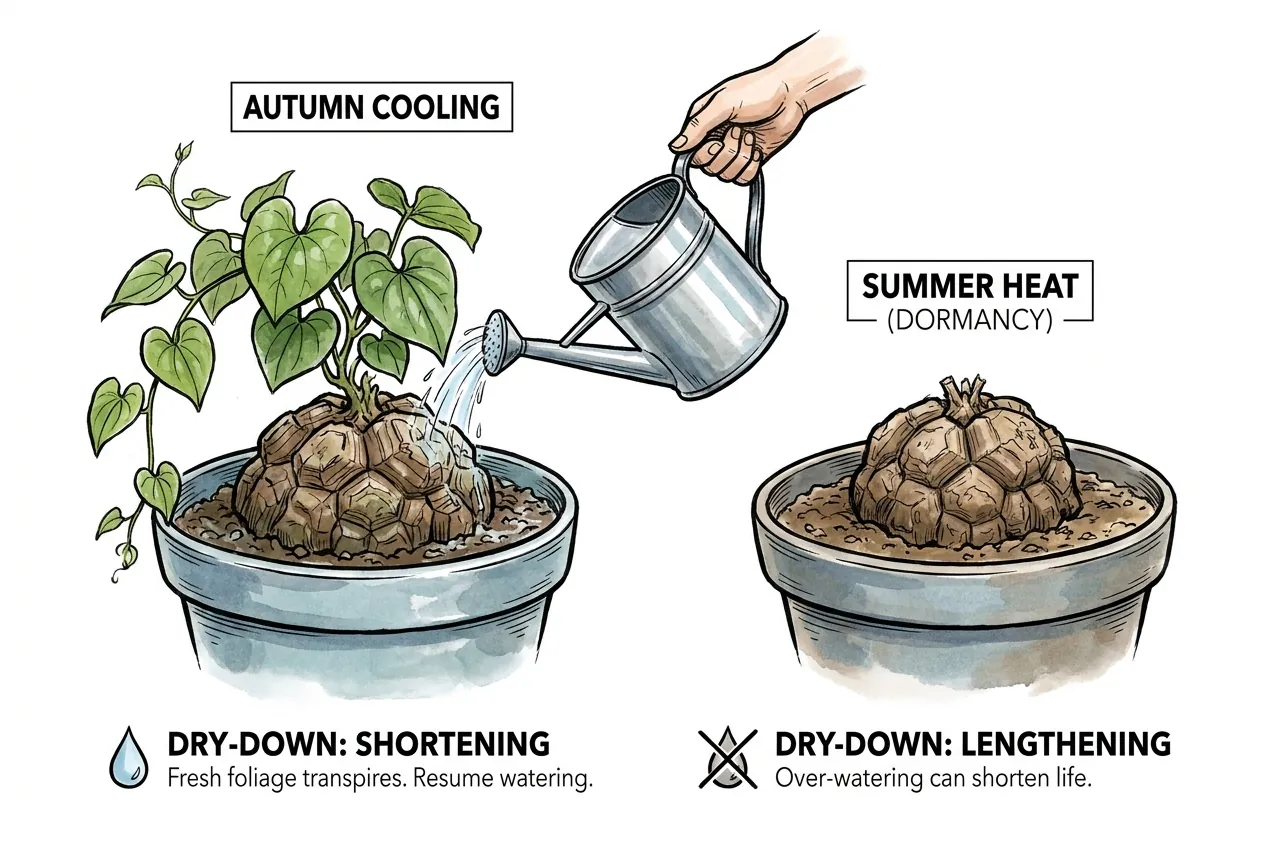
Dioscorea elephantipes, Tylecodon, and many Othonna grow during the cooler season. A new vine or expanding leaves supports resuming appropriate watering when the mix needs it. Shorter drying alone cannot prove a plant has woken, because indoor heat and lower humidity can produce the same change.
SANBI describes Dioscorea elephantipes as a winter and spring grower with summer rest. Follow that plant’s observed cycle rather than an autumn water increase on every pot.
Confirm the Review With Two Cross-Checks
Confirm a changed drying interval with root-zone temperature and the plant’s condition.
Read root depth and the pattern of softness
Place a suitable probe at mid-pot depth beside the root ball without forcing it through roots. Log overnight lows for three nights if possible. A spot reading before dawn is useful but can miss the true minimum. Keep the worst low visible instead of averaging it away.
A plump, firm, resting caudex is a reason to skip water. Gradual uniform reserve loss in dry mix is different from a dark, expanding soft patch. The firmness map helps separate those findings.
Mistakes that break the comparison
Changing the pot, losing many leaves, adding a support, or reducing the watering dose changes the mass record. Label the change and start a new baseline when normal growth permits. Do not compare a new pot directly with its old summer drying time.
Check both roots and air. A single cold night may not establish dormancy, but it can still injure a tender plant and needs immediate protection. Neither a slow weight trend nor a warm afternoon overrides that risk.