
Dehumidifier for Overwintering Caudex: Stop Cold-Damp Rot
Prevent condensation around overwintering caudex plants with airflow, same-time dew-point checks, and a dehumidifier suited to the room temperature.
Derek Kim · 2026-10-04 · Updated 2026-10-24 · 13 min read
Key Takeaways
- Measure room conditions before choosing a dehumidifier. Compare extraction at that temperature, not just its operating minimum.
- Condensation depends on surface temperature and air dew point. An 85% room reading is not a universal threshold.
- Keep air moving at a low continuous drift to break the wet boundary layer where mold and soft rot start.
- Use the dehumidifier’s built-in humidity control. An external power-cutting relay can interrupt a required cooldown.
- Watch dew point against your coldest surface, not just room humidity, to predict overnight condensation.
Condensation on a caudex is a reason to check the cold surface and surrounding air together. A dry-looking room can still wet a plant beside cold glass. Moving that plant may solve the immediate problem before a new appliance is needed.
Simple check at the coldest pot
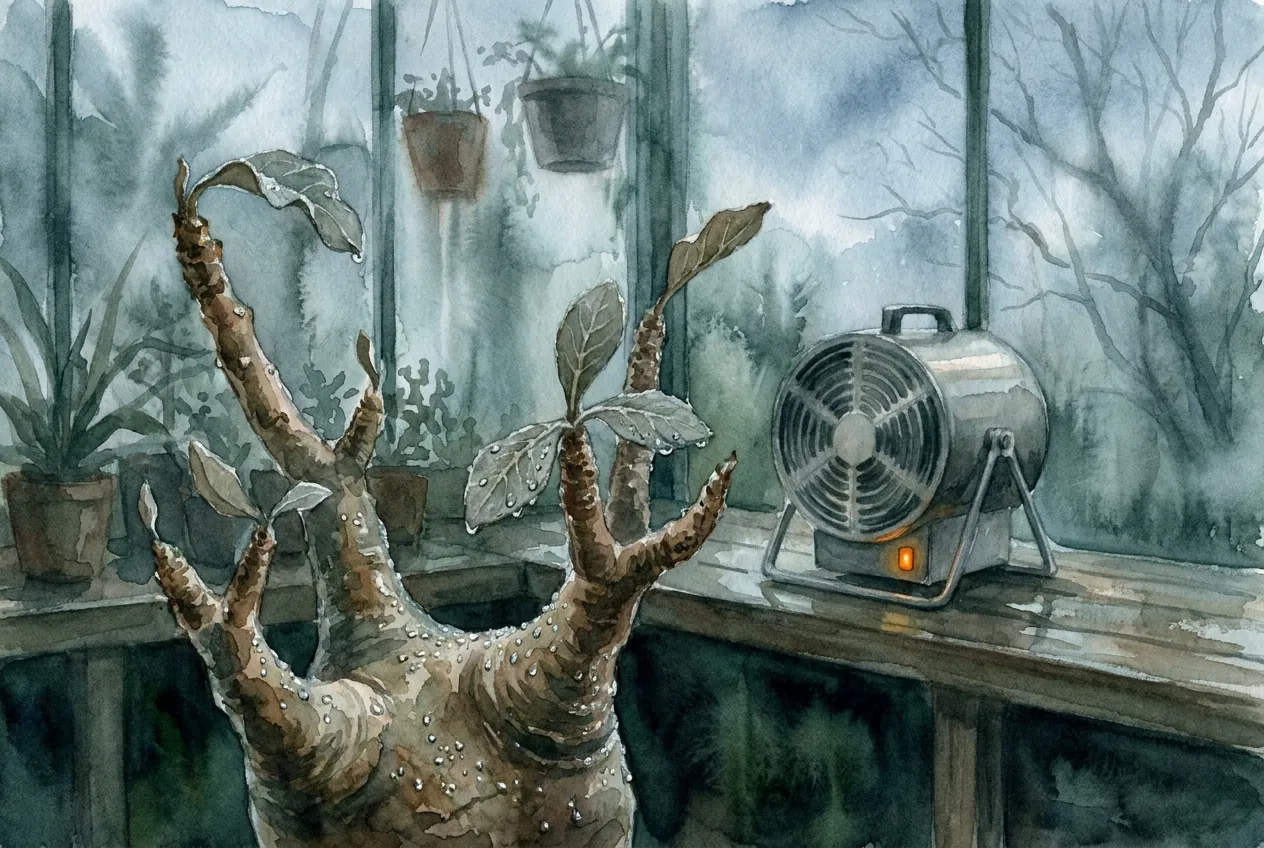
Before sunrise, inspect the plant nearest the glass and the undersides of nearby leaves. If moisture beads there, move the plant back from the glass and open space between pots. Keep gentle circulation across the shelf without blasting one caudex.
Check the same surfaces for three mornings after the move. Persistent wetness calls for the paired temperature check below. Dry leaves at noon do not tell you how long they were wet overnight.
Buy against the actual room temperature
For a persistently cold room, a rotary desiccant unit can be useful. For a warmer room, compare compressor models rated for that temperature. Minimum operating temperature and water-removal capacity are different specifications.
Start with a humidity monitor, circulation where needed, and the dehumidifier’s own controls. A wet pot still needs drainage and watering correction, as the cold wet soil guide explains.
Why cold damp air rots a dormant caudex
Dormant caudex plants are not growing, so they cannot outrun an infection. The damage comes from two mechanisms that both need water the room is handing them for free.
The first is fungal.
Long periods of high humidity and surface wetness favor gray mold. Infection depends on the plant, pathogen, temperature, and time wet. An 85% room reading is not a universal boundary between safe and infected tissue.
Water films can also restrict gas exchange and favor soft-rot conditions. A wet surface does not by itself diagnose infection, but keeping it wet through the night is a reason to change the setup.
As air cools without losing water vapor, its relative humidity rises. A colder plant surface can reach condensation conditions before the room sensor does.
Where condensation forms first in a cold room
Condensation does not wait for the whole room to saturate. It forms on any surface that drops to or below the dew point of the air, which is the temperature the air must cool to before it becomes saturated.
On a clear cold night a caudex near a window radiates heat to the glass and sky.
Its skin can fall several degrees below the room air, so the plant surface reaches dew point while the room reading still looks safe.
That is why a plant can be wet at dawn in a room that never showed 85 percent on the wall gauge.
This is the reason a dew-point readout matters more than a bare humidity number. A dew point within a few degrees of your coldest surface is a warning that dew is about to form there tonight.
What to measure and the specs that matter
Match extraction to the coldest room conditions, and measure beside the plants rather than at the appliance outlet. Use the unit’s own humidity controls whenever available.
| Role | Decision spec | Target value | Price tier |
|---|---|---|---|
| Dehumidifier | Type and minimum operating temperature | Rotary desiccant, runs to about 34 F | The one higher-cost item |
| Circulation fan | Airflow volume and noise | A few hundred CFM, low dBA for continuous use | Low cost |
| Humidity control | Built-in control and required shutdown sequence | Use the appliance controls, preserve cooldown | Usually already included |
| Thermo-hygrometer | Dew point readout, min-max memory, RH accuracy | Shows dew point, recalls min-max, about plus or minus 3 percent RH | Low cost |
A separate switching controller is unnecessary for a unit with suitable built-in humidity control. Confirm shutdown compatibility before buying any accessory that cuts mains power.
The dehumidifier that works in the cold
Compressor coils can frost in a cold room, reducing extraction while the unit defrosts. Performance varies by model, so check its minimum operating temperature and low-temperature capacity rather than applying a universal 60°F cutoff.
A rotary desiccant unit avoids a refrigerated coil. That can make it useful in colder spaces, but a near-freezing operating rating does not mean it removes its full advertised daily volume there.
How the two dehumidifier types compare by temperature
Use this table to choose which specifications to request. Do not read a rated operating floor as a tested extraction rate at that temperature.
| Condition | Compressor unit | Rotary desiccant unit |
|---|---|---|
| Room near 70°F | Compare rated capacity and efficiency | Works, but compare running cost |
| Room near 50°F | Check low-temperature rating and defrost behavior | Check actual extraction at the measured RH |
| Room near 40°F | Some models are outside their rated range | Use only within the model’s operating range |
| Room near 34°F | Do not assume operation is permitted | The EDV-4000 lists this operating floor, not full capacity here |
A desiccant unit built for this is the Eva-Dry desiccant unit
Its manufacturer rating is about 7 liters of water per day at 68 F and 60 percent humidity.
Its operating range runs from 34 to 104 F with a 2 liter tank. The 34 F floor is the reason it fits a cold overwintering room where a compressor model stalls.
The tradeoff is honest. A desiccant unit gently warms the air it processes and draws a few hundred watts continuously, so it costs more to run than a compressor unit in a warm room.
Skip this class of product entirely if your overwintering space never drops below about 65 F, because there a cheaper compressor unit will extract more water per watt.
The fan that keeps air off the plant surface
Gentle circulation can reduce stagnant humid pockets and temperature differences around plants. It cannot guarantee a dry surface that remains below the surrounding air’s dew point.
How moving air breaks the wet boundary layer
Extension guidance for greenhouses keeps air moving at roughly 50 to 100 feet per minute to prevent the still, saturated film where mold establishes. You do not need a gale. You need gentle air that never fully stops, aimed to wash across the plants rather than blast them.
A fan that fits this is the AC Infinity clip fan
It moves about 325 cubic feet per minute at roughly 31 decibels on its quiet settings.
Its ten speeds let you dial in a low continuous drift instead of an on-off blast.
The low noise matters because this fan should run around the clock all winter.
Do not point a strong fan directly at a caudex for weeks. Constant hard airflow on one side can over-dry and desiccate exposed tissue, so aim it to circulate the room air and cross the bench at an angle.
Skip a large floor fan here, because the goal is a steady low drift, not high volume.
The controller that automates the humidity response
Do not switch the recommended EDV-4000 on and off with a plug-in humidistat. Its manual requires shutdown with the power button followed by a two-minute powerdown before unplugging. Use its built-in target-RH function instead.
The 50% mode regulates around 50 to 55% RH according to the manual. Start there if this model is needed, then inspect plant surfaces and the room log rather than forcing a separate 70-to-55% switching band.
For any other appliance, external control needs explicit compatibility with power interruption and restart, as well as the correct electrical rating. Sufficient relay amperage alone does not establish that compatibility.
The monitor that makes the danger zone visible
You cannot manage a humidity band you cannot see, and a plain hygrometer that reads only the room average hides the real risk.
The number that predicts dew on your plants is the dew point, not the headline humidity.
A monitor that shows this is the SensorPush HT1 sensor
Its companion app reads relative humidity and temperature from a Swiss sensing element accurate to about plus or minus 3 percent.
It then computes dew point and vapor pressure deficit from those readings. The sensor logs continuously, so the app keeps the overnight history instead of a single glance.
Air-temperature and humidity history lets the app calculate air dew point. It does not measure a cold caudex surface. Add a suitable surface-temperature measurement to determine the margin at that plant.
The tradeoff is the phone dependency. The sensor reports over Bluetooth within roughly 300 feet, and reaching it from indoors or away from home needs the optional WiFi gateway, which adds cost.
Skip it only if you already log dew point with another sensor.
Measured check with simultaneous dew point and surface temperature
Keep the air sensor beside the coldest plant, away from the dehumidifier outlet and out of direct sun. Measure the same marked surface point with a suitable contact probe or infrared thermometer, following its accuracy and emissivity instructions.
| Step | Action | Target |
|---|---|---|
| 1 | Record air dew point and plant-surface temperature at the same time | Use readings before lights-on for three mornings |
| 2 | Subtract dew point from surface temperature | Record the smallest paired margin, not separate daily minima |
| 3 | Move a cold plant, improve circulation, or use built-in dehumidification | Change one thing and check the same location again |
| 4 | Inspect for beads and persistent dampness | Visible wetness overrides a reassuring sensor number |
Use a 3°C margin as an early-action buffer when instrument uncertainty is smaller than that. If your combined uncertainty is larger, enlarge the buffer. This is a practical allowance for sensor error and local variation, not the condensation threshold itself.
Heat, light, and the enclosure itself are a separate layer of the overwintering question. Route those decisions through the caudex overwintering setup hub rather than buying a second expensive appliance for this air problem.
Read the difference in the correct direction
For example, a surface at 10°C and a simultaneous dew point of 8°C give a 2°C margin. That is inside the working buffer, so improve placement or drying and recheck. A surface at or below dew point can collect condensation.
Do not compare the night’s lowest dew point with a surface reading taken later. A higher dew point may have coincided with the coldest surface. Continuous paired logs capture this best, while morning spot checks cover only the moments measured.
Three mornings above the buffer with dry tissue support keeping the new arrangement. Repeat after a cold spell, watering, or shelf rearrangement. They do not certify that condensation never occurs.
Check whether the air dried or only warmed
Log temperature and dew point before the dehumidifier starts and after two hours, using the same sensor beside the plants. A lower RH with nearly unchanged dew point can mainly reflect warmer air. A falling dew point supports actual moisture removal from that air.
Check again before dawn, when appliance heat or sunlight may no longer warm the shelf. Use the two-hour reading to compare operation and the dawn reading to judge the coldest period. Water in the tank proves collection, but does not prove the coldest plant stayed dry.
UMass Extension explains why warming lowers relative humidity even without removing water. Pairing dew point with surface temperature avoids mistaking that change for protection from overnight condensation.
When your watering, not your air, is the problem
A dehumidifier cannot establish that the root zone is aerated. If the mix remains wet, inspect drainage and reconsider watering even when the room is dry. Wetness increases risk but does not prove the roots have already rotted.
Confirm your dry-down happened before you blame the room air. The companion guide on the last watering before dormancy sets that cutoff. For the physiology of how humidity and vapor pressure act on caudex tissue, the VPD and caudex rot guide covers the mechanism.
Who should not buy each item
Not every grower needs this setup, and buying the wrong piece for a mild room wastes money.
| Product class | Skip it if |
|---|---|
| Desiccant dehumidifier | Your space never drops below about 65 F, where a cheaper compressor unit extracts more water per watt |
| Circulation fan | Your room already has steady gentle air movement and no still corners |
| External humidity controller | Skip for the EDV-4000 and any unit requiring a powered cooldown. Use built-in controls. |
| Dew-point monitor | You already run a calibrated data logger with a dew-point channel |
Maintenance and failure modes
Each piece has a predictable way it stops working. Catch these before a plant pays for them.
The desiccant wheel and the dehumidifier filter load with dust over a season, which cuts extraction.
Clear the tank or run the drain hose so a full tank does not shut the unit down overnight.
A fan that runs all winter will collect dust on the blades, which raises noise and drops airflow, so wipe it when you notice either change.
Confirm that the built-in humidity control changes operating mode as expected and that the tank does not fill overnight. Shut down with the appliance controls and allow its specified cooldown before disconnecting power.
FAQ
Can I just open a window to drop the humidity?
Sometimes, but not reliably in a cold snap.
Compare outdoor and indoor dew points, not relative humidity alone. Outdoor air with a lower dew point can remove moisture when exchanged, but stop ventilation if it chills plants below their species limit.
Will a cheap compressor dehumidifier work if I run it longer?
It depends on the model and room. If the room is outside its operating range or extraction is poor during repeated defrosting, longer runtime may not help enough. Check low-temperature specifications and actual collection under your conditions.
What humidity is actually safe for dormant caudex?
No room-RH number guarantees a dry caudex beside cold glass. Use the simultaneous surface-to-dew-point margin and inspect the actual plant. Move a locally cold plant before drying the whole room further.
Do I need all four items at once?
No. Start with measurement and placement. Add circulation and extraction only where the observations support them, and use built-in humidity control instead of an unnecessary external switching unit.
Affiliate Disclosure
This article contains Amazon affiliate links. As an Amazon Associate I earn from qualifying purchases. If you use these links, the site may earn a commission at no extra cost to you. Product availability, price, and specifications can change. Check the current listing before buying.