
Pachypodium Horombense Winter Watering by Plant Condition
Check dry mix, winter warmth, and tissue condition before watering Pachypodium horombense. A monthly reminder is for inspection, not an automatic drink.
Rachel Torres · 2026-10-11 · Updated 2026-10-24 · 10 min read
Key Takeaways
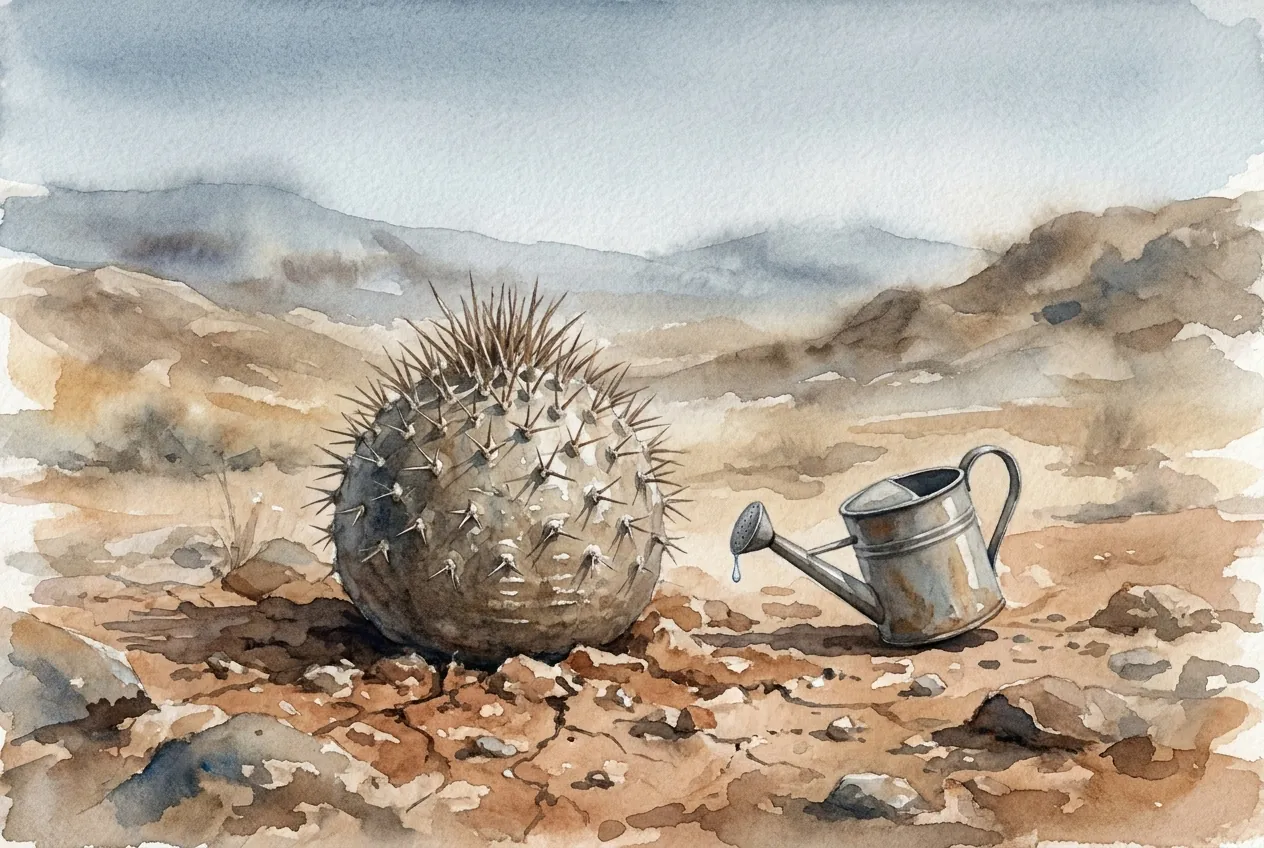
- Use a monthly reminder to inspect a resting plant. A firm, unchanged caudex has no monthly water quota.
- Cold wet soil around inactive roots is the real killer, not the date you water.
- Keep the plant above about 10C, measured at pot height, not at the wall thermostat.
- A dry pot is a check point, not a reason to water a firm, resting plant.
- In spring, resume watering only after new growth appears, then ramp up slowly.
A dormant Pachypodium horombense can go most of the winter on the water already stored in its fat caudex. That single fact decides the whole schedule.
Use a monthly reminder to inspect the plant rather than supply a monthly ration. A firm, leafless plant in cool conditions may need no water through its rest.
Simple check at the monthly inspection
Lift the pot without its saucer and compare it with its familiar dry weight. If the plant remains firm and unchanged, stop there. Dry mix alone does not mean a stored-water plant is thirsty.
Photograph the same exposed caudex side monthly. Progressive even wrinkling calls for closer assessment, while a localized wet or darkening patch calls for inspection without watering.
How often should you water Pachypodium horombense in winter?
Some species references recommend a dry winter, while broader Pachypodium advice permits occasional sparse watering. Those recommendations do not establish once a month as a biological requirement.
For a healthy established, leafless plant, default to observation. A warm, leafy plant that is still growing needs its active-growth routine, and seedlings or rootless imports do not fit this dormant-plant method.
Why winter rewrites the watering rules for this species
Pachypodium horombense is a deciduous caudiciform from a seasonally dry habitat, so winter changes what the plant can use.
It drops its leaves, growth stalls, and water demand collapses. The same drink that was healthy in July becomes a liability in January.
What Pachypodium horombense is and where it comes from
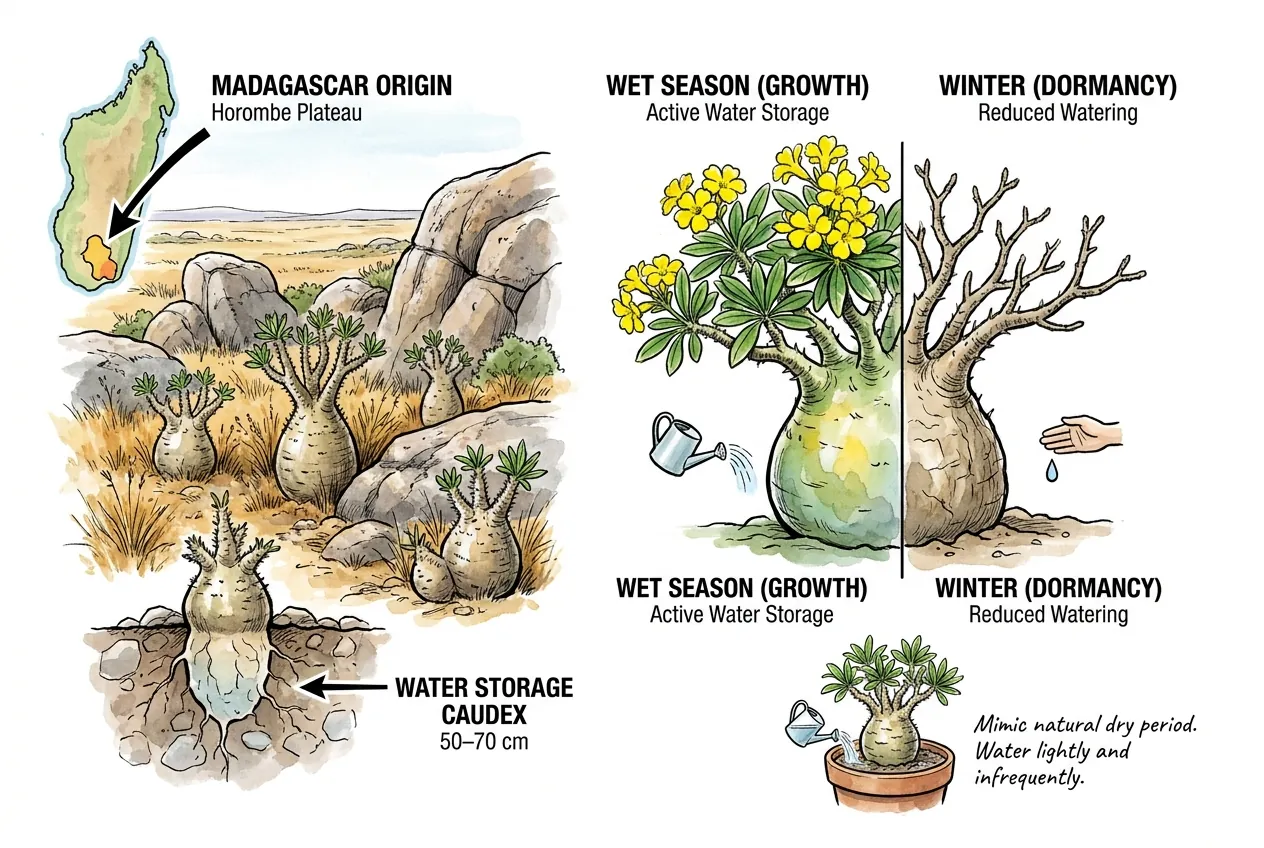
Pachypodium horombense is a dwarf, spiny succulent from the Horombe plateau of southern Madagascar. It grows on granite outcrops at roughly 500 to 1000 meters elevation, in open, rocky, seasonally dry grassland.
The plant stores water in a plump caudex, the swollen trunk-and-root base that can reach 50 to 70 cm across on mature specimens.
Short fat arms carry rosettes of leaves and bright chrome-yellow flowers in the warm months. Its whole body plan is built to bank water in the wet season and coast through the dry one.
That origin is the key to winter care. This is not a tropical plant that grows year round. It evolved to run hard in warm wet weather, then switch off when conditions turn cool and dry.
Why dormancy cuts water demand to almost nothing
A dormant, leafless plant uses almost no water because it has switched off the machinery that spends it.
Leaves are where most transpiration happens, and this species drops them for winter. No leaves means almost no water leaving the plant.
Growth also stops, so the plant is not building new tissue that would need water and nutrients.
At the same time its caudex is still full from the growing season. A resting plant draws from that internal reserve instead of pulling steadily from the pot.
A leafless, dormant Pachypodium needs so little water that the safest winter error is giving too little, not too much. Caudiciforms tolerate a long thirsty spell far better than a wet one, which quickly turns years of slow growth into mush.
The real driver: cold wet soil, not the calendar
Prolonged wetness around inactive or damaged roots raises rot risk. Cold can lengthen drying, but warm saturated mix can also support disease. Warming a wet pot does not make it safe.
The temperature floor you actually build the schedule around
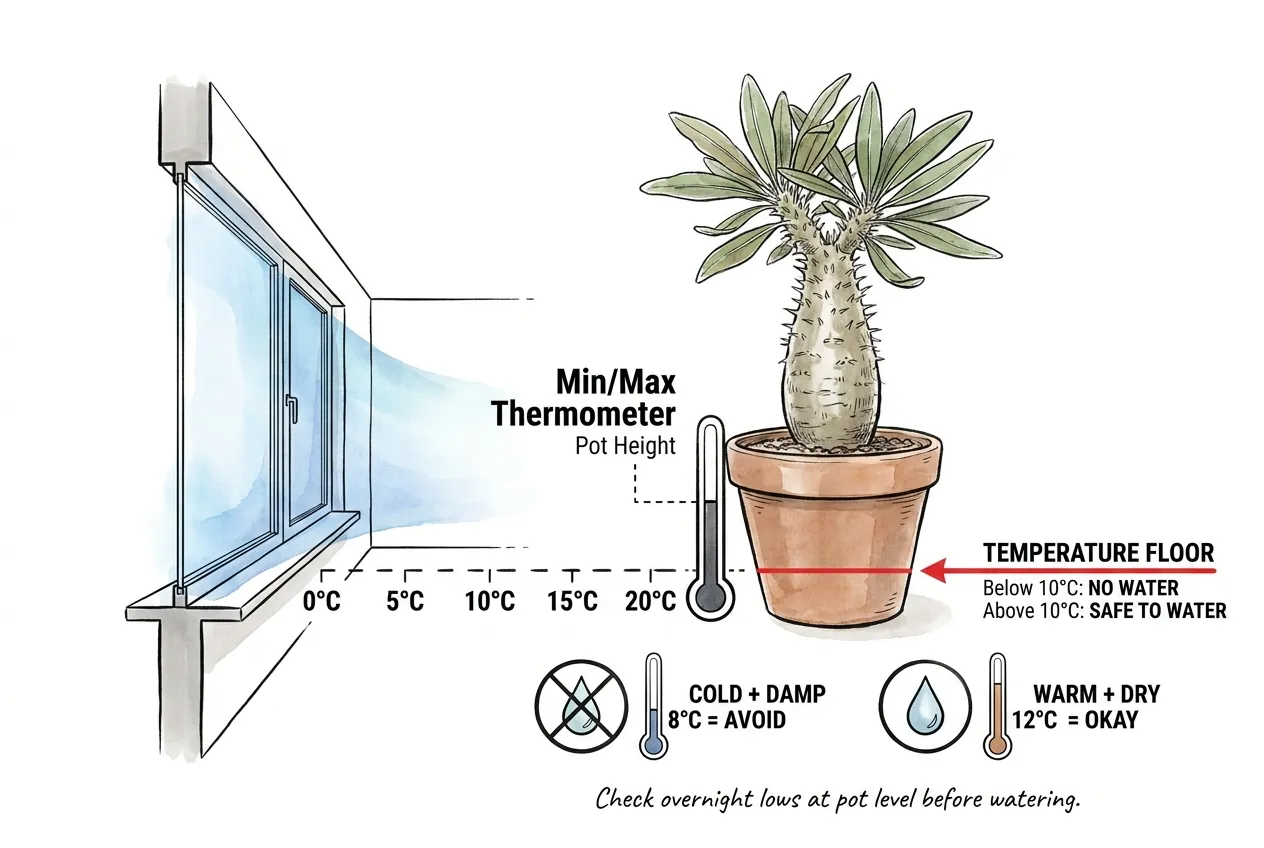
Keep Pachypodium horombense above about 10°C (50°F) through winter and protect it from frost.
Three independent references converge on roughly 10°C as the winter minimum for this plant and its close relatives.
Cold tolerance improves only when the plant is dormant and the soil is bone dry. Cold plus damp is the specific combination to avoid. One stray source cites a brief minimum near minus 3°C, but that conflicts with the cold-sensitive consensus and is not a safe number to plan around.
Your room thermostat is the wrong instrument for this. Air on a winter windowsill or near the floor can sit several degrees colder than the room average, especially overnight.
Log the minimum at pot height for seven nights. Treat readings near or below 10°C as a reason to move the plant to a warmer position and withhold optional water. This is a conservative storage rule, not a temperature at which root activity switches on.
Before any trial watering, also measure inside the rooting zone. For this dormant-plant routine, require at least 15°C before dawn for three mornings, allowing for probe error. That extra margin reduces cold-wet exposure but does not guarantee uptake.
Why cold plus wet rots roots so fast
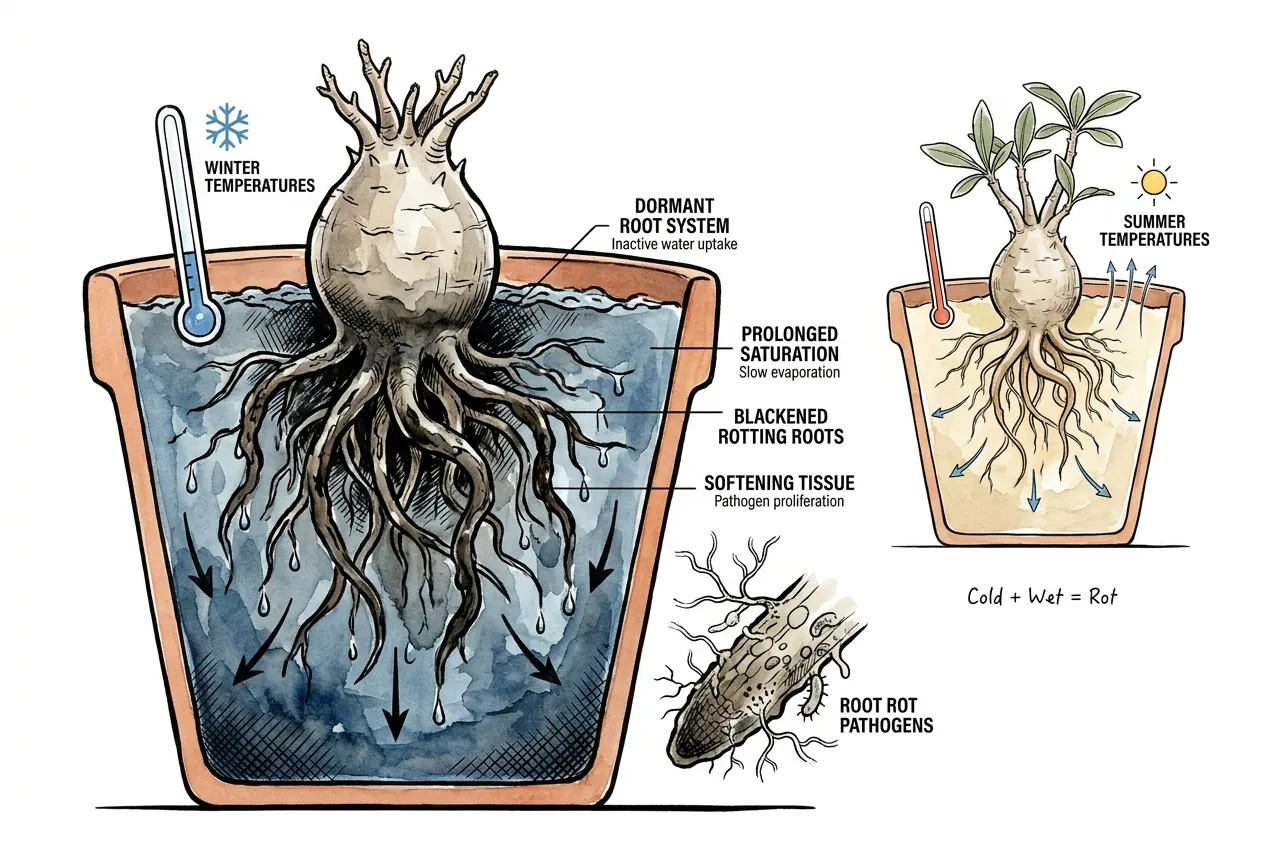
Cold slows both evaporation from the mix and water uptake by the plant, so wet substrate stays wet far longer in winter than in summer.
A drink that would dry out in two days in August can linger for two weeks in December.
That long wet spell is the problem. A dormant root system takes up almost nothing, so the water just sits around the roots.
Prolonged saturation around inactive roots is the textbook setup for root and caudex rot, which shows up as blackened roots and softening tissue.
For the full oxygen-and-saturation mechanism behind autumn root loss, the Caudexology deep dive on cold wet soil is worth reading alongside this. See why cold autumn soil kills caudex roots.
How to decide when, or whether, to water
Check growth state, deep moisture, temperature, and tissue condition together. Even when the first three are suitable, a firm resting plant can simply wait.
Confirm the plant is really dormant
A fully dormant Pachypodium is leafless or nearly so, with no new growth, under cooler and shorter days. That combination is your green light for the minimal winter regime.
A plant still carrying full leaves in a warm, bright indoor room is not fully dormant.
It will tolerate, and even need, a little more water than a bare, cold one. Match the regime to the plant in front of you, not to the month on the calendar.
Measured check that subtracts the pot itself
Keep a wet-to-dry record from a normal growing-season watering. Weigh after 60 minutes of drainage for W, then at the next normal dry stage for D. Keep the same pot, label, and support, with no saucer. Do not drench a dormant plant to obtain W.
Use D + 0.10 × (W − D) as a dryness review line, and confirm accessible deep mix is dry. For W of 1,500 g and D of 1,200 g, the line is 1,230 g. The 30 g allowance comes from the observed water swing rather than the weight of the pot itself.
The 10% rule is a practical review band, not a species requirement or an actual moisture percentage. Repeat three weighings and use the middle value. If their spread exceeds 0.05 × (W − D), improve the weighing setup before using that band.
With no wet reference, use only a known dry-stage weight and a deep-moisture check. A firm plant stays dry. Consider a measured trial only for progressive even wrinkling, suitable root-zone warmth, and no sign of localized decay.
When once a month, a lighter sip, or nothing applies
The right winter amount depends on how cold, how bare, and how fast-draining your setup is.
The table below maps your conditions to the cadence, so you are scaling the species rule to your own pot rather than copying a stranger’s calendar.
| Your conditions | Winter watering | Why |
|---|---|---|
| Fully leafless, cool room, dense mix, large pot, or overnight lows at/below 10°C | None until spring | No leaves and cold wet mix mean any water just sits and rots roots |
| Mostly bare, firm and unchanged, dry mix | No water just because a month elapsed | Stored reserves may still be sufficient |
| Progressive even wrinkling, dry deep mix, warm roots, no wet lesion | One measured trial, then reassess before any repeat | Tests a limited water addition without imposing a monthly quota |
| Leafy plant with new growth in a warm bright position | Water by its active-growth dry-down | It does not fit the leafless dormancy routine |
Never water on a fixed date while the plant is bare and the mix is cold and wet, no matter how many weeks have passed. The calendar is a reminder to check, not a command to pour.
Measure the trial and check where the water went
For a small established plant that passes the checks, start with 5% of the mix volume. That is 50 mL for 1 L of mix, divided slowly around the perimeter, with runoff discarded.
This small trial limits added water while uptake is uncertain. It does not guarantee that only outer roots become wet. Record the drained mass, check again after 48 hours, and wait for dry deep mix before considering any repeat.
Fast runoff alone can mean water bypassed a dry core. If almost all the dose runs out with little mass gain, investigate uneven wetting rather than declaring drainage perfect. Continued decline while the pot stays damp calls for root assessment.
Catch the runoff in a clean measuring cup during that single trial. If a 50 mL pour produces 45 mL of runoff and about 5 g of mass gain, very little water stayed in the setup. Do not immediately repeat the pour to reach a target weight.
Check the next day for dampness at an accessible lower edge and for a change in the wrinkled area. Persistent wrinkling with damp mix calls for assessment, not a larger dose. Photograph the same area after 48 hours so memory does not turn slow recovery into repeated watering.
The indoor setup that makes a safe schedule possible
A safe winter cadence depends on the environment you give the plant, not just the watering can.
Temperature, placement, light, and airflow together decide how long any drink lingers and how much cold stress the plant takes.
Placement and temperature
Keep the plant above about 10°C and off cold windowsills, away from doors and heating vents that blast cold drafts.
A cold draft landing on wet mix is close to the worst case you can build.
Measure where the plant actually lives, at pot height, rather than trusting the wall thermostat. That one habit catches the overnight cold pockets that quietly push a plant below its safe floor.
Light and airflow during rest
A bare dormant plant has low light demand, but a bright spot keeps it healthier and helps the surface dry between any watering.
Gentle air movement speeds that drying and cuts the time the plant sits damp, which costs nothing and changes no watering math.
Cold, humid, still air does the opposite and keeps everything wet longer. For a full dormant-season gear and placement walkthrough, see the Caudexology overwintering setup guide.
Breaking dormancy and bringing water back in spring
Resume watering only when the plant shows new growth, not on the first warm day. Withhold water until new leaves start to appear, usually from mid-spring onward, which can take a month or two.
Reading the resume signal
Swelling buds or new leaves signal renewed shoot growth, which may initially use stored reserves. Pair that signal with suitable root-zone warmth and drying before increasing water. New leaves alone do not prove full root function.
Jumping the gun is the classic spring mistake. Watering a still-bare plant on a warm afternoon is just the cold-wet-into-dormant risk wearing a spring coat.
Ramping up without shocking the plant
For an established plant with continued new growth, suitable warmth, and a sound root system, resume a normal watering and drain fully. Record the resulting dry-down before repeating. A rootless or declining plant needs rooting assessment even if it has produced leaves.
Do not leap straight to frequent summer watering while the plant is barely awake.
Let the first real watering meet active growth, never precede it. Holding off on fertilizer until growth is genuinely underway, and easing the plant back into strong light, keeps a careful winter from unraveling in a week.