
Heat Mat for Caudex Rooting: Winter Import Soil Temperature
Heat mat for caudex rooting means holding the substrate near 77 F so bare-root winter imports root without cold-wet rot or heat overshoot.
Rachel Torres · 2026-10-12 · Updated 2026-10-24 · 13 min read
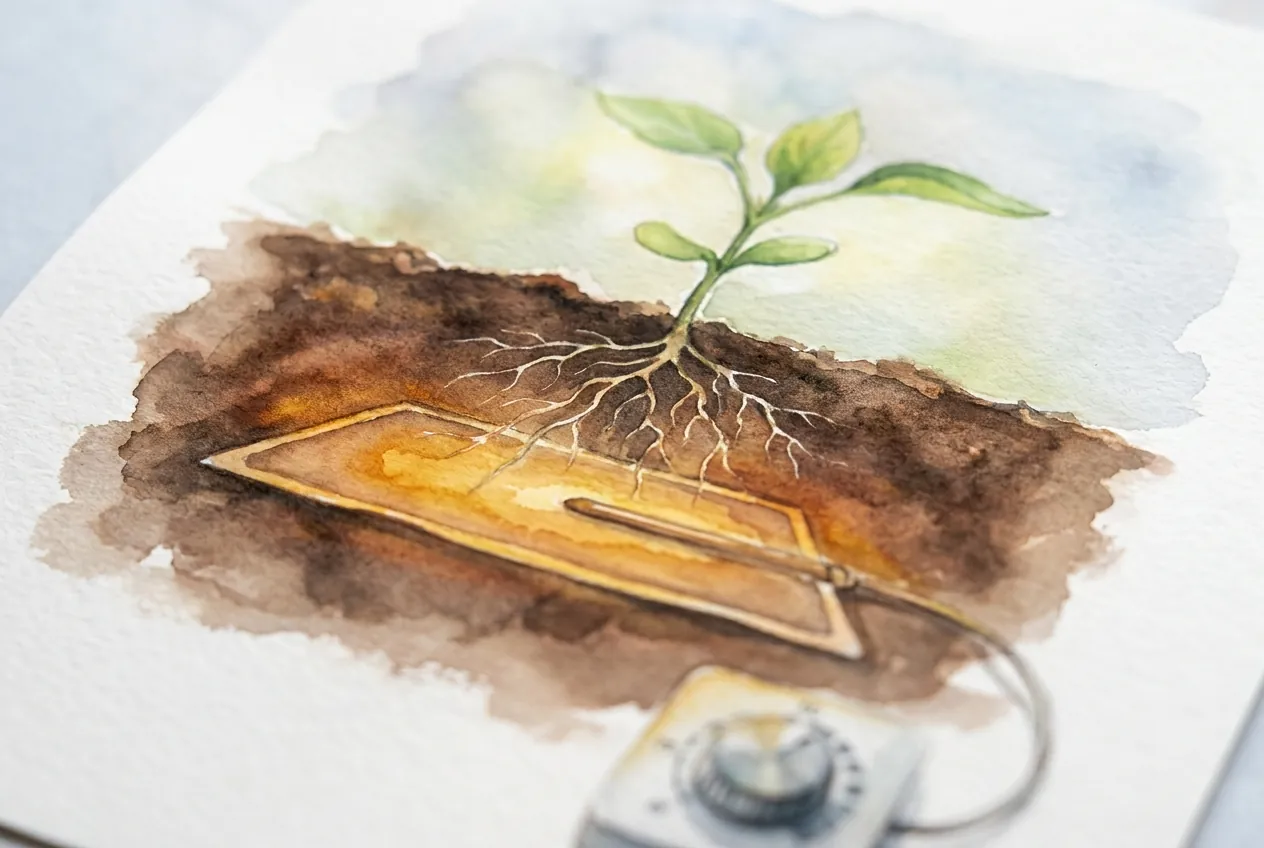
Key Takeaways
- Measure the rooting zone before adding heat. About 77°F (25°C) is a monitored starting trial, not a proven optimum for every caudex.
- A bare mat only offsets the room. A thermostat with a root-depth probe is the real control.
- Use 30°C as a conservative stop-and-check point, not a proven inhibition threshold for every caudex.
- Verify with a soil thermometer, then move a bad probe instead of raising the setpoint.
- Choose a well-drained rooting mix and check its actual moisture. Particle size and warmth do not guarantee freedom from rot.
A bare-root winter import may need warmer rooting conditions, but delayed growth can also reflect its season, wound condition, or failing tissue. Measure the substrate through a day and night before adding bottom heat.
Buy temperature control only when the measured rooting zone is too cold for the plant. If the medium is already suitably warm, check tissue health and moisture instead of increasing the setpoint.
What to buy to root a winter import, in one answer
When supplemental heat is needed, pair a compatible propagation mat and thermostat with an independent temperature check. Use a suitable rooting mix and match moisture to the plant. Equipment controls temperature, not infection or root viability.
If you want one package that covers the two hardest parts, start with the VIVOSUN mat and thermostat combo
It pairs a 20 by 20.75 inch mat with a controller that regulates from 40 to 108 F. Check that its footprint fits your tray before buying it.
The buying decision is really a temperature-control decision, so spend on regulation first and decoration never.
Simple check before buying a heat mat
Measure the actual rooting depth before lights-on and late in the light period for three days. If it already stays near 24 to 25°C, extra heat is unlikely to solve a stalled import. Check wounds, tissue condition, and drainage first.
Do not raise the thermostat because a shoot has not appeared. A leaf can grow from stored reserves, and a rootless base can rot while the display shows the chosen temperature.
Why soil temperature, not air temperature, controls rooting
Root initiation is an enzymatic process that speeds up as the substrate warms. A peach-rootstock study tested substrate at ambient, 19, 22, 25, and 28 C and recorded the highest rooting rate, 91 percent at 40 days, at 25 C. Rooting fell off above that optimum.
Some cold-tolerant ornamental cuttings can root with warmer medium than air. That finding does not establish a safe air temperature for a tropical caudex. Keep both canopy and root zone within the species tolerances.
A sunny windowsill may have a warm canopy at noon and a much colder pot before dawn. Measure both periods rather than assuming a sunny leaf means a warm rooting zone.
The peach and ornamental-cutting results do not establish a universal caudex ceiling. For a cautious home trial, start near 25°C and stop heating to investigate any root-zone reading at or above 30°C. This leaves room to catch overshoot without pretending the species optimum is known.
The target number and the ceiling you must stay under
Use about 77°F (25°C) as an initial monitored target. It matches the peach-rootstock study, not a caudex-specific trial, and should be adjusted for a species with better-established requirements.
General propagation guidance from Virginia Cooperative Extension and Texas A&M gives warm rooting conditions around 70 to 75°F. Use these as context for the monitored trial, not as caudex-specific proof.
Bottom heat can warm the medium without heating the whole room. Do not deliberately chill the canopy to create a gap between air and soil readings. A temperature difference alone does not prove that roots will grow ahead of shoots.
Set the controller near 77°F and verify the medium independently. Treat 86°F (30°C) as the trial’s stop line, chosen to avoid drifting far above the starting target. Temperature control cannot compensate for decayed tissue or saturated mix.
How to compare the equipment on measurable specs
Compare the mat permitted use, thermostat load rating, probe placement, and independent thermometer accuracy. No wattage or particle-size number substitutes for a test of the assembled setup.
| Role | What it does | Spec that proves fit | Honest limit |
|---|---|---|---|
| Heat mat | Lifts root zone above room air | Match rated load and dimensions to the permitted setup | Temperature rise varies with conditions |
| Thermostat and probe | Holds a setpoint | Settable 40 to 108 F, probe at root depth | Only as good as probe placement |
| Soil thermometer | Verifies real root-zone temp | Reads to about 1 to 2 F at root depth | You must read and act on it |
| Gritty substrate | Maintains drainage and air space around the rooting zone | 3 to 6 mm particles, high air porosity | Pure pumice dries fast |
Check the assembled system. A controller can show its setpoint while the plant sits in a colder or warmer location. A well-drained mix can still hold water longer than an unrooted plant needs.
Use the equipment already available when it can measure and control the actual rooting position. A larger bundle does not resolve an unsuitable probe or wet mix.
The heat mat supplies the lift, but only a fixed amount
A mat’s temperature rise depends on the room, pot contact, substrate moisture, and heat loss. Rated wattage describes its input, not a guaranteed number of degrees above room temperature.
The linked VIVOSUN mat is an option for a small propagation area. Confirm the exact model dimensions, wattage, moisture rating, and mounting instructions before use. Its electrical input cannot predict the temperature rise in your pot.
A bare mat may underheat a cold pot or overheat a warm one. Use a compatible thermostat with its probe secured in the medium, then verify the temperature independently.
Skip an unregulated mat as the only control for a valuable import. A lower wattage alone does not prove that a small pot will stay within your intended range.
The thermostat is the safety control, and the probe is the catch
A thermostat cycles the mat according to its probe reading. Verify the actual rooting zone separately because an accurate controller cannot correct a probe measuring the wrong place.
A mat and controller bundle can suit several pots when both components match the electrical load and growing area. Check the current manual for permitted use, probe placement, and load limits before choosing the size.
Skip it if you only root one small pot, because the large mat wastes heat on empty space.
If you already own a mat, add the lower-cost iPower heat mat thermostat instead.
It controls from 40 to 108 F, carries up to 8.3 A and 1000 W, and ships with a roughly 6 foot probe.
It pairs with almost any mat, so it is the efficient upgrade when the mat is not the missing piece.
The catch is probe placement, and it fails silently. A probe taped to the mat surface reads the hot pad, so the controller thinks the job is done and under-heats the actual substrate.
A probe left dangling in air reads the cool room, so the controller overheats the substrate trying to catch up.
The probe must sit at root depth inside the substrate, because that is the only place the controller can read the temperature that matters.
The soil thermometer closes the loop the controller cannot
A thermostat only knows the temperature where its probe sits. A separate soil thermometer tells you the real temperature where roots form, which is how you catch a mis-placed probe before it costs you the plant.
The REOTEMP soil thermometer has a 5 inch stainless stem, is waterproof, and reads across a 0 to 220 F range.
The analog dial never needs batteries and shrugs off a wet bench, which makes it a reliable spot-check tool.
Its resolution is coarser than a digital readout, so you read it by eye to about 2 F. For a once-a-day verification that is plenty.
If you prefer a digital number, a waterproof digital soil thermometer with a similar 5 inch stem does the same job.
Check the thermometer’s required immersion length. Angling a long dial stem does not make it a tip-only sensor. For a shallow 2 to 3 cm rooting zone, use a probe specified to read correctly at that depth.
The substrate decides whether warmth roots or rots
Rooting and pathogen activity can both respond to warming. Air-filled porosity, retained water, tissue condition, and the organism present all affect the result. Heating wet, failing tissue is not a rooting treatment.
Test the actual pot and medium before placing an import on the mat. A fine mix may stay wet longer, but a coarse mix can also retain substantial water or dry unevenly.
Screened pumice and gritty mixes can preserve large air spaces, but porous particles still retain water. A nominal 3 to 6 mm particle size does not prove that a particular pot dries quickly.
Use the plant’s actual wet-to-dry behavior to set watering checks. Do not water pure pumice automatically every few days or assume adding heat makes an already wet rootless pot safe.
This is the same failure mode covered in the guide on cold wet soil and caudex root rot, seen from the heat side.
Measured check before the import goes on the mat
Use a spare pot with the same dimensions and mix to test the setup first. Match the moisture condition you intend to use, and follow the mat manual for its supporting surface and permitted load.
The setup sequence
Step 1 pot dry and shallow
Pot the bare-root import in dry-ish gritty or pumice substrate. Set the stem base at the depth where roots should form, not deeper.
Step 2 follow the specified mounting surface
Lay the mat flat as its manual directs. Do not wrap it in insulation or cover it with extra insulating material. If the bench loses too much heat, use a manufacturer-approved arrangement rather than improvising a heat trap.
Step 3 bury the probe at root depth
Secure the thermostat probe at the intended root depth, with good substrate contact and no contact with the pot wall or mat. A probe in air can keep calling for heat while the pot overheats.
Step 4 record a full day and night
Set 77°F and allow at least three hours to settle. Then check before lights-on and late in the light period for two days. Test both the center and edge of the tray with the independent thermometer.
Step 5 check disagreement before adding heat
Compare both probes side by side at the same depth after their readings stabilize. If their difference exceeds their combined stated errors, stop and check contact, placement, and calibration. With two probes rated ±1°C, a difference over 2°C needs investigation.
Any reading at or above 30°C stops the heating trial. Lower the setting or change the arrangement, then repeat the two-day check. Recheck after moving pots or changing mix moisture because both alter heat transfer.
Write the center and edge readings on a sketch of the tray. For example, an edge at 23°C and a center at 29°C call for rearranging the pots and retesting, not raising the setting to warm the edge. The warmest occupied position constrains the shared heater.
Repeat the trial with a damp spare pot as well as the dry one before trusting the arrangement through watering. Keep pot size, depth, and substrate identical. Water changes heat transfer, so a dry-pot check alone does not describe both conditions.
One safety rule before you plug anything in
This is mains power sitting next to moist substrate. Put the circuit on a GFCI outlet, keep the mat off standing water, and treat the waterproof rating as splash protection rather than permission to submerge it.
Failure modes and when to replace each piece
Check these common failure modes before changing equipment or the watering routine.
Overshoot
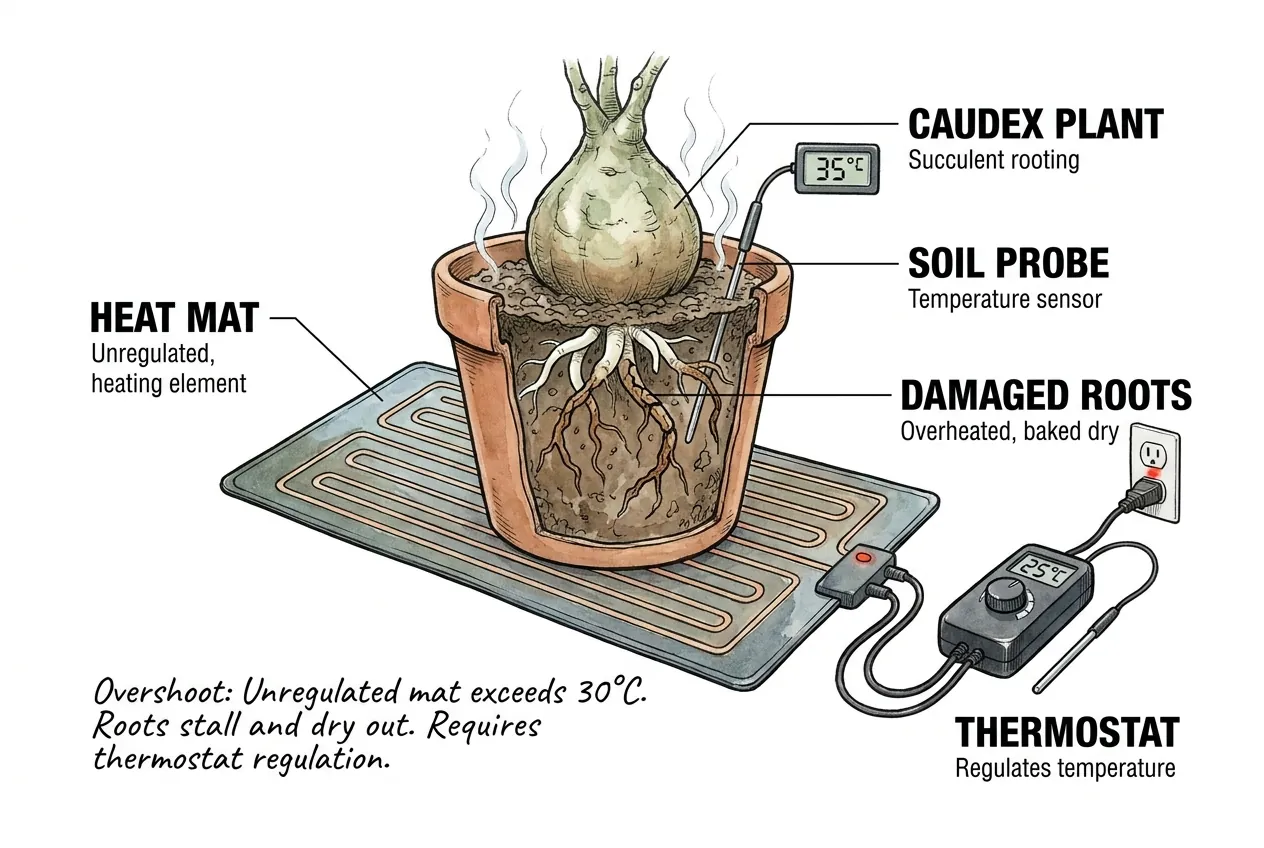
If the rooting zone reaches the 30°C trial stop line, stop heating and check sensor placement and thermostat operation before restarting. Do not infer root damage from that number alone.
Cold-wet rot
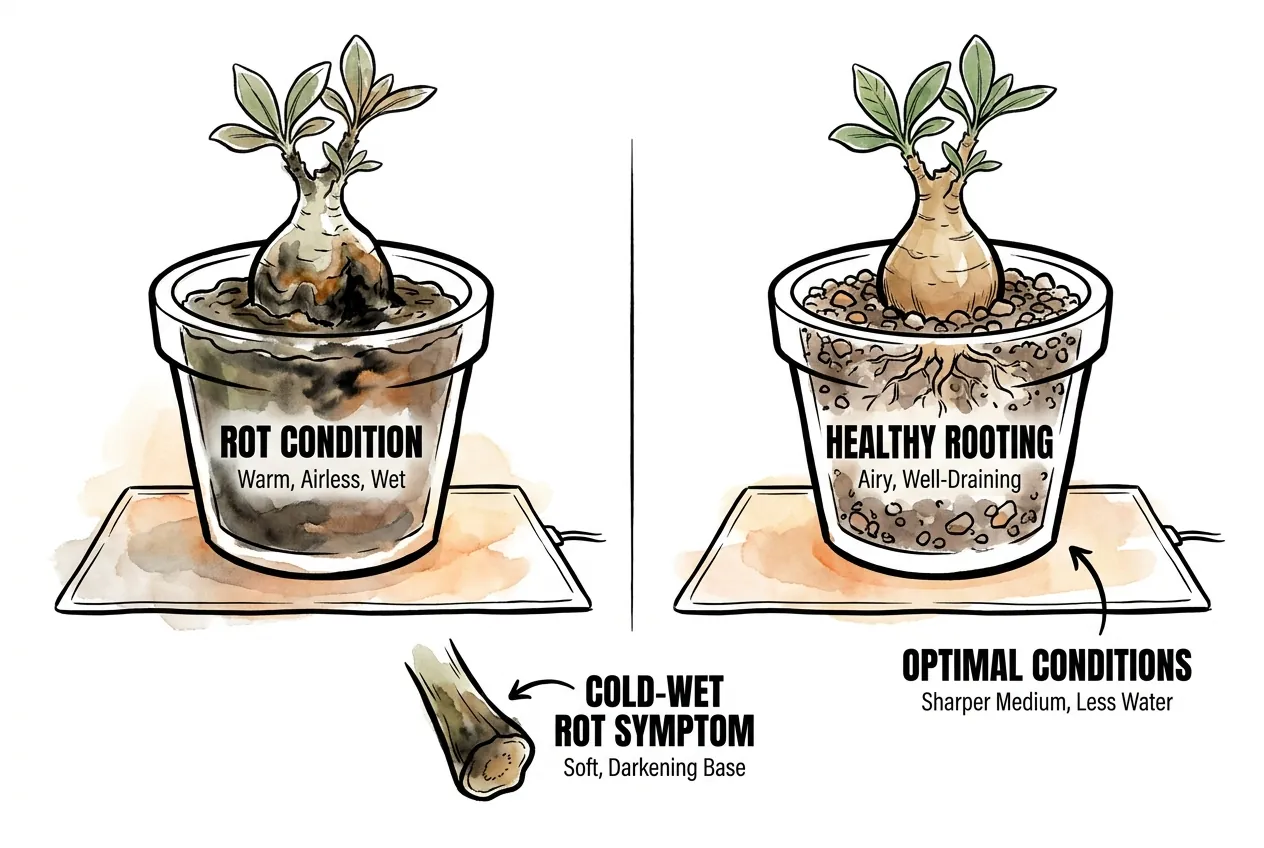
Persistently wet medium with a soft, darkening stem base needs tissue and root assessment. Isolate the plant and inspect as appropriate before changing the mix or simply watering less. Appearance alone does not identify the pathogen.
Silent probe error
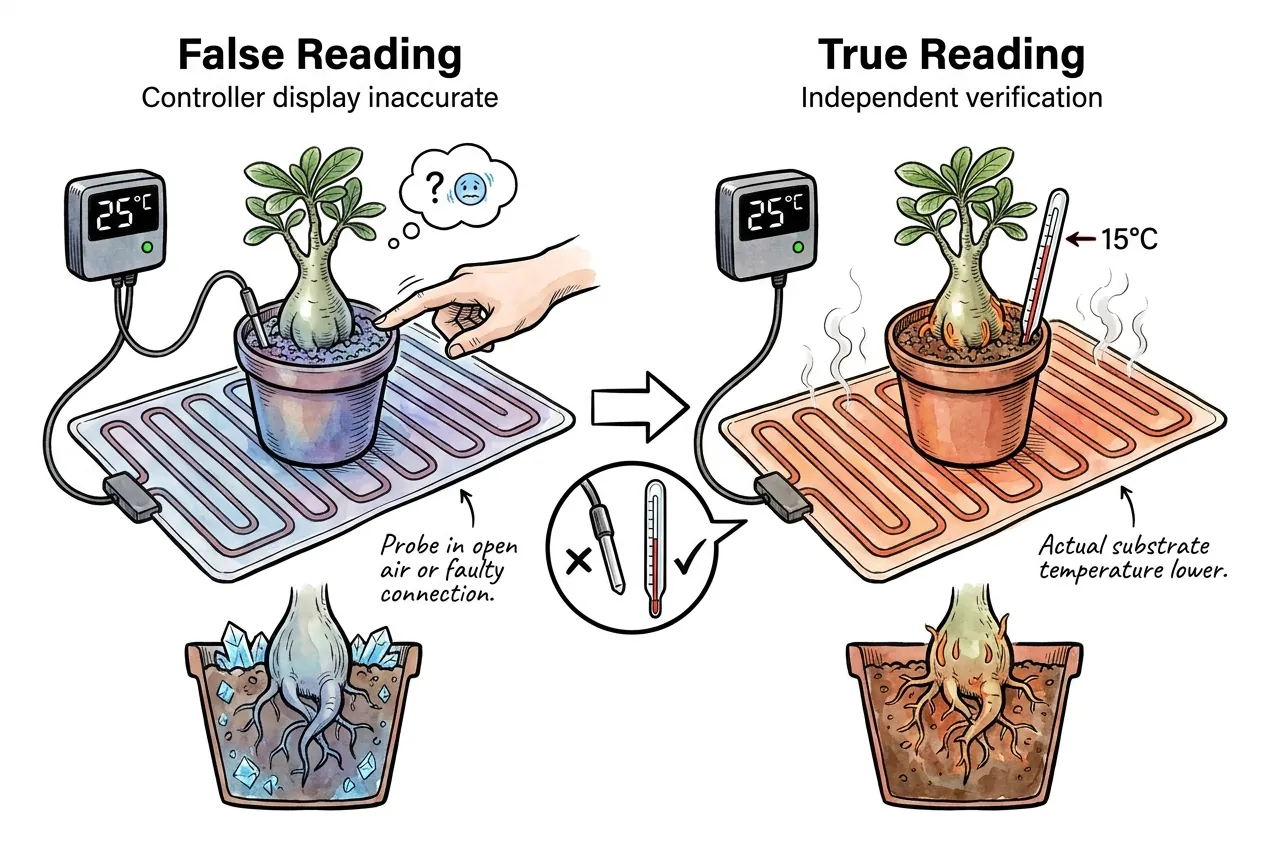
A probe on the mat surface or in open air feeds the controller the wrong number.
The substrate then runs too cold or too hot while the display looks fine. The fix is the verification step with an independent thermometer.
Dry-out
A heated pot can dry faster than expected. Check actual moisture and mass rather than adding a fixed few-day watering schedule. A shriveling plant in still-damp mix needs root assessment, not another pour.
When to replace hardware
Stop using a mat with cracks, damage, or unexplained hot spots. Before replacing an underperforming unit, check its permitted mounting, room temperature, load, and controller settings. Investigate sensor disagreement before assuming either instrument is correct.
Repeat the spare-pot check after correcting placement or changing equipment. Do not put the plant back merely because the display looks normal.
Who should skip part or all of this kit
Not every grower needs the full setup, and forcing it wastes money.
Skip the whole kit
Skip bottom heat entirely if your rooting room already holds the substrate at 70 to 77 F through the day and night. A spot-check with the thermometer settles this in a day.
Skip an oversized combo
Choose a mat sized for the occupied area. For one small pot, a compact compatible mat and controller may be sufficient. Compare the actual models rather than assuming a bundle is cheaper or safer.
Skip pure pumice
If the test pot dries faster than you can inspect it, choose a mix that retains more water while keeping adequate air space. Compare the actual dry-down rather than assuming every pumice mix requires the same schedule.
For the rest of the winter shelf, use the broader caudex overwintering setup guide and the companion on caudex soil temperature and autumn watering.
Common questions from winter-import growers
What temperature do caudex cuttings root at
About 25°C is a monitored starting target extrapolated from other plants. There is no single demonstrated optimum for all caudex imports. Confirm the rooting-zone temperature and adjust to species evidence where available.
Do I really need a thermostat, or is the mat enough
Use a compatible thermostat whenever supplemental heat is needed. A bare mat has no feedback from the pot, and its temperature rise changes with the setup. Verify the regulated temperature with an independent probe.
Can a sunny windowsill replace a heat mat
Sometimes the location already supplies enough warmth. Measure before lights-on and late in the day instead of deciding by the room temperature or the feel of a sunny leaf.
Why did my import rot instead of rooting
Inspect tissue condition, drainage, moisture, and the temperature record. Decay can arrive with an import or develop after injury, and a thermostat cannot rule it out. Isolate a plant with spreading wet softness before adjusting its rooting setup.
Affiliate Disclosure
This article contains Amazon affiliate links. As an Amazon Associate I earn from qualifying purchases. If you use these links, the site may earn a commission at no extra cost to you. Product availability, price, and specifications can change. Check the current listing before buying.