
Dormant Caudex Watering Measurement Kit: Scale and Gates
Dormant caudex watering measurement with a 1 g pot scale, substrate thermometer, and min/max hygrometer turns the winter water-or-wait call into numbers.
Rachel Torres · 2026-10-13 · Updated 2026-10-24 · 15 min read
Key Takeaways
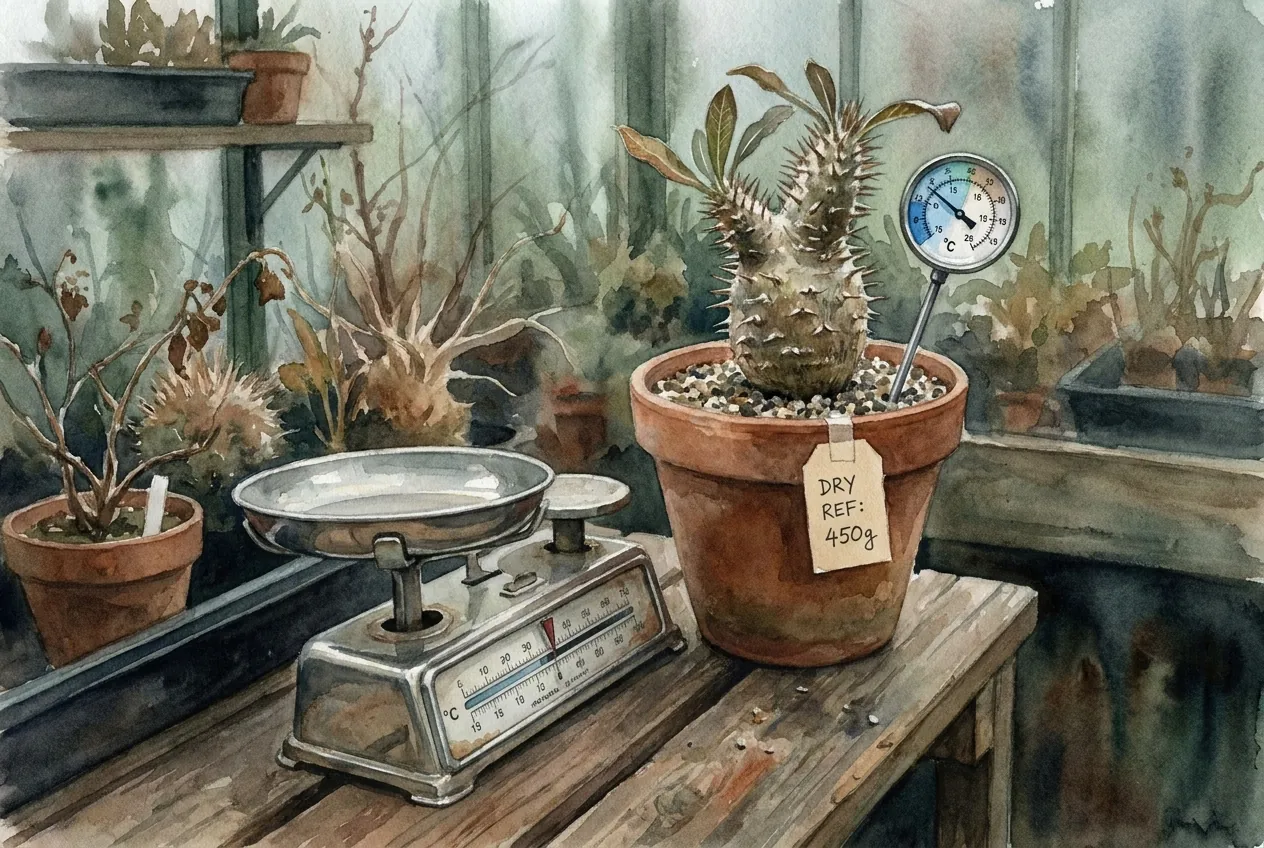
- Pot weight tracks changes in the whole setup. Compare with the same pot at its normal dry stage.
- For resting summer growers, pause optional water below the 15°C working line. Warmth alone does not authorize watering.
- The shelf’s recorded overnight minimum, not an evening reading, sets winter watering risk. Log seven nights.
- Resistance moisture meters misread pure pumice and gritty mixes. Use them only where the mix holds an organic fraction.
- Every role in the kit is covered by sub-$50 tools. Buy against the spec floor, not premium gear.
The watering decision that kills a dormant caudex in winter is usually made by feel. The pot looked dry, the plant looked thirsty, and the grower poured.
Three numbers replace that guess. The pot’s mass against a dry reference, the substrate temperature, and the shelf’s overnight minimum. All three are measurable with tools that cost less than one imported Pachypodium.
The short verdict on what to buy
Start with a kitchen scale if lifting the pot leaves you unsure. A 1 g display makes small changes easier to follow, but check repeatability before interpreting a few grams as water loss.
Add a substrate probe thermometer and a min/max thermometer-hygrometer. The thermometers decide whether watering is even allowed. The scale only decides whether the pot is dry.
Coarse mineral mixes can give inconsistent contact readings on inexpensive resistance probes. Use one only if it responds consistently across a known wet-to-dry cycle in your own mix. A scale and a root-zone temperature check are usually the more useful starting pair.
This kit is the dormancy-entry setup, built around the thresholds that shut a collection down safely.
The caudex watering tools comparison covers the year-round version of each measurement role.
Simple check with one label per pot
Label each pot with its species, whether it is growing now, and its usual dry-stage weight. Lift it without the saucer before deciding to water. An old label becomes invalid after repotting or adding stones, stakes, or other weight.
A firm resting caudex in dry mix does not need water just because it feels light. New growth, progressive even wrinkling, and localized wet softness lead to different decisions. Wet softness or a spreading lesion calls for inspection, not a top-up.
Why dormant caudex watering goes wrong without numbers
The failure is not too much love. It is three pieces of physiology working against intuition at the same time. Each one is measurable.
Your plant is running on stored water
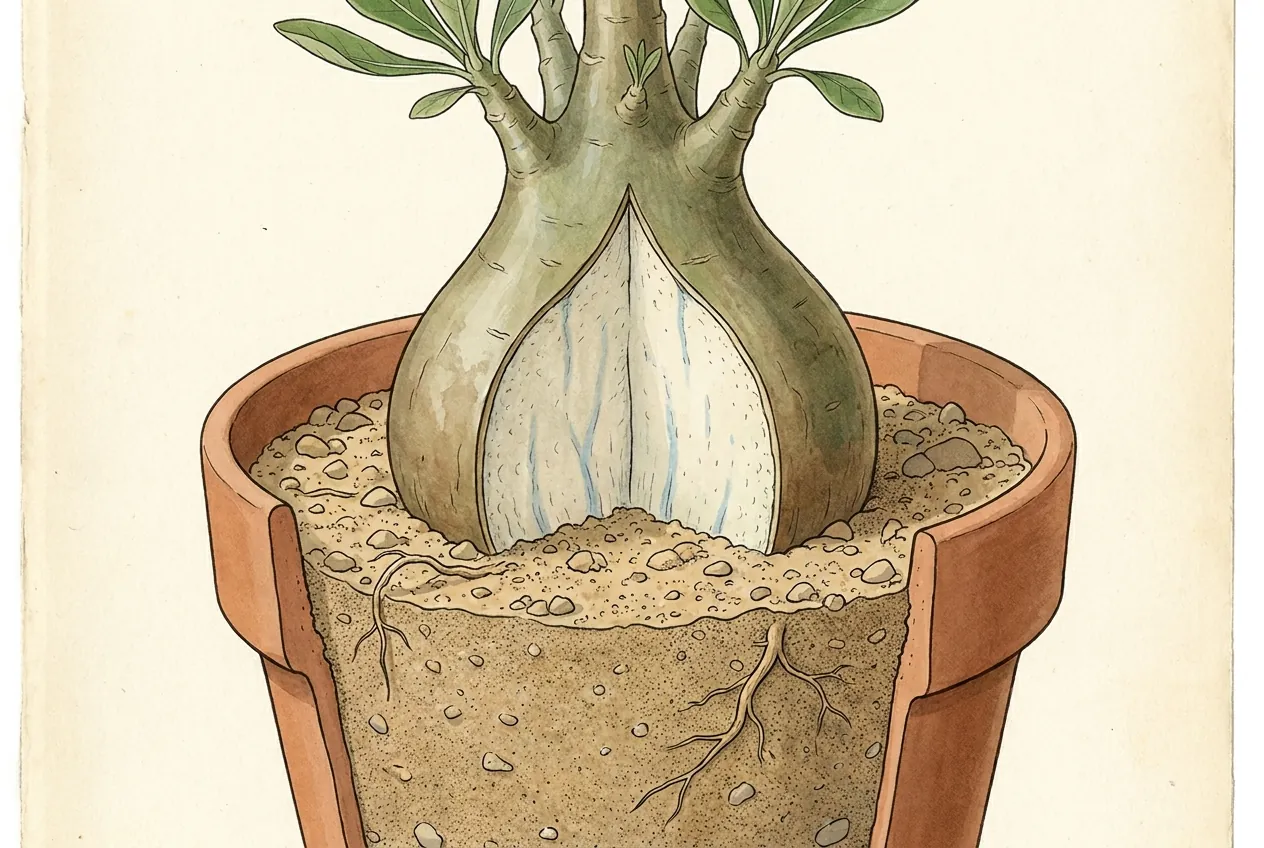
A caudex is a water tank. Succulent storage tissue holds enough reserve that these plants maintain high internal water status through drought that would kill a leafy shrub.
Research on succulent water relations shows stored water buffering tissue water potential while the surrounding soil dries out.
In plain terms, the plant stays internally hydrated long after the soil is bone dry. A dormant caudex does not need moist soil to survive the winter.
Mild even wrinkling during rest can reflect stored water use. Progressive softness needs inspection for both dehydration and root damage before any watering decision.
Cold, dry roots stop drinking
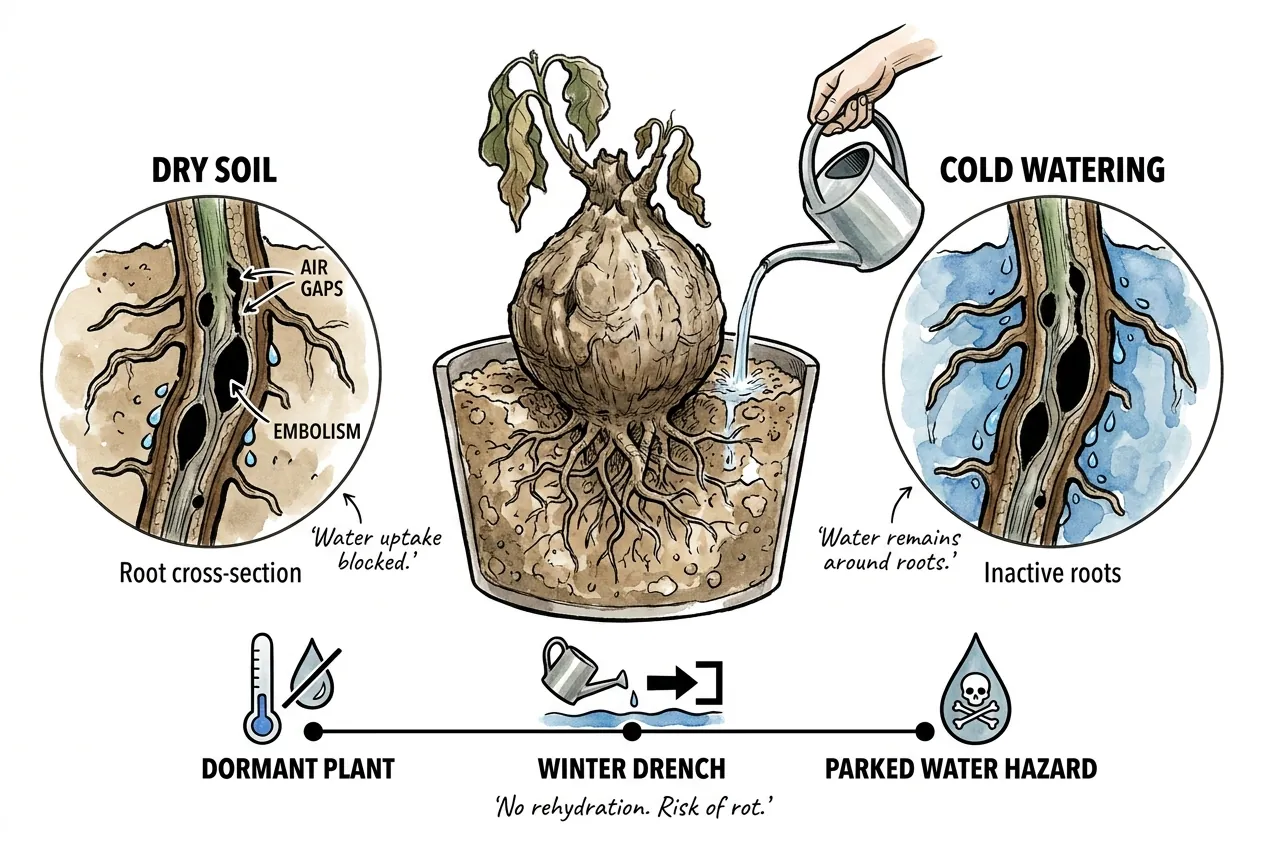
Desert succulent roots behave like one-way valves. As soil dries, their hydraulic conductivity collapses through suberization, air gaps, and embolism, which protects the plant from losing water back to dry soil.
The practical consequence is brutal for winter watering. Water poured into a cold, dormant pot is barely taken up. Studies on Agave and cactus roots show conductivity falling as much as 20-fold in dry soil, with recovery depending on new root growth that dormant plants are not doing.
So a winter drench does little to rehydrate the plant. It mostly parks water around inactive roots, and parked water is the actual hazard.
Cold plus wet is the combination that kills
Root-rot organisms do not sleep through winter. Cool-season Pythium root rot is active at air temperatures of roughly 55 to 70 F when media stay wet.
Controlled work found one species, Pythium torulosum, more aggressive at 13 C than at 23 C, so cold does not switch the risk off.
Phytophthora management guidance says the same thing from the other direction. The disease is most common in wet, over-irrigated media, so the control is drainage and water management.
A cold pot stays wet for weeks because evaporation is slow and the dormant roots are not pulling water out.
That is why dryness alone cannot authorize watering. The full mechanism and the rescue options once rot is suspected are covered in the cold wet soil and caudex root rot guide.
The specs that decide each tool
Every tool in this kit is bought against one measurable spec floor. Meet the floor and the cheapest unit works. Miss it and no price fixes the gap.
| Role | Spec floor | Why that number | Skip it when |
|---|---|---|---|
| Pot-weight scale | 5 kg capacity at 1 g resolution | Resolves day-scale water loss of a few grams on a 1-3 L pot | Watered pots exceed about 4 kg (buy a 10 kg class) |
| Moisture probe | Probe reach of 7 in (180 mm) or more | Reads the root zone of deep pots, not the misleading top inch | Mix is pure pumice, akadama, or gritty mineral |
| Substrate thermometer | Range covering 0-50 C, about plus or minus 1 C | Gates the cold-wet rule at root level | A checked controller probe already measures the same rooting zone |
| Min/max thermometer-hygrometer | Records overnight minimum at the shelf | The minimum, not the evening reading, sets the risk | You already log that shelf with a smart sensor |
Match capacity to your heaviest watered pot and probe reach to the actual rooting zone. A larger measurement range is not useful if you cannot resolve the temperatures you need.
The four tools inside the water-or-wait decision
Each tool answers one question in a fixed order. The temperature gates rule on whether watering is allowed at all, and only then does the scale rule on dryness. The plant itself gets the final vote.
Measured check using the wet-to-dry difference
Pot mass tracks water only while the plant, pot, mix, and accessories remain comparable. Keep the same label and support, remove the saucer, and note any fallen leaves or lost mix. Do not dry a healthy plant excessively to manufacture a reference.
- During a normal watering in active growth, drain for 60 minutes and record wet mass W. Do not drench a dormant plant merely to calibrate a scale.
- At its next normal dry stage, record dry-reference mass D. Confirm accessible deep mix is dry and compare three morning readings. A flat weight curve alone can also mean slow evaporation from wet mix.
- Lift and replace the pot three times. Use the largest reading spread from these sessions as repeatability error E. If E exceeds
0.05 × (W − D), improve the weighing setup before using a percentage threshold. - For an established resting plant, flag dryness for inspection when current mass is no more than
D + 0.10 × (W − D). Still require dry deep mix, suitable temperature, and a plant-based reason to water.
For example, W of 1,300 g and D of 1,100 g give a 200 g observed water swing. The review line is 1,120 g, regardless of how heavy the empty pot is. The 10% band prompts a check near the dry end of the observed cycle. Limiting scale variation to half that band keeps measurement noise smaller than the decision allowance. Neither number measures actual moisture percentage or authorizes watering.
Keep only a dry-stage reference if no normal wet reference exists. Do not invent the missing value. An uncertain deep-moisture check means wait, and a new pot or major leaf change means the reference needs rebuilding.
Check what left the scale
Collect fallen leaves before weighing if they were included in the previous reading. Weigh them immediately and log their mass separately, then remove them from the growing area. Leaf fall can make a resting pot look as though it is using water faster.
For example, a 12 g fall in pot mass with 10 g of freshly fallen leaves leaves only 2 g unexplained. If repeated placement varies by 3 g, that change is too small to interpret. Missing leaves or spilled grit invalidate a precise comparison until a new dry reference is recorded.
A long probe helps only in organic mixes
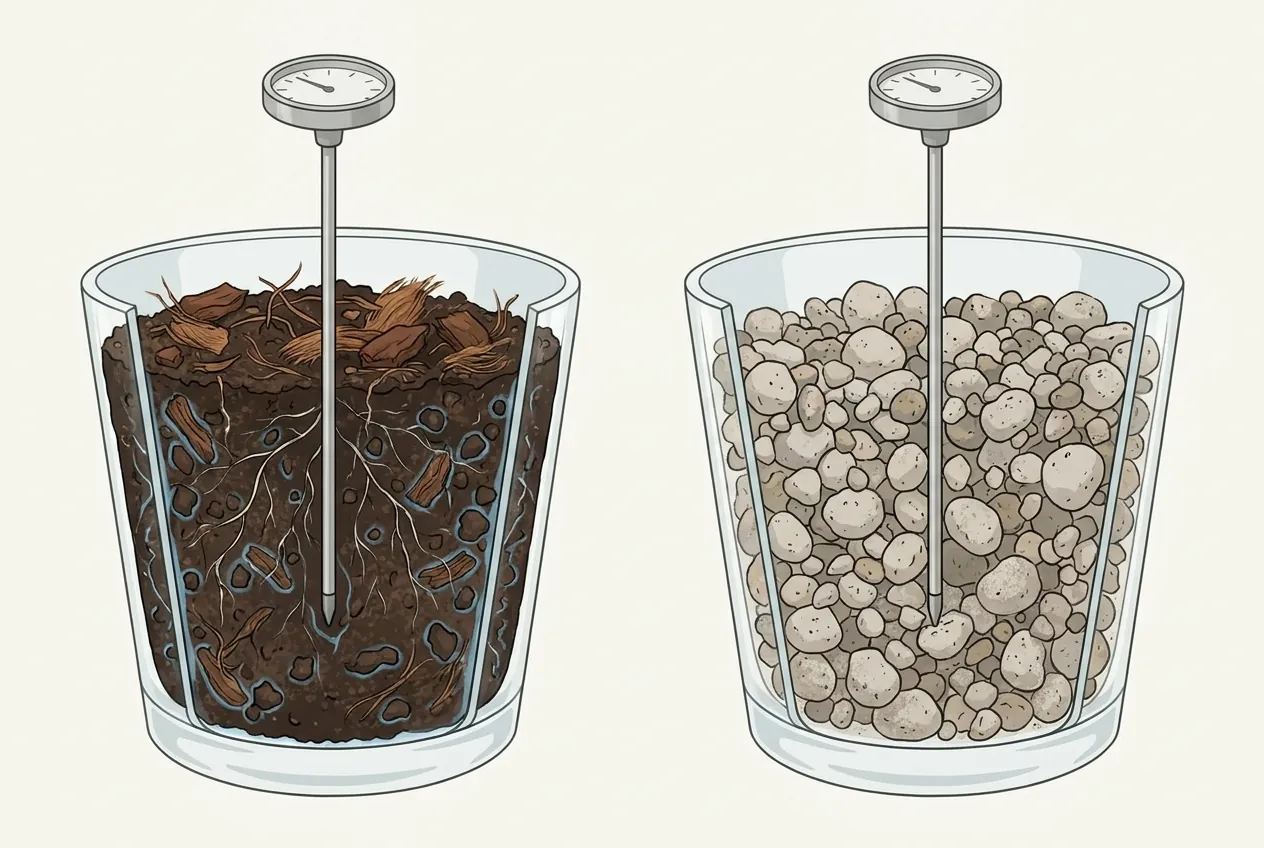
The familiar battery-free moisture meter is a resistance device. Moist substrate carries a weak current between the probe’s metal zones and moves the needle. The reading depends on continuous, ionic water touching the probe.
Coarse mineral mix breaks all of that. The probe meets air gaps instead of a water film, the mix is low in dissolved ions, and much of the water hides inside porous particles.
Published sensor tests show that low-cost readings depend on substrate properties. In coarse mineral mix, poor contact can produce a low reading even with retained water. Do not let a dry-looking dial override a heavy pot or damp deep mix.
In mixes with a bark, coir, or peat fraction the meter becomes a fair triage tool, and there the spec that matters is reach.
The XLUX long-probe moisture meter carries a manufacturer-listed 10.23 in probe, well past the 7 in floor, and needs no batteries.
It ships as a 2 pack, which is more than a one-windowsill grower needs. Treat its 1 to 10 dial as comparative within one pot over time, not as a percentage.
Probe discipline keeps readings honest. Insert to root depth, read within a minute, then wipe the probe dry. A probe stored in soil corrodes and drifts low.
A substrate thermometer enforces the cold gate
Air temperature at the thermostat is not root-zone temperature at the glass. The substrate tracks the shelf, lags the air, and holds cold through the morning. The number that gates watering lives in the pot, not on the wall.
For established, resting summer growers, use 15°C as a conservative pause line for optional watering, not a universal safe temperature. Pythium activity at 13°C shows that cold is not protective. Raising the pot above 15°C does not eliminate pathogens or authorize watering.
A substrate thermometer must resolve the chosen threshold at its stated insertion depth. A broad 0 to 220°F analog dial may be too coarse for this decision. Use a suitable probe in the pot even if a tent controller already measures air.
Measure the same marked root-zone point before sunrise or lights-on for three mornings. If a reading minus the instrument’s stated error falls below 15°C, hold optional water and improve the position. Repeat the checks after a cold spell or a move.
A min/max gauge finds the shelf’s true minimum
An 8 pm spot reading overstates safety. Setback thermostats and radiative cooling at the glass bottom the shelf out near dawn, hours after the room felt fine. Only a recording sensor catches that minimum.
Extension overwintering guidance keeps resting cacti and succulents cool and dry, watered only enough to prevent shriveling.
Arkansas extension calls a cool greenhouse held at 45 to 50 F ideal for overwintering most caudiciforms.
Do not apply a single cool-greenhouse range to every species. Record the minimum at the actual shelf and compare it with the plant’s needs. A winter-growing vine and a leafless summer grower need separate watering decisions.
The TempPro TP50 hygrometer covers the role at a manufacturer list price of 15.99 dollars.
Its listed specs are accuracy within 0.5 C, a range of minus 50 to 70 C, and humidity reading from 10 to 99 percent.
Its high and low memory holds until manually cleared rather than logging by timestamp. That design needs one habit. Clear the memory at lights-out and the morning display is your overnight minimum.
Growers who want graphed multi-week history should buy a Bluetooth logger class instead. One sensor only ever represents one shelf.
Log seven nights at pot height, resetting the memory every evening. If comparing the shelf and room, use simultaneous readings from two checked instruments rather than an overnight shelf minimum against a daytime thermostat.
A 3°C gap is a useful prompt to investigate placement, not a safety boundary. Any minimum below the species’ chosen limit calls for a warmer position even when the room-to-shelf gap is small. See the overwintering setup guide for layout changes.
Set up the log before the next watering
Record the shelf minimum, root-zone temperature, pot mass, and visible tissue condition on one line per visit. Missing or conflicting measurements mean investigate, not average them into permission.
For a small established summer grower with progressive even wrinkling, fully dry mix, a firm base, and suitable warmth, a trial pour can be 5% of mix volume. A pot containing 1 L of mix gets 50 mL around the perimeter, followed by complete drainage.
The small dose limits the initial water load during uncertain uptake. It does not guarantee a dry center. Weigh after drainage and again after 48 hours, then withhold repeats until deep mix is dry and the plant has been reassessed.
Stop the trial if a wet lesion appears or the plant declines despite damp mix. Rootless imports, seedlings, active winter growers, and species requiring a strict dry rest need their own routines. Fockea is not a blanket winter grower, as the Fockea and Dioscorea comparison explains.
Who should skip each tool
Each tool below has a population that genuinely does not need it.
| Tool | Skip it when | What covers you instead |
|---|---|---|
| 1 g scale | You keep one or two small plants in light pots | The extension hand-lift test, done consistently |
| Long moisture probe | Your mix is pure mineral, or pots are under 5 in deep | The scale, or a finger to root depth |
| Substrate thermometer | A suitable controller probe already measures the same rooting zone | That root-zone sensor, checked independently after setup changes |
| Min/max hygrometer | A smart logger already records that exact shelf | The existing logger’s minimum |
Readers escalating past measurement should route the budget elsewhere. Weak winter light is a light problem, measured before buying anything per the PAR meter guide.
Root-zone heating decisions live in the heat mat for caudex guide rather than in this kit.
Maintenance, failure modes, and replacement
Cheap instruments fail quietly, and a quiet failure in January costs plants. Each tool gets one check at dormancy entry and one habit through the season.
Check scale repeatability by weighing the same stable object three times. A sealed water bottle is not a calibrated mass because its packaging also weighs something. Use a known calibration weight if you need an accuracy check.
The moisture probe gets wiped clean and dried after every insertion and is never stored in soil.
Galvanic probes wear out with use, so test against a known-wet organic pot each fall. When that wet pot reads low on the dial, the meter is spent and gets retired.
The bimetal soil thermometer can lose calibration when dropped. An ice-water check should read 0 C, and the dial needs about a minute in substrate to settle.
The min/max unit runs on one AAA that gets replaced every fall, because its memory and your log die with the battery.
A humidity display that never changes means a stuck sensor, which is a replacement signal rather than a repair.
Dormancy watering measurement FAQ
Choose tools that answer a measurement your current setup cannot already provide.
Can a wooden skewer replace the kit?
In an organic mix a skewer answers damp or dry, and that is all. It reads nothing in mineral mix, says nothing about how much water remains, and knows nothing about temperature.
It substitutes for the probe at best, never for the scale or the gates.
Do I need all four tools?
No. The scale plus the min/max gauge covers a pure-mineral collection on a shelf that logs warm.
Add the substrate thermometer for cold sills and unheated rooms, and add the probe only when your mix holds an organic fraction.
Is a Bluetooth smart sensor better than a basic min/max gauge?
A logger with an air sensor records shelf conditions. A model with a suitable substrate probe may also record root-zone temperature. Check the sensor type and placement rather than assuming an app measures the pot.
Is there one safe temperature below which you never water?
No. The 15°C pause line here applies to optional water for resting summer growers. It is a cautious operating choice, not a pathogen-free temperature or a rule for active winter growers.
What about a half-organic, half-mineral mix?
Use both signals. The probe gives usable comparative readings in the organic fraction, while the dry reference weight still carries the real decision.
The scale works in every mix, which is why it is the first purchase.
Affiliate Disclosure
This article contains Amazon affiliate links. As an Amazon Associate I earn from qualifying purchases. If you use these links, the site may earn a commission at no extra cost to you. Product availability, price, and specifications can change. Check the current listing before buying.