
Overwinter Adenium in a Garage: The 40 °F Floor and Weigh-In
Overwinter adenium in a garage only leafless, dry, and above 40 °F at pot height. A 7-night thermometer log and a monthly weigh-in tell you when to act.
Derek Kim · 2026-11-07 · 20 min read
Key Takeaways
- Only a leafless, firm, mature, bone-dry Adenium belongs in a dark garage.
- 50 °F (10 °C) is the no-water line. Below it, the plant gets no water while it stays in the garage.
- My storage floor is 40 °F at pot height. Adenium is not freeze tolerant below 32 °F.
- Log the exact shelf for 7 nights. My rule passes it only if every minimum reads 42 °F or higher.
- Weigh monthly against a dry baseline. Past 5% loss with wrinkling, move it indoors. Never water in the garage.
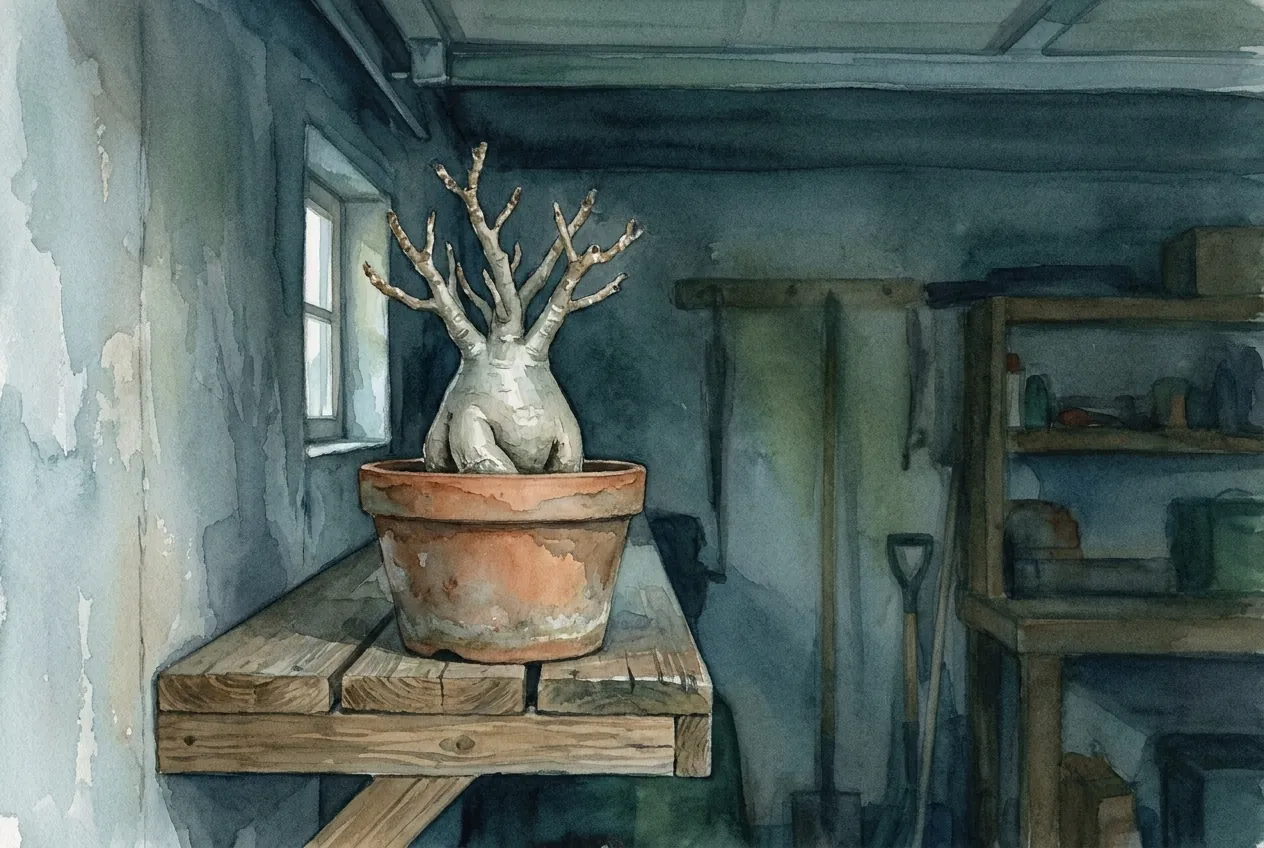
Yes, a desert rose can spend winter in a dark garage. It has to go in leafless, bone-dry, and mature, parked in a spot you have actually measured. Treat the garage as a waiting room, not a greenhouse.
The number most growers quote is doing the wrong job. 50 °F (10 °C) is the no-water line, not the survival floor.
Many tropical plants suffer chilling injury below 50 °F. A cold, wet Adenium is in trouble, while a cold, dry one is mostly waiting.
The storage floor I use is 40 °F (4.4 °C) at pot height, and freezing is the hard stop. Two routines make the plan work. A seven-night thermometer log decides whether the garage qualifies, and a monthly weigh-in decides whether to do anything at all, which is usually nothing.
50 °F Is the No-Water Line, Not the Survival Floor
Adenium has three temperature lines, and each one controls a different decision. Mixing them up gets healthy plants watered into rot.
Three temperatures with three different jobs
UF/IFAS rates Adenium obesum chill tolerant from 55 °F down to 35 °F, with leaf yellowing and leaf drop as the expected cost.
The same fact sheet says it is not freeze tolerant below 32 °F. It also tells growers to withhold water and let the plant rest for 3 to 4 months in winter.
A second UF/IFAS page calls desert rose sensitive to temperatures below 40 °F. That page names a specific cold limit for desert rose itself, so it anchors the storage floor in the table below.
The 50 °F figure is real, but it belongs to tropical plants in general. UF/IFAS gives it as the point where many tropicals begin to suffer chilling injury. The University of Arizona Campus Arboretum adds that Adenium should not be exposed below 50 °F for long periods of time.
My reading of those sources is that the 40 to 50 °F band is tolerable only when the plant is dry.
The UA warning is about long exposure, so a spot that hovers near 50 °F is the safer garage.
| Night minimum at the pot | What it means for a leafless, dry Adenium | Basis |
|---|---|---|
| Nights falling to 55 °F (13 °C) | Start prep. NC State brings Adenium indoors at 55 °F | NC State Extension |
| Below 50 °F (10 °C) | No-water line. Zero water while it stays in the garage | UF/IFAS chilling line, UA Campus Arboretum |
| 42 °F (5.6 °C) or higher every night | The spot passes my seven-night garage test | Author house rule |
| 40 °F up to just under 42 °F | Marginal. Treated as a fail | Author house rule |
| Below 40 °F (4.4 °C) | The spot fails. Move the plant | UF/IFAS sensitivity line, author floor |
| Below 32 °F (0 °C) | Hard limit. Adenium is not freeze tolerant | UF/IFAS EDIS |
The 40 °F floor and the 2 °F margin above it are my house rules, not a published kill threshold.
I want room for a thermometer that reads slightly warm and a night that runs colder than the forecast.
Below 50 °F the plant gets no water at all, and below 40 °F at pot height the spot fails.
Only a Leafless Adenium Belongs in the Dark
Darkness is safe for a sleeping plant and costly for a working one. The deciding factor is the plant’s leaves, not the calendar.
A bare plant lives on what the caudex stored
UF/IFAS describes the winter rest plainly. All leaves and flowers drop, and that is part of the plant’s natural cycle. A bare Adenium has almost nothing left that needs light.
Green stem tissue can recycle some of its own respired carbon, but only when light reaches it. In a dark garage that small bonus disappears. The plant pays its upkeep from water and sugar stored in the caudex instead.
Think of the caudex as a pantry while the shop is closed. Respiration slowly draws down the stored carbohydrate, and a large, firm caudex holds more than a thin one.
Respiration slows as tissue cools, so a cool shelf stretches reserves further than a warm, dark closet.
Here colder is better, as long as the spot stays above the floor.
Plants that should stay in the light
A plant still in leaf does badly in the dark. University of Missouri IPM explains that when respiration uses more food than photosynthesis makes, the plant stops growing and loses leaves.
In a garage, it spends reserves on leaves it will drop anyway.
Maryland Extension gives two routes for tropicals such as hibiscus and mandevilla. One is a bright indoor spot, and the other is frost-free dormant storage with little or no light.
For Adenium, the bright spot is the default and the garage is the conditional fallback.
I keep these plants out of the garage whatever the weather does.
- Seedlings and young plants with a caudex thinner than a thumb, because a small reserve has less to spend.
- Plants still in full leaf in late autumn, including hybrids that barely go dormant.
- Any plant pushing new shoots or flowers.
- Plants repotted in the last few weeks, since broken roots and cool mix favor rot.
- Any plant with a soft spot or a recent rot treatment.
If pale, stretched shoots appear in storage, the spot is too warm or the rest has ended. Move that plant to bright light and treat it as awake.
Prepare the Plant Before the First Cold Night
The garage stay starts outdoors, before the move. A plant that goes in dry, bare, and clean gives the monthly checks little to fight.
Time the move from the 55 °F forecast
NC State brings Adenium indoors when outside temperatures reach 55 °F and cuts water while the plant is dormant.
Iowa State uses nights that dip consistently to around 50 °F as its general signal to bring houseplants in.
My timing uses both numbers. The first forecast run of 55 °F nights starts prep, and the plant comes indoors before nights reach 50 °F.
That window gives the leaves time to yellow while the plant is still above the no-water line.
Indoors, it waits in a bright, dry room with no water. It moves to the garage only after the shelf passes the seven-night log described below.
Iowa State also says to check for insects before the move and to keep plants isolated for 3 to 4 weeks.
Keep the waiting spot away from your other houseplants for that stretch. The full routine is in the caudex pest gate before bringing plants indoors.
Dry it down and let the leaves fall on their own
Skip the farewell soak. A firm, leafless plant in dry mix goes in as it is, and the last watering before caudex dormancy covers how to time that final drink.
Let leaves yellow and drop on their own. Yellowing is the plant pulling resources back before it lets a leaf go. Stripping green leaves wastes that and leaves fresh wounds.
Clear fallen leaves off the mix. UC IPM notes that gray mold invades through injured tissue or a food base such as a fallen leaf.
Its spores need free moisture to germinate, and it can grow from about 28 °F, so cold only slows it. Leave the plant unwrapped, since plastic traps condensation.
Qualify the Exact Garage Spot With a Seven-Night Log
Garages vary far more than people expect. Iowa State calls an attached, unheated garage suitable for hardy dormant plants only if it stays in the 20 to 45 °F range.
It also warns that many structures get much colder than 20 °F at night.
That whole range sits below the tropical chilling line, so a garage that is fine for potted shrubs proves nothing for Adenium.
Iowa State’s own advice is to monitor and adjust temperatures inside the structure. The log below turns that advice into a pass or a fail.
A shelf on the house wall beats the floor by the door
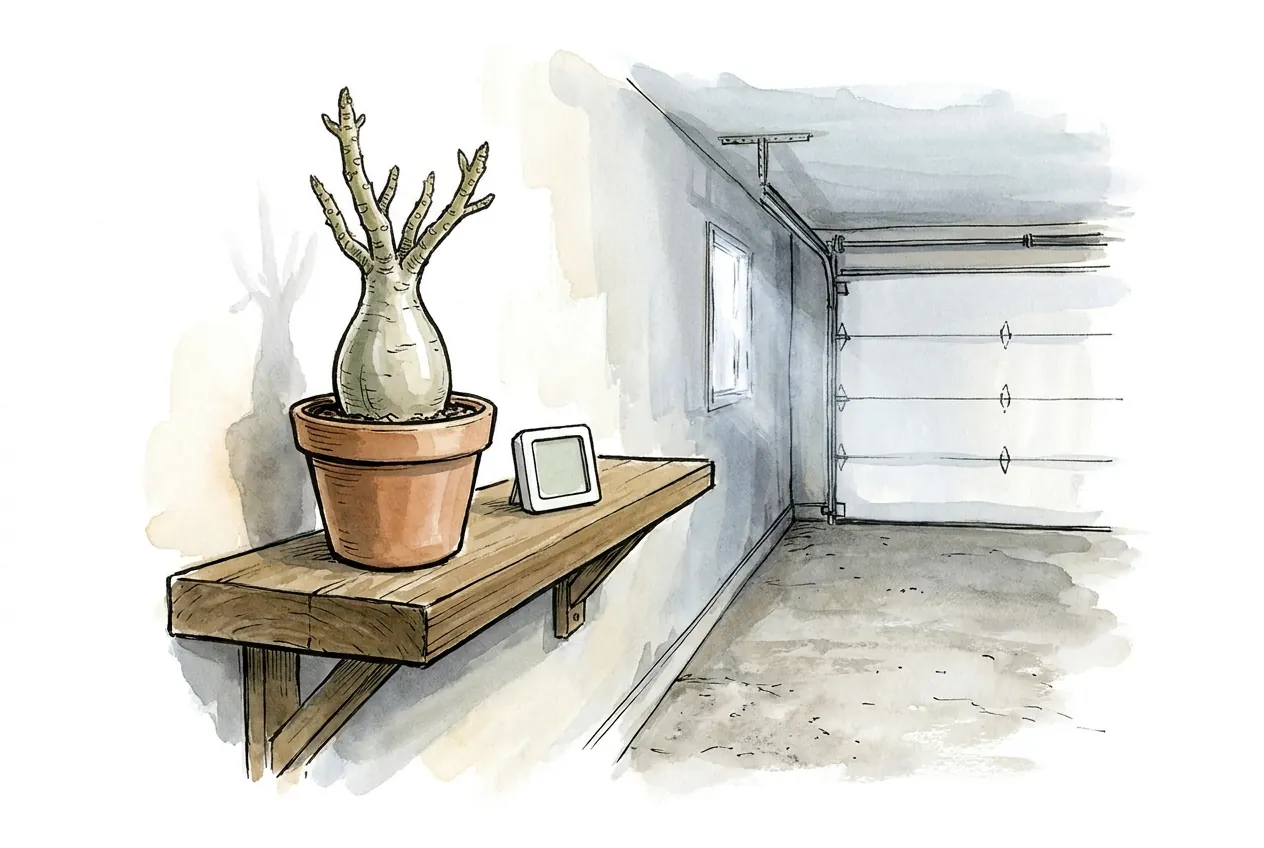
UF/IFAS warns against placing tender plants where cold air collects. Radiating surfaces can also get colder than the air above them. In a still garage, the slab by the overhead door is the likely cold spot.
The shared house wall is the one surface leaking any warmth. A shelf against that wall, off the floor and away from the door, is where I look first.
The size of the gap is not published for garages, which is exactly why the thermometer goes in the spot itself.
The outdoor forecast describes open air somewhere else. Use it as a trigger for re-reading the garage, never as a stand-in for the garage reading.
The seven-night thermometer test
I qualify a spot before the plant ever moves in. The tool is a digital min/max thermometer, and the measured value is the overnight minimum air temperature at pot height in the exact storage spot.
The caudex overwintering setup guide covers how to choose one.
The sensor sits where the pot will go, off the slab and not touching a wall. Then the log runs like this.
- Start on the first night the forecast low drops below 40 °F.
- Read and reset the thermometer at the same morning time for 7 consecutive nights.
- Write down the garage minimum, that night’s outdoor low, and whether the door opened overnight.
- Compare every garage minimum against 42 °F (5.6 °C).
The spot passes only if all 7 minimums read 42 °F or higher. Any minimum below 42 °F fails it, even by a single degree. After a fail, move the pot higher, nearer the house wall, or elsewhere, then run a fresh 7 nights.
Why 42 °F and not 40 °F? A reading within 2 °F of the floor leaves no room for a warm-reading thermometer or a door left open.
Failing a marginal spot in October beats discovering the problem in January.
Turn the test week into a winter re-check trigger
Each morning of the test, subtract the outdoor low from the garage minimum. That difference is the buffer, the warmth the garage added that night.
Keep the smallest buffer of the week, because it is the cautious case. Subtract it from 40 °F and you get the outdoor low at which this spot would reach the floor.
If the tightest night showed an 18 °F buffer, the spot would hit 40 °F at an outdoor low of 22 °F.
The thermometer gets re-read the morning after any forecast low at or below that trigger. It also gets re-read after any forecast colder than the coldest night in the test week, since the log never covered that range. All winter, I read and reset it once a week.
Fix a failing spot by moving the plant, not heating the garage
When the log fails, the safe fix is relocation. A heater in a garage brings risks that a dormant plant does not justify.
EPA lists unvented kerosene and gas space heaters, and car exhaust from attached garages, as carbon monoxide sources.
It repeats the warning never to run a generator in a garage, even with the doors open, and says not to idle the car inside.
Park the plant well away from the tailpipe zone and any fuel-burning appliance. Keep it off the shelf that holds fuel cans, herbicides, and solvents too.
If you run an electric heater anywhere, USFA says to keep anything that can burn at least 3 feet from all heat sources.
It also says to turn space heaters off when leaving the room. Safe ways to add warmth indoors are in the caudex winter warmth setup.
A spot that fails the log gets a different spot, not a heater.
The Monthly Weigh-In Usually Tells You to Do Nothing
UF/IFAS tells growers to withhold water from Adenium for a 3 to 4 month winter rest. That makes the scale a surveillance tool, not a watering calendar.
There is good reason to expect small numbers. In a dry forest study, leafless deciduous trees, including a stem succulent, ran sap flux close to zero. A large monthly drop is the exception worth noticing.
Wisconsin Horticulture advises checking stored dormant plant parts monthly for dehydration and soft spots. A monthly visit with the pot in hand follows the same idea. The percentages below are my house rule, not a published standard.
Setting the dry baseline weight
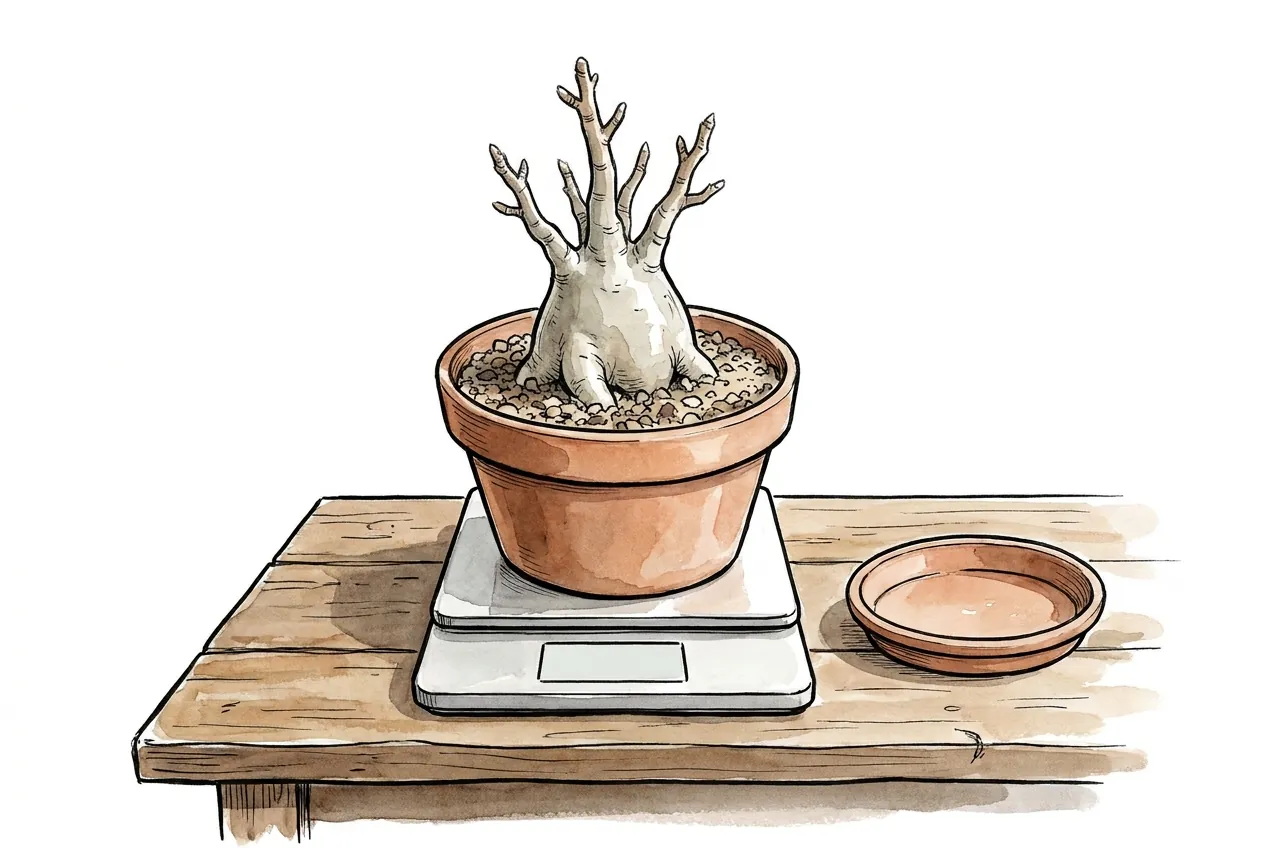
The measured object is the whole assembled pot, meaning pot, dry mix, plant, and tag, with the saucer removed.
It goes on the same 1 g kitchen scale every time. Scale choice is covered in the dormancy watering measurement kit.
Start after the last watering and the full dry-down, once leaf drop has finished. Weigh the pot, wait 7 days with no water, and weigh it again.
The second reading becomes the baseline, B, once it sits within 1% of the first and the caudex base is firm.
A bigger drop means the mix is still drying, so wait another week and repeat.
Test the scale before trusting it. Lift and reweigh the same pot 3 times, and the spread must be no more than 1% of B. On a 1,500 g pot, that means 15 g or less.
Reading the monthly number
I weigh on the same date each month, with the same scale on the same surface.
Then the caudex base gets a gentle thumb press and the stems get a quick pest look.
Loss is how far the pot has fallen below B, as a percent of B. In numbers, loss equals B minus today’s weight, divided by B, times 100.
- Loss up to 3% of B with a firm base is normal. Do nothing.
- Loss greater than 3% with a firm base still gets no water. Recheck in 2 weeks instead of 4.
- Loss greater than 5% with even wrinkling and a firm base means the plant leaves the garage.
- Loss greater than 5% with no wrinkling stays in the 2-week recheck loop. Wrinkling moves it to the line above.
- In either 2-week loop, two rechecks in a row that move less than the scale’s 1% spread return the plant to monthly weighing.
For a 1,500 g baseline, the 3% line sits at 1,455 g and the 5% line at 1,425 g.
Pot and dry mix make up most of that weight, so a few percent is a large share of the plant’s own water.
The two-step band also leaves room for normal, reversible shrinking of storage tissue before anything happens.
Cold roots explain why any rescue happens outside the garage. A review of low root temperatures reports a dramatic drop in water uptake for chilling-sensitive herbs as roots cool.
Water poured into a cold pot mostly just lengthens the wet period.
A plant past 5% with even wrinkling moves where the root zone stays at 15 °C (59 °F) or warmer, the measurement kit guide’s house line.
Only there does it get a small trial pour of about 5% of the mix volume. After that drink, I take a new baseline.
Water never goes into a pot that is still in the garage.
Rot signals that override the scale
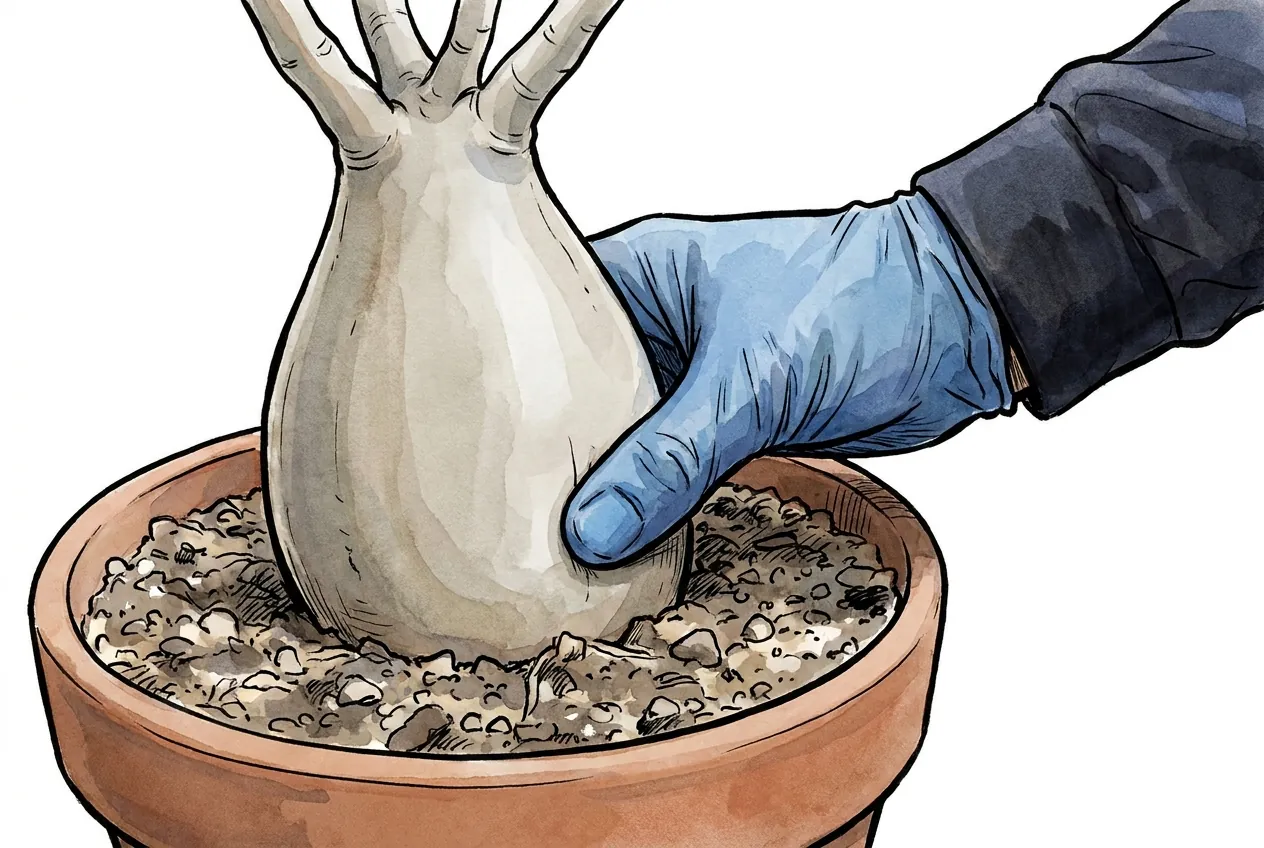
Some readings point to rot risk, and none of them earn water.
- Any unexplained gain of more than 1% of B over the previous reading. A dormant, leafless plant has no honest way to add mass, so check for condensation, a leak, or a wet saucer.
- A loss over any 4-week stretch that runs more than 2 percentage points larger than the loss over the 4 weeks before it.
- Any soft spot at the caudex base.
A fast drop is not automatically thirst, since rot can drain water from tissue. UC IPM links Pythium infection to soil moisture at 70% or more of available water capacity.
Some Pythium species are active only in cold soil, and infected bulbs can even dry into hard mummies.
Press lightly enough to leave no dent, and never squeeze a soft pocket. The soft caudex firmness map shows how to read what you feel, and the Adenium root rot rescue covers what to do next.
Why cold, wet mix is the classic setup is explained in cold wet soil and caudex root rot.
A two-minute pest and hazard look
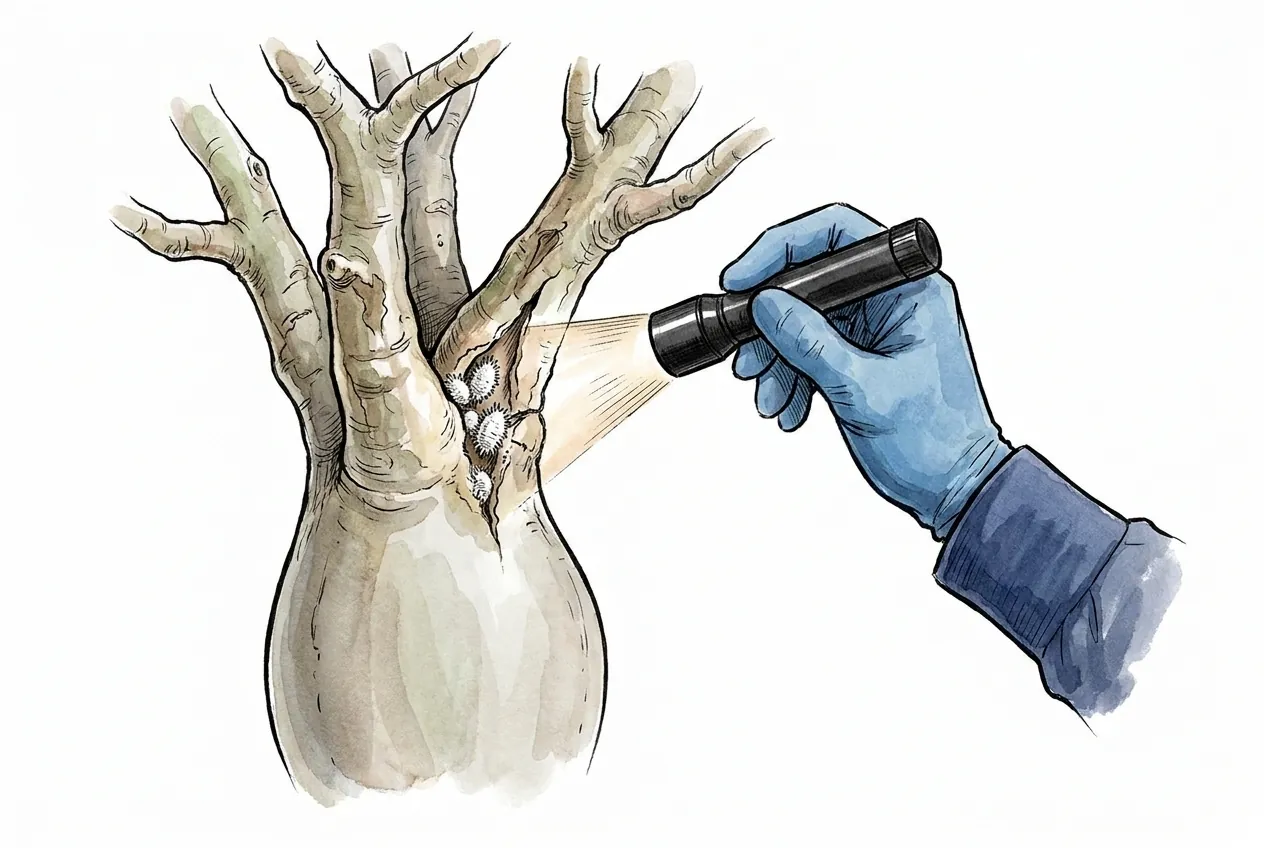
The weigh-in already puts the plant in your hands, so it doubles as a pest pass. Mealybugs are the Adenium pest to watch.
UNH Extension says small mealybug populations wedge into crevices such as the bases of stems, and a few species feed on roots. The white egg masses are often the easiest thing to spot.
Under a flashlight, I check the caudex top, branch forks, leaf scars, and soil line.
Any white wax means isolation and an alcohol swab that day. Test a small patch first, because UNH notes alcohol can damage some plants. A recheck follows in 14 days, since waxy eggs shrug off a single treatment.
Every part of Adenium is poisonous if eaten, and its milky sap irritates skin. Gloves keep that sap off your hands if a brittle stem snaps, and the shelf belongs out of reach of pets and children.
While you are down there, look for gnaw marks, droppings, and disturbed mix. Any rodent sign means the plant moves higher or into a closed room, and gray fuzz on debris goes straight to the rot check above.
Bringing the Plant Back Into Light in Spring
Spring undoes the garage in a fixed order. Warm nights come first, then light, then water.
Shade first, then about two weeks toward full sun
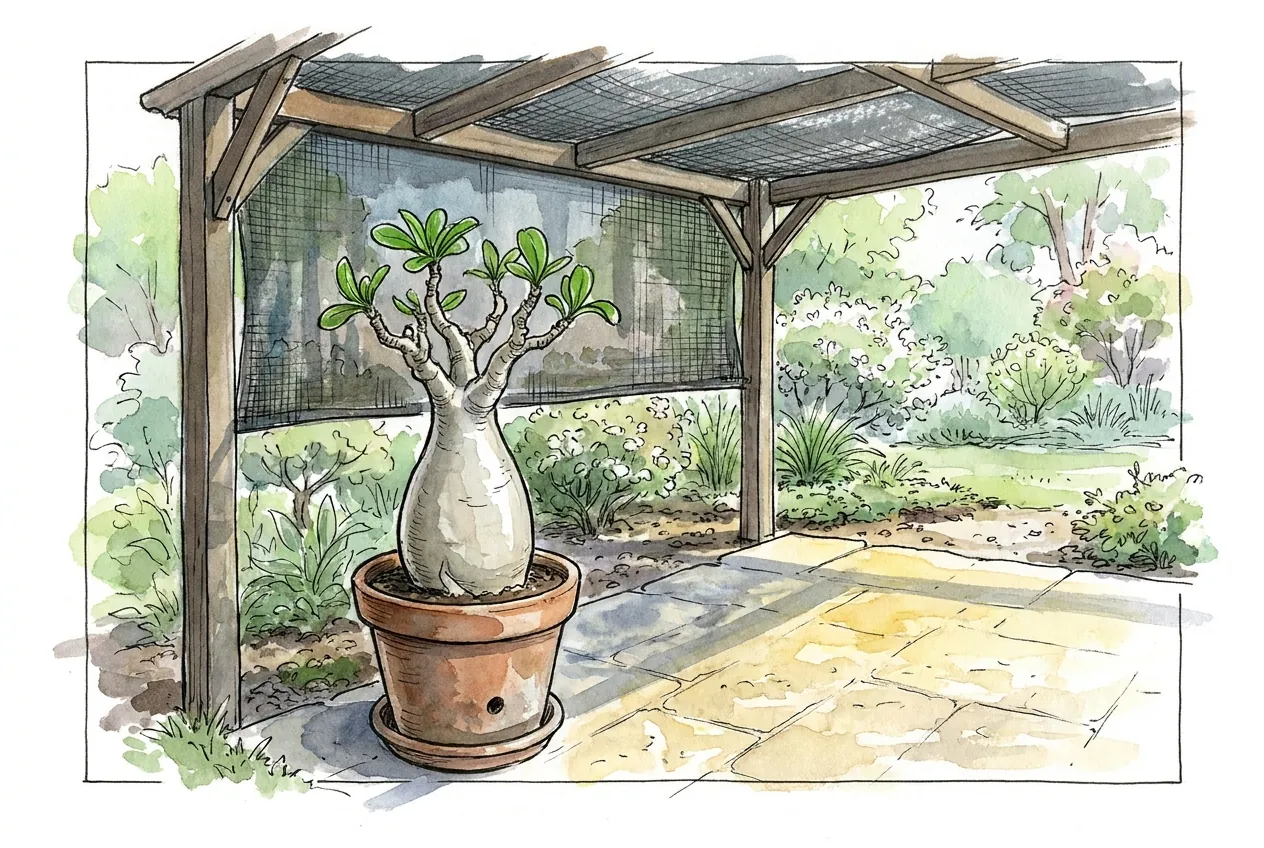
My move-out rule starts the shade step after 7 consecutive nights at or above 55 °F.
Any forecast below 55 °F brings the plant back under cover for that night. Maryland Extension’s cautious assumption for overwintered plants is exposure no chillier than 55 to 60 °F, and my rule uses the lower end of that range.
Shade outdoors is much brighter than indoor light, even when it does not look that way.
Maryland advises starting everything in shade and adding direct light gradually over a few weeks.
A caudex that sat for months in the dark starts from a lower light level than a windowsill plant.
I start in deep shade and stretch the move to full sun over about two weeks.
That is the long end of the range in the Adenium sun scald acclimation guide.
Before each step up, I check the south and west faces of the caudex and upper branches.
UC IPM says bark newly exposed to sun burns most on those sides. A bleached, tan, or sunken patch there means the plant holds at its current step.
The first drink waits for growth
I wait for three things at once before the first real watering. Buds must be swelling or new leaves showing, the mix must be dry, and nights must meet the move-out rule.
Growth shows the plant can use water, and warm nights mean the roots can move it.
NC State’s care notes match that order, letting the plant dry between waterings and watering during growing periods.
They also warn that soils that are too wet will produce rots.
Water thoroughly once, then let the mix dry completely before the next drink. Fine wrinkles in dry mix in early spring usually mean reserve use, while softness in damp mix needs a root check before any more water.
Garage or Bright Room Comes Down to the Plant and the Log
The garage works for one kind of plant. It must be leafless, firm, mature, and dry, in a spot whose 7 logged minimums all read 42 °F or higher.
If any of those fail, the bright room wins. That covers a plant still in leaf after the first cool weeks, a seedling, and a garage that cannot pass the log.
A plant that stays awake needs real light, and the grow light guide for caudex plants covers how much.
If the garage passes, winter is mostly patience. Read the thermometer weekly, weigh monthly, and expect the scale to say do nothing.
Put the thermometer on the shelf before the first 40 °F forecast, and let the seven-night log make the call.