
Adenium Leaves Turning Yellow in Winter: Shed or Cold Roots?
Adenium leaves turning yellow in winter? Read the pattern, press the caudex base, and probe the mix at first light to tell a normal shed from cold roots.
Maya Ellison · 2026-11-13 · 16 min read
Key Takeaways
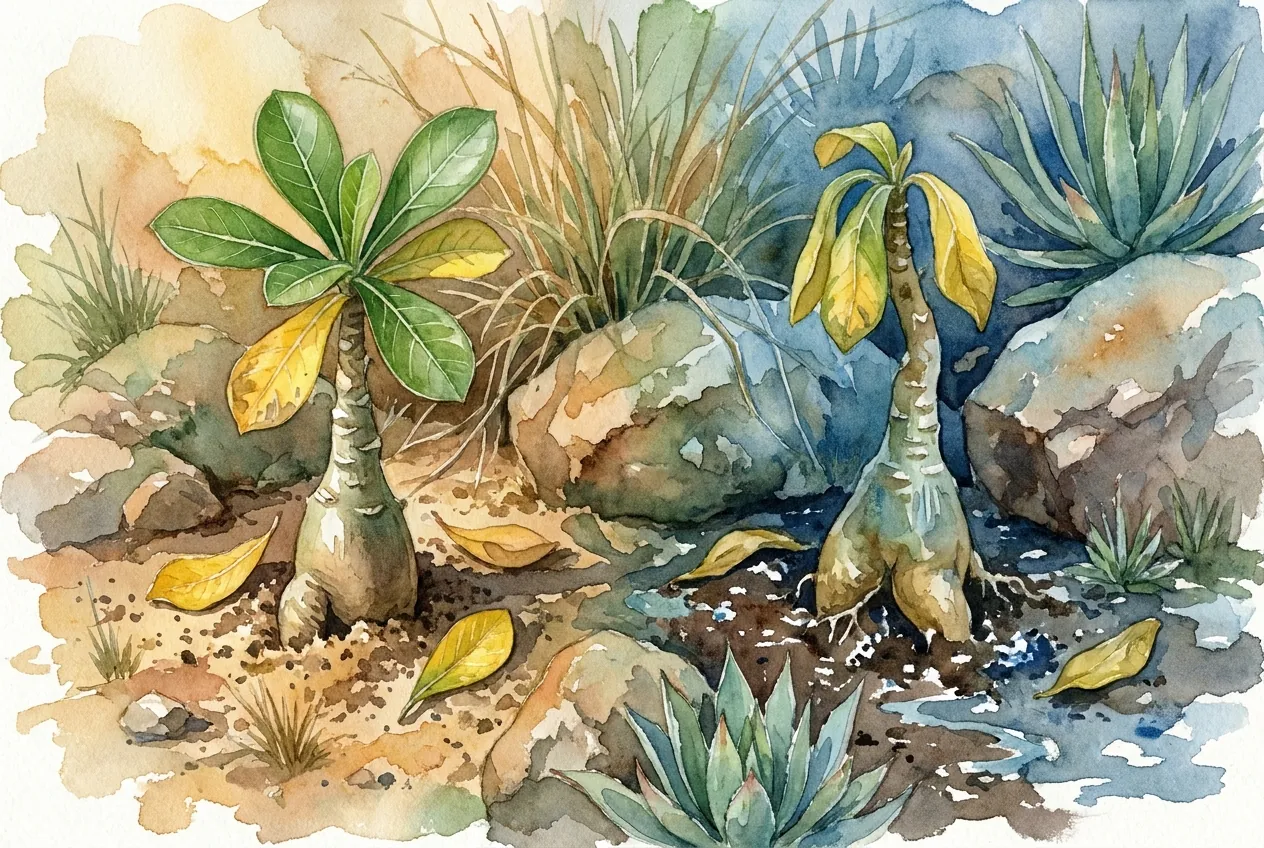
- Oldest-first yellowing with the newest four leaves green and a firm base is the normal November shed.
- Newest leaves going limp within days of a cold night, in wet mix, points to cold roots.
- Probe the mix at two-thirds pot depth at first light. Below 50 °F, the roots get no water.
- A base that gives under the thumb overrides everything. Unpot with gloves and inspect today.
- Skip fertilizer until new spring leaves appear. Salts and nitrogen work against a resting plant.
Adenium leaves turning yellow in winter are usually doing exactly what they should, and November is when the shed begins.
A desert rose is a dry-season deciduous plant, and short, cool days tell it to pack up its leaves and live off the caudex until spring.
The version worth worrying about looks different. It arrives fast, hits the newest leaves along with the old ones, and usually follows a cold night in wet mix.
The leaves alone rarely settle it. The yellowing pattern plus a quick check of caudex firmness, root-zone temperature, and moisture does, and each answer points to a different action.
Three Yellowing Patterns and What Each One Means
Yellow is the plant’s universal signal, so the useful information lies in where the yellow starts, how fast it moves, and how the leaf feels. Three patterns cover nearly every November case.
Oldest-first yellowing on a firm plant is the normal shed
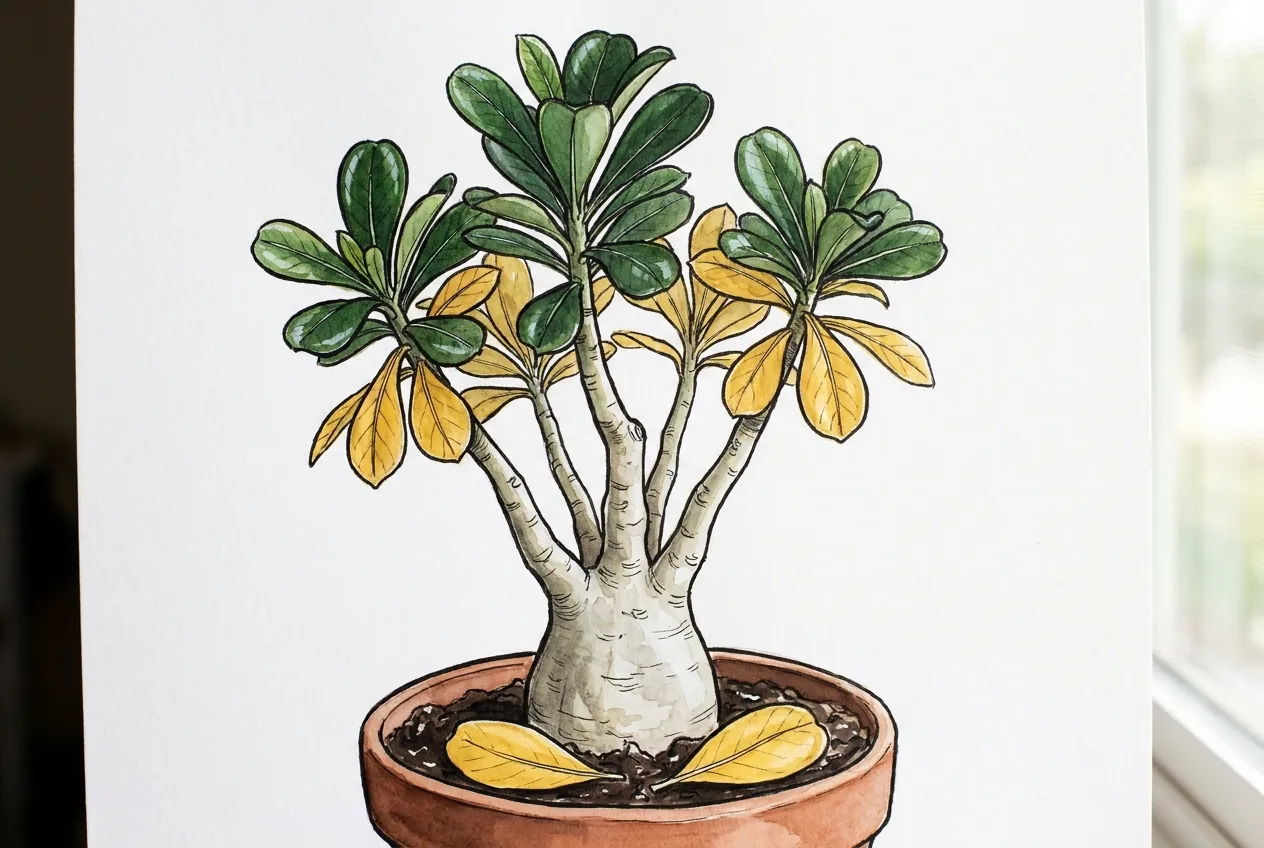
A normal shed starts at the bottom of each branch tip and works upward over weeks.
The yellow leaves stay smooth and firm, then detach cleanly with a light touch.
That order is programmed. In sequential leaf senescence, the plant’s nutrient salvage begins with the oldest leaves and follows the age gradient toward the young growing tips.
The yellow you see is chlorophyll being dismantled so its nitrogen can move back into the stem and caudex.
A global analysis of leaf senescence put average nitrogen resorption at about 62 percent before the leaf falls.
Warmth delays the whole process. The University of Arizona Campus Arboretum notes that adenium needs 60 °F or higher to avoid winter leaf loss, so a plant in a cooler room is expected to shed.
A plant that recently moved indoors can add a second, similar wave. Missouri Extension notes that leaf drop usually shows several weeks after a plant moves from bright light to poorer light. On a firm plant it reads much like the seasonal shed.
To tell this pattern from early root trouble, I tag three branch tips on different branches with loose twist ties.
I count leaves from the tip, so position 1 is the newest leaf. On day 0 and again on day 7, I note which positions are yellow and whether any of positions 1 to 4 look limp, translucent, or dark.
If yellowing stays at or climbs from the oldest positions while positions 1 to 4 stay green and firm on all three tips, it is the shed.
If any of the newest four leaves droop, yellow, or blacken within the week, I stop watching and run the root check below.
The 7-day window and the four-leaf control are my own working rule, not a published standard.
A week is long enough to see a slow shed progress, and the cluster of young tip leaves is easy to count reliably.
Yellowing that climbs from the oldest leaves while the newest four stay green and firm is a normal shed, not a disease.
Sudden yellowing with limp tips after a cold night points to the roots
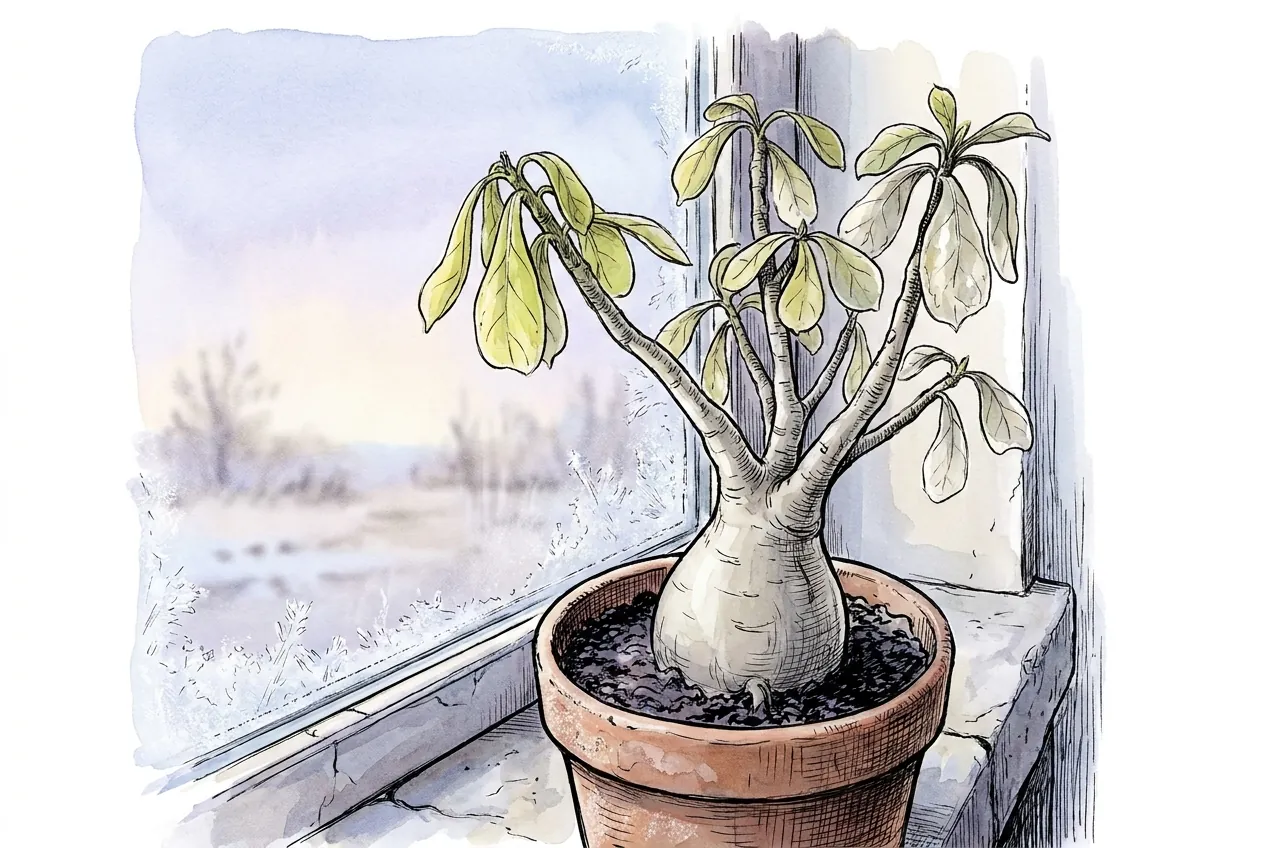
Cold-root yellowing runs on a different clock. Leaves at every position, including the newest, go yellow or limp within days of a cold night, often while the mix is still wet.
Chilling injury in tropical plants starts above freezing. University of Maryland Extension advises protecting indoor plants from temperatures below 50 °F and notes that cold-injury symptoms can keep appearing for up to a week after the exposure.
Cold roots also move water poorly. A study of low root temperature reports that chilling-sensitive herbs lose water uptake dramatically even above 10 °C (50 °F).
The leaves then wilt and yellow while the pot is still damp.
That combination is the classic trap. The University of Wisconsin plant clinic notes that growers usually spot root rot as wilting in soil that is still wet. Watering a wilted cold plant only feeds the rot.
The deeper mechanism of cold, wet mix is covered in why cold wet soil kills caudex roots. For this diagnosis, the visual cue is enough.
Yellowing that hits the newest leaves within days of a cold night, in mix that is still wet, is a root problem until the check below proves otherwise.
Mottled, ringed, or streaked yellow is not seasonal
A shed and a chill both produce fairly even yellow. Patterns with structure, such as mosaics, rings, lines, or green veins on yellow tissue, point somewhere else.
Confirmed adenium virus reports describe patterns like these. Florida desert rose with cucumber mosaic virus showed a mosaic with dark green islands around the veins.
Imported plants carrying a newly identified potexvirus alongside cucumber mosaic virus showed leaf mottling.
Nutrient problems follow a position rule. Deficiencies of mobile nutrients such as nitrogen and magnesium show first in older leaves, while immobile nutrients such as iron show first in new growth.
Patterned leaves deserve a separate look. The cucumber mosaic virus field ID and what flower streaks can tell you cover the virus side in detail.
The Two-Minute Check Before You Change Anything
The leaf pattern gives a suspicion. Three quick readings from the plant itself turn that suspicion into a decision, and none of them requires cutting or unpotting.
Press the base, then the middle of the caudex
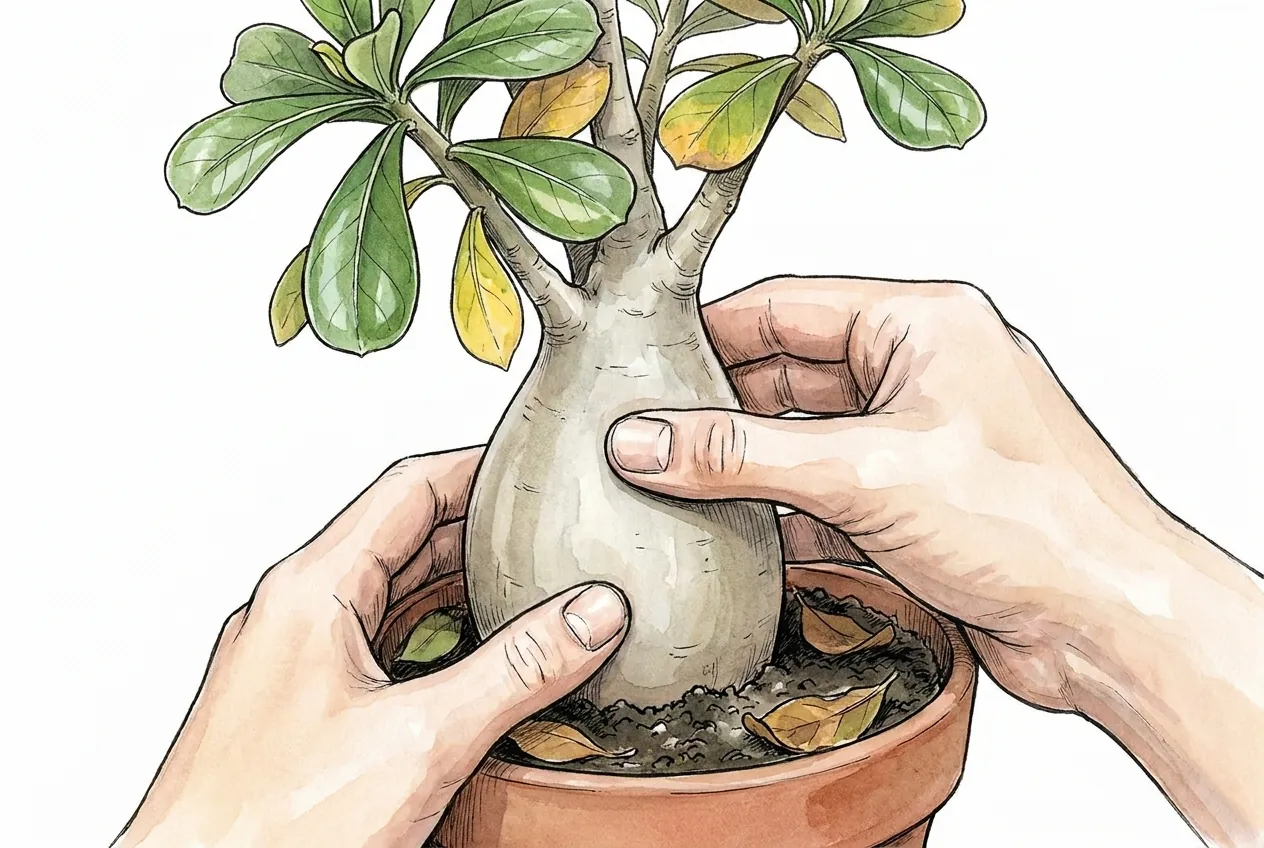
Firmness is the single most important reading, because leaves are expendable and the caudex is not.
A dormant caudex can wrinkle slightly as it uses stored water, but it should not give under the thumb.
I press firmly at the soil line, then at the middle of the caudex, using the same thumb pressure.
The middle is the reference, since rot usually starts at the base and works up.
If both spots feel equally firm, the plant passes. If the base gives while the middle stays hard, the check is over and the roots get inspected now. UC IPM notes that soft stem bases usually indicate overwatering.
A fuller firmness map, including the difference between dormant wrinkling and rot softness, is in soft caudex, rot or dormancy.
Read the mix at root depth at first light
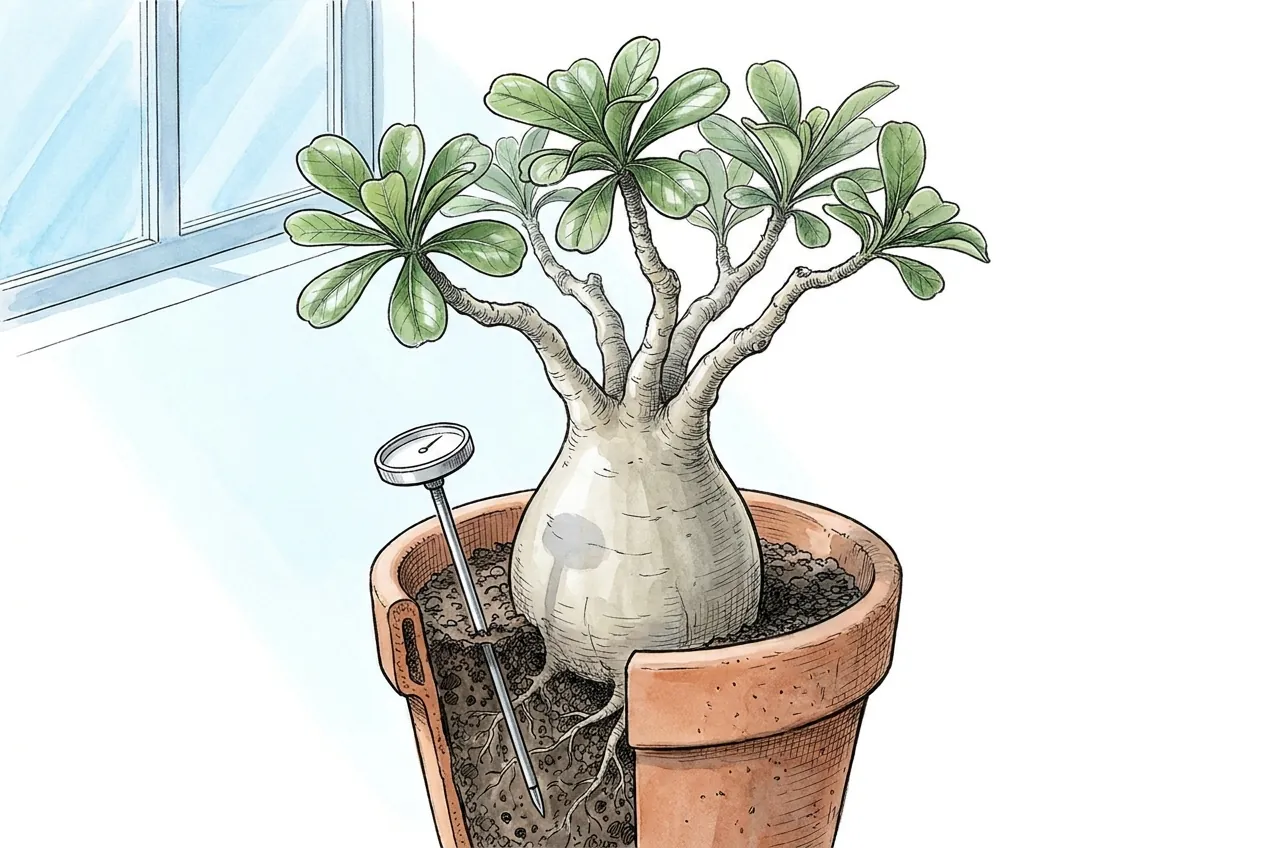
Room air tells you little about the roots. A pot against cold glass or on a concrete floor loses heat through its walls all night, so the mix can sit colder than the thermostat reading.
I read the mix at first light, before sun, lamps, or heaters reach the pot, because extension guidance notes the night’s coolness is still in the soil then.
The probe thermometer goes to about two-thirds of the pot’s depth, close to the wall that faces the window or floor, and stays until the number stops moving.
The next morning, I repeat it in the same spot. Two mornings catch a cold spot that a single reading can miss.
The comparison line is 50 °F (10 °C). That is my working no-water line for a dormant adenium, set at the chilling threshold UMD Extension uses for indoor plants.
The mix clears only when both mornings read 50 °F or higher. A reading below 50 °F on either morning marks a cold root zone, which is trouble only alongside limp newest leaves or wet mix.
If you need a probe thermometer, the dormancy watering measurement kit covers what to look for.
A mix reading below 50 °F at root depth on either of two first-light checks means the roots are too cold to use water well.
Note how wet the mix was when the yellowing started
Moisture decides whether cold is an inconvenience or a threat. A cold, dry adenium is mostly waiting, while a cold, wet one is sitting in the conditions root rot needs.
Two simple checks work. Lift the pot and compare it with how it feels right after watering, or push a wooden dowel to the bottom and look for damp soil clinging to it.
University of Maryland Extension notes that excess moisture first shows as yellowing of lower and inner leaves.
That overlaps the shed pattern, so the pot, not the leaf, breaks the tie.
Putting the three readings together
The readings combine into one verdict. Cold mix alone is not a problem for a dry, firm plant. Use the row that matches what you found.
| What you found | Most likely cause | Next step |
|---|---|---|
| Oldest-first yellow, newest leaves firm, base firm, mix 50 °F or higher | Normal pre-dormancy shed | Let it shed and cut water |
| Oldest-first yellow, newest leaves firm, base firm, mix below 50 °F but dry | Normal shed in a cool spot | Keep it dry, no water |
| Yellow or limp newest leaves, mix below 50 °F, mix wet, base firm | Cold roots | Dry first, then warm the root zone |
| Any yellow pattern plus a base that gives under the thumb | Possible root or basal rot | Unpot and inspect today |
| Mosaic, rings, streaks, or green veins on yellow | Virus, nutrient, or pest | Isolate and inspect leaves |
What to Do for Each Pattern
Each verdict has one main job. Doing the right job early matters more than doing several at once.
Normal shed means let the leaves fall and cut the water
Leave yellow leaves on until they release with a light touch. Stripping green or half-yellow leaves throws away the nitrogen the plant is pulling back and leaves fresh wounds.
Water drops sharply as the leaves go. NC State advises bringing adenium indoors when outside temperatures reach 55 °F and decreasing water while it is dormant.
Once most leaves are gone, watering stops until buds swell in spring. A plant that still holds leaves can take a small drink if the mix reads 50 °F or higher. Even then, wait until the mix is dry to the bottom.
The dormancy cue itself is explained in daylength vs cold as the dormancy trigger.
For storage in an unheated space, see overwintering adenium in a garage.
Cold roots mean dry first, then warm the root zone
Stop all water first. Roots that cannot move water will only sit in it, and UC IPM notes that some Phytophthora species prefer cool conditions and develop mostly in winter.
Then move the pot off the cold sill or floor. A shelf on an interior wall, a plant stand, or a sheet of foam board under the pot breaks contact with cold glass and concrete.
If the room itself stays cool, bottom heat warms the roots without warming the whole room.
In a cucumber study under cool air, warming the root zone from 13 °C to 19 °C improved water supply from the roots. Growth rose by about 18 percent.
That study was a seedling crop under controlled conditions, so the number shows the direction, not a target for a dormant adenium.
For a home setup, use a mat built for plants with its thermostat probe pushed into the mix, not lying on the mat.
Keep the mat, cord, and plug dry and clear of drainage water.
Rather than trusting the dial, I judge the thermostat by the probe reading in the mix.
The job is to keep the mix at or above the 50 °F no-water line on cold-glass nights.
Water resumes only when the mix holds that line, the base is firm, and the plant actually has leaves to use it.
The heat mat and soil-temperature tool chooser covers mat and thermostat options.
For a cold, wet adenium, drying the mix comes before warming it, and water waits until the root zone holds 50 °F or higher.
A soft base or sour smell means unpot and inspect today
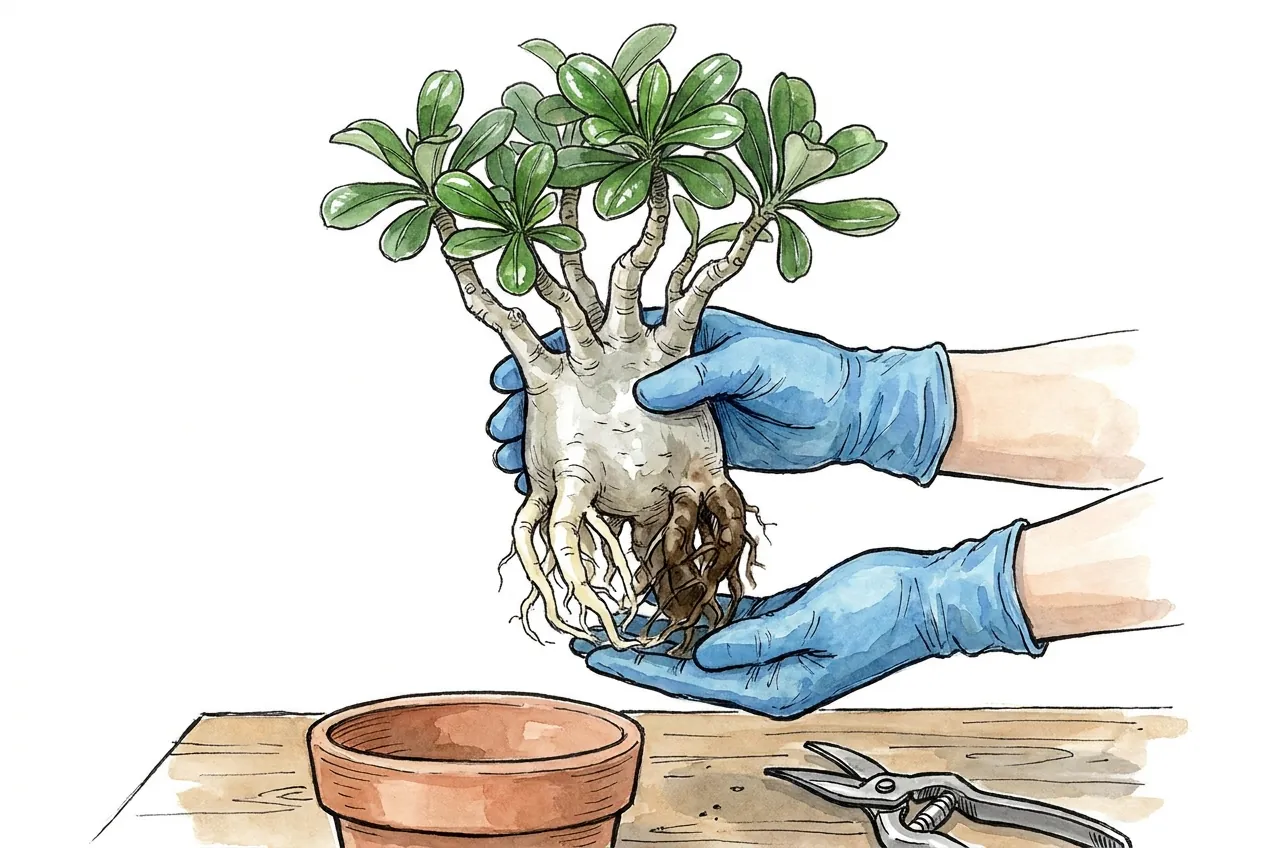
A base that gives under the thumb overrides every other reading. Waiting for spring lets rot climb the caudex.
Wear gloves before you start. NC State notes that adenium sap is milky and poisonous, and it is a hazard for cats, dogs, and horses.
Slide the plant out and rinse the roots. Healthy roots are white or pale and firm. Rotted roots are brown to black and mushy, often with a sour, rotten smell, and their outer layer slips off to leave a fine thread.
Cut only with a sanitized blade, and clean it again between cuts. LSU AgCenter lists undiluted 70 percent isopropyl alcohol as a quick spray or dip for pruning tools.
The full cutting and drying sequence is in adenium root rot rescue.
Patterned leaves mean isolate, then check for mites and viruses
Move the plant away from other adeniums before anything else. Both mites and aphid-spread viruses travel between neighboring pots.
Turn a few leaves over under good light. Spider mites show first as fine stippling of light dots, and heavily infested leaves turn yellow and drop. Damage is usually worst on water-stressed plants in hot, dusty conditions.
If mites are confirmed, start with the gentler steps in adenium white spots on leaves, and see the spider mite treatment chooser for products.
Any miticide, soap, or oil goes on exactly as its label directs, wearing at least the gloves and long sleeves the label requires.
A virus has no cure. Utah State Extension advises removing infected plants, since there is no effective treatment once a plant carries cucumber mosaic virus.
Why Feeding a Yellowing Adenium in November Backfires
Yellow leaves look hungry, and fertilizer looks like the fix. In November it does the opposite.
A resting plant is not taking up much, so fertilizer salts stay in the mix. UNH Extension advises putting the fertilizer away from October until spring because houseplants go through a winter rest.
Those leftover salts compete with roots for water and can injure them. Texas A&M notes that salt-injured roots are predisposed to diseases such as Pythium and Fusarium, which is the last thing a cold root zone needs.
Feeding can also stall the shed itself. In a poplar study, continued fertilization delayed autumn leaf senescence by about a month compared with stopping it.
Fertilizer waits until new leaves appear in spring, whatever the yellow leaves look like now. For the full timing logic, see when to stop fertilizing caudex plants.
The Caudex Decides, Not the Leaves
Adenium leaves turning yellow in winter are a reading on the season, not a verdict on the plant.
By late November, a healthy adenium may be half bare, and that is fine. Leaves are seasonal equipment, while the caudex and roots carry the plant to spring.
So judge the plant by the base and the root zone. A firm caudex in dry mix, or in mix at or above 50 °F, needs patience.
A cold, wet pot needs drying and warmth, and a soft base needs your hands in the roots today.
The same shed-or-trouble logic applies to other deciduous caudex plants, as Operculicarya dropping leaves shows for a different genus.
Recheck the base once a week through winter, and expect new leaves when spring warmth returns.